“After 100 years, films should be getting really complicated. The novel has been reborn about 400 times, but it’s like cinema is stuck in the birth canal.”
Exergue
In the year 470 BCE, in the city of Athens, a bustling metropolis nestled on the eastern coast of the Greek mainland, overlooking the Aegean Sea, there lived a group of people who practiced a very secret religion. The city, framed by rolling hills and the rocky heights of the Acropolis, was a hub of philosophy, politics, and art. Yet, beneath its public debates and grand temples dedicated to the Olympian gods, this clandestine group gathered in hidden chambers and sacred groves. Their practices, whispered about in taverns and markets, involved cryptic rituals and teachings passed down only to the initiated. The group claimed to possess knowledge of the divine that transcended the public pantheon, promising insight into the mysteries of existence and the soul’s journey after death.
One of these people was a man named Socrates. He had once served as a soldier in the Peloponnesian War, a brutal and protracted conflict between Athens and Sparta that spanned nearly three decades. The war saw naval battles on the Aegean, sieges of cities, and devastating plagues that ravaged Athens. It was a clash not only of armies but of ideologies—Athens championing democracy and a maritime empire, while Sparta upheld oligarchy and military discipline.
During his service, Socrates distinguished himself for his bravery and endurance, particularly in the battles of Potidaea, Delium, and Amphipolis. Yet, the horrors of war and the decay it wrought upon his beloved city left a lasting impression on him. Returning to Athens, Socrates became increasingly disillusioned with the way of life of the Athenian people. The pursuit of wealth, political power, and fleeting pleasures seemed to him a shallow existence, one that lacked the deeper reflection necessary for a truly virtuous and fulfilling life.
Driven by this growing dissatisfaction, Socrates abandoned the conventional paths of ambition and began dedicating himself to questioning the very foundations of Athenian society. Along with a group of eager followers—young men from prominent families drawn to his wit and intellect—he took to the public spaces of Athens: the agora, shaded porticoes, and even symposia, where Athenians gathered for drinking and discussion. There, Socrates would engage in spirited debates, using his signature method of relentless questioning to expose contradictions and challenge assumptions. His mission was not to teach but to provoke thought, urging those around him to seek truth and wisdom above all else.
His mission was inspired by the masters of that secret sect, such as Parmenides and Empedocles, whose teachings profoundly shaped his thinking. Parmenides, the enigmatic philosopher from Elea, proclaimed that reality was singular, unchanging, and eternal—a realm accessible only through the exercise of pure reason. Empedocles, a mystic and poet, combined philosophical inquiry with esoteric teachings, positing that the cosmos was governed by the interplay of elemental forces and divine cycles of love and strife. Both figures saw reason not merely as a tool for practical understanding but as a sacred path—an instrument through which the human mind could ascend to divine truth.
Socrates took this lineage to heart, believing that reason, along with its allied disciplines—logic, ethics, and dialectic—was not only the highest craft of humanity but also a means of approaching the divine. For Socrates, the meticulous unfolding of thought, the uncovering of contradictions, and the pursuit of wisdom were all acts of reverence. To him, reason was a gift bestowed by the divine, and its proper use ultimately pointed back to its source: the ineffable and eternal presence of God.
The reason we know of Socrates, even after 2,399 years, is because one of his devoted followers, Plato, took it upon himself to preserve his mentor’s legacy. After Socrates’ untimely death—a result of a trial that accused him of corrupting the youth of Athens and introducing new gods—his life and ideas became the subject of profound reflection among those who had been closest to him. Convicted by a narrow margin in a jury of his peers, Socrates faced his sentence with unwavering resolve, choosing death over exile. He drank the hemlock poison in the company of his friends, engaging in philosophical discussion even in his final moments, exploring topics like the immortality of the soul and the nature of death itself.
Following this tragic end, Plato began to collect, from memory and from the accounts of others who had witnessed Socrates’ debates and conversations, the essence of his teachings. These dialogues, often set in the bustling streets of Athens or during intimate gatherings, covered a wide range of topics: the nature of justice, the pursuit of virtue, the foundations of knowledge, and the role of the divine in human life. Plato’s writings immortalized Socrates as a relentless seeker of truth, a man who believed that an unexamined life was not worth living, and who used the power of reason and dialogue to uncover the deeper principles governing existence.
Through these preserved dialogues, Socrates’ ideas have transcended the ages, inspiring countless generations to ask the same enduring questions: What is the good life? How should we live? What does it mean to truly know?
We have all the dialogues. Not one is missing. This astonishing fact has been confirmed through archaeological findings, including ancient receipts and catalogues that document the meticulous preservation and transmission of Plato’s works over centuries. That these dialogues have survived intact, despite the ravages of time, war, and cultural upheaval, is nothing short of miraculous. Across millennia, they have been translated, copied, and transmitted through countless cultures, each leaving its mark on the interpretation of these texts while ensuring their survival for future generations.
In ancient Greece and Rome, scribes and philosophers revered Plato’s dialogues as foundational texts, preserving them in libraries like the famed Library of Alexandria. Even after the fall of the Western Roman Empire, these works found refuge in the Byzantine Empire, where scholars diligently maintained the Greek manuscripts. During the Islamic Golden Age, Plato’s ideas were translated into Arabic, where they influenced Islamic philosophy and were integrated into the works of thinkers like Al-Farabi and Avicenna. These translations would later travel to medieval Europe, where they were reintroduced to the Latin-speaking world during the Renaissance.
The dialogues played a pivotal role in shaping Western civilization. They laid the groundwork for much of Western philosophy, influencing figures from Augustine and Aquinas to Descartes and Kant. Beyond philosophy, the ideas engendered in these dialogues transformed how we think about justice, governance, education, and the nature of reality inspired developments in politics, law, and science. His concept of an ideal republic influenced political theorists from Machiavelli to Rousseau, while his metaphysical explorations informed centuries of theological discourse.
The survival of these dialogues is not merely an academic or historical curiosity. They represent the unbroken transmission of ideas that have continuously challenged, shaped, and expanded the human understanding of ethics, knowledge, and the divine. Without them, the intellectual and cultural foundations of civilization as we know it would be profoundly different, and the legacy of Socrates would likely have been lost to time.
Despite the greatness of this colossal spirit, it should be noted that Socrates was an outcast in his own time. In fact, he was often mocked and ridiculed by his contemporaries, who saw his unconventional methods and probing questions as subversive or even absurd. A notable example of this is the play Clouds by the famous Athenian playwright Aristophanes, first performed in 423 BCE. The play caricatures Socrates as a comical and eccentric sophist, head of a “Thinkery” where absurd ideas are taught, such as how to use rhetoric to evade debts or justify immoral behavior. Aristophanes portrays Socrates as a man detached from practical realities, preoccupied with nonsensical theories about the heavens and the earth, floating in a basket to better contemplate the cosmos.
The mockery in Clouds was not merely comedic but deeply biting, contributing to the public perception of Socrates as a dangerous influence on Athenian youth. This portrayal arguably played a role in shaping the cultural atmosphere that later led to his trial and execution. Socrates himself referenced the play during his trial, acknowledging its impact on how he was perceived by the jury and the wider public.
There is a story—though its authenticity is debated—that Plato, Socrates’ most devoted student, kept a copy of Clouds under his pillow at night. Whether out of a desire to understand the mindset of his teacher’s critics or as a reminder of the societal challenges Socrates faced, the tale sheds light on Plato’s approach to his writing. Plato may have chosen the dialogue form not only to honor the conversational style of his master but also as a subtle response to Aristophanes. By presenting Socrates in a series of profound and reasoned debates, Plato countered the caricature from Clouds, offering a lasting and dignified image of his mentor to history.
Additionally, in some of his works—most notably the Symposium—Plato does not shy away from including Aristophanes as a character, but he does so in a way that subtly undercuts the playwright. In the Symposium, Aristophanes is given a humorous and memorable speech about love, but his hiccups and comedic tone serve to highlight the intellectual depth of Socrates by contrast. It is tempting to see this as Plato’s way of settling the score, turning Aristophanes into a literary foil and asserting the superiority of his master’s wisdom over the shallow mockery of the stage.
We are coming closer to the topic of this essay. In one of the dialogues—The Republic, one of Plato’s most celebrated works and universally recognized as a cornerstone of philosophical thought—Socrates delves into profound discussions about justice, the ideal society, and the nature of reality itself. The Republic has become a timeless text studied across cultures and disciplines, influencing philosophy, political theory, education, and even psychology. Its themes transcend historical context, offering insights that remain relevant to the modern world.
The dialogue is set during a gathering at the home of Cephalus, a wealthy and elderly Athenian, and unfolds in a conversational setting that includes several key figures: Polemarchus, Cephalus’s son; Thrasymachus, a fiery sophist; and Glaucon and Adeimantus, Socrates’ close companions and Plato’s own brothers. Through their exchanges, Socrates examines and challenges their views on justice, power, morality, and the structure of an ideal society.
Socrates never shies from employing from the sum of his memory all branches of knowing, from ethics, politics, metaphysics, poetry, and mathematics in order to deliver, like a midwife, an Idea. Guiding his interlocutors not by denying different opinions or forcing answers but by helping them bring forth their own understanding. At the heart of his teaching lies the conviction that ideas, like truths, must be uncovered and birthed through rigorous examination and dialectic. An allegory is told, an allegory about a cave. Socrates asks his companions to imagine prisoners chained inside a dark cave, their entire reality limited to shadows projected on a wall by objects moving before a fire behind them. For these prisoners, the shadows are the only truth they know.
Without delving into the meaning or symbolism of this allegory, nor the reasons and motivations behind Plato’s unique arrangement and recollection of these dialogues (as explored, for example, in Derrida’s essay Plato’s Pharmacy), I would like to pause here and begin toward the topic of this essay. The allegory of the cave, and particularly the wall of shadows within it, serves as one of the earliest and most poignant examples of a phenomenon that has come to define the life of every human being in the modern world: screens.
The cave wall, onto which shadows are projected, is more than a metaphor for ignorance or limited perception—it is an eerily prescient precursor to a surface that pervades our lives today. We are immersed in a world mediated by screens: televisions, smartphones, computers, screens that manifest images, stories, and information that have the power to transform our perceptions, beliefs, and identities.
This tension between appearance and reality, between the mediated and the actual, not only serves as a microcosm of the theater but also encapsulates its profound symbolic significance. The theater, as an ancient art form, has always operated as a space of mediated reality—a place where illusion and representation create a world that is not real yet powerfully affects those who witness it. In the theater, the audience willingly suspends disbelief, engaging with shadows of reality that evoke emotion, provoke thought, and reveal truths hidden in the everyday. This act of mediation, where representation becomes a tool for exploring the human condition, mirrors the dynamic of Plato’s cave and prefigures the role of screens in modern life.
Beyond the theater, this tension has come to define what the French theorist Guy Debord famously termed the Spectacle. In his influential work The Society of the Spectacle, Debord describes the Spectacle as a pervasive system of images, representations, and commodities that mediates all aspects of human life. The Spectacle, he argues, is not merely a collection of media or entertainment; it is a social relationship mediated by images. In this sense, the Spectacle transforms reality into a mere representation, replacing direct human experiences with mediated ones. It turns individuals into passive spectators, consuming images that shape their desires, beliefs, and perceptions of the world.
The allegory of the cave finds new resonance in Debord’s critique. Just as the prisoners in the cave mistake shadows for reality, modern individuals are often ensnared by the images of the Spectacle, mistaking mediated representations for authentic experiences. Screens—whether televisions, smartphones, or digital displays—have become the new walls of the cave, projecting images that inform, entertain, and manipulate. They amplify the human condition, offering unprecedented access to information and connection, while simultaneously distancing us from the unmediated presence of reality.
Reflecting on the profound resonance between the shadows of the cave and the images on our screens, we uncover deeper implications of living in this mediated reality. Between presence and absence, reality and representation, lies a fragile boundary that screens constantly negotiate. Indirect representation, as Plato’s allegory warns, can serve as both an illuminating guide and a distorting veil. On one hand, it offers pathways to knowledge, connecting us to ideas and people across vast distances. On the other, it risks alienating us from the immediacy of truth, replacing direct experience with curated fragments of reality.
This risk, for Plato’s Socrates, cannot be understated, as it is not merely a handicap or an obstacle to understanding—it is a profound and existential danger, perhaps the greatest danger humanity faces. For Socrates, the journey of philosophy, of questioning and seeking truth, is ultimately a spiritual endeavor, a means of aligning the soul with the divine. To be deceived by appearances, to mistake shadows for reality, is to turn away from the light of truth and thereby sever our communion with God—the ultimate source of goodness, beauty, and knowledge. To live in ignorance of this reality is not simply to misunderstand the world—it is to live a life alienated from the divine order, a life disconnected from the true purpose of the soul.
It is not just a question of failing to achieve knowledge or wisdom; it is a spiritual failure, a disconnection from the highest good and the divine source of being. This disconnection, perpetuated by the pervasive influence of mediated realities, threatens not only individuals but entire societies, as it fosters a culture of superficiality, distraction, and moral disengagement. The failure of this endeavor—the soul’s resignation to shadows and appearances—represents the ultimate forfeiture of human existence’s true purpose: to seek the Good, to align with the divine, and to live a life grounded in virtue and understanding.
Art, religion, and philosophy: this triptych forms one of the central pillars of The Phenomenology of Spirit and Lectures on Aesthetics by the German philosopher Georg Wilhelm Friedrich Hegel. Hegel, a towering figure of German Idealism, wrote during the late 18th and early 19th centuries, a period marked by profound political, intellectual, and cultural upheaval. His philosophy sought to synthesize the ideas of his predecessors—particularly Kant, Fichte, and Schelling—into a comprehensive system that explained the development of human consciousness, history, and the nature of reality itself.
Hegel’s Phenomenology of Spirit (1807) explores the evolution of human consciousness as it progresses through various stages, from sense perception to self-awareness, and ultimately to absolute knowledge, where the individual recognizes its unity with the universal. This work was written against the backdrop of the Napoleonic Wars and the sweeping societal transformations of Enlightenment rationalism and Romanticism. It reflects Hegel’s belief that history is a rational process, moving toward the realization of freedom and the unfolding of the Absolute Spirit.
Later, in his Lectures on Aesthetics, Hegel delves into art, religion, and philosophy as key modes through which the human spirit expresses and apprehends truth. These lectures, delivered in the 1820s, were part of Hegel’s broader exploration of how the Absolute—the ultimate reality or universal spirit—manifests in human experience. While art reveals truth in sensory forms, religion conveys it symbolically, and philosophy articulates it conceptually and systematically.
Hegel’s triptych illustrates his conviction that human history and culture are not chaotic or arbitrary but part of a grand, dialectical process. This process unfolds as spirit (or mind) seeks to understand and realize itself fully, advancing through these stages of expression. His work profoundly influenced disciplines as diverse as philosophy, theology, art theory, and political thought, leaving a legacy that continues to shape contemporary debates about reason, freedom, and the nature of human existence.
Here we are at last, arriving at the spirit of this exergue, weaving through the lattice of these themes to unveil the fruition of the human spirit through the convergence of three profound disciplines: art, religion, and philosophy. Together, they herald the emergence of a technology that has yet to fully reveal its true essence.
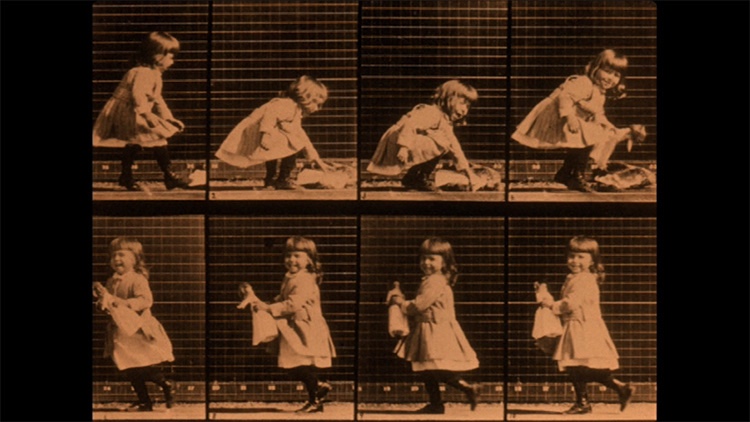
Eadweard Muybridge (1830–1904), born Edward James Muggeridge in England, was a pioneering photographer and inventor who revolutionized the study of motion. After moving to the United States, he became known for his stunning landscape photography, especially of Yosemite. In 1872, he was hired by Leland Stanford to resolve whether a horse’s hooves leave the ground while galloping. Muybridge’s use of sequential photography proved they did, marking a breakthrough in motion studies. His invention of the zoopraxiscope—a precursor to the motion picture projector—laid the foundation for cinema. Muybridge later expanded his work to study human and animal movement, publishing the influential Animal Locomotion (1887).
Science and Art
Muybridge bridged art and science by using photography to analyze motion with unprecedented precision. His images, blending aesthetic composition with empirical observation, provided invaluable insights for biomechanics, physiology, and visual storytelling. Artists like Marcel Duchamp and movements such as Cubism and Futurism drew inspiration from his fragmented depictions of motion, while scientists used his studies to understand locomotion. His work demonstrated that photography could serve as both a creative and scientific tool, transforming static images into dynamic sequences that revealed the mechanics of life.
In cinema, Muybridge’s sequential photography became the basis for creating the illusion of motion, influencing inventors like Thomas Edison and filmmakers like the Lumière brothers. His deconstruction of motion into frames allowed cinema to manipulate time and space, turning movement into a narrative and artistic medium.
Philosophy
Muybridge’s work posed profound questions about time, perception, and reality. By breaking motion into individual frames, he challenged the classical idea of time as continuous, suggesting instead that it is composed of discrete moments. This fragmented view influenced thinkers like Henri Bergson, who debated the tension between mechanical time and lived experience.
His work also revealed the limits of human perception. Movements too fast for the naked eye became visible through technology, raising questions about the reliability of sensory experience and the role of machines in shaping reality. Additionally, his images suggested that motion itself might be an illusion—a construct of the brain interpreting sequential stills, a concept foundational to cinema.
Muybridge’s motion studies not only transformed photography and film but also redefined how we perceive the world, blending art, science, and philosophy into a unified exploration of life in motion.
Silent Cinema
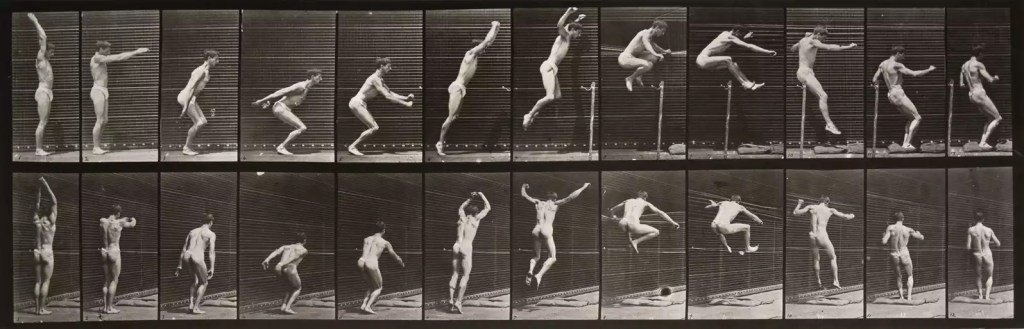
Silent cinema owes an immense debt to Eadweard Muybridge, whose pioneering work laid the conceptual, technical, and artistic foundation for the medium. While the Lumière brothers, Georges Méliès, and Thomas Edison are often credited as the early architects of film, it was Muybridge who first demonstrated that motion could be captured, analyzed, and reconstructed for audiences—a principle at the heart of cinema. Silent film’s reliance on visual storytelling, sequential action, and technical innovation can all be traced back to Muybridge’s groundbreaking experiments.
1. The Foundations of Motion Pictures
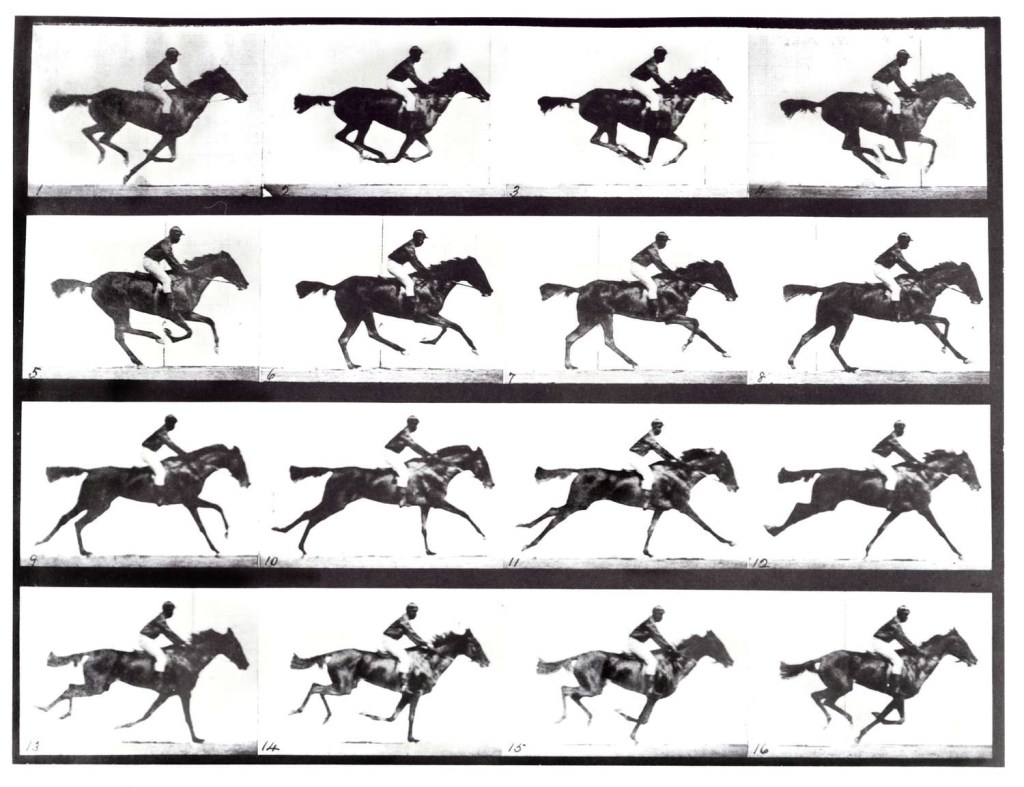
At its core, silent cinema relies on the illusion of movement created by showing a series of still images in rapid succession. Muybridge’s 1878 experiment, The Horse in Motion, was the first systematic effort to dissect and recreate motion using photography. He placed 12 cameras along a racetrack, capturing each phase of a horse’s gallop, proving that motion could be broken into discrete moments and reassembled visually. This principle—motion as sequential stills—forms the backbone of cinema. Without Muybridge’s technical and conceptual breakthroughs, the notion of “moving pictures” may not have emerged.
By tracing this path from Muybridge’s scientific motion studies, through Lang’s sociological depth, to Disney’s imaginative artistry, we see how cinema evolved into a tool not just for representing reality, but for reimagining it, engaging audiences on intellectual, emotional, and moral levels.
2. The Zoopraxiscope: Precursor to Silent Projection
Muybridge’s invention of the zoopraxiscope in 1879 created the first cinematic experience. Using painted discs of his photographic sequences, he projected animated motion onto a screen for live audiences, effectively merging science with entertainment. Silent cinema owes its very format to this moment, as the zoopraxiscope transformed motion studies from private, scientific observations into public, shared experiences.
Muybridge’s traveling lectures, which featured his projected motion studies, prefigured the silent film screenings of the 1890s and early 20th century. His demonstrations not only entertained but also educated audiences, much like early silent films that combined spectacle with storytelling.
3. Visual Storytelling Without Sound
Silent cinema depends entirely on visual storytelling, using movement, expression, and composition to convey meaning. Muybridge’s work pioneered this form of communication by presenting narrative and action purely through motion. His studies of human and animal locomotion, such as people running, leaping, or performing everyday tasks, offered a visual lexicon of action that filmmakers later drew upon.
For example:
Filmmakers like Charlie Chaplin and Buster Keaton relied on nuanced physicality and dynamic movement to create comedic and dramatic tension, echoing Muybridge’s detailed motion studies.
The concept of sequential action in silent film mirrors Muybridge’s framing, where each still tells a part of a broader story.
4. Technical Innovations and Film Equipment
Silent cinema’s technical achievements, including the kinetoscope, cinematograph, and early cameras, were heavily influenced by Muybridge’s methods. His experiments inspired inventors like Étienne-Jules Marey, who refined motion photography, and Thomas Edison, who built the kinetoscope. Muybridge’s trip-wire system for triggering cameras and his fast shutter speeds provided a technical framework for capturing motion, which inventors adapted for moving film reels.
Silent cinema, as an industry, stands on the shoulders of Muybridge’s ability to perfect the mechanical processes required to record motion. Early filmmakers refined what Muybridge had already proven: that still images, when captured sequentially and played back quickly, could produce the illusion of life.
5. Philosophical and Aesthetic Influence
Muybridge’s work had a profound influence on the aesthetic and philosophical underpinnings of silent cinema:
Fragmented Time: Silent films, especially those experimenting with editing, owe their conception of time to Muybridge. His frame-by-frame breakdown of motion mirrored the way filmmakers like D.W. Griffith or Sergei Eisenstein cut and reassembled scenes to manipulate the viewer’s sense of time and space.
Human and Animal Locomotion: Muybridge’s detailed studies of movement provided a reference for animators, directors, and cinematographers, enabling them to recreate realistic or exaggerated motion on screen. His sequences of galloping horses, running athletes, and dancing figures remain iconic visual templates for depicting kinetic energy.
Representation of Reality: Muybridge’s work suggested that motion could be both a scientific and artistic construct, a concept that silent films explored. Filmmakers like Georges Méliès, who blended reality with fantasy, owe their imaginative use of cinema to Muybridge’s early demonstrations that motion itself could be shaped and manipulated.
6. The Human Body in Silent Cinema
Much of silent film focused on the human body—its movements, gestures, and interactions. Muybridge’s studies of human locomotion (e.g., walking, running, jumping) served as a vital reference for actors and directors. His work cataloged the possibilities of human motion, enabling filmmakers to craft believable characters and physical performances.
Silent cinema owes its origins to Eadweard Muybridge, whose work not only provided the technical and conceptual basis for moving images but also shaped the language of visual storytelling. His motion studies bridged art, science, and entertainment, laying the foundation for a medium that would evolve into the most influential form of communication in the modern era. Muybridge was the first to show that movement could be captured, reconstructed, and shared—a debt the silent film era repaid by turning his experiments into a global art form. Without Muybridge, there would be no cinema.
The Metaphysics and Phenomenology of Photography: Light, Time, and Muybridge’s Gaze
Photography, derived from the Greek words phos (light) and graphé (writing), is the art and science of writing with light. It transforms fleeting moments into lasting images, raising profound questions about reality, perception, and representation. Beyond its technical origins, photography is deeply philosophical, engaging with the metaphysics of time, the phenomenology of perception, and the power dynamics inherent in the act of looking—the gaze. Eadweard Muybridge’s pioneering motion studies, which used sequential photography to analyze movement, are a crucial touchstone for exploring these ideas. His work invites us to consider the ways photography shapes how we see and interpret reality, how it mediates power through the gaze, and how it reveals truths hidden in the flow of time.
Photography as Light Writing and the Gaze
The term photography emphasizes its fundamental connection to light, yet it also implicates the act of looking—the gaze. When light reflects off a subject, it is captured by the camera, either on film or through a digital sensor. In traditional photography, silver halide crystals darken when exposed to light, creating a chemical imprint of the scene. In digital photography, photons are converted into electrical signals, which are processed into an image. Whether analog or digital, photography freezes light and gaze into an artifact, preserving the act of looking as much as the subject itself.
This fusion of light and gaze gives photography its philosophical power. The camera is not a passive recorder of reality but an active participant, framing and isolating what is seen. It chooses what to illuminate and what to obscure, directing the viewer’s gaze and shaping how the subject is perceived. Muybridge’s work exemplifies this dynamic. His motion studies, such as The Horse in Motion (1878), dissected continuous movement into discrete frames, transforming an ephemeral phenomenon into a series of moments. The camera’s gaze, operating with mechanical precision, revealed truths beyond the reach of the human eye, demonstrating photography’s capacity to mediate and direct perception.
The Metaphysics of Time and the Gaze
Photography’s most profound metaphysical implication lies in its ability to arrest time. Time, as we typically experience it, flows as a continuous stream, yet photography interrupts this flow, freezing it into discrete fragments. This act of temporal dissection raises enduring philosophical questions about the nature of time, existence, and the power dynamics of the gaze. Is reality an unbroken continuum, as Henri Bergson described in his concept of duration, or can it be divided into measurable, discrete moments, as suggested by the scientific and photographic tools that Eadweard Muybridge pioneered?
Bergson’s notion of time as duration—a qualitative, indivisible flow of lived experience—stands in tension with Einstein’s relativity, which treats time as a quantifiable dimension governed by measurable intervals and the speed of light. Bergson argued that reducing time to mathematical constructs, such as those captured by Muybridge’s sequential photography, fails to capture its dynamic, subjective essence. Muybridge’s dissection of motion into individual photographic frames aligns more closely with Einstein’s perspective, visualizing time as measurable and divisible. Yet it also exposes the limitations of this reduction, as the fluidity of motion and the lived experience of time resist full containment within discrete, static images.
This tension gains additional depth when set against Immanuel Kant’s conception of time as a pure form of intuition, an a priori framework through which human beings structure all experience. For Kant, time is not something external that flows or can be divided but rather a necessary condition of perception itself. Muybridge’s experiments visually materialize time as both a structured framework (echoing Kant’s notion of intuitive order) and as a dissected series of measurable instants (aligning with Einstein). At the same time, Muybridge’s fragmented frames compel the viewer to engage with the idea of Bergsonian duration, as their gaze reconstructs the movement between frames, grasping for the ineffable continuity of time.
The gaze itself becomes central to this philosophical inquiry. Photography, by directing and fixing the gaze, alters our relationship with time and reality. Muybridge’s work amplifies the power dynamics of the gaze: his camera observes and fragments movement, turning subjects—be they human or animal—into objects of analysis. This act of looking is not neutral. It asserts control over the flow of time, reshaping it into something observable and comprehensible to an external viewer. The gaze of Muybridge’s camera, much like the viewer’s gaze upon his work, embodies both an epistemic ambition to know and a metaphysical confrontation with time’s resistance to full capture.
Muybridge’s motion studies, therefore, are far more than technological feats; they are philosophical provocations. By arresting motion and dissecting time, his work challenges us to consider whether time is an indivisible whole, a sequence of quantifiable moments, or a necessary condition of perception. In doing so, Muybridge also reveals the intricate interplay between time and the gaze: how the act of looking, whether through a camera lens or in the contemplation of his images, mediates our understanding of reality. At this intersection of Bergson’s metaphysics, Einstein’s physics, Kant’s idealism, and the dynamics of the gaze, Muybridge’s legacy invites us to confront the profound mysteries of time, existence, and perception.
Through the camera’s gaze, Muybridge also transforms time into an object of scrutiny. Each frame in his motion studies is a fixed point in the flow of existence, preserved for analysis. This preservation of time invites reflection on the transient nature of being. Photography, as Roland Barthes argued, is always tied to the “that-has-been,” simultaneously affirming presence and absence. Muybridge’s photographs, while scientific in purpose, resonate with this metaphysical tension, making visible the impermanence of motion and the inevitability of change.
Phenomenology and the Gaze: How We See
From a phenomenological perspective, photography mediates how we experience and perceive the world, shaping our engagement with reality through the processes of intentionality and reduction. Intentionality—the directedness of consciousness toward an object—is inherent in the act of photography, as both the photographer and the viewer engage with the subject through the frame. By choosing what to capture and how to present it, photography directs our attention and creates a particular meaning for the image.
The photographic act can also be likened to the phenomenological processes of bracketing and epoché, where preconceptions about the world are set aside to focus on the essence of an experience. In photography, the camera isolates its subject from its broader context, creating a form of reduction that emphasizes certain elements while excluding others. This selective framing encourages viewers to engage with the image on its own terms, prompting a fresh encounter with the phenomena presented. In this way, photography transcends mere documentation, becoming a medium that redefines our understanding of reality by suspending assumptions and revealing the world in new ways.
Muybridge’s motion studies complicate this phenomenological dynamic by fragmenting motion into static images. The gaze of the camera isolates moments that the human eye perceives as continuous, revealing patterns and structures that were previously invisible. For instance, his studies of human and animal locomotion reveal the mechanics of movement, challenging viewers to reconstruct the flow of motion mentally. This interplay between the visible and the imagined highlights photography’s dual role as both a record of reality and a stimulus for subjective interpretation.
Moreover, the gaze in Muybridge’s work is not neutral. It is a gaze of control and analysis, dissecting its subjects with scientific precision. This gaze reflects the broader power dynamics of photography, which often transforms its subjects into objects of study. Muybridge’s motion studies exemplify this power dynamic, turning humans and animals into data to be cataloged and understood. This dynamic raises ethical questions about the relationship between the photographer, the subject, and the viewer.
Muybridge’s Gaze as a Philosophical Inquiry
Muybridge’s work demonstrates how the gaze of the camera can transcend its technical function to become a tool for philosophical inquiry. By directing the gaze toward motion, Muybridge revealed truths that lay hidden in the flow of time. His motion studies, such as his depictions of a galloping horse or a man walking, not only resolved scientific questions but also illuminated the structures of reality that lie beyond human perception.
This philosophical gaze extends beyond the individual frames of Muybridge’s work. By dissecting motion, Muybridge challenged viewers to reconsider their understanding of time, space, and existence. His photographs, while seemingly mechanical, are deeply metaphysical, capturing the essence of movement and revealing the complexity of being.
The Gaze and Sociology: Public Engagement
Muybridge’s use of the gaze was not confined to scientific exploration; it also had profound sociological implications. By exhibiting his motion studies to the public, Muybridge made abstract scientific concepts accessible to a wide audience. His work demonstrated how photography could bridge the gap between academic knowledge and public understanding, using the gaze of the camera to illuminate hidden truths.
This sociological gaze finds echoes in contemporary uses of photography and visual media, particularly in their ability to engage with questions of human behavior and societal dynamics. Through its ability to frame and dissect reality, photography extends Muybridge’s legacy by transforming motion and behavior into subjects of scrutiny. His analytical gaze, which deconstructed motion into observable sequences, laid the groundwork for visual explorations of criminology, sociology, and morality, enabling deeper understandings of how individual actions intersect with larger societal structures.
Photography, as an act of light writing and directed gaze, is both a technical and philosophical practice. It engages with profound metaphysical questions about time, existence, and representation, while also shaping how we perceive and understand the world. Muybridge’s motion studies exemplify photography’s power to transform the ephemeral into the eternal, using the gaze of the camera to reveal truths hidden in the flow of time.
Through his pioneering work, Muybridge demonstrated that photography is not merely a mechanical process but a deeply philosophical one, capable of illuminating the nature of reality and mediating human understanding. His legacy endures as a testament to the transformative power of the photographic gaze, inviting us to reflect on the complexities of time, perception, and being.
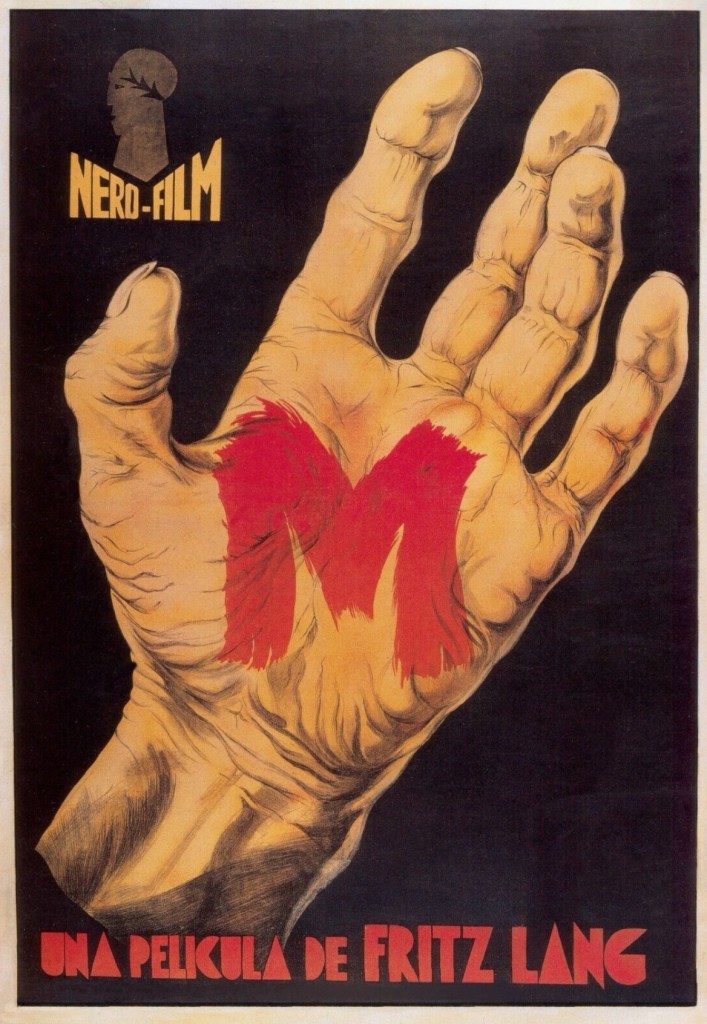
Fritz Lang’s M (1931) represents a culmination of ideas and techniques that can be traced back to Eadweard Muybridge’s groundbreaking work. Although M is a sound film, its visual storytelling, use of motion, and philosophical exploration of human behavior owe a significant debt to the innovations that began with Muybridge. Lang’s mastery of cinematic language builds upon Muybridge’s foundational ideas about motion, perception, and the fragmented representation of time.
1. Visual Storytelling and the Language of Motion
Muybridge’s motion studies laid the foundation for visual narratives in cinema, particularly during the silent and early sound eras. In M, Fritz Lang integrates motion as a vital storytelling element. The hunted killer, played by Peter Lorre, is defined by his nervous, erratic movements, which vividly express his psychological torment. This use of physical motion as a narrative tool reflects Muybridge’s exploration of the expressiveness inherent in human locomotion. Additionally, Lang’s meticulous framing and sequencing of movement, exemplified in the tense pursuit of Lorre’s character through narrow streets, parallels Muybridge’s sequential photography. Each action unfolds methodically, step by step, amplifying tension and drawing the audience into the drama of the chase.
2. Philosophical Ties: Observation and Human Nature
Muybridge’s motion studies introduced the concept that movement could be dissected and analyzed to reveal deeper insights into behavior. Similarly, Fritz Lang’s M employs cinematic techniques to examine human nature and the complex relationship between the individual and society. Just as Muybridge used photography to capture hidden details of motion, Lang utilizes the camera to observe the city and its inhabitants with forensic precision. The pervasive theme of surveillance in M—conducted by both the police and the criminal underworld—echoes Muybridge’s idea that technology can uncover truths invisible to the naked eye. Furthermore, Muybridge’s sequential breakdown of motion finds a parallel in Lang’s fragmented portrayal of the city. The film cuts between disjointed scenes, shifting perspectives, and fleeting actions to construct a chilling depiction of a society on edge. This fragmentation mirrors the fractured morality and psychology of the characters, emphasizing the disconnection and unease within the world of the film.
3. Technical Innovations and Influence
Fritz Lang’s M expands on the technical innovations pioneered by Muybridge. Muybridge’s sequential photographs laid the groundwork for modern editing, demonstrating how individual frames, when viewed in sequence, could create meaning. Lang’s editing style, particularly during the intense manhunt scenes, draws on this legacy by meticulously assembling fragmented actions to build suspense. Similarly, Muybridge’s studies of human and animal motion introduced a new level of realism to visual representation. Lang adopts this principle by capturing the nuanced, naturalistic movements of his characters, from the hunted killer to the frenzied crowds pursuing him. This attention to realistic motion deepens the film’s psychological complexity and reinforces its grounding in reality.
4. Thematic Connections: Time, Movement, and Morality
Muybridge’s work transformed perceptions of motion and time, a legacy that Fritz Lang builds upon in M to explore profound thematic concerns. Just as Muybridge’s studies fragmented time into measurable moments, Lang portrays it as fractured and relentless, with the ticking clock and rhythmic movements of the city underscoring the inevitability of justice—or vengeance—closing in on the killer. Muybridge’s exploration of the inevitability of motion, where each frame logically follows the next, finds a philosophical parallel in Lang’s narrative. Human actions, once initiated, are portrayed as inescapable, leading inexorably to their consequences. This interplay of time, motion, and inevitability forms a central axis of M’s storytelling.
Fritz Lang’s M embodies the legacy of Eadweard Muybridge’s contributions to cinema. From its reliance on motion to its exploration of surveillance, fragmentation, and time, M exemplifies the evolution of Muybridge’s ideas into a sophisticated cinematic language. Lang’s work not only builds on Muybridge’s technical and conceptual innovations but also deepens them, using motion and visual storytelling to probe the complexities of human behavior and morality. In this way, M serves as both a masterpiece of cinema and a testament to the enduring influence of Muybridge’s pioneering work.
Criminology
Eadweard Muybridge’s innovations in motion photography not only laid the technical groundwork for cinema but also established a new way of studying and presenting human behavior. By dissecting motion into discrete, observable moments, Muybridge demonstrated how technology could expose truths hidden to the naked eye, a revelation that would prove invaluable to sociological and criminological inquiry. Fritz Lang’s M (1931) takes these foundational principles and extends them into the realm of social commentary, using the medium of cinema to explore crime, morality, and societal dynamics in ways that Muybridge’s work made possible.
Muybridge’s Innovations and Sociological Implications
Muybridge’s groundbreaking photographic studies, such as Animal Locomotion, systematically analyzed human and animal behavior, transforming abstract movement into observable patterns. By dissecting motion, Muybridge not only advanced fields like biomechanics and psychology but also hinted at broader sociological applications, suggesting that movement could reveal truths about human intent, habit, and emotion. This principle aligns with criminology’s focus on behavior as something that can be observed, analyzed, and dissected to uncover patterns and motivations—a concept Fritz Lang fully explores in M.
Muybridge also introduced the idea of technology as an observer, demonstrating through his experiments that photography could reveal details invisible to the human eye. This concept finds a direct parallel in Lang’s M, where the camera becomes a tool for surveillance and control. Technology is used to track the criminal, played by Peter Lorre, capturing his movements and behavior with meticulous precision. Through this interplay of observation and technology, both Muybridge and Lang reveal the power of the mechanical eye to uncover hidden truths.
Lang’s M: Sociological Exploration Through Cinema
Building on Muybridge’s technical and philosophical framework, Fritz Lang uses the cinematic medium in M to explore criminology and sociology on a public scale. Lang transforms Muybridge’s method of capturing hidden details into a narrative device, using observation and surveillance as central themes. In M, the killer is constantly under watch—not only by the police but also by the criminal underworld and society at large. The camera acts as an impartial observer, echoing Muybridge’s photographic detachment, recording movement and behavior that expose the psychology of both the criminal and those pursuing him. By illustrating how technological observation uncovers the killer’s patterns and movements, Lang highlights the role of surveillance in criminology as a means to understand and predict human behavior.
Lang also draws on Muybridge’s sequential breakdown of motion to depict fragmented narratives and actions in M. The film intercuts between seemingly disconnected sequences—the killer’s aimless wandering, police investigations, and the criminal underworld’s plotting—mirroring Muybridge’s analytical dissection of motion. This fragmented approach portrays crime not as an isolated act but as part of a larger societal network. The disjointed yet interconnected sequences reflect the complexities of human behavior and society’s collective reaction to deviance, creating a sociological map of cause and effect.
Much like Muybridge’s public exhibitions, which made complex ideas about motion accessible to broader audiences, Lang uses M to present criminological theories and societal dilemmas in a visual, relatable format. The film delves into the psychological motivations of a child murderer, inviting viewers to grapple with emerging ideas in criminal psychology and the moral tensions surrounding justice and societal responsibility. The climactic trial, where the killer pleads for understanding rather than condemnation, challenges audiences to consider the root causes of crime—mental illness, societal neglect, or inherent evil—turning the film into a public forum for sociological reflection and debate.
Muybridge’s Legacy in Lang’s Sociological Cinema
Muybridge’s approach to motion studies, which treated human and animal movement as data to be cataloged and analyzed, finds a profound echo in Fritz Lang’s M. In the film, Lang applies this principle by treating the killer’s actions and society’s response as observable patterns, revealing underlying structures of law, morality, and collective fear. Just as Muybridge’s photographic tools uncovered hidden truths about movement, Lang uses the camera to delve into the psychological and societal dimensions of crime. Through a focus on surveillance—both visual, as the killer is tracked, and auditory, with the whistle tune that identifies him—Lang extends Muybridge’s legacy into criminology, demonstrating how technology aids in understanding human behavior.
Much like Muybridge’s motion studies, which engaged the public with groundbreaking visual insights, Lang’s M uses cinema to present sociological concepts to a broad audience. The film challenges viewers to confront questions of guilt, justice, and societal complicity, transforming its narrative into a public forum for reflection on crime and its broader implications.
Muybridge’s work transformed the study of motion into a scientific and artistic pursuit, introducing methods of observation and analysis that Fritz Lang would adapt to explore crime and society in M. By applying Muybridge’s techniques of fragmentation, observation, and public presentation, Lang extends these innovations to address sociological questions, using cinema to expose the complexities of criminology and societal behavior. Muybridge opened the door to understanding human actions in measurable terms, and Lang used that foundation to explore the human condition, presenting these ideas to audiences in a powerful, accessible medium. Together, they represent a continuum of innovation that shaped cinema as both art and social commentary.
Dr. Mabuse and M: A Comparative Exploration of Power, Crime, and Society
Fritz Lang’s Dr. Mabuse, the Gambler (1922) and M (1931) are seminal works in the history of cinema, each a masterful exploration of power, crime, and the fragile structures of society. While the films differ in tone, narrative, and historical context, they complement each other by presenting two sides of Lang’s overarching fascination with the interplay between individuals and social systems. Dr. Mabuse portrays the destructive potential of a master manipulator operating outside moral constraints, while M offers a more intimate and psychological view of crime, focusing on a society’s collective struggle to confront and comprehend deviant behavior. Together, these films reveal Lang’s ability to dissect the anxieties of his era and provide an enduring commentary on power, fear, and the human condition.
The Plot of Dr. Mabuse, the Gambler
Dr. Mabuse, the Gambler introduces the titular character as a criminal mastermind who uses hypnosis, psychological manipulation, and elaborate schemes to control others and amass wealth and influence. Mabuse, portrayed with chilling precision by Rudolf Klein-Rogge, is a shadowy figure who operates in the underbelly of Weimar-era Berlin. The film is structured as a sprawling two-part epic. In the first part, “The Great Gambler: A Picture of the Time,” Mabuse’s schemes are revealed as he manipulates stock markets, gamblers, and political figures, destabilizing the fragile social order. The second part, “Inferno: A Game for the People of Our Age,” sees Mabuse’s criminal empire begin to crumble as he is pursued by State Prosecutor von Wenk.
The film’s narrative oscillates between scenes of chaos and control, with Mabuse embodying unchecked power and societal corruption. As his schemes unravel, Mabuse descends into madness, ending the film imprisoned, scribbling cryptic symbols in his cell—a powerful image of the self-destructive nature of absolute power.
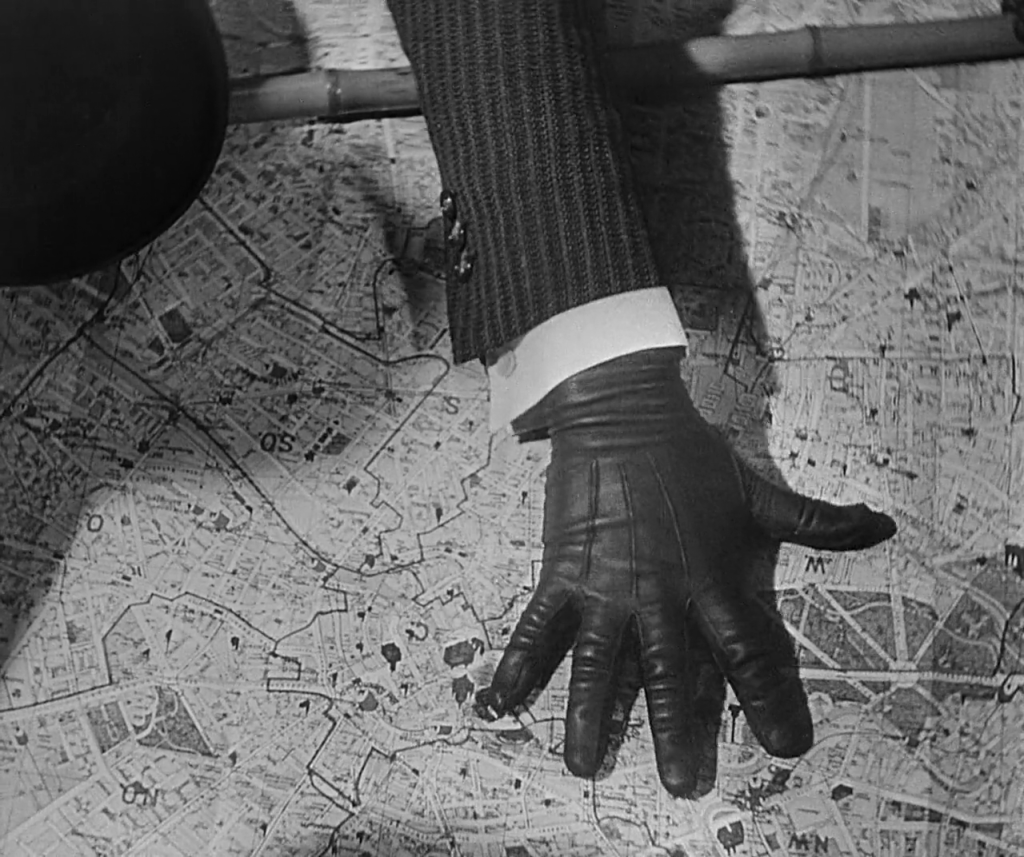
The Plot of M
Nine years later, Lang released M, a tightly focused and psychologically rich examination of a society in turmoil. The film follows Hans Beckert, a child murderer played hauntingly by Peter Lorre, as he evades capture in a city gripped by fear and paranoia. Unlike the expansive scope of Dr. Mabuse, M concentrates on the collective response to Beckert’s crimes. The police intensify their surveillance efforts, while the criminal underworld organizes its own manhunt, frustrated by the increased police presence disrupting their activities.
Beckert is eventually captured by the criminals and brought to an underground trial, where he pleads for his life, claiming he cannot control his impulses. The film ends ambiguously, with Beckert’s fate left unresolved, emphasizing themes of justice, morality, and the limits of human understanding.
Complementary Themes: Power, Crime, and Society
Despite their differences in scale and tone, Dr. Mabuse and M are deeply interconnected through their exploration of power, crime, and societal response. Mabuse and Beckert are contrasting embodiments of deviance: Mabuse is a manipulative genius who wields power over others, while Beckert is a pitiable figure controlled by his own compulsions. Yet both characters disrupt the fragile balance of their respective societies, revealing the cracks in social and moral structures.
In Dr. Mabuse, the titular character’s crimes are grandiose and theatrical, reflecting the chaotic, disillusioned zeitgeist of post-World War I Germany. Mabuse’s ability to manipulate society mirrors the instability of the Weimar Republic, where political and economic systems seemed vulnerable to exploitation. The film’s subtitle, “A Picture of the Time,” reinforces this connection, presenting Mabuse not just as an individual villain but as a symbol of societal corruption and chaos.
M, on the other hand, offers a more intimate examination of crime, shifting the focus from societal systems to individual psychology and collective fear. Beckert’s murders expose the vulnerabilities of a society grappling with its own sense of morality and justice. The collaboration between the police and criminals in the hunt for Beckert highlights the desperation of a city willing to blur ethical boundaries in the name of security. Where Dr. Mabuse critiques systemic power, M delves into the moral ambiguities of justice, forcing viewers to confront uncomfortable questions about human behavior and responsibility.
Technology and Surveillance
Both films also emphasize the role of technology and observation in the pursuit of control. In Dr. Mabuse, technology is a tool of manipulation, with Mabuse using his skills in hypnosis and psychological warfare to dominate others. His ability to orchestrate chaos from the shadows reflects anxieties about unseen forces shaping society. In M, technology plays a more neutral role, with tools like surveillance, maps, and coordinated searches used to track Beckert. The camera itself becomes an omniscient observer, echoing the film’s themes of surveillance and control.
A Society on Trial
Perhaps the most striking connection between the two films is their shared critique of society itself. In Dr. Mabuse, the decadence and corruption of Berlin provide fertile ground for Mabuse’s schemes, suggesting that societal decay enables the rise of figures like him. Similarly, in M, the underground trial of Beckert reflects the mob mentality and moral uncertainty of a society desperate for justice. Both films place society on trial, questioning whether it is equipped to handle the forces that threaten its stability.
Fritz Lang’s Dr. Mabuse, the Gambler and M are not merely crime films but profound meditations on the nature of power, fear, and human behavior. Through their exploration of societal vulnerabilities, technological observation, and moral ambiguity, the two films complement each other, offering a multifaceted critique of the worlds they depict. Together, they form a cinematic dialogue on the fragility of social order and the enduring challenge of reconciling justice with the complexities of human nature.
Dr. Mabuse and M: From Societal Corruption to Innocence Lost
Fritz Lang’s Dr. Mabuse, the Gambler (1922) and M (1931) represent two pivotal explorations of crime and its relationship to society, forming a continuum in Lang’s cinematic critique of social order. In Dr. Mabuse, crime operates within a concealed yet pervasive underworld, where corruption spreads like a contagion, infecting the fabric of Weimar society. By the time of M, Lang narrows his focus to the devastating consequences of this criminal chaos as it spills over into the most vulnerable parts of society—specifically, its children. Through these films, Lang traces a progression from the manipulative, abstract power of a criminal mastermind to the intimate horror of violence inflicted on the innocent, offering a stark commentary on how societal decay and unchecked criminality ultimately harm its weakest members.
From Corruption to Chaos: The Criminal Underworld in Dr. Mabuse
In Dr. Mabuse, the Gambler, crime exists as a shadowy but structured force, orchestrated by the titular character. Mabuse is a master manipulator who uses his intellect, hypnotic abilities, and a network of operatives to destabilize society for his personal gain. His schemes—rigging stock markets, sabotaging the rich, and undermining political stability—are far-reaching, impacting the public indirectly but profoundly.
This underworld operates in parallel to society, exploiting its weaknesses without immediate visibility. Mabuse’s actions represent a predatory system that thrives on societal instability, mirroring the fears of Weimar Germany, where economic crises, political upheaval, and moral decay provided fertile ground for such figures to flourish. Though Mabuse’s crimes are grand in scale, they are primarily directed at the elites and institutions of society, keeping the general public largely peripheral to his schemes.
However, the film suggests that such a system cannot remain contained indefinitely. Mabuse’s descent into madness at the film’s conclusion is emblematic of a broader unraveling. His loss of control foreshadows the eventual collapse of the boundary between the criminal underworld and the public sphere, setting the stage for M, where the repercussions of such corruption are felt directly by ordinary people—especially children.
The Underworld Spills Over: The Tragedy of M
In M, Lang shifts his focus from the machinations of a single mastermind to the devastating human consequences of criminal activity when it invades the everyday lives of citizens. The child murderer Hans Beckert, played by Peter Lorre, represents the horrifying culmination of unchecked deviance. Unlike Mabuse, whose crimes manipulate systems, Beckert’s actions are personal and visceral, targeting the most innocent and defenseless members of society.
The film’s depiction of Beckert’s crimes underscores the transition from systemic corruption to direct harm. While Dr. Mabuse focuses on societal elites as the victims of crime, M shows how the criminal underworld’s influence spills over into the streets, preying on children and creating a pervasive atmosphere of fear. This transition reflects Lang’s broader critique of a society that has failed to contain the consequences of its own corruption.
Beckert’s crimes trigger a dual response: the police intensify their surveillance efforts, while the criminal underworld mobilizes to capture him. This collaboration between law enforcement and organized crime highlights the porous boundary between the two realms. The criminals are not acting out of moral responsibility but out of self-interest, frustrated by the increased police pressure disrupting their activities. The irony is stark: those who operate outside the law now become its enforcers, demonstrating how deeply crime has infiltrated every level of society.
Children as the Ultimate Victims
The focus on children in M marks a profound shift in Lang’s exploration of crime. In Dr. Mabuse, the victims are largely adults—wealthy elites, gamblers, and political figures who are complicit, to some degree, in their own downfall. In M, however, the victims are entirely innocent. This shift underscores the ultimate consequence of societal decay: when systems of justice and morality fail, it is the most vulnerable who suffer.
Beckert’s crimes are not just acts of individual pathology but symptoms of a larger societal failure. The public’s fear and hysteria, the ineffectiveness of the police, and the criminal underworld’s opportunism all point to a community unable to protect its children. Lang uses this focus to expose the fragility of the social contract, suggesting that when society fails to address corruption and crime at its roots, it inevitably leads to the exploitation and harm of its weakest members.
The Intersection of Surveillance and Innocence
Both films emphasize the role of observation and control in addressing crime, but their approaches differ significantly. In Dr. Mabuse, surveillance is a tool of power, wielded by Mabuse to manipulate and exploit. In M, surveillance becomes a collective effort, as society turns its gaze inward to hunt Beckert. However, this collective observation is not entirely altruistic; it is motivated by fear and self-preservation rather than a genuine concern for justice or morality.
The chilling irony of M is that the community’s combined efforts to track Beckert mirror Mabuse’s manipulative tactics. The same tools of observation that Mabuse used for control are now used to hunt a murderer, blurring the line between justice and vengeance. This parallel suggests that society has internalized the predatory logic of the criminal underworld, turning it against itself in an attempt to restore order.
Complementary Narratives of Decline
Together, Dr. Mabuse and M form a cohesive narrative about the dangers of societal corruption and the unchecked spread of criminal influence. In Dr. Mabuse, crime is an abstract force that destabilizes systems, operating in the shadows and preying on the powerful. In M, the consequences of this destabilization become horrifyingly tangible, as the violence spills into the public sphere and targets children.
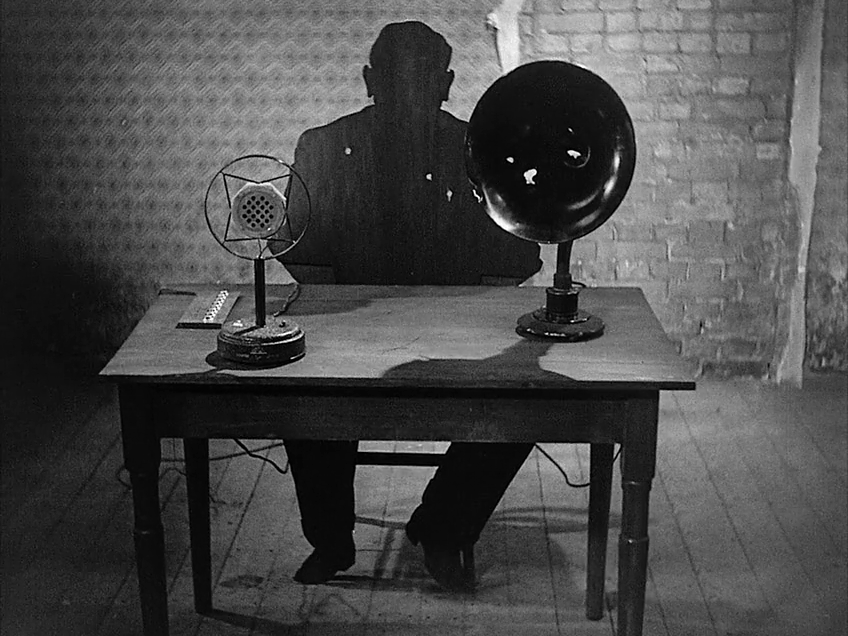
Lang uses these films to critique the failure of societal systems to address crime at its root. In Dr. Mabuse, the failure is one of control, as a corrupt society allows figures like Mabuse to thrive. In M, the failure is one of protection, as the community proves incapable of safeguarding its most vulnerable members. The films complement each other by revealing different stages of a shared problem, ultimately illustrating the devastating consequences of a society unable to confront and contain its own moral and structural weaknesses.
Fritz Lang’s Dr. Mabuse, the Gambler and M are profound examinations of crime and its relationship to society, tracing a trajectory from systemic corruption to personal tragedy. Through their complementary narratives, Lang explores how the criminal underworld, left unchecked, spills over into society, culminating in the exploitation and harm of its most innocent members. By highlighting the failures of social systems to address these issues, Lang offers a timeless critique of power, morality, and the fragility of human civilization.
Muybridge’s Legacy in Lang’s Dr. Mabuse and M: Dissecting Crime and Society Beyond Entertainment
Fritz Lang’s Dr. Mabuse, the Gambler (1922) and M (1931) are landmark films that transcend the boundaries of entertainment to offer profound meditations on criminology and sociology. These works are united by Lang’s detailed exploration of crime and its impact on society, but they also share a conceptual lineage with the groundbreaking innovations of Eadweard Muybridge. Muybridge’s motion studies, which meticulously dissected human and animal movement, laid the groundwork for cinema as both a technological and philosophical tool. By breaking down motion into sequences of observable data, Muybridge transformed visual storytelling into a medium capable of revealing hidden truths about behavior, intent, and society. Lang builds on this legacy, using the cinematic medium to dissect criminal behavior and societal dynamics in a way that engages the public with questions of justice, morality, and human vulnerability.
Muybridge’s Innovations and the Birth of Analytical Cinema
Eadweard Muybridge’s motion studies in the late 19th century introduced the idea that movement could be captured, analyzed, and understood through sequential photography. His experiments, such as The Horse in Motion and Animal Locomotion, broke time into measurable intervals, revealing details imperceptible to the naked eye. These studies were not merely technical achievements but also philosophical inquiries into the nature of motion and behavior. By isolating individual moments within a continuous action, Muybridge demonstrated how observation could uncover patterns and insights, transforming abstract phenomena into tangible, analyzable data.
This approach directly influenced the development of cinema, turning it into a medium capable of examining complex ideas beyond mere storytelling. Muybridge’s work suggested that film could serve as a tool for understanding human behavior and societal dynamics, paving the way for filmmakers like Fritz Lang to use the medium as a lens for criminology and sociology.
From Muybridge to Mabuse: Dissecting Criminal Mastery
In Dr. Mabuse, the Gambler, Lang channels Muybridge’s analytical approach to explore the mechanisms of power and crime. Mabuse’s actions, though larger-than-life, are presented with a clinical precision that mirrors Muybridge’s methodical breakdown of motion. Lang uses the cinematic medium to reveal Mabuse’s manipulations in detail, from his psychological domination of victims to his orchestration of stock market crashes and political unrest.
Just as Muybridge’s motion studies revealed the hidden mechanics of movement, Lang’s film dissects the invisible forces that drive societal instability. Mabuse’s crimes are not random acts of violence but calculated disruptions that expose the fragility of societal structures. Through the lens of Lang’s camera, the audience becomes an observer, much like Muybridge’s viewers, gaining insight into the patterns and consequences of Mabuse’s actions.
This dissection of Mabuse’s criminal empire transcends traditional storytelling, transforming the film into a sociological study of corruption and control. Lang invites viewers to consider how systems of power and greed, when left unchecked, can infiltrate and destabilize society. In this sense, Dr. Mabuse functions as an extension of Muybridge’s legacy, using the cinematic medium to analyze not just movement but the broader dynamics of human behavior and societal interaction.
M: The Fragmentation of Time and Society
Lang’s M takes Muybridge’s influence a step further by applying the principles of motion analysis to the psychology of crime and the collective response to deviance. The film’s fragmented narrative structure, which cuts between disparate actions and perspectives—the murderer’s movements, police investigations, and the criminal underworld’s plotting—mirrors Muybridge’s sequential breakdown of motion. Each scene functions as a piece of a larger puzzle, contributing to a chilling portrait of a society in crisis.
Beckert’s crimes and the ensuing manhunt are presented with an almost forensic precision, emphasizing observation and analysis over sensationalism. The rhythmic editing and deliberate pacing echo Muybridge’s systematic approach, allowing the audience to scrutinize not just the killer’s behavior but also the societal structures attempting to apprehend him. The film’s focus on surveillance—visual tracking of Beckert’s movements and the auditory clue of his whistle—further underscores the legacy of Muybridge’s technological observation, illustrating how cinema can reveal truths invisible to the unaided senses.
Bringing Criminology and Sociology to the Public
Both Dr. Mabuse and M transcend mere entertainment by presenting criminological and sociological concepts to a mass audience, continuing the democratizing impulse initiated by Muybridge’s public exhibitions of motion studies. Muybridge’s work made complex ideas about movement and behavior accessible to a wide audience, transforming abstract scientific inquiry into a visual experience that could be understood by anyone. Lang adopts a similar approach, using the accessibility of cinema to engage viewers with profound questions about crime, justice, and society.
In M, this is particularly evident in the climactic underground trial of Beckert. The scene shifts the focus from the individual criminal to society itself, turning the film into a public forum for moral and philosophical debate. Beckert’s plea for understanding—claiming that he cannot control his impulses—forces the audience to confront uncomfortable questions about the root causes of crime. Is Beckert a victim of mental illness, societal neglect, or inherent evil? The film offers no easy answers, instead challenging viewers to grapple with the complexities of justice and societal responsibility.
Similarly, Dr. Mabuse uses its sprawling narrative to explore the broader sociological implications of crime. Mabuse’s manipulation of financial and political systems exposes the vulnerabilities of society, prompting viewers to consider how power and corruption operate within their own world. Lang’s meticulous depiction of Mabuse’s schemes transforms the film into a case study in the dynamics of control, offering insights that extend far beyond the confines of its narrative.
Cinema as a Tool for Understanding Society
By building on Muybridge’s innovations, Lang elevates cinema into a medium for public education and engagement with complex ideas. Muybridge’s motion studies proved that technology could reveal hidden truths about behavior and movement, offering new ways of understanding the world. Lang extends this principle to the realms of criminology and sociology, using film to dissect crime and its impact on society.
In Dr. Mabuse, Lang explores how criminal power operates within and against societal systems, highlighting the dangers of corruption and the fragility of order. In M, he shifts the focus to the consequences of crime, illustrating how societal failures to address systemic issues ultimately harm the most vulnerable. Together, the films reflect Lang’s belief in cinema as a tool for revealing truths and fostering public understanding, continuing the legacy of Muybridge’s analytical and democratizing approach.
Muybridge’s innovations in motion studies laid the groundwork for a cinematic language capable of analyzing complex phenomena, from individual behavior to societal dynamics. Fritz Lang’s Dr. Mabuse, the Gambler and M build on this foundation, using film to dissect the mechanisms of crime and its consequences for society. By engaging viewers with criminological and sociological questions, Lang transcends entertainment, transforming cinema into a medium for public inquiry and understanding. In doing so, he carries forward Muybridge’s vision of technology as a tool for uncovering hidden truths, offering a timeless critique of power, morality, and human vulnerability.
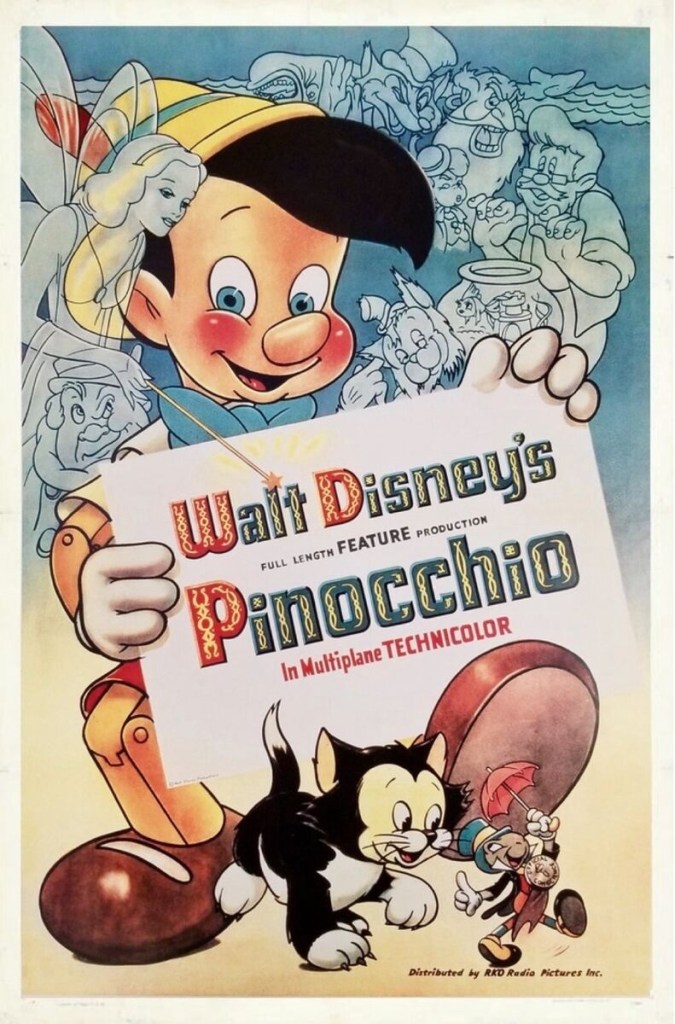
The 1940 Disney film Pinocchio might seem worlds apart from the innovations of Eadweard Muybridge, Fritz Lang’s M, and their contributions to cinema and sociological inquiry, but a closer examination reveals a fascinating lineage. At its core, Pinocchio inherits the cinematic language and philosophical questions about motion, observation, and morality that Muybridge and Lang helped establish. Through its groundbreaking animation techniques and exploration of human behavior, Disney’s Pinocchio continues this tradition by using motion and storytelling to engage with moral and societal themes, presenting them to a mass audience in an accessible and emotionally resonant way.
1. Muybridge: The Foundation of Motion and Animation
Eadweard Muybridge’s photographic motion studies, which deconstructed movement into sequential frames, laid the groundwork for animation and its reliance on the illusion of motion. His pioneering efforts resonate profoundly in Disney’s Pinocchio.
The film’s lifelike movement—such as Pinocchio’s clumsy, puppet-like steps evolving into confident strides—embodies Muybridge’s focus on replicating real motion. Disney animators, like Muybridge, meticulously observed human and animal movement to create the illusion of life. Additionally, Muybridge’s exploration of human gestures as vehicles for emotion finds an artistic counterpart in Disney’s work, where characters’ nuanced motions—Pinocchio’s curiosity, Geppetto’s tenderness, Jiminy Cricket’s exasperation—transform the story into an emotional experience.
2. Lang’s Sociological Exploration and Pinocchio’s Morality
Fritz Lang’s M used cinema to delve into societal morality and deviance, themes that are similarly explored in Pinocchio, though in allegorical form.
Lang’s portrayal of observation and societal judgment finds a parallel in Pinocchio, where figures like the Blue Fairy, Jiminy Cricket, and Monstro embody moral oversight. Pinocchio is constantly watched, guided, or judged, reflecting Lang’s vision of a society that scrutinizes individual behavior. Both works also grapple with crime and punishment: Lang humanizes the deviant, suggesting crime as a product of circumstance, while Pinocchio portrays characters like Lampwick as victims of external influences. Redemption, a key theme in both, is tied to action; just as Lang examines ethical dilemmas, Pinocchio’s humanity is defined by his ultimate choice to act selflessly.
3. Technology, Motion, and Emotional Engagement
Disney’s Pinocchio extends the technological innovations of Muybridge and Lang, pushing animation’s storytelling potential.
Muybridge’s zoopraxiscope, which gave motion to still images, and Lang’s cinematic framing and editing techniques paved the way for Disney’s use of the multiplane camera. This innovation, employed extensively in Pinocchio, added depth and realism, immersing audiences in the story’s fantastical world. Motion, a central narrative device for Muybridge and Lang, is also pivotal in Pinocchio. Whether it’s Pinocchio’s transformation from wooden rigidity to lifelike fluidity or the frenetic chaos of Pleasure Island, movement drives the emotional and narrative stakes, echoing the importance of motion as a storytelling tool in Muybridge’s studies and Lang’s films.
4. Philosophical and Sociological Themes in Pinocchio
Muybridge and Lang introduced profound questions about humanity and morality that find expression in Pinocchio.
Muybridge’s exploration of human motion and Lang’s focus on societal morality are synthesized in Pinocchio’s central question: What does it mean to be human? The film argues that true humanity lies not in form or function but in moral choice and responsibility. External forces—whether societal pressures in M or physical influences in Muybridge’s work—also shape Pinocchio’s journey, highlighting the tension between personal agency and external manipulation.
Lastly, Pinocchio reflects Lang’s and Muybridge’s shared interest in observation and self-awareness. As Jiminy Cricket acts as Pinocchio’s conscience, guiding him toward self-reflection and moral accountability, the film mirrors Lang’s examination of societal surveillance and Muybridge’s technological observation of the human form. In both works, the act of watching—whether by society, technology, or the self—becomes a mechanism for understanding and transformation.
5. Presenting Morality to a Public Audience
Muybridge’s public exhibitions and Lang’s socially charged cinema made complex ideas accessible to large audiences. Disney’s Pinocchio continues this legacy by presenting profound moral and philosophical questions in an engaging, family-friendly format. Themes like the consequences of dishonesty, the dangers of temptation, and the rewards of selflessness resonate universally, ensuring that the film’s sociological and philosophical messages reach a wide audience.
Disney’s Pinocchio stands on the shoulders of Muybridge and Lang, inheriting their innovations in motion, observation, and sociological exploration. Muybridge’s scientific dissection of movement enabled animators to breathe life into characters, while Lang’s use of cinema to examine morality and behavior laid the groundwork for Pinocchio’s allegorical storytelling. By blending technical innovation with profound moral inquiry, Pinocchio extends the legacy of these pioneers, proving that cinema, whether through photography, film, or animation, is a powerful medium for exploring what it means to be human.

Criminology
The Disney film Pinocchio (1940) weaves a profound narrative around the dangers children face, presenting themes of criminology, moral corruption, and societal responsibility in a way that engages a broad public audience. These themes, while universal, resonate with the lineage of cinematic exploration pioneered by Eadweard Muybridge and Fritz Lang. Muybridge’s work with motion studies and Lang’s sociological inquiry in M (1931) provided the intellectual and technical groundwork for Pinocchio’s exploration of crime, deviance, and the moral challenges children face in navigating a world fraught with danger.
1. The Dangers Facing Children: Pleasure Island as a Criminal Trap
In Pinocchio, Pleasure Island functions as a vivid allegory for societal forces that exploit vulnerable children, paralleling the themes of deviance and societal neglect seen in Lang’s M. The boys who are lured to the island by promises of fun and indulgence are ultimately transformed into donkeys—literal beasts of burden—reflecting the consequences of falling prey to criminal manipulation. The Coachman, who orchestrates this scheme, represents a predatory figure who exploits children’s innocence for personal gain. His actions echo the concerns of early criminology, as seen in M, where crime is portrayed as a symptom of societal failure and moral decay. Additionally, Pleasure Island symbolizes broader societal neglect of children’s welfare. Just as Lang’s M critiques a society unable to protect its most vulnerable, Pinocchio warns of the dangers children face when left without proper guidance or protection.
2. Pinocchio and the Criminology of Influence
Pinocchio’s journey mirrors the sociological exploration of crime and morality seen in Lang’s M. Both works examine the factors that lead individuals to deviate from societal norms and the possibility of redemption through self-awareness and choice. Pinocchio’s encounters with figures like Honest John and Gideon reveal how easily children can be led astray by persuasive influences. These characters embody criminal manipulators who exploit trust and naivety, much like the societal forces shaping deviant behavior explored in M. Pinocchio’s transformation into a donkey serves as a metaphor for the dehumanizing consequences of moral and behavioral failure. This aligns with Lang’s portrayal of crime in M as a process that strips individuals of their humanity, reducing them to objects of fear or scorn.
3. Surveillance, Responsibility, and Justice
Like Lang’s M, Pinocchio addresses the idea of societal surveillance and justice, particularly in the context of protecting children from harm. Jiminy Cricket, as Pinocchio’s conscience, functions as a form of internal moral surveillance, mirroring the societal scrutiny depicted in M. His guidance represents the ethical framework that children must internalize to navigate a world filled with criminal threats. Both M and Pinocchio explore the tension between punishment and redemption. While Lang’s film questions the morality of retributive justice, Pinocchio offers a path to redemption through personal growth and moral accountability. Pinocchio’s eventual transformation into a real boy represents the potential for rehabilitation and the importance of second chances.
4. Exposing Societal Issues to a Public Audience
Just as Lang’s M used the cinematic medium to critique society’s failures in addressing crime and deviance, Pinocchio presents its themes in a way that engages a family audience while addressing significant societal concerns. By framing its criminological themes within an engaging, fantastical narrative, Pinocchio makes profound moral questions accessible to children and adults alike. This echoes Lang’s ability to use popular cinema to provoke societal reflection. Both M and Pinocchio demonstrate how storytelling can illuminate the root causes of crime and the dangers faced by vulnerable populations. By showing how societal neglect and predatory influences shape behavior, Pinocchio calls for collective responsibility in safeguarding children.
5. A Warning About Societal Complicity
Pinocchio also addresses the societal complicity in endangering children, a theme central to Lang’s M. The indifference of the adults in Pinocchio—from Geppetto’s initial naivety to the townsfolk who fail to intervene—mirrors the societal failures depicted in Lang’s film. Just as M critiques a society that fails to protect its children from predatory forces, Pinocchio serves as a cautionary tale about the consequences of neglecting children’s moral and emotional development. Both works ultimately argue for greater societal accountability. Pinocchio suggests that guidance, vigilance, and compassion are necessary to protect children from falling into the hands of those who would exploit them.
Disney’s Pinocchio stands as a cinematic heir to the criminological and sociological themes explored by Eadweard Muybridge and Fritz Lang. Muybridge’s foundational work with motion studies enabled the technical innovations that brought Pinocchio to life, while Lang’s exploration of crime and morality in M shaped the film’s thematic depth. By addressing the dangers children face and the societal responsibility to protect them, Pinocchio uses the medium of animation to bring these critical issues to a large public audience, continuing a tradition of cinema as both entertainment and social commentary.
In The Uses of Enchantment: The Meaning and Importance of Fairy Tales (1976), Bruno Bettelheim explores how fairy tales help children grapple with moral dilemmas and psychological challenges by presenting archetypal struggles in symbolic terms. In relation to Pinocchio, Bettelheim’s insights highlight how the film uses its narrative to address complex issues like temptation, moral growth, and the consequences of wrongdoing in a manner accessible to children. The story’s allegorical elements, such as Pleasure Island and the transformation into a donkey, align with Bettelheim’s argument that fairy tales provide a safe space for children to confront fears and navigate the challenges of growing up.
Walt Disney’s work and legacy are deeply aligned with the ideas Bruno Bettelheim explores in The Uses of Enchantment. Disney understood the profound psychological and moral significance of fairy tales, adapting them into animated films that not only entertained but also guided children through universal challenges. His films, including Pinocchio (1940), served as modern fairy tales, offering moral instruction and emotional resonance through symbolic storytelling, much like the traditional tales Bettelheim champions.
Disney’s adaptations often emphasize themes of temptation, transformation, and redemption, which align closely with Bruno Bettelheim’s framework for understanding fairy tales.
1. Temptation and Consequences
In Pinocchio, the seductive allure of Pleasure Island mirrors the moral testing central to fairy tales. Bettelheim suggests that these trials help children navigate complex ethical landscapes by illustrating the dangers of giving in to temptation. The boys’ transformation into donkeys vividly depicts the consequences of moral failure, reinforcing the importance of personal responsibility in a way that resonates with younger audiences.
2. Transformation and Growth
Pinocchio’s journey from a wooden puppet to a real boy reflects Bettelheim’s view that fairy tales facilitate emotional and moral development. This transformation is symbolic of the challenges children face as they grow, presenting obstacles that must be overcome to achieve maturity and self-actualization. By presenting these trials within a fantastical framework, Disney enables audiences to engage with profound ideas about growth and identity in an accessible way.
3. Accessible Morality for Mass Audiences
Disney, much like the traditional storytellers Bettelheim discusses, translates complex moral concepts into narratives that are easily understood by global audiences. Through characters, visuals, and music, Disney ensures these universal lessons resonate across cultures and generations, preserving the educational and emotional power of the fairy tale medium.
More broadly, Disney’s legacy lies in his ability to marry art, psychology, and mass media, creating a cultural touchstone where audiences of all ages could confront the struggles of human existence through timeless, enchanted tales. Pinocchio epitomizes this approach, cementing Disney’s place as a modern interpreter of fairy tale wisdom and a pioneer of emotionally rich cinematic storytelling.
Walt Disney’s dedication to expanding the world of children is inseparable from his pioneering work in the art of animation, a medium that uniquely enabled unbounded creativity and limitless storytelling. Through animation, Disney transcended the constraints of live-action cinema, creating fantastical worlds where moral lessons and emotional truths could be conveyed with unparalleled imagination. This fusion of creativity and storytelling was central to his vision of enriching children’s lives.
Animation allowed Disney to fully realize the symbolic and archetypal elements that Bruno Bettelheim identifies in fairy tales. In Pinocchio, the medium’s flexibility brought to life complex metaphors like Pleasure Island, the transformation into a donkey, and the terrifying scale of Monstro the whale—each representing abstract dangers and consequences in ways children could intuitively grasp. Animation’s ability to blend realism with fantasy made these ideas both accessible and visually unforgettable.
More broadly, Disney saw animation as a tool for expanding not just children’s imaginations but their sense of what was possible in life. By creating characters who could defy physics, traverse magical landscapes, and evolve emotionally, Disney invited young viewers to envision a world without limits. This ethos of unbounded creativity is evident in his willingness to push the boundaries of technology, from synchronized sound in Steamboat Willie to the multiplane camera in Pinocchio, which added depth and dynamism to animated storytelling.
Ultimately, Disney’s commitment to the art of animation was rooted in his belief in the transformative power of creativity. He used the medium not just to entertain, but to inspire children to dream, to grapple with moral questions, and to see the world as a place of infinite possibility. Animation, for Disney, was more than a storytelling device—it was a way to expand the inner and outer worlds of his audience, creating a legacy of wonder, growth, and enduring artistic innovation.
Walt Disney’s work, particularly in Pinocchio (1940), elevated cinema to a new level by pushing the boundaries of storytelling, art, and technology, blending them into an emotionally rich and visually innovative medium. This evolution can be traced back to Eadweard Muybridge’s motion studies, Fritz Lang’s M (1931), and ultimately Disney’s animation, each building upon the previous in their exploration of movement, morality, and human experience.
1. Eadweard Muybridge: Foundations of Motion
Muybridge’s sequential photography in the late 19th century provided the first scientific exploration of kinetic movement, laying the groundwork for both cinema and animation. By capturing motion frame by frame, Muybridge turned motion into an observable and reproducible phenomenon, sparking a revolution in how humans could study and represent the world.
2. Fritz Lang’s M: Morality and Sociological Depth
Fritz Lang expanded on cinema’s capacity to not only reproduce motion but also explore moral and sociological questions. In M, Lang used sound, framing, and editing to create a cinematic language capable of interrogating crime, deviance, and societal failure. Lang showed how film could be a medium for examining the human condition in ways that transcended mere storytelling.
3. Disney’s Pinocchio: Artistic and Emotional Integration
Disney took the technical and thematic advancements of Muybridge and Lang to new heights. Animation, a medium born of Muybridge’s studies, allowed Disney to create symbolic, morally charged worlds unrestrained by physical reality. Pinocchio combined innovative technology (the multiplane camera), rich visual storytelling, and universal moral lessons, transforming cinema into a medium of unbounded creativity and profound emotional resonance.
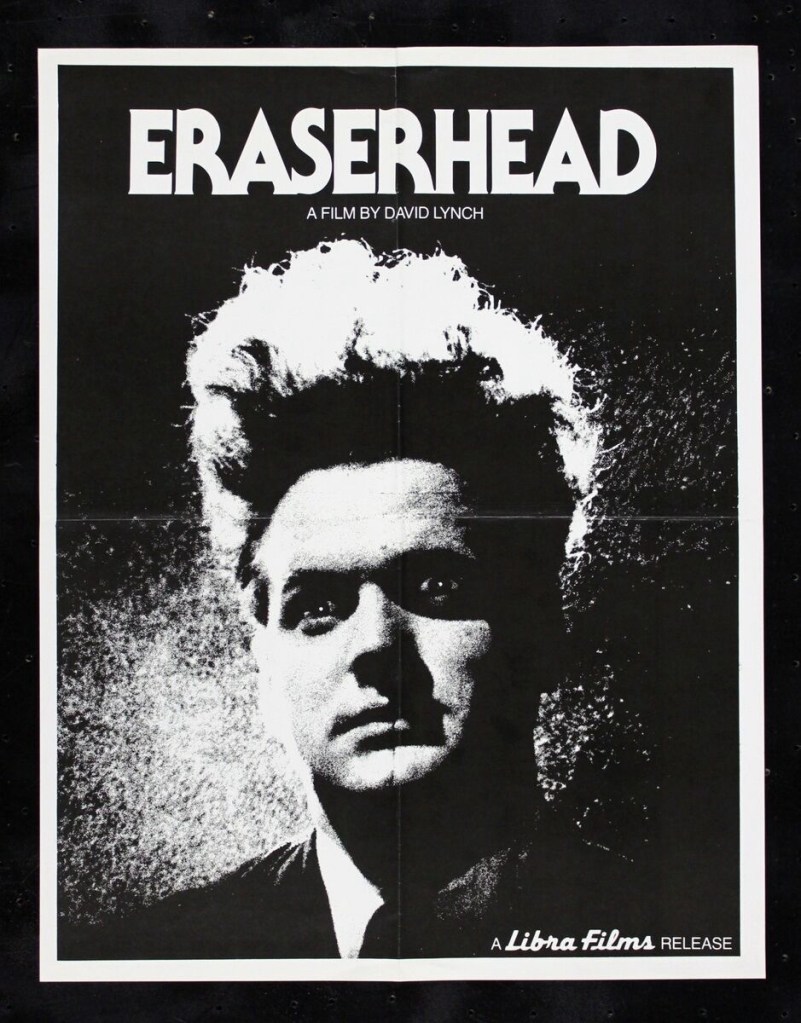
David Lynch’s Eraserhead (1977) stands as a radical work that reimagined the possibilities of cinema, tying together the evolution of visual storytelling that began with Eadweard Muybridge’s motion studies, Fritz Lang’s M, and Walt Disney’s Pinocchio. To understand Eraserhead’s innovations and its connection to this cinematic lineage, it’s essential to consider Lynch’s formative years as an artist, his experimental approach to filmmaking, and his deep engagement with the surreal and the psychological.
David Lynch: From Art Student to Visionary Filmmaker
Lynch began his creative journey as a painter, studying at the Pennsylvania Academy of Fine Arts, where he was profoundly influenced by the dark, visceral imagery of Francis Bacon. Bacon’s distorted figures and unsettling emotional landscapes left a lasting mark on Lynch, inspiring him to explore the boundaries of visual representation and the subconscious in his work.
While at art school, Lynch began experimenting with moving images, creating short films like Six Men Getting Sick (1967) and The Alphabet (1968). These films blended animation, live action, and sound to create surreal, nightmarish sequences that foreshadowed his later work. His fascination with the interplay of motion and emotion echoes Muybridge’s exploration of kinetic movement and Disney’s ability to infuse motion with meaning.
Lynch’s experimental work earned him a scholarship to the American Film Institute (AFI), where he began work on his first feature film, Eraserhead. The making of the film was itself a radical artistic act. Shot over several years with minimal resources, Eraserhead was a deeply personal project that Lynch meticulously crafted, blending his painterly sensibilities with his cinematic vision. The film’s haunting imagery, oppressive sound design, and elliptical narrative reflect Lynch’s singular approach to storytelling, combining surrealism with psychological and societal critique.
Eraserhead and the Evolution of Cinema
Eraserhead represents a culmination of cinematic innovations that began with Muybridge, were expanded by Lang, and reached new creative heights with Disney, all reimagined through David Lynch’s distinctive artistic lens. Each of these influences contributes to Lynch’s unsettling masterpiece in profound ways.
Lynch’s fragmented and disjointed approach to motion recalls Muybridge’s early studies of movement. The jerky physicality of the characters, the mechanical rhythms of the industrial setting, and the surreal pacing deconstruct natural motion, making it feel alien and deeply unsettling. This experimental treatment of movement serves to heighten the psychological unease that permeates the film, aligning Lynch’s work with Muybridge’s early exploration of human and mechanical motion.
The oppressive soundscape of Eraserhead draws heavily from the innovations of Fritz Lang’s M. Just as Lang used sound to create tension and expose societal failure, Lynch employs industrial noises and eerie, ambient sound to evoke a sense of alienation and anxiety. The relentless hums and mechanical roars mirror the psychological toll of living in a dehumanizing, uncaring environment. Lynch, like Lang, critiques societal breakdown, reflecting the alienation of individuals trapped within larger, failing systems.
Finally, Lynch’s symbolic storytelling connects to the tradition established by Disney, particularly in films like Pinocchio. While Disney explored moral growth and psychological transformation through animation, Lynch delves into existential dread and subconscious fears through surreal imagery. The mutant child at the center of Eraserhead, like Pinocchio’s transformation into a donkey, operates as a metaphor—this time for parental anxiety, guilt, and the crushing weight of responsibility. While Lynch’s tone is darker and more introspective, his ability to weave emotional resonance into symbolic narratives reflects Disney’s influence, though reinterpreted through a lens of existential horror.
By synthesizing these diverse cinematic traditions, Lynch crafts a film that is at once experimental and emotionally profound, carrying forward the innovations of his predecessors while charting entirely new territory.
From Pinocchio to Eraserhead: The Expanded Language of Cinema
The lineage from Muybridge to Disney to Lynch highlights cinema’s evolution into a medium capable of exploring not just motion and morality but also the deepest recesses of the human psyche. Muybridge laid the technical foundation, Disney expanded its emotional and symbolic potential, and Lynch shattered traditional boundaries, using cinema to explore existential fears and surrealist imagery.
Where Pinocchio used animation to guide children through moral dilemmas, Eraserhead uses its experimental form to confront adult fears—of parenthood, alienation, and mortality. Both films, however, share a commitment to pushing the medium of cinema beyond its surface entertainment value, making it a tool for profound emotional and philosophical inquiry. Lynch’s work, like Muybridge’s and Disney’s before him, redefines what cinema can achieve, expanding its potential for creativity, symbolism, and sociological engagement.
The Event
David Lynch’s Eraserhead (1977) is a singular event in the history of cinema because it redefined the boundaries of narrative, sound, and visual storytelling. It emerged as an uncompromising work of personal vision, blending surrealism, experimental techniques, and profound psychological depth in ways that were virtually unprecedented in mainstream or avant-garde cinema. Its uniqueness lies in its radical form, thematic daring, and the cultural and artistic context in which it was made.
A Radical Vision: The Birth of a Personal Language
Lynch used Eraserhead to create a cinematic language entirely his own. The film eschews traditional narrative coherence, opting instead for an associative, dreamlike structure that mirrors the inner workings of the subconscious. It tells the story of Henry Spencer, a man trapped in a decaying industrial world, grappling with fears of parenthood and existential dread. But the “story” is secondary to the atmosphere, symbolism, and emotion, making the film more experiential than plot-driven.
This radical departure from traditional storytelling aligns Eraserhead with other art forms—painting, surrealist literature, and experimental music—while still being unmistakably cinematic. Lynch’s use of recurring motifs (industrial machinery, deformity, organic decay) creates a symbolic universe that is both intensely personal and universally resonant.
Sound: A Revolutionary Approach
One of Eraserhead’s most groundbreaking aspects is its sound design, which Lynch developed with Alan Splet. Rather than merely supporting the visuals, the sound in Eraserhead becomes a character in its own right, enveloping the viewer in an oppressive, industrial hum that mirrors the protagonist’s psychological state.
This revolutionary use of sound influenced generations of filmmakers. The droning, non-diegetic noises blur the line between external reality and inner anxiety, creating an aural experience that hadn’t been seen (or heard) before in cinema. It is a precursor to modern sound-driven psychological horror, from The Shining to Under the Skin.
Visual Aesthetic: The Cinema of the Grotesque
Visually, Eraserhead is meticulously crafted. Its stark black-and-white cinematography evokes the chiaroscuro of German Expressionism, while its grotesque imagery recalls the surrealist works of artists like Salvador Dalí and Francis Bacon. The deformed “baby” that lies at the heart of the film is both a physical object of horror and a metaphor for parental anxiety and societal decay.
Lynch’s painterly background is evident in every frame, with his compositions conveying isolation, dread, and beauty in equal measure. The visuals work in tandem with the sound to create a world that feels simultaneously hyper-real and completely alien, solidifying Eraserhead’s status as a wholly unique cinematic experience.
Themes: Existential Horror and Subconscious Fears
Eraserhead delves into themes rarely explored so viscerally in film—existential dread, bodily horror, and the anxieties of modernity. At its core, it examines the terror of parenthood, the overwhelming responsibilities of care, and the alienation of life in an industrialized world.
Lynch’s ability to externalize these fears through surreal and grotesque imagery makes the film feel like a universal nightmare. The symbolism of the deformed baby, the barren industrial landscape, and the ambiguous ending invites interpretation, ensuring that Eraserhead remains relevant and thought-provoking across generations.

Cultural Context: A Triumph of Artistic Independence
The making of Eraserhead is itself part of its uniqueness. Lynch spent years creating the film on a shoestring budget, supported by the American Film Institute (AFI) and a small, dedicated team. The slow, meticulous production process mirrors Lynch’s obsessive attention to detail and unyielding commitment to his vision.
At a time when Hollywood was transitioning into blockbuster cinema with films like Star Wars (1977), Eraserhead stood out as a defiant act of artistic independence. Its success on the midnight movie circuit signaled that audiences were hungry for unconventional, challenging films, paving the way for future independent and experimental cinema.
Influence: A Cultural Ripple Effect
Despite its initial obscurity, Eraserhead became a touchstone for filmmakers and artists who saw it as proof that cinema could be deeply personal and profoundly experimental. Directors like Stanley Kubrick, the Coen Brothers, and Ari Aster have cited Lynch’s debut as an influence. Kubrick reportedly showed Eraserhead to the cast and crew of The Shining as a tonal reference, emphasizing its power to evoke dread and unease.
Why Eraserhead Is Singular
Unlike any film before it, Eraserhead exists at the crossroads of cinema, painting, sound art, and surrealism. Its singularity lies in its refusal to adhere to established norms, its creation of a wholly unique and immersive world, and its pioneering use of sound and imagery to evoke psychological terror. It is a film that doesn’t merely tell a story but transforms the medium into an emotional, sensory, and philosophical experience. Eraserhead continues to stand alone as a testament to the unbounded potential of cinema as an art form.
New Possibilities
David Lynch’s Eraserhead (1977) takes cinema’s capacity to reimagine reality and further expands its possibilities by completely untethering the medium from conventional narrative, visual, and auditory norms. Lynch’s debut goes beyond merely representing reality or interpreting it symbolically; it creates an entirely self-contained, surreal universe that engages audiences on intellectual, emotional, and moral levels through its visceral atmosphere, experimental techniques, and deeply personal themes.
Breaking Free of Narrative Conventions
While many films use narrative to guide audiences through a clear sequence of events, Eraserhead rejects traditional story structure in favor of a dreamlike, associative flow. Lynch crafts a narrative that reflects internal psychological states rather than external realities.
This approach invites viewers to interpret the film as they would a piece of abstract art, expanding cinema’s potential as a medium for personal and subconscious expression. By prioritizing mood, symbolism, and texture over plot, Lynch demonstrates that a film doesn’t need to follow linear storytelling to resonate deeply with audiences.
Redefining Sound as a Cinematic Tool
Eraserhead revolutionized the role of sound in film, elevating it from a supportive element to an integral part of the storytelling experience. The oppressive industrial hums, distorted mechanical noises, and eerie silences in the film are not just background effects but active participants in building the emotional and psychological landscape.
This radical use of sound creates an atmosphere of existential dread that immerses viewers in Henry Spencer’s disjointed reality. By doing so, Lynch expanded the boundaries of how sound could be used to communicate emotion and meaning in cinema, influencing countless filmmakers who sought to experiment with auditory design.
Visualizing the Subconscious
Lynch’s painterly background is evident in the film’s meticulous black-and-white cinematography, where every frame is composed to evoke a specific mood or sensation. The grotesque baby, barren industrial wastelands, and surreal domestic spaces serve as visual representations of subconscious fears and anxieties, particularly surrounding parenthood, alienation, and societal decay.
Through these nightmarish images, Lynch shows that cinema can operate as a direct window into the human psyche, bypassing traditional realism to engage with audiences on a more primal, instinctual level. This approach significantly expands cinema’s potential as a medium for exploring psychological and emotional depths.
Thematic Exploration of Existential and Moral Questions
Whereas earlier films like Fritz Lang’s M used sound and visuals to interrogate sociological questions like crime and justice, Eraserhead turns inward, exploring deeply personal and existential fears. Henry’s journey speaks to universal anxieties about responsibility, isolation, and the unknown.
The grotesque and surreal imagery invites moral and philosophical reflection, challenging viewers to confront uncomfortable truths about the human condition. This thematic openness allows Eraserhead to engage with audiences in a way that is both universal and deeply personal, proving that cinema can tackle moral and existential questions without adhering to traditional forms.
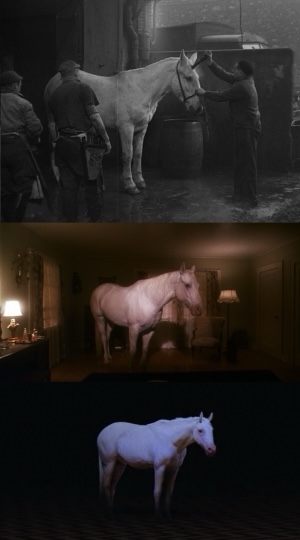
Elevating Cinema as Personal Art
Eraserhead redefined the idea of cinema as an auteur-driven medium. Lynch’s meticulous, handcrafted approach—writing, directing, and even designing aspects of the film’s sets and effects—created a deeply personal work that resonates with authenticity and artistic integrity.
This focus on personal vision proved that cinema could be more than collaborative storytelling; it could be a singular artistic statement, as unique as a painting or a poem. By doing so, Lynch opened the door for other filmmakers to embrace their personal vision, inspiring a wave of experimental and independent cinema.
Cinema as Experience, Not Just Storytelling
Most films aim to tell a story or deliver a message. Eraserhead instead offers an experience. Its deliberate pacing, surreal imagery, and oppressive soundscape create a sensory and emotional immersion that forces viewers to engage with the film on multiple levels simultaneously.
Lynch demonstrates that cinema can be a visceral, multi-sensory experience rather than just a medium for storytelling. This experiential quality has had a lasting impact, influencing filmmakers like Stanley Kubrick, the Coen Brothers, and Darren Aronofsky, who have similarly sought to create films that immerse audiences in unique emotional and intellectual states.
Expanding the Realm of Possibilities
Eraserhead serves as a profound example of cinema unbounded, transforming the medium into a powerful tool for exploring the subconscious, creating immersive realities, and addressing universal fears and moral dilemmas. Through its symbolic imagery and nonlinear narrative, the film delves deeply into the hidden recesses of the human psyche, uncovering anxieties and desires that often remain unspoken. Lynch crafts a surreal, otherworldly environment that challenges conventional perceptions of reality, immersing audiences in a disorienting yet profoundly emotional experience.
By embracing surrealism and redefining both sound and visual design, Lynch turned cinema into a deeply personal and experiential art form. The film transcends traditional storytelling, using its experimental language to evoke existential dread and timeless questions about responsibility, alienation, and the fragility of human connection.
With Eraserhead, Lynch expanded the possibilities of film, demonstrating that cinema is not merely a tool for representing reality but a medium for reimagining it. His groundbreaking work continues to inspire filmmakers, artists, and audiences, pushing the boundaries of the medium and opening doors to new realms of creativity and exploration.
Disney and Lynch
The connection between Walt Disney and David Lynch may initially seem tenuous, given their vastly different styles and thematic focuses, but both are pioneers who expanded the possibilities of cinema by creating immersive, meticulously crafted worlds that blend fantasy and reality. Each redefined the language of film, engaging audiences on intellectual, emotional, and moral levels through their unique approaches to storytelling, sound, and visual design.
1. World-Building and Escapism
Disney and Lynch share a profound dedication to world-building, creating immersive, self-contained universes that transport audiences into the depths of their imaginations.
In Disney’s films like Pinocchio and Fantasia, animation becomes a tool for constructing fantastical landscapes that serve as metaphors for moral lessons and psychological truths. Disney used the limitless potential of animation to blur the line between fantasy and reality, crafting worlds of magic, danger, and redemption that captivate and teach. His creations invite viewers into spaces where external adventures mirror internal struggles, fostering deep emotional and moral engagement.
Similarly, Lynch’s Eraserhead builds a surreal, nightmarish industrial world that feels both alien and unsettlingly familiar. Lynch uses the cinematic medium to transport audiences into a psychological realm where external reality and internal fears converge. His world, like Disney’s, functions as a mirror, reflecting universal anxieties and existential questions.
Both artists invite audiences to escape into their imagined worlds, but their ultimate aim transcends escapism. Instead, they use their meticulously crafted universes to confront fundamental emotions, fears, and truths about the human condition, demonstrating the power of cinematic storytelling to resonate on the deepest levels.
2. The Symbolism of Innocence and Fear
A central theme in both Disney’s and Lynch’s work is the interplay of innocence and fear, often explored through vulnerable protagonists navigating hostile and unpredictable worlds.
In Pinocchio, Disney examines the dangers children face, such as temptation, exploitation, and moral failure. Pinocchio’s journey is a fable of growing up, charting his struggle with responsibility and self-discovery. The story highlights how innocence, while precious, leaves one susceptible to corruption and harm, with redemption hinging on courage and moral growth.
In Eraserhead, Lynch similarly explores themes of innocence under threat, using the haunting image of the deformed baby to evoke deep fears about vulnerability and helplessness. Henry’s struggle with parenthood, alienation, and the crushing weight of responsibility reflects darker, existential anxieties. The grotesque juxtaposition of innocence and fear underscores the fragility of human connections in an uncaring world.
Both filmmakers use their respective mediums—animation and surrealist cinema—to delve into how innocence is both cherished and endangered. Their works reveal the universal tension between the idealized purity of innocence and the harsh realities that threaten it, resonating with audiences on emotional and existential levels.
3. Sound and Atmosphere
Disney and Lynch both revolutionized the use of sound in their respective mediums, employing it as a powerful tool to create mood and deepen storytelling.
Disney’s innovation began with synchronized sound in Steamboat Willie, where sound effects and music were perfectly timed to enhance character actions and humor. This approach evolved into the groundbreaking score of Fantasia, where music became the driving narrative force, evoking wonder, emotion, and awe. For Disney, sound was integral to immersing audiences in the magic and emotional depth of his animated worlds, making it a cornerstone of his storytelling craft.
Lynch, in Eraserhead, takes sound to a different level of immersion, using it to evoke unease and disorientation. The film’s industrial hums, mechanical clanks, and eerie silences are not merely atmospheric but central to its narrative, heightening the tension and alienation of its surreal world. Lynch’s use of sound mirrors Disney’s in its meticulous construction and emotional resonance, but whereas Disney’s soundscapes inspire wonder and joy, Lynch’s evoke dread and existential unease.
Both filmmakers understood the transformative power of sound, using it to transport audiences into their meticulously crafted universes. Whether creating magic or amplifying tension, Disney and Lynch demonstrated that sound is not an accessory to storytelling but an essential part of its emotional and psychological impact.
4. Universal Themes Through Surrealism
Both Disney and Lynch harness the power of surrealism to explore universal themes, though their approaches and tones differ significantly.
Disney’s surrealism often manifests in sequences like Pinocchio’s transformation into a donkey or the dreamscapes of Fantasia. These moments externalize inner struggles and moral dilemmas, using fantastical imagery to make abstract ideas tangible and emotionally resonant. Disney’s surrealism, while vivid and otherworldly, feels authentic and accessible, serving as a teaching tool for children to grapple with themes of responsibility, growth, and morality.
Lynch’s surrealism, on the other hand, is darker and more ambiguous. In Eraserhead, the grotesque baby serves as a haunting symbol of parental anxiety, guilt, and existential dread. His surreal imagery forces audiences to confront deeply buried fears and unresolved emotions, challenging them to engage with the subconscious in ways that can be unsettling and profound.
Both filmmakers demonstrate how surrealism transcends the limits of realism, providing a language to express complex human emotions and internal conflicts. Whether inspiring wonder or unease, their work highlights the power of the fantastical to illuminate the most universal aspects of the human experience.
5. Artistic Integrity and Unbounded Creativity
Disney and Lynch are united by their unwavering artistic integrity and their bold commitment to pushing the boundaries of their medium, each revolutionizing cinema in their own way.
Disney transformed animation into a groundbreaking art form, introducing revolutionary techniques like the multiplane camera and producing feature-length animated films that redefined the scope and ambition of storytelling. His meticulous attention to craft and relentless pursuit of innovation forever altered the cinematic landscape, proving animation could achieve emotional depth and narrative complexity on par with live-action cinema.
Lynch, with Eraserhead, redefined independent filmmaking. His uncompromising dedication to his vision and meticulous involvement in every aspect of production—from haunting soundscapes to intricate set design—established him as a leading figure in auteur cinema. Lynch’s work exemplifies how deeply personal storytelling can resonate with universal themes, challenging conventional cinematic norms.
Both artists demonstrate how unbounded creativity elevates cinema into a medium capable of profound artistic expression. Their work reflects a shared belief in the transformative power of storytelling to engage audiences on intellectual, emotional, and moral levels, cementing their legacies as pioneers in their respective domains.
6. The Psychology of Childhood and Adulthood
Disney and Lynch both delve into the transition between childhood and adulthood, examining the fears, challenges, and responsibilities that shape this universal journey, albeit from contrasting perspectives.
In Pinocchio, Disney explores the child’s path to maturity, focusing on how a young protagonist learns to navigate moral choices, overcome naivety, and embrace responsibility. The story captures the trials of growing up, emphasizing the importance of self-awareness, discipline, and courage in the face of life’s temptations and dangers.
In Eraserhead, Lynch approaches these themes from the adult’s perspective, presenting the overwhelming fears and anxieties of parenthood, societal alienation, and personal responsibility. The surreal and unsettling imagery externalizes the protagonist’s internal struggles, offering a darker, more existential view of the burdens that come with adulthood.
Both filmmakers use cinema to explore these profound transitions, engaging audiences of all ages with narratives that reflect shared human experiences. While their approaches differ—one fantastical and didactic, the other surreal and introspective—Disney and Lynch highlight how the journey between innocence and maturity defines us all, making their work timeless and deeply resonant.
Though their aesthetics and tones are worlds apart, Disney and Lynch share a commitment to expanding cinema’s potential to explore universal emotions and themes. By creating immersive worlds that engage with innocence, fear, and morality, they demonstrate the power of cinema not just to represent reality, but to reimagine it. Disney’s innovations in animation and Lynch’s groundbreaking work in experimental film both push the boundaries of the medium, proving that film can simultaneously be a deeply personal art form and a universally resonant experience.
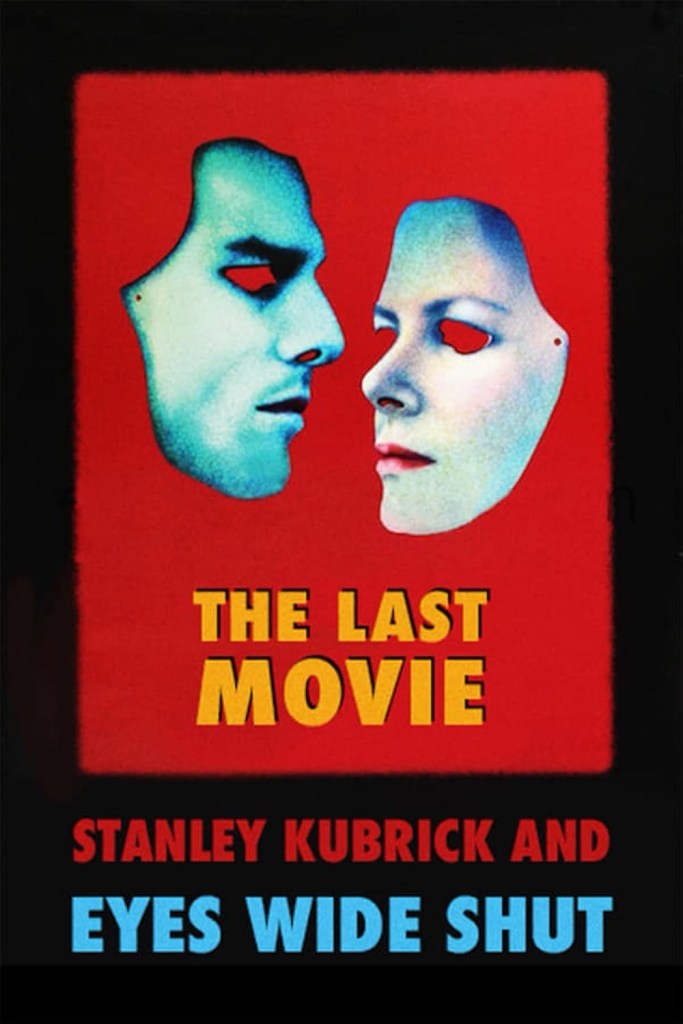
Cinema’s journey from its inception to the turn of the 21st century is a story of continuous evolution, blending technological innovation, artistic experimentation, and global cultural exchange. The silent era, spanning the late 19th and early 20th centuries, marked the birth of motion pictures. Early pioneers like the Lumière brothers and Georges Méliès laid the groundwork for the medium, with Méliès introducing fantastical storytelling and visual effects in films like A Trip to the Moon (1902). In the United States, D.W. Griffith’s The Birth of a Nation (1915) revolutionized cinematic storytelling through advanced techniques like cross-cutting, while comedic legends like Charlie Chaplin and Buster Keaton brought humor and emotional depth to silent films. Meanwhile, international movements like German Expressionism, exemplified by The Cabinet of Dr. Caligari (1920), pushed cinema into new realms of stylized visual storytelling.
The introduction of synchronized sound in the late 1920s transformed cinema forever. With the release of The Jazz Singer (1927), Hollywood entered the Golden Age, where sound enriched storytelling and opened new creative avenues. Major studios like MGM and Warner Bros. dominated the industry, producing classics in genres such as musicals, screwball comedies, and film noir. Iconic films like The Wizard of Oz (1939) and Casablanca (1942) emerged during this period, establishing Hollywood as a global cultural force. Outside Hollywood, European filmmakers experimented with their own cinematic traditions. French Poetic Realism, exemplified by La Grande Illusion (1937), offered poignant reflections on human struggles, while directors like Akira Kurosawa in Japan began to rise with works such as Sanshiro Sugata (1943).
Post-World War II cinema reflected the changing global landscape. In Hollywood, the decline of the studio system allowed independent productions to flourish, while themes of alienation and societal change became prevalent in films like Rebel Without a Cause (1955). Technological innovations, such as Cinemascope and Technicolor, enhanced the cinematic experience, attracting audiences back to theaters in the face of competition from television. Globally, cinema underwent a renaissance, with movements like Italian Neorealism focusing on the struggles of everyday life in films like Bicycle Thieves (1948). Japan’s Golden Age saw masterpieces like Kurosawa’s Seven Samurai (1954) and Yasujiro Ozu’s Tokyo Story (1953), while the French New Wave, led by filmmakers like Jean-Luc Godard and François Truffaut, rejected traditional filmmaking conventions, producing groundbreaking works such as Breathless (1960). Across the globe, auteurs like Ingmar Bergman, Federico Fellini, and Andrei Tarkovsky elevated cinema to an art form that could explore deep psychological and philosophical themes.
The 1970s ushered in a new era of filmmaking with the rise of New Hollywood. Young directors like Martin Scorsese, Steven Spielberg, and Francis Ford Coppola reinvigorated American cinema, blending artistic ambition with commercial success. Films like The Godfather (1972) and Taxi Driver (1976) tackled complex themes and moral ambiguity, resonating with audiences seeking stories that reflected the turbulent times. This period also saw the emergence of the modern blockbuster. Spielberg’s Jaws (1975) introduced the concept of high-concept filmmaking with nationwide marketing campaigns, while George Lucas’s Star Wars (1977) set new standards for special effects and franchise filmmaking. Concurrently, world cinema continued to flourish. German New Wave directors like Wim Wenders explored existential themes, while Iranian filmmakers like Abbas Kiarostami gained global recognition.
By the 1990s, cinema had entered the digital age, transforming both its artistry and accessibility. Hollywood continued to dominate with blockbusters like Jurassic Park (1993) and Titanic (1997), but independent filmmakers such as Quentin Tarantino and the Coen Brothers brought fresh perspectives to the mainstream. Animation, too, underwent a revolution, with films like The Lion King (1994) and Pixar’s Toy Story (1995) showcasing the potential of computer-generated imagery. Globally, Asian cinema gained prominence, with Hong Kong’s action films and Japanese anime captivating international audiences. The Iranian New Wave continued to produce groundbreaking works, while filmmakers like Wong Kar-wai redefined cinematic storytelling with their innovative use of visuals and mood.
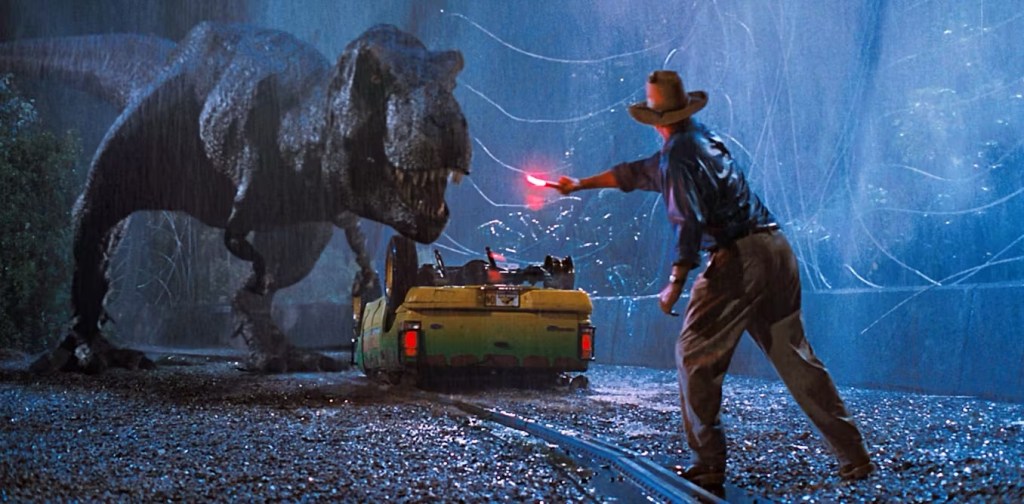
Throughout the 20th century, cinema evolved from silent experiments to a global art form capable of representing and reimagining the human experience. With the advent of digital technology, the possibilities for storytelling expanded exponentially, setting the stage for the 21st century and further cementing cinema’s role as a powerful cultural force.
The cinematic journey, from its inception in the silent era to the revolutionary digital age, can be seen as a trajectory culminating in Stanley Kubrick’s Eyes Wide Shut (1999). This film represents the pinnacle of cinema’s ability to merge technical mastery, narrative ambition, and thematic depth. Kubrick’s final work embodies the medium’s evolution as an art form that transcends mere representation of reality, reimagining it to explore the most profound aspects of human existence—identity, desire, morality, and the masks we wear in society.
The Silent Era to Kubrick’s Precision
Cinema began with silent films, where pioneers like Eadweard Muybridge, Georges Méliès, and D.W. Griffith experimented with visual storytelling and narrative structure. These innovations laid the groundwork for Kubrick’s meticulous visual style. Just as German Expressionism used stylized sets and lighting to delve into psychological landscapes, Kubrick’s controlled compositions and lighting in Eyes Wide Shut evoke a dreamlike atmosphere that mirrors the inner turmoil of his characters.
Sound and Storytelling
The introduction of synchronized sound brought depth and complexity to storytelling. Kubrick, known for his innovative use of soundtracks, carried this tradition forward. In Eyes Wide Shut, the music—particularly the haunting repetition of Ligeti’s “Musica Ricercata II”—echoes the suspense and disorientation of the protagonist’s journey. This interplay of sound and image, perfected over decades of cinematic advancement, heightens the film’s hypnotic and unsettling quality.
World Cinema and Psychological Exploration
The global evolution of cinema, from Italian Neorealism to the French New Wave, introduced a focus on human experience and existential questions. Kubrick’s films, particularly Eyes Wide Shut, echo these traditions. The film’s exploration of marriage, fidelity, and suppressed desires connects to the introspective storytelling of directors like Ingmar Bergman and Michelangelo Antonioni. The dreamlike structure and open-ended interpretation recall the surrealism of Luis Buñuel, whose films challenged conventional narratives to reveal deeper truths about human nature.
The Blockbuster Era and Kubrick’s Subversion
While the blockbuster era brought spectacle and commercial appeal to cinema, Kubrick often worked in opposition to these trends. Even as audiences in the 1990s gravitated toward CGI-driven epics like Jurassic Park and Titanic, Kubrick chose to craft a deeply intimate, almost theatrical drama with Eyes Wide Shut. The film, however, retains the grandeur of a cinematic event—its intricate production design, hypnotic pacing, and enigmatic story elevate it beyond a traditional drama, aligning it with the ambitious spectacle of earlier cinematic milestones.
Themes of Masks and Identity
From The Cabinet of Dr. Caligari to Eyes Wide Shut, cinema has explored themes of identity, societal roles, and the masks we wear. Kubrick’s film uses this rich cinematic history to probe deeper into these ideas. The secretive rituals, masks, and dreamlike sequences recall the ways in which filmmakers like Fritz Lang (M) used visual storytelling to critique societal constructs and hidden dangers. Kubrick pushes this further, presenting a world where reality and fantasy blur, forcing his characters—and the audience—to question the nature of truth and authenticity.
Eyes Wide Shut as the Culmination of Cinema
Eyes Wide Shut synthesizes over a century of cinematic advancements into a singular experience. Its visual precision owes much to early silent innovators and the psychological depth of world cinema auteurs. Its exploration of morality, identity, and suppressed human desires speaks to the existential themes explored throughout cinema’s history. Kubrick’s control over every aspect of the film—from the dreamlike pacing to the layered performances by Tom Cruise and Nicole Kidman—reflects the unbounded potential of cinema as an art form.
In many ways, Eyes Wide Shut serves as both an endpoint and a new beginning. It encapsulates the medium’s ability to question the very nature of reality and human existence, much like Eraserhead reimagined the possibilities of surrealism or Pinocchio captured the innocence and darkness of human experience. By bridging the intellectual rigor of art cinema with the immersive qualities of Hollywood spectacle, Kubrick’s final masterpiece demonstrates that cinema is not just a mirror of life but a means of reimagining its deepest mysteries.
Kubrick’s opus stands as a testament to cinema’s unending evolution, drawing from its origins and pointing toward its boundless future.
The journey from Eadweard Muybridge’s photographic experiments to Stanley Kubrick’s Eyes Wide Shut is a profound exploration of cinema’s evolution as a medium that unites visual art, narrative depth, and philosophical inquiry. This thread connects early technological innovation, moral storytelling, and psychological exploration across decades, culminating in Kubrick’s enigmatic masterpiece.

Muybridge and the Origins of Visual Narrative
Eadweard Muybridge’s late 19th-century motion studies introduced the idea of capturing kinetic movement, fragmenting time into discrete, observable moments. His work bridged art and science, offering a new way to perceive reality. Muybridge’s sequential photographs are not merely technical achievements but philosophical meditations on the unseen rhythms of life, laying the groundwork for cinema’s capacity to depict—and question—reality. Kubrick, who began his career as a photojournalist, was deeply engaged with photography’s ability to frame, isolate, and expose layers of truth. This meticulous approach to image-making is evident in Eyes Wide Shut, where every frame is composed with photographic precision, capturing both the surface opulence and the underlying dread of its characters’ world.
M and the Cinematic Exploration of Criminology
In Fritz Lang’s M (1931), cinema expanded into the realm of sociological and psychological inquiry. Lang’s story of a serial child murderer delved into criminology, exploring the moral decay of a society unable to protect its most vulnerable. This theme of societal corruption resonates through Kubrick’s Eyes Wide Shut. Just as M portrayed the collective guilt and complicit blindness of a community, Kubrick’s film examines a morally degraded elite class, engaging in ritualistic excess while perpetuating a façade of respectability. The pervasive tension in Eyes Wide Shut mirrors Lang’s use of dread and ambiguity, positioning the protagonist as an outsider confronting an enigmatic and dangerous world.
Pinocchio and the Dangers Facing Innocence
Disney’s Pinocchio (1940) brought the dangers of moral corruption into the realm of children’s storytelling, warning of the temptations that lead astray and the perilous consequences of chasing hedonistic pleasures. The island of lost boys, where indulgence turns children into literal beasts, finds a chilling echo in Eyes Wide Shut. The elite’s masked rituals in Kubrick’s film are a grotesque extrapolation of this theme—a hidden society lured into depravity by unbounded pleasure-seeking. Just as Pinocchio warns of innocence corrupted, Eyes Wide Shut offers a dark meditation on a world where moral anchors are eroded, leaving individuals adrift in a sea of danger and temptation.
Eraserhead and the Ineffable Dread
David Lynch’s Eraserhead (1977) represents a radical expansion of cinema’s ability to convey psychological and existential dread. Its surreal imagery and oppressive soundscapes create a world where the ordinary is rendered uncanny and reality feels unfathomable. Kubrick’s Eyes Wide Shut echoes this atmosphere of ineffable unease. As Dr. Bill Harford navigates a labyrinthine series of events, from strange encounters on New York streets to the terrifyingly cryptic masked ritual, he is plunged into a world where surface appearances conceal inscrutable dangers. Like Lynch, Kubrick crafts an emotional and intellectual experience that transcends narrative, inviting audiences into a space where dread and ambiguity dominate.
Kubrick, Photography, and the Cinematic Sublime
Kubrick’s engagement with photography deeply informs Eyes Wide Shut. His early career sharpened his eye for detail, light, and composition, which later translated into his cinematic mastery. In Eyes Wide Shut, Kubrick uses meticulously framed shots and carefully controlled lighting to create an atmosphere of both beauty and menace. The soft glow of Christmas lights contrasts with the shadowy figures and ominous settings, reflecting the tension between the ordinary and the extraordinary. This visual duality underscores the protagonist’s journey into a world where moral degradation hides beneath a veneer of civility and glamour.
Eyes Wide Shut: Criminology, Morality, and the Dangerous Unknown
At its core, Eyes Wide Shut is a study of moral degradation in a society chasing after pleasure, wealth, and power. Dr. Bill Harford’s journey begins as a personal crisis but soon transforms into an unsettling odyssey through a morally bankrupt world. As he infiltrates the secret rituals of the elite, he becomes an unwitting observer of societal corruption, criminality, and existential danger. Like Lang’s M, the film raises questions about collective guilt, societal complicity, and the hidden mechanisms of power that allow such depravity to flourish.
Kubrick also engages with the theme of criminology on a psychological level. Bill’s initial arrogance and naivety gradually dissolve as he confronts the dangerous and opaque forces around him. The film leaves these forces deliberately ineffable—what Bill encounters is less a concrete conspiracy than a profound sense of human fallibility and moral collapse. In doing so, Kubrick evokes the dread of Lynch’s Eraserhead and the moral warnings of Pinocchio, creating a cinematic experience that is both specific and universal.
The Ineffable and Cinema’s Evolution
From Muybridge’s first motion studies to Kubrick’s final film, cinema has evolved not just as a medium for storytelling but as a means of probing the ineffable aspects of human existence. Kubrick’s Eyes Wide Shut synthesizes these advancements, blending the psychological depth of M, the moral allegory of Pinocchio, and the existential dread of Eraserhead into a singular work of art. It represents a culmination of cinema’s potential to engage audiences on intellectual, emotional, and moral levels, leaving them, like Bill Harford, to confront the mysteries and dangers of an unfathomable world.
Stanley Kubrick’s Eyes Wide Shut is a masterclass in cinematic language, transforming a seemingly straightforward narrative into a layered exploration of the subconscious, identity, and moral decay. Through meticulous attention to visual detail, symbolic imagery, and psychological motifs, Kubrick employs techniques rooted in Freudian psychoanalysis—particularly the concepts in The Interpretation of Dreams—to create a dreamlike world that operates on multiple levels of meaning.
The Dream Logic of Freud’s Dream-Works
Freud’s The Interpretation of Dreams describes mechanisms such as displacement, condensation, and symbolism as central to how the subconscious processes and expresses desires, fears, and repressed emotions. Kubrick uses these principles to construct the cinematic world of Eyes Wide Shut.
The film’s narrative structure mirrors the disjointed, surreal flow of dreams. Sequences unfold with an unsettling lack of causality or explanation, creating a sense of unreality. For example, Dr. Bill Harford’s encounters—whether with the grieving daughter, the sex worker Domino, or the cultic orgy—feel simultaneously random and inevitable, much like the episodic unfolding of a dream. The film’s use of recurring motifs, such as masks, keys, and reflections, condenses complex ideas into visual symbols, making the story resonate on a subconscious level.
The Use of Doubles
Kubrick integrates the Freudian concept of the “double” to examine identity and moral ambiguity in Eyes Wide Shut. Bill and his wife Alice function as mirrors for one another, each wrestling with their own suppressed desires and fantasies. Alice’s confession of a sexual fantasy destabilizes Bill’s sense of control and masculinity, triggering his descent into a shadowy, dreamlike underworld. Along the way, Bill encounters figures who act as doubles for himself or Alice, embodying their internal conflicts and unspoken fears.
Domino, the sex worker, reflects Alice’s hidden sexual agency and Bill’s latent infidelity. The masked women at the secret ritual embody Alice’s symbolic confession and expose Bill’s insecurities surrounding desire and power. The costume shop owner and his daughter echo Bill’s relationship with Alice, offering a distorted view of control, temptation, and moral compromise.
Through these doubles, Kubrick deepens the psychological complexity of the characters and blurs the boundaries between reality and fantasy. Bill’s encounters with these figures feel dreamlike, as though he is confronting fragmented, distorted versions of himself and his wife. These mirror images amplify the film’s exploration of identity, sexuality, and the unstable nature of human desire.
Hidden Symbols and Visual Storytelling
Kubrick’s meticulous attention to symbolic detail infuses Eyes Wide Shut with layers of meaning, inviting close analysis and interpretation. Masks play a central role, particularly in the orgy sequence, symbolizing the duality of identity—the division between public personas and private, hidden desires. This motif extends beyond the ritual, highlighting how societal expectations and personal secrets mask the true selves of the characters. The masks also echo Freudian ideas of repression, concealing deeper impulses beneath a veneer of decorum.
Mirrors and reflections are another recurring symbol, emphasizing themes of self-examination and distorted perception. Bill frequently encounters his reflection, suggesting an ongoing confrontation with his shifting sense of identity. Alice’s confession of her sexual fantasy unfolds in front of a mirror, reinforcing the idea of duality and self-reckoning. These reflective surfaces hint at the layers of reality and illusion that define the characters’ lives.
The omnipresent glow of Christmas lights adds yet another layer of symbolism, creating an atmosphere of artificial warmth and festivity. This visual motif contrasts sharply with the cold, sinister currents running beneath the narrative, acting as a metaphor for the illusions and façades of happiness that the characters cling to. Together, these symbolic details weave a rich tapestry of meaning, enhancing the film’s exploration of identity, desire, and deception.
Color and Lighting as Emotional Signifiers
Kubrick’s use of color and lighting is deliberate and psychological. The warm, golden hues of the Harfords’ home contrast with the cold, bluish tones of Bill’s nighttime wanderings, signifying his departure from a stable, albeit deceptive, reality into a realm of danger and moral ambiguity. The deep reds of the orgy sequence evoke eroticism, danger, and primal urges, creating a stark contrast with the sterile environments of Bill’s professional life.
The Oneiric Camera Movement and Composition
Kubrick’s camera movements and compositions reinforce the dreamlike quality of the film. The fluid tracking shots, particularly during Bill’s nighttime journey through New York, mimic the sensation of drifting through a dreamscape. The settings, while ostensibly real, are subtly stylized—New York feels simultaneously familiar and otherworldly, heightening the sense of unease. Kubrick’s penchant for symmetry and deliberate framing isolates Bill in the frame, emphasizing his detachment from his surroundings and his growing alienation.
Freudian Themes of Repression and Desire
Kubrick’s narrative in Eyes Wide Shut is deeply rooted in Freudian psychology, exploring the conflict between the id (primal desires), the ego (the conscious self), and the superego (moral conscience). Bill’s journey can be understood as an odyssey through these Freudian realms, each element of his experience reflecting a different aspect of the psyche.
The orgy sequence serves as a vivid manifestation of the id, a realm where societal norms are stripped away, and primal instincts reign. It is a world of raw, unrestrained desire, confronting Bill with the dark undercurrents of human sexuality and power. In contrast, Bill’s professional persona as a successful doctor symbolizes the ego—his conscious self, outwardly composed and confident but increasingly destabilized as suppressed insecurities and desires begin to surface throughout the film.
The superego is represented by the societal structures that surround Bill: the rituals of marriage, his professional obligations, and the secretive elite society he stumbles upon. These structures impose order and control, functioning as moral frameworks, but they also conceal hypocrisy and corruption beneath their polished surfaces. Through this psychological framework, Kubrick crafts a narrative that not only dissects the protagonist’s inner turmoil but also critiques the broader societal tensions between order, desire, and morality.
A World of Dread and the Ineffable
Bill’s journey through the film is suffused with dread, as he encounters a world that defies logical explanation. The orgy scene, with its ritualistic chanting and masked figures, is the pinnacle of this ineffability, embodying the idea of a hidden order that is both seductive and terrifying. This aligns with Freud’s notion of the “uncanny”—the feeling of something familiar rendered strange and threatening.
By the end of the film, Bill’s sense of control and understanding has been entirely dismantled. The hidden symbols, doubles, and dream logic reinforce the central theme: in a world driven by repressed desires and societal illusions, the true nature of reality remains elusive and dangerous.
Kubrick’s Subversion of the Straight Story
While the surface narrative of Eyes Wide Shut follows Bill’s nocturnal odyssey and marital tension, the film is anything but straightforward. Kubrick’s use of Freudian dream-work techniques—doubles, symbols, and repressed desires—imbues every scene with ambiguity, creating a psychological and philosophical puzzle. The film transcends its narrative framework to become a meditation on identity, morality, and the ineffable mysteries of human existence, making it one of the most singular and profound works in the history of cinema.
Stanley Kubrick’s Eyes Wide Shut is an extraordinary achievement, functioning both as a meticulously crafted narrative and as a piece of investigative cinema that delves into the reality of secret societies, exploitation, and hidden systems of power. Kubrick uses the tools of cinema—symbolism, atmosphere, and visual storytelling—not only to entertain but also to shed light on dark societal undercurrents, effectively bringing these unsettling realities to a mainstream audience.
Kubrick as a Deep Journalist
Kubrick’s films often function as deep inquiries into human behavior and societal structures, with Eyes Wide Shut standing as a culmination of his career-long investigation into power, control, and moral decay. His meticulous research and attention to detail transform the film into more than just a story; it becomes a kind of cinematic journalism that exposes the mechanisms of privilege and corruption often hidden from public view. Kubrick’s ability to weave real-life issues into a compelling narrative ensures these uncomfortable truths reach a wide audience while remaining palatable enough for mainstream consumption.
Secret Societies and Hidden Power Structures
The depiction of the secretive, ritualistic sex cult in Eyes Wide Shut taps into long-standing rumors and documented evidence about elite societies operating outside the bounds of moral and legal scrutiny. These groups, often insulated by wealth and influence, exploit their power to engage in behaviors that remain shielded from public accountability. Kubrick captures this dynamic through the orgy sequence, presenting an anonymous, hierarchical world where masks symbolize both anonymity and complicity.
The film suggests that these societies are not aberrations but extensions of broader systemic corruption. The rich and powerful are shown to operate under their own rules, protected by their wealth and connections, while ordinary individuals like Bill Harford are at best spectators—and at worst, pawns—in these secretive games.
Gang Stalking and Psychological Manipulation
Kubrick’s narrative subtly explores themes of surveillance and intimidation, akin to what is often described as gang stalking. Bill’s journey is marked by moments where he feels watched, threatened, or deliberately manipulated by forces he cannot fully understand. From the mysterious warnings he receives to the veiled threats of powerful figures, the film creates a pervasive atmosphere of paranoia and control.
This dynamic mirrors real-world accounts of organized stalking and psychological manipulation, where individuals who stumble too close to forbidden knowledge are systematically disoriented and silenced. Kubrick’s decision to leave much of this dynamic ambiguous heightens the sense of unease, allowing viewers to feel Bill’s disorientation and vulnerability.
Sex Cults and Exploitation
The ritualistic orgy in Eyes Wide Shut serves as a chilling representation of exploitation under the guise of consensual hedonism. The commodification of human bodies, particularly women’s, is laid bare in this sequence, where the participants are stripped of individuality and reduced to anonymous objects of desire. This portrayal echoes real-world investigations into sex trafficking rings and the abuse of power by influential individuals, from Jeffrey Epstein’s network to other high-profile scandals.
Kubrick’s unflinching gaze forces viewers to confront the uncomfortable reality that such exploitation often exists in plain sight, hidden behind wealth, secrecy, and societal complicity. By juxtaposing the glamour of the elite with the dehumanization inherent in their rituals, Kubrick exposes the moral rot underlying the façade of privilege.
Murder and the Threat of Exposure
The theme of murder as a means of silencing dissent or protecting secrets runs throughout the film. The fate of Mandy, the woman who “saves” Bill during the ritual, is a stark reminder of the violence lurking beneath the surface of this world. Her death, officially dismissed as an overdose, carries the hallmarks of a calculated execution designed to send a message.
Kubrick’s portrayal of this dynamic mirrors real-world cases where individuals threatening powerful systems—whether whistleblowers or victims of exploitation—face silencing through discreditation, intimidation, or outright violence. The film implicates the viewer in this system, forcing us to grapple with the complicity of ignoring these realities in exchange for comfort and ignorance.
Kubrick’s Mastery: Merging Journalism with Art
Kubrick investigates dark societal truths in Eyes Wide Shut while crafting a film that is both engrossing and accessible. His masterful balance of artistic complexity and narrative clarity allows the film to resonate on intellectual and emotional levels, engaging audiences deeply with its layered storytelling.
Symbolism plays a crucial role in this balance, as Kubrick encodes complex ideas about identity, power, and deception through masks, mirrors, and striking visual contrasts. These symbols act as investigative tools, prompting the audience to uncover hidden truths alongside the protagonist. The film’s deliberate pacing mirrors the slow unraveling of a mystery, maintaining tension and drawing viewers into Bill’s journey of discovery. This careful rhythm reflects the investigative process, as each revelation peels back another layer of secrecy.
Kubrick’s use of ambiguity further enhances audience engagement, leaving key questions unanswered and inviting viewers to actively interpret the narrative. This open-endedness mirrors the nature of real-world investigation, where absolute truth often remains elusive. By intertwining these elements, Kubrick ensures that Eyes Wide Shut transcends mere entertainment, serving as both a psychological exploration and a critique of societal corruption.
Bringing Dark Truths to a Popular Audience
Kubrick’s genius lies in his ability to cloak these unsettling realities in the guise of an engaging narrative. Eyes Wide Shut is ostensibly about marital discord and personal desire, but its deeper layers reveal a scathing critique of societal power structures, moral degradation, and exploitation. By framing these themes within a story that is both intimate and universal, Kubrick ensures that audiences confront these truths, even if only subconsciously.
This approach mirrors the strategy of fairy tales and other mythic narratives, as described in Bruno Bettelheim’s The Uses of Enchantment. Kubrick, like a modern-day storyteller, embeds profound moral and psychological truths within a framework that captivates and entertains, making the film a Trojan horse for exploring dark and uncomfortable realities.
A Cinematic Exposé
Eyes Wide Shut is not just a film but a deep inquiry into the hidden forces shaping our world. It uses the language of cinema—visual storytelling, symbolism, and atmosphere—to expose the exploitation, manipulation, and moral corruption that often remain hidden in plain sight. By merging the investigative rigor of journalism with the immersive power of cinema, Kubrick creates a work that is as intellectually provocative as it is emotionally compelling, ensuring that its revelations resonate with audiences long after the credits roll.
Stanley Kubrick’s claim to being the greatest filmmaker of all time rests on his unparalleled mastery of cinema’s technical, narrative, and philosophical dimensions. Across his career, Kubrick not only redefined filmmaking but also expanded the boundaries of what cinema could achieve, transforming it into an art form capable of grappling with the most profound questions of human existence. His meticulous craftsmanship, visionary approach, and ability to create films that endure across generations make him a singular figure in the history of cinema.
Kubrick’s command of the cinematic medium is unmatched, with his films celebrated for their precision and innovation. He obsessively controlled every aspect of production—camera angles, lighting, sound design, and even the smallest set details—to create films that are visually and aurally perfect. His cinematography revolutionized visual storytelling, as seen in his use of custom lenses for Barry Lyndon to shoot scenes by candlelight, creating painterly and atmospheric imagery. The groundbreaking special effects in 2001: A Space Odyssey and his pioneering use of the Steadicam in The Shining set new standards for the industry. Kubrick’s innovative use of music also redefined its role in film, such as the juxtaposition of classical compositions with futuristic imagery in 2001 and the haunting minimalist scores of The Shining and Eyes Wide Shut. Every detail in his films is meticulously crafted, resulting in works that demand and reward repeat viewings.
Kubrick’s storytelling was as daring as his technical achievements. His films defy simple categorization, blending genres and subverting audience expectations. He explored almost every major genre, but each of his films transcended conventions, such as Paths of Glory, a war film that doubles as a critique of military bureaucracy, or Dr. Strangelove, a dark comedy that incisively critiques nuclear warfare. His narratives often unfold at a deliberate pace, drawing audiences into richly textured worlds, with examples like the nonlinear storytelling in 2001 and the episodic structure of Full Metal Jacket. He explored enduring themes such as violence (A Clockwork Orange), existentialism (2001), the nature of war (Paths of Glory, Full Metal Jacket), and morality (Eyes Wide Shut), layering his films with ideas that provoke thought and debate long after they end.
Kubrick’s films also serve as profound philosophical meditations, exploring the darkest and brightest aspects of human nature and confronting viewers with uncomfortable truths. He tackled humanity’s place in the universe, free will, the morality of control, and the complexities of desire and societal corruption. His refusal to provide easy answers or moral resolutions gives his films a timeless quality. The ambiguous ending of 2001, the supernatural dread of The Shining, and the unresolved tensions in Eyes Wide Shut invite audiences to grapple with the mysteries of life, death, and human nature. Kubrick masterfully evokes both existential dread and transcendent beauty, as seen in 2001, where the grandeur of space contrasts with the chilling silence of the void, or in The Shining, where mundane spaces are transformed into a labyrinth of terror.
The legacy of Kubrick’s work is enduring and transformative. His films have transcended cinema to become cultural landmarks, with works like 2001 and A Clockwork Orange embedded in the collective imagination. Kubrick’s meticulous visuals and provocative themes inspire filmmakers across generations, including Christopher Nolan, Steven Spielberg, Martin Scorsese, and David Lynch. His fearless exploration of controversial themes and his mastery of the cinematic medium remain a model for filmmakers everywhere. His films, as relevant today as when they were made, continue to be studied, analyzed, and celebrated for their universality and depth.
Kubrick’s greatness lies in his ability to balance the technical, artistic, and philosophical aspects of filmmaking. He was not just a director but an auteur who controlled every element of his films to create works of unparalleled depth and beauty. His films engage the mind, stir the emotions, and challenge the soul, pushing cinema to its highest potential as an art form. By uniting rigorous craftsmanship with bold, uncompromising vision, Kubrick transformed cinema into a medium capable of exploring the profoundest mysteries of existence. Few filmmakers have consistently combined technical innovation, narrative daring, and intellectual depth, and none have done so with such sustained brilliance. For these reasons, Stanley Kubrick stands as the greatest filmmaker of all time.

Descent
Bill’s odyssey through a world of deception, masked appearances, and hidden realities becomes a profound exploration of the human condition and the consequences of turning away from deeper truths. To be ensnared by the allure of surface appearances—symbolized by wealth, sex, and power—is to mistake shadows for reality. In doing so, one risks severing their connection to the transcendent, the source of true meaning and moral clarity.
Kubrick’s film suggests that to live in ignorance of this deeper reality, to remain seduced by the masks of pleasure and pretense, is not merely to misunderstand the world—it is to alienate oneself from a higher, divine order. Like Socrates’ warning in the Allegory of the Cave, Eyes Wide Shut challenges its protagonist and audience to confront uncomfortable truths, forcing them to reckon with the ways in which we turn away from light, truth, and the ultimate purpose of the soul. Bill’s journey is ultimately one of spiritual reckoning, as he is confronted with the fragile facade of his life and the dark realities lurking beneath, pushing him toward a deeper understanding of himself and his place in a morally ambiguous world.
In Eyes Wide Shut, Bill Harford embarks on a journey that echoes a philosophical and spiritual descent into the underworld, akin to the rites of initiation found in the Eleusinian Mysteries of ancient Greece. His odyssey through a shadowy, masked society mirrors the ancient rituals that symbolized a soul’s confrontation with mortality, ignorance, and the hidden truths of existence. Kubrick transforms this modern narrative into a meditation on human desire, societal corruption, and the struggle to glimpse transcendent meaning amid a world of illusion.
The Eleusinian Mysteries were secretive ceremonies that guided initiates through a symbolic death and rebirth, often using darkness and concealment to lead participants toward an encounter with ultimate truth. In a similar manner, Bill’s journey begins with his comfortable yet superficial life—a surface reality where he believes he understands his role as a husband, father, and professional. When his wife, Alice, reveals her own hidden desires, it fractures his certainty, forcing him to confront the mysteries of human intimacy and the masks people wear to conceal their deeper selves.
The orgy sequence functions as Bill’s symbolic descent into the underworld. The masks and rituals of the elite society parallel the concealment and revelation of the Eleusinian rites. The women in the ritual, stripped of individuality and turned into objects of desire, symbolize the commodification of the sacred and the debasement of what should be transcendent. Bill, as an outsider, is uninitiated and thus unprepared for the full implications of what he witnesses. His unmasking, both literal and figurative, threatens the integrity of the hidden order, much as the Eleusinian Mysteries reserved their truths only for those who could grasp them.
The journey through this underworld is both terrifying and enlightening. Like the initiates in Eleusis, Bill is forced to confront death, symbolized by the fate of Mandy, the woman who sacrifices herself to save him. Her death represents a profound mystery, one that Bill cannot fully comprehend but which leaves an indelible mark on his soul. This confrontation with mortality forces Bill to reckon with the limits of his understanding and the dangers of his curiosity.
Kubrick structures the narrative as a modern myth, where Bill’s journey leads not to clear answers but to a confrontation with the ineffable. Like the Eleusinian initiates, he returns to the world above changed, though not entirely enlightened. His final conversation with Alice suggests a tentative acceptance of the mysteries of life, marriage, and desire, but without fully grasping the divine order that Socrates or the Eleusinian rites sought to illuminate.
In this way, Eyes Wide Shut becomes a meditation on the human quest for meaning in a world filled with masks and shadows. Bill Harford’s journey through the underworld reflects the ancient rites of initiation, where the ultimate goal was not just knowledge but transformation—a reconciliation of the soul with the mysteries of existence and, perhaps, the divine.
Cinema has a unique power to guide audiences into hidden realms, allowing them to confront the moral, emotional, and psychological underpinnings of the human experience. When a film like Eyes Wide Shut takes viewers into a “real-life underworld”—a shadowy, morally ambiguous space filled with secret societies, exploitation, and the disintegration of societal facades—it creates the potential for profound transformation. This journey is not merely voyeuristic; it serves as a mirror, forcing audiences to reckon with their own vulnerabilities, desires, and relationship to truth.
By immersing viewers in the underworld, cinema bypasses intellectual defenses, engaging them on a visceral, subconscious level. The secret society in Eyes Wide Shut, for example, is both tantalizing and horrifying. It represents the allure of unrestrained desire and power, but also the existential dread of stepping beyond the boundaries of what is socially or morally acceptable. This duality provokes an intense emotional reaction, compelling the audience to question their complicity in systems of exploitation or their own willingness to remain blind to uncomfortable truths.
The transformation occurs in the interplay between the familiar and the alien. Films like Eyes Wide Shut present a world that is both reflective of real-life corruption—elite decadence, secret power structures, and moral decay—and heightened through Kubrick’s meticulous cinematic language. The audience experiences this world not passively but as active participants, drawn into its mysteries and its consequences. Kubrick’s use of masks, for instance, symbolizes the masks society wears, prompting viewers to confront the facades they themselves might maintain.
This cinematic descent into the underworld also echoes the ancient rites of initiation or philosophical journeys into darkness, where confronting hidden truths leads to self-awareness. Just as Bill Harford emerges from his odyssey forever changed—no longer naive about the world or his own desires—audiences may leave the theater with a heightened awareness of the unseen forces shaping their lives. They are compelled to question the structures of power, the nature of their relationships, and the moral compromises inherent in modern existence.
Furthermore, the immersive nature of cinema creates a safe space to explore these unsettling realities. Unlike real-life encounters with the underworld, which carry physical or emotional risk, cinema allows viewers to confront these truths at a distance, processing them intellectually and emotionally. This detachment, however, does not lessen the impact; instead, it allows for reflection and insight, paving the way for personal growth or societal critique.
Ultimately, films that take audiences into a real-life underworld serve as a catalyst for transformation by challenging them to face uncomfortable truths about society and themselves. They illuminate hidden realities, reveal the fragility of moral and social structures, and offer a space for deep introspection. In doing so, cinema transcends entertainment, becoming a tool for awakening and, potentially, for change.
Cinema, like the Eleusinian Mysteries of ancient Greece, holds the potential to guide us through a symbolic journey of death and rebirth, awakening a deeper understanding of life, morality, and the divine. Both the mysteries and the cinematic experience share a capacity to transport us into hidden realms, confront us with profound truths, and ultimately bring us closer to the transcendent. In films like Eyes Wide Shut, cinema’s unique power to immerse and transform is fully realized, offering audiences a modern form of initiation into the mysteries of existence.
The Eleusinian Mysteries were sacred rites that symbolized the soul’s journey through darkness and ignorance toward light and divine truth. Initiates experienced symbolic death, confronting the reality of mortality, and emerged reborn, with a deeper connection to the divine and the ultimate order of the cosmos. Similarly, cinema has the ability to create transformative experiences for audiences, immersing them in narratives that reflect the struggles and revelations of the human condition. Just as the mysteries used ritual and symbolism to reveal hidden truths, cinema employs its own language of images, sound, and narrative to explore the ineffable.
In Eyes Wide Shut, Stanley Kubrick acts as a cinematic hierophant, guiding audiences through a symbolic underworld of masks, hidden rituals, and moral ambiguity. Bill Harford’s journey mirrors the initiate’s path in the Eleusinian Mysteries. He descends into a world where surface appearances and societal norms are stripped away, forcing him to confront the darker truths of human desire, power, and mortality. The death of Mandy, who sacrifices herself to protect Bill, serves as a modern echo of Persephone’s descent into the underworld, where death and rebirth become inextricably linked. Mandy’s fate reminds both Bill and the audience of the cost of ignorance and the need to confront uncomfortable truths about human frailty and moral corruption.
Cinema’s capacity to bring us closer to God—or to a higher understanding of the divine order—lies in its ability to unite the intellectual, emotional, and spiritual dimensions of experience. Just as the Eleusinian Mysteries aimed to align the soul with the divine by revealing the ultimate source of goodness, beauty, and truth, films like Eyes Wide Shut encourage viewers to reflect on the hidden forces shaping their lives. By plunging audiences into darkness, both literal and metaphorical, Kubrick’s film mirrors the initiatory process of the mysteries, offering not easy answers but profound questions that point toward the transcendent.
Through its ability to immerse us in symbolic worlds, cinema becomes a spiritual tool, guiding us closer to the divine by reflecting our struggles, fears, and longings. The act of watching a film, like participating in the Eleusinian Mysteries, becomes a ritual in itself—a collective experience that moves us from ignorance toward greater understanding. In its greatest moments, cinema does more than entertain; it awakens, challenges, and transforms, reminding us of our connection to the sacred and our potential to align our lives with deeper truths. Through this capacity, cinema stands as one of the modern world’s most profound pathways to the divine.

 ov1d.com