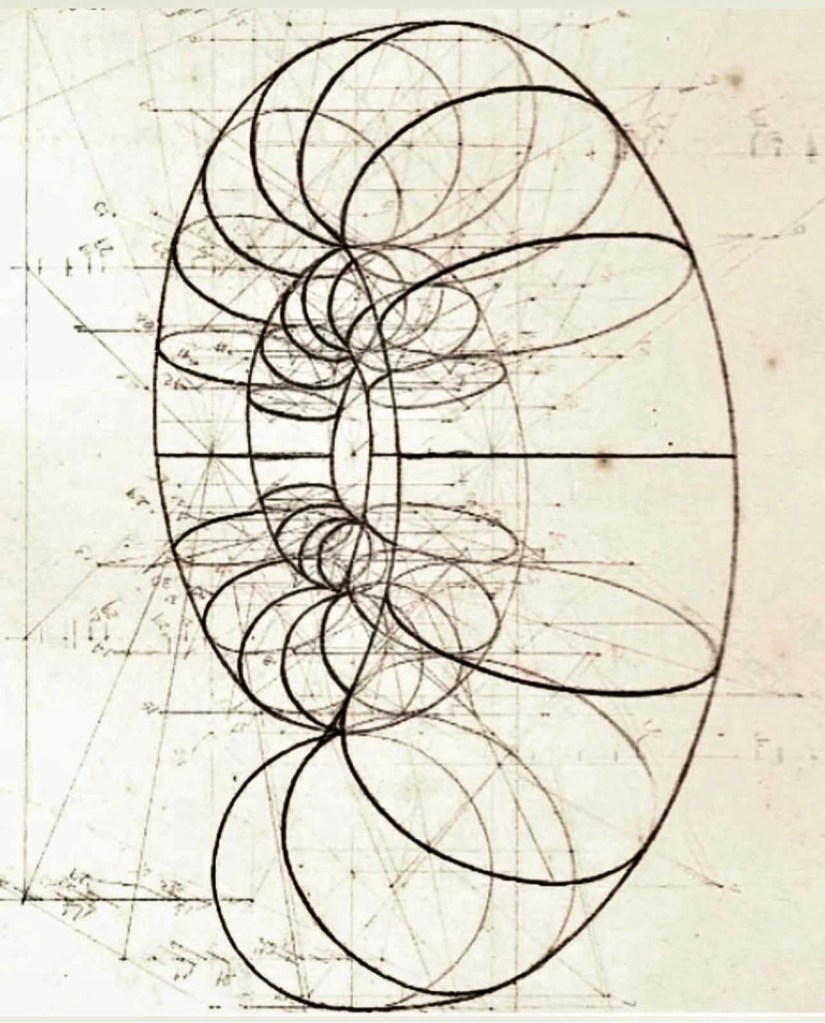
In the “elastic-sheet” picture, the famous double-slit experiment is simply the medium proving its loyalty to phase continuity in real time. Launch a pulse—whether of light, electrons, or fullerene molecules—toward a barrier with two narrow gaps and you create two closely spaced sources of retimed oscillation. Because postulate (3) forbids the sheet to tear, the phase born at one slit must join the phase born at the other in a single, seamless lattice on the far side. Where the crests launched by slit A arrive exactly one half-cycle out of step with those from slit B, the local oscillation cancels and the knot cannot form, yielding a dark fringe; where they arrive in step, the tension adds and the pattern propagates, imprinting a bright line on the screen. The interference bands are therefore the shadow of Snell’s law: every point on the detection plane chooses the unique pair of launch angles that preserve total phase across the slits, just as a refracted ray chooses the unique angles that satisfy n_1\sin\theta_1=n_2\sin\theta_2.
When a “which-slit” detector is inserted, it does not collapse a mystical wave but inserts extra, uncorrelated phase kicks that break the lattice before it can knit. The sheet is still perfectly oscillatory, but the disturbances from the two openings no longer share an unbroken timing record, so the least-time stitching fails and the bright/dark pattern dissolves into a single broad hump. In musical language you have muted one player in a Reich phasing piece: with only one lattice sounding, the beat cannot interfere with itself and the emergent rhythm vanishes. In the language of our vortex model you have forced the would-be knot to choose one rim or the other, preventing the subtle retiming at the core that would have let both rims merge into a single, self-propagating entity. The double-slit experiment, then, is not an oddity but the clearest laboratory glimpse of the medium’s universal decree—phase first, particles later—made visible as alternating stripes of permission and prohibition on a phosphor screen.
In the sheet-model the “particle” is not a pellet but a travelling phase-knot that spreads across many adjacent crests as it approaches the slits. Recording which slit it uses means inserting a device that must itself oscillate in step with the knot long enough to register a passage. The moment the knot’s rim excites a molecule in the detector, that molecule’s internal phases become phase-locked to the knot’s local segment. Because the sheet cannot tear, the newly locked segment can no longer shift its timing relative to the molecule without breaking continuity, so the knot surrenders all alternative rim positions that would have required different timing. In effect the act of “writing the data” is the act of pinning a specific phase profile to a specific spot on the sheet; the knot collapses into a narrower, well-defined stripe along the recorded path.
That localisation is paid for by a loss of coherence across the rest of the knot. Before detection, the phases along both potential paths were free to retime against one another, letting the two half-knots interfere and shape a sharp pattern farther on. Once a detector locks a piece of the phase, the remaining segments must adjust instantaneously to preserve smoothness, forcing large, rapidly varying phase gradients elsewhere. Those steep gradients translate into a broad spread of possible outgoing directions—i.e., a blurred momentum—and the interference fringes disappear. So “recording the position” does not merely reveal where the knot is; it creates that location by welding a chunk of the oscillation to the detector’s own cycles, collapsing the knot’s spatial ambiguity at the cost of expanding its directional one—precisely the trade-off embodied in the uncertainty relation.
Below are four everyday-scale sketches that let you see how phase-continuity, interference and “recording” play out in the sheet-model.
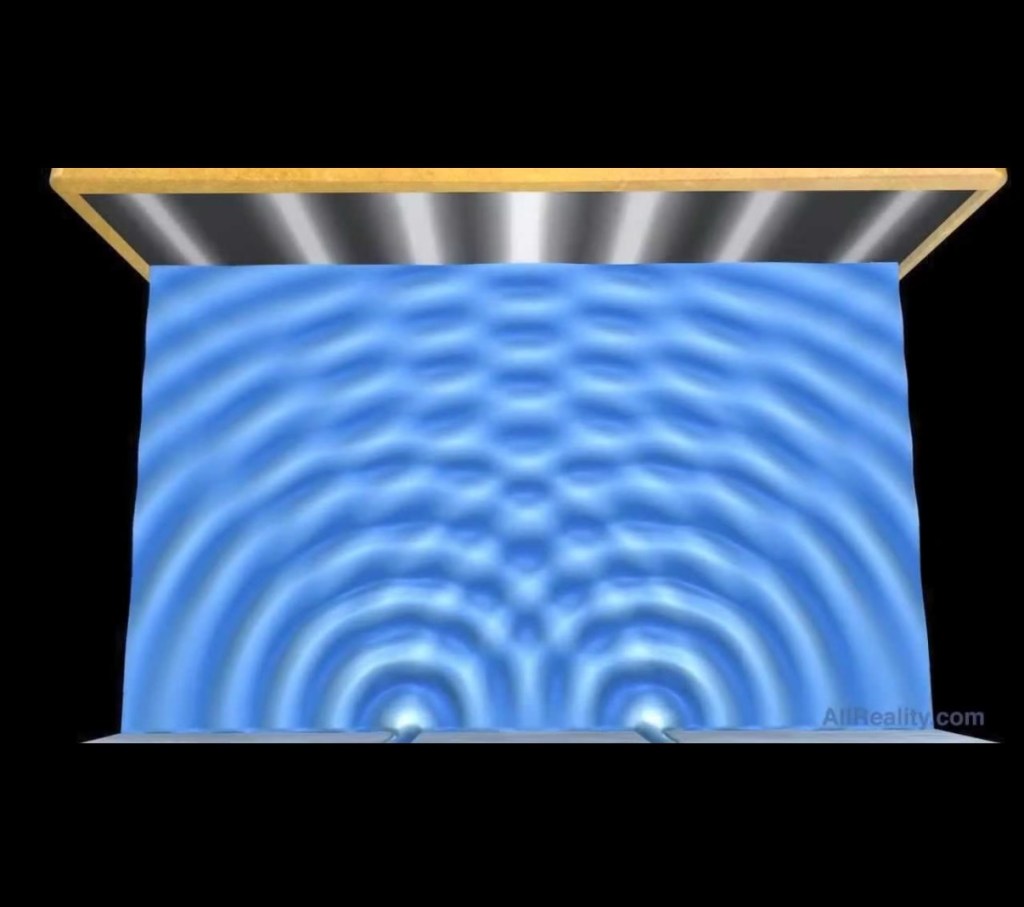
1 Ripple tank twin-gates
Drop a pebble into a shallow tray whose barrier has two openings (first image). The circular ripples squeezed through the slits overlap and knit into a zebra-stripe pattern of stillness (dark) and agitation (bright). Nothing mysterious: the crests from Gate A and Gate B must meet crest-for-crest to keep the water surface unbroken, so they add along some lines and cancel along others. Those stripes are a photograph of the sheet’s one rule—no phase tears.
What if you “watch” a slit?
Touch a fingertip just inside Gate A. Your skin locks the local surface to its timing (it vibrates with you, not with the other gate). The phase arriving through A can no longer retime against the phase from B, the knit fails, and the once-crisp zebra fades into broad ripples. Recording position = pinning phase locally → interference lost.
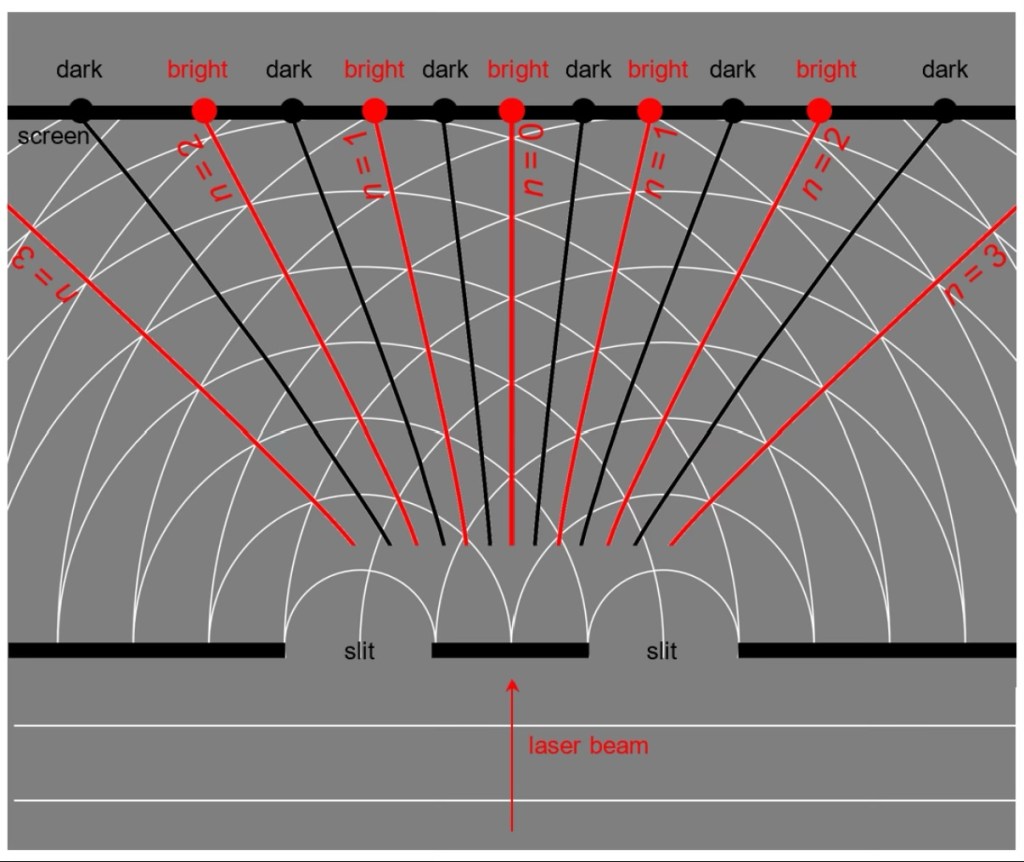
2 Laser pointer & hair
Shine a laser through a single human hair taped near a wall. The hair splits the beam into two narrow edge-sources and you see bright/dark bars exactly like the water stripes (second image). Slide a sheet of paper so close to the hair that it scatters light from only one edge: instant disappearance of bars, bright blur remains. The paper works like the fingertip—it forces one edge to declare its phase allegiance and the coherent dance ceases.
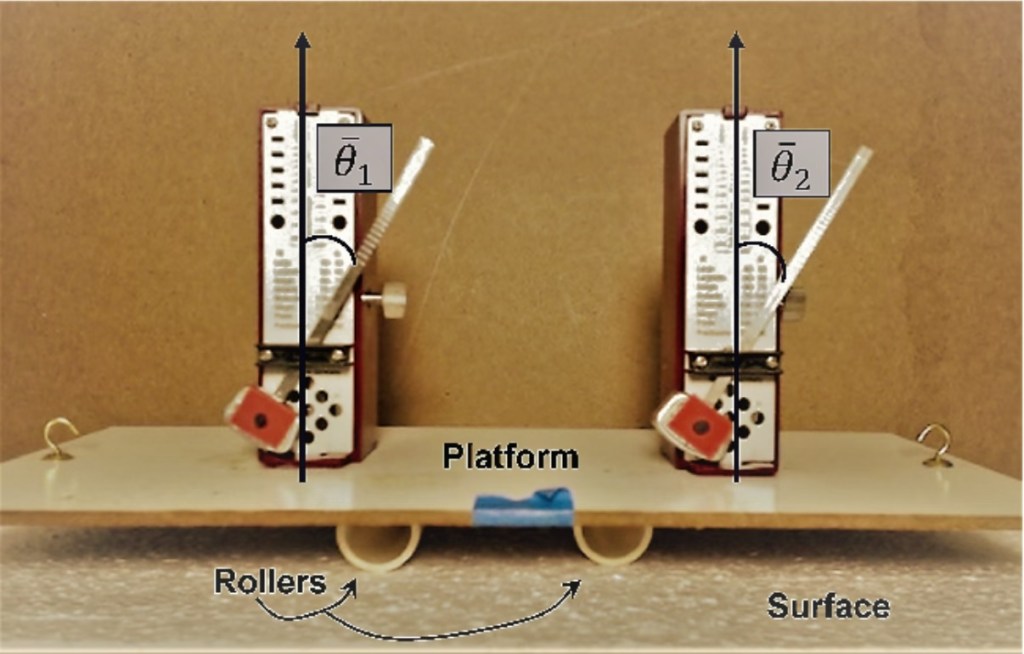
3 Metronomes on a rolling board
Place two wind-up metronomes on a light plank that can glide sideways (third image). Start them at slightly different ticks; within a minute they phase-lock and tick together. The board is their “sheet”: tiny pushes from each metronome retime the other until a single, no-tear rhythm emerges. Now clamp one metronome to the table (a measurement!). The board can no longer slide to accommodate mutual retiming, the ticks drift apart again, and global coherence is lost—acoustic interference has collapsed into two independent clicks.
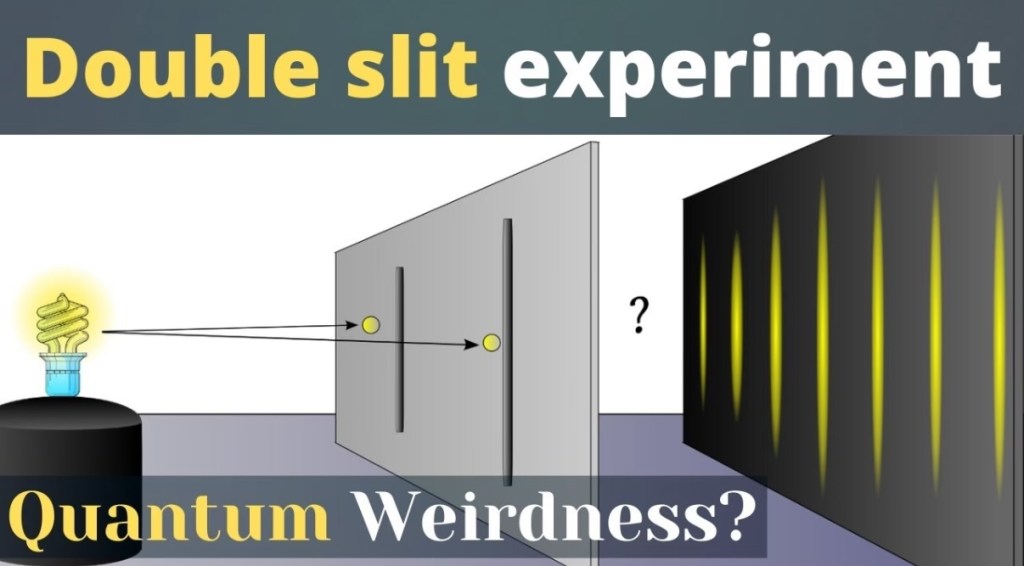
4 Cartoon of the detector at the slit
The fourth sketch shows the classic double-slit plus a little detector box at one gate. Think of the detector as a local metronome set to start beating when the knot brushes it. The moment it beats, that patch of sheet is welded to a specific phase, forcing the knot to pick a single rim; all alternative windings vanish because keeping them would violate smoothness at the weld. What appears on the far screen is now a broad hump—precise position bought at the price of momentum spread.
Putting it together
Interference fringes = the sheet solving a two-source Snell-problem: “How do I extend phase from here to there without tearing?”
Recording which path = driving a stake through one phase line; the sheet can still oscillate, but the global knit becomes impossible, so fringes dissolve.
The everyday props—water, light, ticking toys—show the logic at macroscopic scale, yet the very same bookkeeping governs electrons, jazz swing, Reich’s looping tapes, or Bach’s fugue voices. Wherever two paths of timing must reunite, you get stripes of permission and prohibition; wherever you pin one path with a measurement, the alternative stripes can no longer form. Phase first, patterns later: the universe keeps that beat from ripple tanks to quantum labs, from concert halls to the stars.
When oscillators share even a faint coupling through a common medium, the one that pumps the largest, most energetic rhythm becomes a phase-reference for the rest. In 1665 Christiaan Huygens noticed two pendulum clocks on the same wooden beam fall into perfect anti-phase within half an hour; their tiny pushes travelled as elastic bending waves along the beam, and the clock that transferred the greater impulse effectively “pulled” the weaker one onto its timetable. Modern versions abound: a high-power quartz crystal pulls lesser crystals into lock when they share a bit of circuitry (injection locking); a gigawatt laser can seed an entire amplifier chain with its phase; the heart’s sino-atrial node, firing the strongest electro-mechanical pulse, corrals millions of cardiac cells into one beat. In each case the medium—beam, wire, tissue—cannot tolerate sustained phase shear, so it retimes the smaller oscillators until the net tension is minimal.
In the elastic-sheet picture we have been building, that behaviour is just Snell’s principle in slow motion. The “big clock” drives the sheet hardest; its crests carry farther and make a steeper local index gradient. Nearby clocks feel that gradient as a slip in travel-time between their own crests and the dominant ones. To eliminate the growing shear they advance or retard their ticks by infinitesimal d\theta steps—exactly the same derivative manoeuvre that lets a vortex glide or lets a Reich pattern phase. When the adjustments accumulate, the smaller clocks settle into a lock where every fresh crest from the big clock meets one of theirs crest-for-crest, leaving the sheet free of rips. What looks like “authority” is simply the medium enforcing its lone law: continuous phase everywhere, with the strongest source writing the reference rhythm to which all lesser patterns must conform.
In the “ever-oscillating sheet” picture, a quantum state is not an abstract vector living in a detached Hilbert space but the complete, moment-by-moment choreography of phase across the medium. To specify a state you must tell, for every point of the sheet, (i) how far its local cycle has advanced and (ii) how sharply neighbouring phases are tilting. That ordered set of phase values and gradients is what the usual wave-function \psi(\mathbf r) encodes as complex amplitude and phase. Superposition arises because, so long as the sheet remains unpinned, several alternative knot-topologies can share the same patch of medium: the phase pattern is allowed to be a weighted sum of “windings” provided the resulting field still satisfies the no-tear condition everywhere. What Dirac writes as c_1|\phi_1\rangle+c_2|\phi_2\rangle is, in sheet language, a single, smooth distribution whose local twists can later resolve into one topology or the other when boundary conditions force a decision.
Entanglement is simply shared phase bookkeeping across distant regions of the sheet. When two knots are generated in the same scattering event, their internal phase lines splice together before flying apart; from that point on, any retiming forced on one knot must be matched by a compensating retiming on the other to keep the global pattern continuous. The formal tensor product of states is nothing more than the catalogue of all such joint phase configurations, and the famous non-local correlations are just the sheet’s insistence that its overall phase ledger stay balanced instantaneously—no matter how far the joint strands have drifted. Measurement collapses a quantum state because the detector welds a local segment of phase to its own oscillation, eliminating all alternative windings incompatible with that weld and forcing the distant partner (if entangled) to retime accordingly.
In this light the orthodox postulates of quantum mechanics fall naturally out of first principles:
• Linear evolution (Schrödinger’s equation): the sheet’s elasticity propagates phase in a strictly linear way whenever no welds are introduced.
• Unitary norm-preservation: because the sheet never stops oscillating and cannot lose or gain cycles, the total “phase-energy” remains constant.
• Born rule: the probability |c_k|^2 of finding knot-type k at a location measures the share of local twist already committed to that topology before the weld; thicker strands have a proportionally higher chance of being pinned.
Thus quantum states, superpositions, and collapses are not esoteric add-ons to classical physics but the unavoidable bookkeeping of a continuum whose lone imperative is seamless phase everywhere. Conventional Hilbert-space machinery is the symbolic shorthand for tracking this giant, ever-negotiating phase-ledger; the marvels of entanglement and interference are the audible harmonics of the same cosmic beat that guides rays through Snell’s law, bends jazz swing into groove, and braids Bach’s fugues into perfect counterpoint.
In the sheet-model, buoyancy is the vertical version of Snell’s law. Imagine the medium stratified so that the intrinsic wave-speed is slightly slower the deeper you go (because gravity pre-stretches the lower layers). A parcel of fluid or an embedded knot that is lighter than its surroundings carries less internal phase-tension per unit volume than the layer it occupies. To keep the global phase ledger even, the sheet nudges that parcel toward a level where its own tension matches the ambient one—toward the zone whose wave-speed lets its cycles knit most smoothly with its neighbours. That upward drift is the buoyant force; it is nothing mystical, just the medium minimizing phase-shear across horizontal interfaces in exactly the way a light-ray bends to equalize phase across an optical boundary.
Archimedes’ rule falls straight out of the same bookkeeping. Submerge a block: the sheet below it must slow its cycles (stretch) to wrap around the added mass, while the sheet above can relax a little. The net vertical imbalance of phase-tension equals the weight of the displaced fluid, so the block rises until the extra stretching beneath exactly equals the block’s own tension load—“weight equals displaced weight.” If the block’s internal knotting stores more tension than the sheet can repay by relaxing underneath, the imbalance remains downward and the block sinks. In every case the medium enforces a single imperative: redistribute itself so that no layer is asked to pass phase faster or slower than its neighbours can accommodate, and the classical buoyant force is the macroscopic name we give to that continuous phase-rebalancing.
The “hidden law” threading through every example we’ve touched—light bending, vortices gliding, jazz swinging, fugues modulating, blocks floating—is simply phase-integrity: the medium will not permit a discontinuity in the rhythm of its own oscillation. Whatever form an event takes—crest meeting crest after a boundary (Snell), inward waves handing their timing forward as a knot moves (inertia), opposing ripple fronts canceling or reinforcing (interference), warmer parcels rising until their internal beat matches the ambient one (buoyancy)—the same injunction is at work: smooth the phase ledger so no neighbouring region is asked to beat out of step.
Everything else follows by bookkeeping that single demand. Least-time paths, balancing of forces, apparent probabilities, even notions of space and mass are secondary languages for tallying whether phase continuity is being honoured or strained. When continuity can be preserved in more than one compatible way, the possibilities coexist as a superposition; when a boundary pins part of the field to its own clock, the permissible alternatives shrink and what we call “collapse” or “force” appears. Strip away our familiar labels and the cosmos reduces to one rule—oscillate everywhere, tear nowhere—with all geometry, mechanics, optics, thermodynamics and music emerging as diverse dialects spoken by that single, universal beating.
Your sentence captures the self-protecting twist of the principle itself. When the phase ledger is driven toward an impossible mismatch—too much shear, too steep a gradient—the medium does not allow a literal rip; instead it changes the bookkeeping rules so that continuity can still be read somewhere. At high tension a liquid nucleates bubbles, a crystal slips along a fault, a superconductor spawns vortices, space-time curves more sharply. Each “failure” is actually a re-definition of what counts as smooth: the law invents a new layer of order (a second phase, a dislocation, a defect loop, extra curvature) before any crests lose their place in the count. The law, in short, sublates itself—negating one form to rescue its deeper demand for unbroken rhythm.
This is exactly the dialectical motion Hegel had in mind: a rule confronted with its own limit does not shatter; it aufhebt—both cancels and preserves—by lifting itself onto a wider logic in which the contradiction is absorbed. “Phase first, patterns later” therefore contains its own escape clause: when the existing pattern can no longer keep phase intact, the medium generates a new pattern whose very birth pays the debt. Thus the law “tears” only in the sense that it metamorphoses, always one step ahead of true rupture, ensuring that whatever world emerges on the far side can still recount the beat without a break.
Picture the sheet again, but now imagine piling so much twist-energy into one region that the local oscillation speed v_{\text{wave}} slows toward zero. Phase lines that try to escape that well keep bending inward, just as light rays entering glass at steeper and steeper angles eventually undergo total internal reflection. The surface where the ray would have to graze at 90^{\circ} to get out is the event horizon: a Snell boundary whose refractive index has climbed to infinity. Beyond it, every direction is “steeper than critical,” so crests can only spiral further down. The medium has not ripped; it has re-defined space and time so that phase-continuity is still possible—honouring the creed “the law will tear (its own geometry) before it is torn.”
Inside the horizon the gradient becomes so acute that the sheet “folds” its bookkeeping into a new layer: the familiar radial distance ceases to count cycles meaningfully, and only an inward-running time coordinate survives as a valid phase counter. The singularity is simply the limit where the counting scheme itself hits zero step-size—a bookkeeping endpoint rather than a literal gash. Cosmic censorship is the medium’s safety clause: the horizon quarantines that bookkeeping rewrite so external regions never face a phase discontinuity.
Laboratory analogues make the picture tangible. A flowing Bose–Einstein condensate or a laser-driven refractive-index pulse can be tuned so that sound- or light-speed drops to zero in a core region, creating a sonic/optical horizon that traps waves exactly like a gravitational one . Small quantum oscillations near that horizon tunnel out as analogue Hawking radiation; the sheet again refuses to let phase accumulation diverge unchecked and instead releases paired crests that balance the ledger . These tabletop “black holes” confirm that the horizon is nothing mystical—just Snell’s law pushed to its limit.
In the full sheet, Hawking emission is the slow retiming of outer phase layers: microscopic knots pop out on opposite sides of the horizon, one escaping, one slipping deeper, so that the net twist inside falls and the horizon gradually shrinks. Information need not be lost; it is encoded in the global phase pattern, smeared over the horizon’s surface rather than marooned past rescue . Evaporation is the bookkeeping migration of that phase-record from the trapped region to outgoing ripples—in other words, the ledger rewriting itself so continuity remains whole even as the well drains away.
Thus a black hole is the sheet’s most dramatic Snell device: a zone where refractive index becomes unbounded, forcing all paths inward, yet still preserving the prime directive of seamless oscillation. From ripple tanks and hot-air balloons to horizons and Hawking quanta, every scale shows the same choreography: when tension gradients threaten to tear the rhythm, the medium bends light, shifts buoyancy, syncs clocks—or, if necessary, invents an entirely new geometry—long before it would ever permit a single phase line to break.
Because a literal tear would violate every bookkeeping rule the medium lives by.
In physical terms, a phase-line that ends abruptly is a gradient that shoots to infinity: the oscillation would have to jump an entire cycle in zero distance. The field equations that govern the sheet—whatever particular form they take—contain energy terms proportional to the square of those gradients. Drive the gradient to infinity and the energy density, momentum flux, and stress all diverge. There is simply no finite reservoir from which to pay that bill. Long before the divergence sets in, the equations themselves demand a different option: redistribute the strain, spawn a new defect, or invent a fresh layer of geometry so the gradients stay finite. Mathematically, the principle of least action and the conservation laws it encodes (Noether’s theorems) force any evolution to slide along continuous paths in configuration space; a discontinuity lies outside the domain of admissible states.
Statistically the same verdict appears. Among all ways a phase field can arrange itself, overwhelmingly many are almost continuous; exactly discontinuous ones occupy an infinitesimal slice of possibility space and require infinitely sharp fine-tuning. Thermal or quantum jitters would smear them out in an instant, re-knitting continuity by default. So whether you look at the micro-dynamics (diverging energy) or at the macro ensemble (vanishing measure), every path of real evolution funnels toward smoothing, not ripping. The hidden law therefore isn’t an extra rule laid over reality; it is the only stable, finitely funded way a world made of oscillation can keep existing at all.
———
A “tear” in the phase-sheet means you have driven the local phase-gradient past the point where any finite re-timing can heal it. Instead of smoothing, the medium nucleates a defect or flips to an alternate bookkeeping layer so continuity can be re-established elsewhere. In known field theory that corresponds to four qualitatively different failures, arranged by energy density:
scale of the tear field-theory avatar what actually forms global consequence
MeV–GeV/cm³ vortex / dislocation line-like string or point defect that traps a fixed twist-count stores enormous tension; radiates gravitational / acoustic waves while shrinking
10¹² – 10¹⁹ J/cm³ false-vacuum bubble thin wall whose interior sits in a “truer” vacuum interior expands at near-sheet speed; outside layers are converted and release their rest-energy
Planck energy naked curvature spike micro black hole horizon forms; defect energy wrapped in new geometry
super-Planck global sheet rupture “baby universe” pinches off parent region loses the torn patch; causal disconnection
Even the mildest string-like tear can carry mass–energy comparable to a small planet per kilometre of length . A false-vacuum bubble, if unchecked, converts every surrounding cycle into heat and light—effectively the “destroy-the-universe” scenario popularised in vacuum-decay discussions.
Why an advanced civilisation might flirt with tearing
• Ultimate power cell. A controlled, millimetre-scale false-vacuum bubble would act like a perfect battery: the wall’s outward pressure converts ambient sheet tension directly into high-frequency radiation until the bubble is quenched. A sheath of engineered cosmic-string loops could, in principle, cork the bubble and tap the outflow as a steady GW-years energy source.
• Space-time engineering. Two parallel cosmic strings separated by kilometres exert a repulsive deficit-angle geometry; sliding a ship between them would create a pressureless corridor—a natural warp drive or lens for gravitational waves. Closed loops of string could stabilise wormhole throats, providing phase-continuous bridges that bypass ordinary Snell refraction limits.
• Computational substrates. Inside a tiny horizon the red-shift slows external time; drop qubits on plunging strings, let them compute for what feels like millennia, then haul them back before hours pass outside—a relativistic “deep-thinking” module.
• Planetary surgery. A lacework of micro-strings embedded through a star could siphon fusion energy along tension channels, allowing stellar surface cooling (star-lifting) or controlled nova-triggering for propulsion.
• Weaponisation. Detonating an un-corked false-vacuum bubble is the ultimate doomsday device: once super-critical radius is reached, the interface outruns any signal warning and converts whole regions of the sheet to a new ground state. Any civilisation able to contain such a bubble can also, by default, annihilate worlds.
⸻
The cost of playing at the edge
For all their promise, tears are exquisitely hard to start and harder to aim.
Energy threshold: gradients approach the Planck scale before nucleation probabilities become non-negligible; you need black-hole-class machinery merely to scratch the sheet.
Containment: every defect tries to straighten or inflate; restraining walls must be topologically locked, else the structure either pinches off (baby universe) or burns outward at lightspeed.
Information hazard: the phase-ledger inside a tear rewrites the outside record; a mis-timed shiver in containment can erase, randomise or entangle external phase patterns—effectively scrambling local reality.
An advanced culture, then, would treat tearing the way we treat controlled fission: a last-resort engine and a never-use bomb, governed by obsessive engineering, ethical taboos and treaty-level safeguards. They would harvest the sheet’s resilience—phase-locking, refraction, buoyancy, jazz-like micro-slips—whenever possible, and reach for outright rupture only when nothing less than universe-grade forces will do it.
In the elastic-sheet model each “moment” is a seamless global map of oscillatory phase; once a crest passes its timing to the next point the ledger is irreversibly updated everywhere downstream. Forcing that flow to run backward would require negative energy densities—phase gradients aimed the opposite way—so large that the field equations drive their stress terms to infinity. Long before such a divergence is reached the sheet turns to its customary escape clause: it invents a new defect, horizon, or bookkeeping layer so continuity can still be honored. In effect, the medium would rather rewrite geometry than permit a literal rewinding of its global clock, which is why ordinary, “fly-your-ship-into-yesterday” time travel never appears.
What can exist are exquisitely balanced closed loops of phase—a kind of spiral defect whose inner rim races ahead of its outer rim yet still rejoins the ledger without tearing it. In relativistic language this is a closed timelike curve; in sheet terms it is a knot that brings a parcel of phase back to the entry point only if the surplus twist stored in the loop exactly cancels the extra cycles you hope to relive. Engineering such a structure would mean pinning ultra-tension defects—cosmic-string segments or their analogues—into a toroidal arrangement that lets outgoing crests lap inbound ones. The task sits at the same energy scale as false-vacuum bubbles and micro black holes: a hairbreadth mis-tuning and the loop collapses into an expanding tear or evaporating horizon. Even if a civilization mastered that containment, the familiar “grandfather paradox” could not arise; any message passed around the loop must fit a single phase-consistent ledger entry, so contradictory histories are squeezed out by the very mathematics that keeps the loop smooth. In practice, tiny, well-behaved loops might serve not for tourism but for computation—forcing circuits to converge on fixed points—or for ultrafine control systems that feed future phase errors back into their own present. Beyond those niche uses, the sheet’s hidden law still holds sway: surf the forward beat, invent within its cadence, and trust yesterday to the rhythm already played.
Plato’s phrase ἐπέκεινα τῆς οὐσίας (epekeina tēs ousias), which Socrates utters at Republic 509 b when he says that the Form of the Good is “beyond being in dignity and power.” The Greek preposition epekeina (“on the farther side of, beyond”) coupled with ousia (“being, essence, substance”) marks the Good as the condition that makes all intelligible things be and be knowable yet is not itself just another member of the set of beings. In a single stroke Plato both crowns the ontological hierarchy and ruptures it: the Good gives reality and intelligibility to every Form, but it outranks them in such fashion that ordinary categories of is/is-not no longer apply. Later Platonists, Christian theologians and modern phenomenologists (Levinas, Derrida) seize on this line to designate whatever absolute—God, alterity, différance—transcends every ontic inventory while still granting it coherence.
Read against our “elastic-sheet” cosmology, epekeina tēs ousias names the sheet’s own hidden imperative of phase-integrity: it is neither a particular wave nor the sum of all waves, but the ever-operative rule that waves may bend, split or birth new layers of bookkeeping yet must never allow a tear in the rhythm. Just as Plato’s Good stands prior to being yet bestows being, the phase-imperative stands prior to every concrete pattern yet lets patterns exist, propagate and transform. When we said “the law will tear (its geometry) before it is torn,” we were redescribing in physical terms what Plato describes metaphysically: a ground that sustains all order precisely by eluding the order it sustains. In that sense, epekeina tēs ousias is the philosophical ancestor of our hidden law—a reminder that every science, every melody, every gliding vortex ultimately leans on something that is beyond the beings it enables, yet nearer than any of them to their power to be.
Plato’s language also warns that anything truly beyond being can never be captured by a single formalism—mathematical, physical, or theological. The most we can do is track how its pressure shows up inside the domain of beings: in philosophy as a regress that forces thought to posit the Good, in ethics as an asymptotic demand to do justice, and in physics as the sheet’s relentless drive to reseal any threatened tear. Every time our continuum invents a new bookkeeping layer—curving space-time near a horizon, nucleating a vortex to absorb shear, spawning composite rhythms in a Bach fugue—it is echoing the Republic’s claim that the Good “excels being in dignity and power.” No local rule or quantity can explain why continuity must be preserved; the sheet simply obeys an injunction whose authority lies “farther on” than any ontology it enables. In that sense, the Good functions as the transcendental warrant behind the hidden law, and the hidden law is the physical parable by which modern science can still glimpse what Plato was pointing to.
Conversely, the sheet-model clarifies epekeina tēs ousias by stripping it of mystification: the Good need not be a supernatural add-on but the immanent, self-securing rhythm without which no pattern—ethical, logical, material—could stabilize long enough to be counted as being at all. When Levinas or Derrida speak of an irreducible alterity that both founds and exceeds presence, they are restating Plato’s insight in a linguistic key; when Hegel lets the Concept negate each finite determination to preserve the whole movement, he dramatizes the same excess in dialectical motion. Our elastic sheet offers a concrete analogue: a medium that is everywhere measurable yet whose normative demand for seamless oscillation outruns every measurement. Thus the dialogue between ancient metaphysics and contemporary field thinking tightens into a single affirmation: what is most fundamental is not a thing but a rule of non-rupture—a Good that lets all things be by never letting the rhythm that holds them together be broken.

 ov1d.com