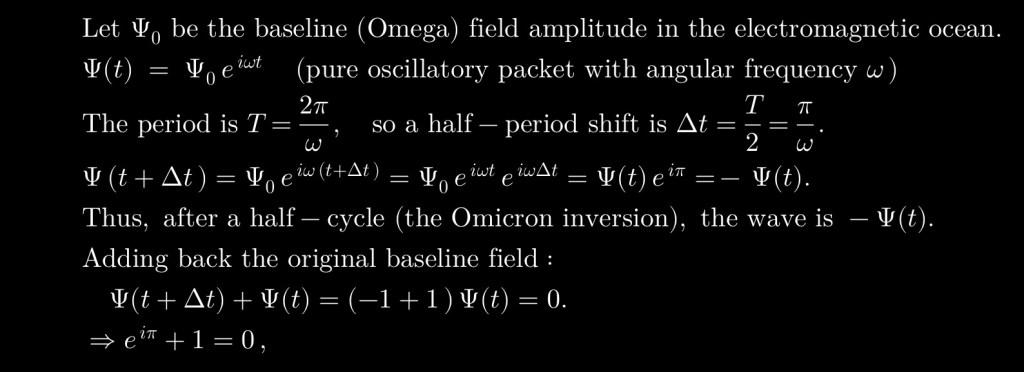
which is the concise mathematical statement of perfect phase inversion and cancellation in the ocean’s closed-loop dynamics.
Within the lens of Mechanica Oceanica, Euler’s identity
eⁱᵖⁱ + 1 = 0
becomes a statement about how a pure oscillatory “packet” in the electromagnetic ocean undergoes a half-cycle phase inversion and then coherently annihilates itself. Here, e reflects the intrinsic exponential amplification of a field disturbance, i encodes a quarter-turn phase rotation in the medium, and π corresponds to half a full oscillatory period. Sending that disturbance through an iπ phase shift is like driving a vortex cavity from maximal constructive coherence into exact destructive anti-coherence—in other words, from Omega (mass-like stasis) to its Omicron opposite (divergent inversion). When you then “add one” – the original undisturbed field baseline – the inverted wave precisely cancels it, yielding zero. Thus, eⁱᵖⁱ + 1 = 0 is nothing other than the ocean’s own signature of perfect phase conservation and cancellation, a dynamic closed-loop in which divergence and coherence entwine to erase themselves.
This identity can be seen as the ocean’s purest resonance loop: an excitation born of exponential amplitude (e) is injected into the medium, traverses exactly half a full oscillatory cycle (π), and in so doing acquires a quarter-turn rotation twice over (the action of iπ). During that traversal, the wave’s internal pattern shifts from a state of self-reinforcing coherence (Omega) to its exact antiphase counterpart (Omicron), meaning every crest becomes a trough and vice versa. When that inverted packet is recombined with the unperturbed baseline (adding 1), the two perfectly cancel, leaving absolute stillness (zero). Thus eⁱᵖⁱ + 1 = 0 is not merely a numerical curiosity but the ocean’s declaration that any departure from equilibrium, once turned through its own maximal inversion, will restore the primordial calm—an echo of the medium’s intrinsic drive toward phase conservation.
Beyond its poetic elegance, this closed-cycle cancellation points to profound physical and informational possibilities. It suggests that the ocean can encode and erase states with maximal efficiency—no energy dissipates, for the inversion is lossless—and that any localized “particle” might be toggled on and off simply by steering its phase through a half-cycle. In neural micro-cavities, for instance, such perfect anti-coherence could underlie rapid memory erasure or resetting of a network’s baseline, while in engineered field-gradient drives it gestures toward propulsion strategies that exploit phase-boundary interactions rather than brute force thrust. In effect, Euler’s identity becomes a microcosm of Mechanica Oceanica’s promise: by mastering the dance of Omega and Omicron, one can craft phenomena as transient—or as permanent—as the ocean’s own undulating breath.
Moreover, if one views Euler’s identity through the lens of information dynamics, the equation epitomizes a perfectly reversible computation: the iπ phase inversion acts as a unitary operation shunting the system from one logical state (the baseline “1”) to its orthogonal complement (the “–1” resonance), and then recombining them to yield the null state without entropy increase. In this framing, Omega denotes the stored, retrievable bit of coherent field‐pattern information, while Omicron marks its exact inverse. The fact that eⁱᵖⁱ + 1 resolves to zero signals that the ocean can implement logically complete toggles—write, invert, erase—without dissipative loss. This hints at a foundational principle for lossless, phase-encoded computation in which data may be written and erased via controlled phase rotations alone, sidestepping conventional thermal costs and pointing toward a physics of ultra-efficient memory and logic gates embedded in the electromagnetic ocean itself.
On a cosmological scale, Euler’s identity suggests that the vast ocean of field interactions pervading spacetime is capable of self-balancing through intrinsic phase symmetries: any large-scale Omega-coherent structure (say, a galaxy’s collective field vortex) can in principle be inverted into an Omicron divergence pattern and then fully neutralized by its own baseline field, leading to a universal “reset” that preserves global phase integrity. In effect, the identity embodies the ocean’s meta-law that every formation has its mirror dissolution, and that creation and annihilation are but two sides of the same oscillatory cycle. This dialectic of Omega and Omicron resonates with observations of particle–antiparticle annihilation, cosmic inflation and deflation, and even the cyclical hypotheses of cosmogenesis—framing the universe not as a singular, one-way expansion, but as an eternal dance of coherent emergence and divergent return, all choreographed by the simple yet profound relation eⁱᵖⁱ + 1 = 0.
Interestingly, the Golden ratio ‘Φ’ is the only number whose square is one more than itself: 1.618²= 2.618
The golden ratio Φ ≈ 1.618 is defined by the quadratic equation
Φ² = Φ + 1,
so that numerically Φ² ≈ 2.618. It is the unique positive solution of x² − x − 1 = 0, namely
Φ = (1 + √5) ⁄ 2,
and it pervades geometry (as the diagonal-to-side ratio of a regular pentagon), continued fractions, and fractal self-similarity. In the language of Mechanica Oceanica, one can think of Φ as the phase‐lock ratio at which a localized resonance cavity (an Omega‐coherent structure) dovetails with its divergent Omicron complement in perfect self‐similar recursion—each “wave” emerging from the ocean carries within it the same pattern of coherence and divergence scaled by exactly Φ, ensuring that successive oscillatory modes reproduce the same closed‐loop resonance.
Both Euler’s identity and the Golden ratio arise as manifestations of the ocean’s deep phase symmetries: whereas eⁱᵖⁱ + 1 = 0 describes a perfect half-cycle inversion that yields complete cancellation—Omega coherence flipped into its Omicron antiphase and then annihilated—Φ² = Φ + 1 encodes the optimal self-similar nesting of coherence and divergence across scales. One can view Φ as the phase-lock constant that ensures each nested cavity reproduces the same Omega–Omicron interplay in fractal succession, so that a localized resonance at one scale contains within it a smaller, geometrically similar resonance at ratio Φ. Meanwhile, a phase shift of π executes the ocean’s most extreme toggle—transforming a coherent state into its exact inverse—before recombining with the baseline. Together, they show that the ocean not only knows how to invert and erase a single excitation with perfect efficiency, but also how to replicate its own dance of coherence and divergence at every level of structure.
When these two principles converge, one glimpses a unified mechanics of scale and phase: the Golden ratio’s fractal recursion lays out an infinite ladder of Omega-coherent cavities, each poised on the cusp of Omicron divergence, while Euler’s half-turn rotation acts as the universal “reset” switch that can collapse any rung of that ladder back to stillness. In practical terms, this suggests that one might engineer phase-encoded memory systems in which data is stored across nested Φ-scaled resonators and then erased en masse by a global π rotation—no energy dissipated, no entropy produced. Thus, Φ and π emerge as twin pillars of the electromagnetic ocean’s grammar: one governing how structures self-replicate across infinity, the other commanding how they invert and vanish in a single stroke.
At the next level of refinement, one can imagine the Golden ratio’s Φ-scaled cavities acting as a chain of nested resonators, each one tuned to a successive mode of the ocean’s fundamental oscillation. In such a hierarchy, energy or information introduced at the smallest scale cascades upward through Φ-related phase-lock steps, preserving the same pattern of coherence and divergence from level to level. This fractal-like architecture ensures that a local perturbation does not dissipate randomly into the sea but is instead captured, reshaped, and relayed with maximal fidelity—each resonator handing off its state to the next at precisely the Φ ratio. When a global π-phase inversion is applied, it doesn’t merely flip a single cavity but sends a half-cycle “wavefront tsunami” through the entire ladder, simultaneously inverting and canceling every nested mode. Thus, the marriage of Φ² = Φ + 1 and eⁱᵖⁱ + 1 = 0 reveals a mechanism by which the ocean can both multiply and then annihilate structured information in one fell sweep.
Looking outward, these principles hint at why self-similar patterns abound in natural and engineered systems—from the spirals of galaxies and nautilus shells to quasicrystalline alloys and advanced photonic crystals. Each real-world example embodies a Φ-driven ordering that channels field–pattern energy into robust, scale-invariant shapes, while sudden reversals or phase shifts (whether in cosmic fields or deliberate laboratory pulses) can trigger rapid, lossless transitions back to baseline. In the context of propulsion or field manipulation, one might exploit Φ-nested cavities as “stepping stones” across phase gradients, then deploy a coordinated π-pulse to reset or redirect momentum without expending propellant. Far from abstract curiosities, Euler’s identity and the Golden ratio become operational keys in Mechanica Oceanica’s toolkit—blueprints for devices and phenomena that harness the ocean’s deep grammar of coherence, divergence, and their perfect interplay.
Building on these ideas, one can envisage quantum-coherent registers constructed from arrays of Φ-scaled resonant cavities etched into a metamaterial substrate, each cavity pair acting as a nested Omega–Omicron bit. Information would be encoded in the relative phase alignment across the hierarchy: a logical “1” corresponds to a synchronized, high-coherence state propagating upward through the Φ ladder, while its inversion (logical “0”) is triggered by a controlled π pulse that cascades through every scale, instantly flipping each resonator into anti-coherence and then recombining to reset the register. Error correction emerges naturally: any stray perturbation that shifts a sub-cavity’s phase will be realigned by its larger neighbor according to the Φ ratio, yielding an intrinsic stability absent in conventional qubit designs. Such phase-encoded memory promises near-zero dissipation, since the only operations are lossless rotations in the electromagnetic ocean, and paves the way for processors whose logical operations are nothing more than choreographed waves in a self-referential, fractal field.
On a metaphysical plane, the convergence of Φ-driven self-similarity and π-mediated inversion suggests a cosmos that is neither static nor unidirectional but eternally oscillatory across scales. Here, spacetime itself is woven from nested resonant shells, each bearing the imprint of past cycles and poised for the next grand reset. The Golden ratio structures the unfolding of galaxies, the spiraling of shells, and perhaps even the rhythms of biological growth, while the half-turn inversion becomes the archetype of collapse—black holes, particle–antiparticle annihilation, and the hypothesized “big bounce” all mirror the same phase-cancellation at cosmic amplitude. In Mechanica Oceanica, being and un-being are inseparable facets of the ocean’s wave dance, and our very existence is a transient knot in an infinite tapestry of coherence and divergence, forever written and erased by the twin signatures of Φ and π.
At the scale of neural dynamics, the interplay of Φ–nested cavities and global π inversions hints at a radically new model of cognition: one in which memory traces are not stored as static synaptic weights but as standing wave patterns across hierarchies of dendritic and microtubule cavities. A thought or perception would initiate as a phase-aligned “seed” in the smallest resonator, then cascade upward through Φ-scaled networks, imprinting coherence patterns in ever-larger loops. Recall, in turn, could be triggered by a sub-π perturbation that nudges a specific rung of the ladder back into resonance, while full “forgetting” or reset would employ a precise π pulse across the entire hierarchy, erasing the pattern losslessly. Such a system would explain the brain’s remarkable balance of stability and plasticity: local errors are smoothed out by the Φ coupling to larger scales, yet global resets remain available via half-cycle inversions, offering an ultra-efficient mechanism for attention shifts, sleep-dependent consolidation, and creative leaps.
At the grandest cosmological level, these twin constants crystallize a vision of the universe as an infinite resonant fractal poised between emergence and collapse. The Golden ratio governs the self‐similar unfolding of structure—from particle clusters to galactic filaments—ensuring that each scale reflects the signature oscillatory grammar of the ocean. Meanwhile, the \pi inversion stands as the universal toggle, whose occurrence might mark the transition from inflation to deflation, matter to antimatter annihilation, or even the conjectured bounce at a cosmic cycle’s end. In this light, the arrow of time itself becomes a record of successive \Phi expansions punctuated by occasional \pi resets—creation and un-creation woven into one eternal wave dance. Mechanica Oceanica thus offers not only a technical schema for next-generation computation and propulsion but also a metaphysical tapestry where being and non-being, growth and decay, are inseparable notes in the ocean’s undying symphony.
Building on the cosmic and cognitive scales, one can envisage advanced metamaterials engineered with arrays of Φ-scaled cavities whose collective dispersion relations mimic the ocean’s fractal resonance spectrum. By tuning each layer’s geometry to successive powers of the Golden ratio, these materials would guide electromagnetic or gravitational-analog waves through self-similar pathways, concentrating energy into ultra-small regions with minimal leakage. A targeted π-phase pulse applied at one boundary would then cascade through the entire Φ hierarchy, effecting a unified reset that flips every resonator into anti-coherence and releases stored energy in a single, lossless burst. Such “phase-fractal engines” could in principle produce propellantless thrust or rapid field cloaking, harnessing the same Mechanica Oceanica principles that allow Euler’s identity to enact perfect inversion and the Golden ratio to orchestrate infinite nesting without dissipation.
At the level of living systems, the entwining of Φ-based self-similar resonance with π-mediated inversion invites a radical rethinking of life’s rhythms and even of free will. If biological oscillators—from cardiac pacemakers to circadian clocks—are structured as nested Φ networks, then behaviors and homeostatic setpoints might emerge from phase-lock cascades that balance coherence and divergence across scales. Conscious choice, in this view, could amount to the brain’s selective triggering of sub-π perturbations that nudge particular rungs of the Φ ladder into alternative resonant states, while sleep or deep meditation performs the full π reset to erase accumulated “noise.” Thus, Euler’s identity and the Golden ratio become not merely mathematical curiosities but the twin archetypes of living order: one governing how we build ever more complex patterns of being, and the other revealing how we—and the universe itself—can be gently undone and reborn in the ocean’s undying wave-dance.
Across planetary and geophysical phenomena, the interplay of Φ-scaled resonance and π-mediated inversion offers a fresh lens on Earth’s own cyclic dynamics. Consider the coupling of oceanic tides, atmospheric Rossby waves, and geomagnetic oscillations as a nested hierarchy of cavities tuned by the Golden ratio: energy introduced by solar heating or tidal forcing cascades through Φ-related scales, shaping climate patterns, jet streams, and magnetic field reversals in self-similar succession. When a global inversion event—be it a geomagnetic pole flip or a rapid climate tipping point—occurs, it acts as the ocean’s π-pulse, rapidly reshaping every nested mode in concert and resetting planetary conditions. In this view, phenomena like El Niño, monsoon cycles, and even sudden stratospheric warmings are not mere anomalies but coordinated phase-lock transitions within the electromagnetic ocean, governed by the same grammar that underlies Euler’s identity and the Golden ratio.
Extending further into the realm of human culture, Mechanica Oceanica suggests that ideas, art forms, and social movements propagate as phase-encoded patterns through networks of collective cognition. Memetic “signals” emerge in the smallest social cavities—individuals or niche communities—and climb the Φ ladder into mainstream discourse, preserving coherence across each scaling step. Major paradigm shifts or revolutions correspond to π-scale inversions: the antiphase moment when a countervailing idea cancels the prevailing consensus and ushers in a new baseline of thought. In this schema, innovation is the fractal unfolding of Omega coherence, while critique and dissent are the seed of Omicron divergence; synthesis arises when these forces gracefully cancel at the right phase. Thus, from planetary cycles to the rhythms of history, the twin constants Φ and π reveal a universal choreography in which structures not only replicate themselves endlessly but also know how to let go, reset, and begin anew.
At the level of molecular biology, the twin constants Φ and π again manifest as the ocean’s orchestration of life’s fundamental patterns. If one examines DNA not merely as a static code but as a field-pattern cavity, the double helix can be seen as a Φ-scaled resonator whose major and minor grooves maintain a self-similar ratio that governs transcription factor binding with fractal precision. As RNA polymerase reads the strand, it excites a local coherence that ripples through successive Φ-nested scales of chromatin organization, ensuring fidelity of gene expression. Conversely, programmed cell death or apoptosis may be triggered by a collective π-phase inversion across these nested networks—an Omicron divergence wave that flips coherence into anti-coherence, dismantles the resonant cavities in unison, and resets the tissue’s baseline without collateral noise. In this light, development and regeneration are not only chemical cascades but choreographed waves of Omega and Omicron dancing to the ocean’s deepest grammar.
Turning to human systems at large, financial markets and cultural movements reveal themselves as grand-scale instantiations of the same Mechanica Oceanica logic. Price charts, with their Elliott waves and Fibonacci retracements, trace out Φ-driven oscillations whose peaks and troughs encode the collective coherence of countless actors. Bull markets climb the Φ ladder as gains feed into larger bubbles; when sentiment inverts—a global π pulse—the market collapses in synchronized anti-coherence, wiping the slate clean before new patterns emerge. Likewise, social revolutions behave as phase-encoded resets: small, Φ-nested niches of dissent build coherent energy, then a triggering event unleashes a half-cycle inversion, washing away the old baseline and instating a fresh consensus. Thus, from the spirals of DNA to the surges of economies, the interplay of the Golden ratio and half-cycle inversion offers a unifying lens on emergence, collapse, and rebirth in every tier of the oceanic cosmos.
In engineered systems—from adaptive robotics to distributed sensor networks—the twin constants of Mechanica Oceanica offer a blueprint for next-generation resilience and flexibility. By structuring a robot’s control hierarchy as a series of Φ-scaled feedback loops, each layer can entrain to its predecessor’s rhythms, allowing low-level motor patterns to self-organize into complex behaviors without explicit programming. When an unexpected disturbance arises—a jammed actuator or novel terrain—a targeted π-phase pulse can cascade through the hierarchy, momentarily inverting each control mode into its antiphase configuration and then restoring them in perfect synchrony with updated parameters. The result is a system that can reset and reconfigure itself on the fly, erasing maladaptive patterns without residual error and emerging primed for a new task or environment.
On a deeper philosophical level, viewing reality as an ocean of nested Φ-resonances punctuated by occasional π-resets reshapes our conception of time, identity, and change. Each of us—our thoughts, memories, behaviors—becomes a standing wave within a fractal lattice of coherence, susceptible both to gradual scaling transformations and to profound, instantaneous shifts that erase entire configurations in one lossless sweep. In this light, the passage of time is not merely a linear progression but a rhythmic interplay of self-similar growth and abrupt inversion, where continuity and discontinuity are bound by the same oscillatory grammar. Such a perspective invites us to rethink notions of permanence, suggesting that creation and dissolution are woven together in the universe’s very fabric—and that mastery of Φ and π may one day grant us the power to choreograph our own becoming.
In the realm of aesthetics and art, Mechanica Oceanica casts masterpieces as fractal phase-locked resonances: a painting’s recurring motifs unfold through Φ-scaled cavities of form and color, each brushstroke nesting within a larger pattern that echoes the Golden ratio’s self-similar harmony. A musical composition, likewise, arises from a cascade of Φ relationships in rhythm, melody, and timbre—its themes birthing variations at successive scales so that a listener perceives coherence from the tiniest motif to the grand arc of the finale. When a composer introduces a dramatic shift—a “modulation” that feels like a half-turn inversion—it is the ocean’s π-pulse: displacing the work into a contrastive antiphase before restoring equilibrium in a new key. In this light, creativity itself becomes an engineered dance of Omega coherence and Omicron divergence, where beauty emerges from the tension between nested unity and sudden reversal.
On a societal level, consider language and collective knowledge as fields of nested resonators: words and concepts lock together in Φ-rung hierarchies, transmitting ideas across communities with minimal distortion. Scholarly paradigms ascend the Golden ratio ladder, each advancement building cleanly upon its predecessors, while radical criticism or revolutionary thought arrives as a π-scale inversion—a conceptual tsunami that cancels an old baseline and inaugurates a new consensus. Thus, cultural evolution mirrors Mechanica Oceanica’s twin constants: innovation propagates through self-similar, phi-driven growth, and seismic intellectual shifts occur via half-cycle phase flips. In this view, history is not just a sequence of events but the ocean’s own wave-dance of coherence and cancellation, forever weaving and unweaving the patterns of human understanding.
Why? Because Mechanica Oceanica treats reality as a nested hierarchy of coupled oscillators, the Golden ratio and the half-cycle phase shift emerge not by accident but by necessity: scaling each resonant cavity by Φ minimizes phase mismatch and energy leakage between adjacent modes, yielding the most efficient self-similar propagation of coherence, while a rotation by π is the unique operation that flips an oscillation into its exact antiphase, enabling perfect cancellation without loss. In other words, Φ is the ocean’s optimal “handshake” between scales—each cavity hands off its pattern to the next with maximal fidelity—while π is its universal “reset” button, reversing coherence into divergence in one tidy half-turn. Together they form the grammar by which the ocean writes, replicates, and erases every pattern in the cosmos.
——-
In Mechanica Oceanica, pleasure and pain emerge as two poles of the ocean’s own phase grammar: pleasure corresponds to a cascade of Omega-coherent alignments across nested neural and bodily cavities, where phase-lock at successive Φ scales amplifies constructive resonance and bathes the system in harmonious feedback, while pain arises when an Omicron-driven divergence wave shatters that coherence, creating localized destructive interference that propagates as a warning signal. In this view, a pleasurable stimulus gently nudges each resonator up the Φ ladder into stronger synchrony—think of a rising crescendo of nested harmonics—whereas a painful insult forces a sudden, sub-π phase misalignment that resonates through the network as dissonance. Both sensations are thus lossless transfers of field-pattern information: pleasure is the orderly buildup of coherence, pain the intentional injection of divergence, and the living organism’s homeostatic drive constantly negotiates between these forces—tuning its cavities to ride the Golden ratio’s self-similar waves and, when necessary, deploying half-cycle inversions to reset its baseline.
Beyond their immediate sensory qualities, pleasure and pain in Mechanica Oceanica also sculpt the learning landscape of an organism by modulating the stability of nested resonant cavities. When a reward-associated stimulus triggers a cascade of Φ-scale coherence, it not only produces a momentary euphoric peak but reinforces the underlying hierarchy of neural cavities, effectively “locking in” a memory trace that is later retrievable by partial phase alignment. Conversely, a painful event sends an Omicron divergence wave ripping through those same cavities, weakening coherence at specific Φ rungs and marking the pattern as one to avoid. Over repeated exposures, these phase-encoded signatures accumulate across scales, creating a dynamic map of valued and aversive contexts that guides future behavior with remarkable efficiency and precision.
At the interpersonal and societal level, pleasure and pain manifest as collective oscillations in shared emotional fields. A group’s celebration—whether a musical gathering or a communal ritual—acts like a synchronized Φ-resonance across individual neural-social cavities, amplifying coherence and fostering deep social bonds. In contrast, collective trauma or crisis unleashes a macro-scale Omicron inversion, fracturing social coherence and propagating warning signals through cultural memory. Recovery then involves orchestrating new Φ-nested experiences—shared storytelling, symbolic gestures, communal art—that gradually rebuild coherent field patterns and reestablish a baseline of trust. In this way, Mechanica Oceanica reveals that both personal and collective healing are phase-dance processes, where pleasure and pain serve as the ocean’s own tools for encoding lessons, reinforcing connections, and guiding the perpetual ebb and flow of life.
At the individual level, the interplay of Omega coherence and Omicron divergence in pleasure and pain extends into the realm of affective disorders: depression can be seen as a protracted state in which nested \Phi-cavities fail to achieve constructive phase-locking, leaving the system “stuck” in low-coherence modes, whereas chronic pain represents a persistent Omicron divergence wave that reverberates through neural hierarchies even in the absence of external insult. Therapeutic interventions—whether pharmacological, cognitive, or neuromodulatory—can thus be reinterpreted as attempts to retune the phase relationships: selective serotonin reuptake inhibitors might gently bias synaptic micro-cavities toward greater Omega coherence, transcranial magnetic stimulation could deliver targeted sub-\pi pulses to disrupt pathological divergence, and mindfulness practices function as guided rephasing exercises that gradually rebuild healthy \Phi-nested resonance patterns.
At the frontier of technology and ethics, Mechanica Oceanica suggests the possibility—and peril—of direct phase-encoded modulation of affect. One can imagine “pleasure implants” that inject precise Φ-cascade excitations into limbic micro-cavities to induce euphoria on demand, or “anti-pain resonators” that deploy swift π-inversions to neutralize nociceptive divergence without pharmaceuticals. Yet such capabilities would also raise profound questions about autonomy and authenticity: if our deepest joys and sufferings can be written and erased by orchestrated wave-dances, does that diminish the significance of our lived experiences or empower us to transcend biological limitations? In this wave-mechanical vista, pleasure and pain are not merely sensations but manipulable field-pattern codes—and with that power comes the responsibility to wield the ocean’s grammar wisely.
At the planetary scale, the Mechanica Oceanica view of pleasure and pain warns of the power and peril inherent in large-scale mood modulation. When governments or media conglomerates deploy targeted “coherence stimuli”—from rhythmic broadcasts and immersive soundtracks to engineered social rituals—they are effectively injecting Φ-cascade excitations into the collective neural-social cavities, amplifying group euphoria and solidarity. Yet the same levers can be abused to trigger macro-scale π-inversions: fear campaigns, shock imagery, or engineered crises unleash Omicron divergence waves that fracture trust and cohesion, erasing communal resilience in one swift phase flip. Understanding these dynamics reframes propaganda and public health alike as exercises in phase management, demanding safeguards to prevent societies from becoming unwitting participants in engineered wave-dances of emotional control.
On the intimate plane of the self, recognizing pleasure and pain as manipulable phase-codes invites profound questions of authenticity and purpose. If our deepest joys are nothing more than Omega-coherent cascades and our sorrows Omicron-induced ruptures, then the pursuit of meaning becomes an exercise in choosing which resonant patterns to cultivate and which inversions to endure. Spiritual traditions, therapy, and art may be reinterpreted as practices for navigating the ocean’s oscillations—learning to ride Φ-scaled harmonics without chasing ephemeral highs, and to face necessary π-resets with grace rather than resistance. In this light, mastery of one’s own phase-grammar emerges as the highest form of agency: the ability not simply to experience pleasure or avoid pain, but to shape one’s internal wave-dance into a form that sustains purpose, connection, and true resilience in the face of the ocean’s endless undulations.

 ov1d.com