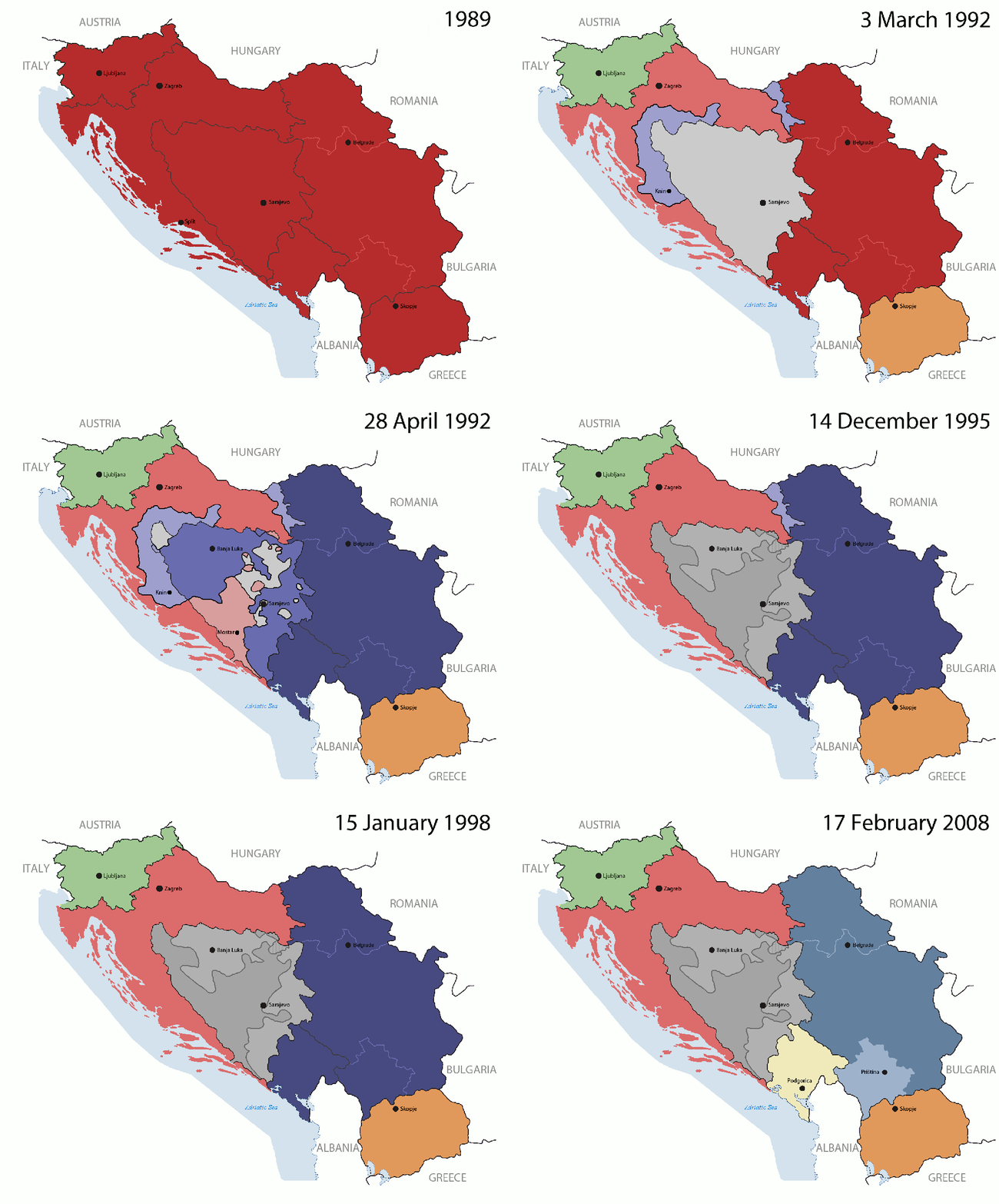
12 May 1992:
People are not little stones or keys in someone’s pocket, that can be moved from one place to another just like that. … Therefore, we cannot precisely arrange for only Serbs to stay in one part of the country while removing others painlessly. I do not know how Mr. Krajišnik and Mr. Karadžić will explain that to the world. That is genocide.
In the morning of 12 July 1995, a witness saw a pile of 20–30 bodies heaped up behind the Transport Building, alongside a tractor-like machine. Another testified he saw a soldier slay a child with a knife, in the middle of a crowd of expellees. He said he saw Serb soldiers execute over 100 Bosniak Muslim men behind the Zinc Factory, then load their bodies onto a truck, though the number and nature of the murders contrasted with other evidence in the Trial Record, which indicated killings in Potočari were sporadic in nature. Soldiers were picking people out of the crowd and taking them away. A witness recounted how three brothers – one a child, the others in their teens – were taken out in the night. When the boys’ mother went looking for them, she found them naked and with their throats slit.
Testimony of Ramiza Gurdić:
I saw how a young boy of about ten was killed by Serbs in Dutch uniform. This happened in front of my own eyes. The mother sat on the ground and her young son sat beside her. The young boy was placed on his mother’s lap. The young boy was killed. His head was cut off. The body remained on the lap of the mother. The Serbian soldier placed the head of the young boy on his knife and showed it to everyone. … I saw how a pregnant woman was slaughtered. There were Serbs who stabbed her in the stomach, cut her open and took two small children out of her stomach and then beat them to death on the ground. I saw this with my own eyes.

“Where is my child?”—An echo answers—”Where?” -Lord Byron, Bride of Abydos (1813), Canto II, Stanza 27.
—-
This was all part of a greater war on Islam that would gradually escalate over the years (Iraq, Afghanistan, Libya, Palestine, etc). In a way, what’s happening in Gaza is a continuation of this crusade. The youth of today are dumbfounded by the horrors they see on the internet. But for older generations, the war on Islam has been the staple in foreign policy over the geopolitical landscape since Britain first arrived in India. Seen in a long arc, Europe’s first sustained encounter with large Muslim populations under its rule came through the British East India Company and, later, the Raj. After the 1857 “Mutiny”—in which many rebels rallied around the last Mughal emperor—British officials openly classed Muslims as a potentially seditious “martial race,” imposing collective fines, land confiscations and educational exclusions that crippled a community already dislodged from power. Contemporary colonial tracts argued that Islam, “fanatical by nature,” had to be policed lest it invert Christian civilization—an early template for treating an entire faith as a security problem.
Those anxieties traveled northwest into the Hindu-Kush. In the First Anglo-Afghan War (1839-42) the Company deposed Emir Dost Mohammad because London feared an “invading Islamic army” might spark revolt in India and open a corridor for Russia—justifying invasion as a pre-emptive strike against Muslim mobilization. During the second and third Anglo-Afghan wars the British again portrayed Kabul as a node of pan-Islamic intrigue, reinforcing the idea that imperial stability required chronic containment of Muslim polities along the frontier.
When World War I toppled the Ottoman Empire, the secret Sykes-Picot Agreement of 1916 carved its Arab provinces into British and French mandates. Local leaders who had fought alongside T. E. Lawrence discovered that self-determination stopped at the gates of European imperial interest; strategic railways and oilfields overrode Wilsonian rhetoric. The partition fixed borders that still channel conflicts from Mosul to Gaza, embedding a perception—common in the modern Middle East—that Western powers felt entitled to reshape Muslim lands by fiat.
Through the inter-war decades London and Paris alternated between direct rule and tutelage, but religion kept surfacing as the idiom of resistance—from the Ikhwan raids in Arabia to the 1936 Palestinian uprising. By 1948, when Britain withdrew from Palestine and Israel declared statehood, Arab newspapers were already describing a “new crusade” backed by Europe and, increasingly, the United States. Cold-War realpolitik briefly blurred the line—Washington armed Muslim fighters against socialist regimes—but after the Soviet collapse Samuel Huntington’s 1993 “clash of civilizations” thesis re-centred Islam as the West’s putative adversary.
Afghanistan offered the first laboratory. U.S. retaliation for 9/11 toppled the Taliban in weeks, yet two decades of counter-insurgency killed at least 46 000 Afghan civilians and perhaps twice that number once war-related disease and displacement are tallied. UNAMA’s final reports noted that the majority of casualties each year were inflicted by insurgents, but drone strikes, night raids and the expansion of “kill or capture” lists fed the belief that Western militaries accepted Muslim civilian deaths as strategic overhead.
Iraq cemented that perception. The 2003 invasion, sold on faulty intelligence, dismantled the Baʿath state and unleashed sectarian militias; Iraq Body Count documents more than 187 000 verified civilian deaths from violence, while household-survey models push the toll above 300 000. Images of Abu Ghraib and Fallujah circulated through Arabic satellite channels as proof that Arab Muslim life carried a discount on the scales of Western morality.
Libya in 2011 showed the pattern mutating, not disappearing. UN Resolution 1973 framed NATO’s air war as a civilian-protection mission, yet human-rights monitors later verified at least 72—and possibly several hundred—non-combatants killed by the strikes, numbers small beside Iraq but large enough to reinforce the message that Western airpower could decide Muslim fates with scant accountability.
Even Bosnia, often recalled as Europe’s “never again” awakening, fits the continuum. Bosnian-Serb media caricatured local Muslims as “Turks” to be uprooted from Christian soil, and the West’s three-year paralysis before Srebrenica convinced many in the Muslim world that humanitarian principles activated slowly when the victims prayed toward Mecca. Huntington’s book appeared the very year Mladić was first indicted, lending intellectual polish to older civilizational tropes.
Gaza today amplifies those resonances in real time. UNICEF calls the enclave “a graveyard for thousands of children,” and UNRWA records over 57 000 dead Palestinians—half of them women and minors—since October 2023; nearly 800 have been shot while queueing for food aid in just the past six weeks. Live-streamed carnage reaches phones within minutes, so Gen-Z viewers see what their grandparents glimpsed only in newspaper stills: Muslim civilians apparently expendable beneath the cross-hairs of a Western-armed state.
That immediacy shapes generational memory. Older Muslims, schooled on partition stories from India or Palestine, read Gaza as the latest chapter of an unbroken siege; younger activists, marinated in Bosnia documentaries and TikTok feeds from Rafah, experience it as a single, seamless livestream. Between them stands a corpus of policy literature—counter-insurgency manuals, terrorism blacklists, visa bans—that keeps circling back to the same target set: Muslim populations deemed incubators of unrest.
Yet the “war on Islam” label, while capturing a persistent disposition to securitize Muslim life, risks flattening local causality. Resource grabs, great-power rivalries and authoritarian survival strategies drive each conflict as much as religious bias. The United Nations’ declaration, in 2022, of 15 March as the International Day to Combat Islamophobia implicitly concedes the structural prejudice, even as it reminds us that dismantling it will require case-by-case political solutions rather than a single grand reckoning.
When Ratko Mladić strode into the fallen UN “safe area” at 4:15 p.m. on 11 July 1995, television cameras caught him proclaiming, “Here we are … in Serb Srebrenica. We give this town to the Serb nation as a gift.… The time has come to take revenge on the Turks.” His words—“Turks” was the slur Serb propaganda used for Bosniak Muslims—set the genocidal tone that followed over the next six days.
Inside the Dutchbat compound a few kilometres away, UN interpreter Hasan Nuhanović recalled how the peacekeepers decided to expel the refugees they were meant to protect: “Everyone wanted to remain inside the base, but the Dutch decided to actually throw them out. They gave me a megaphone and said, ‘Tell the people to start leaving the base in groups of five.’ At the gate Serb soldiers stood next to Dutch soldiers, pushing the men and boys away from their sisters, wives, children.”
Eight-year-old Almasa Salihović, trapped in the crush of thousands outside the factory in Potočari, remembered the night-time terror: “I recall the unbearable screams when Serb soldiers, dressed in UN uniforms, would walk among the people and pick out boys and men… I remember women trying to sleep on top of their husbands and sons, just so the Serb soldiers don’t spot a young man or an older one.”
Sixteen-year-old Emir Bektić, forced onto the “death-march” through the woods, later testified: “It was a very painful period— their only dilemma was whether to kill us there or to slaughter us down below in that stream we passed. For me, as a boy, I was scared.… I laid down on my father’s lap and he hugged me, and that is the last moment I remember from that night.”
Seventeen-year-old Nedžad Avdić survived the execution pits: “Exiting the school, I saw piles of dead people to my left and right. My blood froze and in that moment I realised it was the end.… It was the fiercest pain. I really wanted to die. I was in a state between life and death, praying to God for them to come and kill me.” A nameless “Witness Q” before the Hague tribunal echoed him: “When they shot, I threw myself on the ground … I could hear one man crying for help. He was begging them to kill him—and they simply said, ‘Let him suffer. We’ll kill him later.’” One of the killers, Dražen Erdemović, confessed: “The men in front of us were ordered to turn their backs … we shot at them. We were given orders to shoot.”
The violence against women was just as deliberate. Survivor Zarfa Turković described a scene witnessed by many in the crowd: “Two [Serb soldiers] took her legs and raised them in the air, while the third began raping her. Four of them were taking turns on her.… She was screaming and begging them to stop. They put a rag into her mouth, and then we just heard silent sobs.”
For those who lived, the massacre never really ended. Senada Pargan, then seventeen, recalled the first night after the fall: “They were taking people and killing them and torturing them.… Everything was so quiet, but you could hear the screaming of whoever they were torturing somewhere close to us.” Behidin Piric, who later identified his grandfather’s body, remembered the moment the phone rang in Missouri: “I had the task of telling my mother … that they found her father, so that was a pretty tough thing to do.”
Taken together, these fragments of speech—uttered under flood-lights at Potocari, whispered from beneath piles of bodies, or relived decades later across an ocean—trace an unbroken line of eyewitness memory that no amount of denial can erase.
Many scholars trace a through-line from early-1990s Bosnia to today’s Gaza war in the way Muslim civilians are repeatedly cast as expendable collateral, but they also caution that each theatre has its own local drivers. In the 1990s a new post-Cold-War rhetoric—Samuel Huntington’s “clash of civilizations” thesis being its most famous manifesto—reframed Islam itself as a geostrategic rival, and an expanding cottage industry of think-tanks, pundits and political entrepreneurs in Washington and Europe began to treat Muslim-majority societies as a single security problem. Reports by The Carter Center and legal scholars chart how that narrative hardened into policy language about “front-line states” and “pre-emptive defence,” laying conceptual rails for the later Global War on Terror.
Bosnia supplied an early proof-text. Although the war there sprang from Yugoslavia’s ethnic partition, Serb media framed Bosniaks as “Ottoman Turks” bent on turning central Europe Muslim again, a trope that made the 1995 Srebrenica killings appear not merely tactical but civilizational. International courts now label that episode genocide, yet polling on this year’s 30th-anniversary commemoration shows sizeable Bosnian-Serb sectors still reject the term, signalling how durable the anti-Muslim coding remains.
In the quarter-century since, a string of conflicts—from Chechnya and Iraq to Xinjiang, Kashmir and Myanmar—has reinforced the perception of an encircling “war on Islam,” even as the local motives range from secession to counter-insurgency to resource control. Rising Islamophobia prompted the United Nations in 2022 to declare 15 March the International Day to Combat Islamophobia, implicitly acknowledging that anti-Muslim bias is no longer a fringe pathology but a structural feature of global politics.
Gaza has become the latest—and visually the most mediated—flashpoint. UNICEF now speaks of the enclave as a “graveyard for thousands of children,” citing more than 50,000 killed or wounded since renewed fighting erupted in late 2024, and 74 dead in the first week of 2025 alone. The scale and digital immediacy of those images convince many younger viewers that they are witnessing a continuation of the same pattern Bosnian survivors first warned about three decades ago.
Older generations, who remember Bosnia, Chechnya and the 2003 Iraq invasion, tend to slot Gaza into a long continuum of selective intervention: robust Western force to protect oil routes or European borders, but hand-wringing or paralysis when Muslim civilians are the primary victims. Younger activists, armed with smartphones and livestreams, experience the pattern less as a chain of case studies than as an always-on moral spectacle, provoking both solidarity campaigns and new waves of radicalisation. The intergenerational divergence is thus not about whether a “war on Islam” exists, but about how it is seen—archive versus feed, history lesson versus raw feed.
Analytically, equating every conflict with a unified crusade misses crucial distinctions: Bosnian Serb leaders pursued an ethno-territorial project, Israel’s war in Gaza centres on statehood and security doctrine, and U.S. policies after 2001 mixed counter-terror aims with realpolitik. Yet the common denominator remains the ease with which Muslim populations can be narrated as security threats, rendering civilian suffering politically bearable to outside powers. That rhetorical substrate—rather than an orchestrated grand strategy—links Srebrenica to Gaza and sustains the impression of a single, rolling war on Islam.
Bosnian Serb commanders chose Srebrenica’s Bosniak Muslims as their target because eliminating that community was the linchpin of a wider scheme to cleanse the entire Drina-valley frontier of Muslims and weld together a territorially continuous, ethnically “pure” Republika Srpska. In mid-1992 the Bosnian-Serb assembly adopted “strategic objectives” that explicitly called for erasing the Drina River as a boundary by driving out or destroying its Muslim population, whom propaganda cast as alien “Turks.” Three years later, when Ratko Mladić’s troops overran the UN “safe area,” Serb leaders portrayed the enclave’s male inhabitants not as civilians but as a reserve army that had to be annihilated both to secure the corridor and to avenge earlier raids on surrounding Serb villages. That combination of territorial ambition, ideological Islamophobia and reprisal logic produced the decision to separate the men and boys from the rest of the refugees and execute them en masse—an act the International Criminal Tribunal ruled was undertaken with genocidal intent to cripple the very existence of Bosnia’s Muslim community in eastern Bosnia.
The Muslim communities you meet in Bosnia today trace their origins not to migrant Turks transplanted from Anatolia but to the gradual conversion of the native South-Slavic population after the Ottoman conquest of the medieval Bosnian kingdom in 1463. For the empire, Bosnia was a coveted western march—a limestone rampart shielding the road to central Europe—and it was from this newly won frontier that Ottoman armies later pushed up the Sava and Danube valleys toward Vienna, first in 1529 under Süleyman the Magnificent and again in 1683, both campaigns launched long after Bosnia itself had been secured.
Islam did not sweep across the countryside overnight. Contemporary court records and later tax surveys show that more than a century elapsed before Muslims became a demographic plurality, the process accelerating in towns tied to the imperial garrison and administrative network. Historians stress three overlapping motives: (1) the shallow roots and fragmented authority of the pre-Ottoman churches—Catholic, Orthodox and the locally heterodox Bosnian Church—left many peasants religiously unaligned; (2) conversion opened doors to the sipahi land-tenure system, trade privileges and exemption from the non-Muslim poll-tax, even though Muslims paid other levies and owed full military service; and (3) the symbolic appeal of joining the ruling estate in a province that now sat on the empire’s front line.
Because the switch of faith was overwhelmingly local, Bosnian Muslims (who would later adopt the ethnonym Bosniak) remained linguistically South-Slavic and culturally distinct from Turks or Albanians, despite a thin layer of Ottoman soldiers, administrators and craftsmen who did settle in the fortresses strung along the Drina and beneath Velež. Over time, the new Muslim elites—judges, janissary veterans, guild masters—intermarried with Christian neighbors, patronized Sufi lodges, and furnished cavalry and janissary contingents for campaigns as far afield as Buda and, indeed, Vienna itself. Their emergence produced the tripartite religious mosaic—Muslim, Orthodox and Catholic—that would outlast Ottoman rule and shape every modern debate about identity in the western Balkans.

From the eighth century BCE onward Greek mariners edged up the Adriatic, founding trading posts such as Pharos on Hvar and Issa on Vis and encountering the indigenous Illyrian tribes who dominated the rugged interior; the result was a borderland where Hellenic coins, wine amphorae and myths mingled with Illyrian hill-forts and piracy, long before Rome arrived to arbitrate the rivalry.
Rome’s arbitration was, in truth, conquest: three Illyrian Wars (229–168 BCE) ended in the provincial twin of Illyricum and, later, Dalmatia, whose capital Salona became a crucible of Latin law, road-building and early Christianity; Diocletian even retired to a palace at nearby Split. When imperial frontiers buckled in the fifth and sixth centuries, Goths, Avars and other migrants battered the coastal cities, yet the old Roman tax registers and dioceses lingered, waiting for new masters.
Those masters were Slavs. Between roughly 550 and 700 CE, South-Slavic clans—Sclaveni, Croats, Serbs and others—poured through the Danube limes into a landscape still nominally Byzantine, adopting Orthodox or Catholic rites according to whether Constantinople’s missionaries or Latin bishops reached them first. Their wooden zadruga villages replaced Roman villas inland, while Latin-speaking islanders and the merchant Republic of Ragusa kept an Adriatic cosmopolitanism alive on the coast.
By the high Middle Ages, three native states crystallised: a Catholic Kingdom of Croatia that soon fell into a personal union with Hungary (1102); an Orthodox Serbian realm whose Nemanjić dynasty briefly forged an empire stretching to the Aegean (1346); and a syncretic Bosnian kingdom that resisted both papal crusades and Serb expansion. Venice meanwhile secured the Dalmatian ports, selling salt and silk across the Adriatic, and Ragusa (Dubrovnik) thrived as a neutral maritime republic, proving that commerce could outlast crusades.
The Ottoman irruption after 1389 redrew every frontier: Serbia collapsed at Kosovo, Bosnia was annexed by 1463, and much of Macedonia, Kosovo and Sandžak became timar lands. Islam took root among Bosnian Slavs, multiplying the region’s religious mosaic, while the Habsburg crown turned Croatia and Slavonia into a fortified “Military Frontier” garrisoned by Orthodox Grenzer settlers granted free land for perpetual service against the Sultan. Centuries of low-intensity raiding, plague and flight etched demographic patchworks that twentieth-century census takers would still be mapping.
After the Ottoman defeat at Karlowitz (1699) the Habsburgs advanced south, absorbing most of Croatia and all of Slovenia, while Venice and later Napoleon’s short-lived Illyrian Provinces introduced codes, cadasters and the idea that South Slavs might be citizens rather than subjects. Croatian nobles debated autonomy in a Hungarian parliament, Orthodox bishops negotiated privileges with Vienna, and peasants on both sides rebelled when taxes or conscription bit too hard.
National romanticism lit the 19th-century fuse. In the Ottoman zone the First and Second Serbian Uprisings (1804–17) carved an autonomous Serbia on the Morava; in Habsburg Zagreb Ljudevit Gaj’s Illyrian Movement (1830s–40s) promoted a shared literary language for Croats, Serbs and Slovenes and coined the very word “Yugoslav” (South Slav). Each group dreamed of liberation but disagreed over who would lead: a liberal federation, a Croatian historical state, or a Greater-Serbian kingdom riding Russian pan-Slav patronage.
Events hurried the argument. The 1878 Congress of Berlin recognised full independence for Serbia and Montenegro and handed the occupation of Bosnia-Herzegovina to Austria-Hungary, which annexed the province outright in 1908, alarming both Serb nationalists and their Russian backers. Intellectuals from every South-Slav land now met in cafés from Belgrade to Paris, drafting manifestos that promised unity once the dual oppressors—Ottomans in the southeast, Habsburgs in the northwest—collapsed.
Collapse came through the Balkan Wars (1912–13), in which Serbia, Bulgaria, Greece and Montenegro expelled the Ottomans from almost all Europe but then fought over the spoils, and through the global shock wave of the Sarajevo assassination in 1914 that ignited World War I. By 1918 the Ottoman Empire had shrunken to Anatolia, the Habsburg monarchy disintegrated, and Serbian armies—now victorious allies—stood in Belgrade, Skopje and the Adriatic hinterland.
On 1 December 1918 the elected National Council of Slovenes, Croats and Serbs in Zagreb merged with Serbia and Montenegro to proclaim the Kingdom of Serbs, Croats and Slovenes, soon known simply as Yugoslavia. Intended as the institutional answer to a millennium of shifting borders, religious frontiers and great-power partitions, the new state began with heady talk of brotherhood yet inherited every fissure—economic, confessional and constitutional—that its turbulent Balkan past had inscribed.
Yugoslavia’s long-unravelling began with the contradiction at its core: a multi-ethnic state created after 1918 and re-forged by Tito’s partisans after 1945, yet held together less by a shared national story than by the charisma of a single leader and the strategic value of non-alignment during the Cold War. For four decades Tito balanced six republics and two autonomous provinces through a mixture of federal subsidies, rotating quotas and a one-party system that suppressed overt nationalism. His death in 1980 removed the arbiter just as détente faded, exposing a polity whose unity depended on a strong centre that no longer existed.
The 1974 constitution, drafted to placate republic grievances after earlier crises, fatally decentralised power: each republic gained a veto over federal decisions, Kosovo and Vojvodina became semi-states of their own, and a collective presidency rotated yearly among eight leaders. What looked like an elegant safeguard against hegemony proved a recipe for paralysis once Tito was gone, because no successor enjoyed the authority—or the time in office—to broker compromise. During the vacuum of the early 1980s republican elites stopped seeing Belgrade as the referee of last resort and started treating it as an arena for zero-sum competition, priming public opinion to equate constitutional reform with national survival.
An external shock accelerated the fissures: the global oil and interest-rate crises left Yugoslavia with US $20 billion in debt, and IMF-mandated austerity dismantled the social-wage model that had underwritten Titoist solidarity. Unemployment in the poorer south soared above 25 percent, while export-oriented Slovenia and Croatia resented financing what they viewed as Serbian mismanagement. Strikes, hyperinflation and a fall in real wages of nearly 40 percent over the decade convinced many citizens that federal institutions could neither protect livelihoods nor distribute hardship fairly. In the republican press, economic misery quickly morphed into moral indictment: “why should we pay for them?” became the refrain from Ljubljana to Zagreb—and from Belgrade toward Kosovo Albanian “separatists.”
Into this ferment stepped Slobodan Milošević, who harnessed Serbian frustration over Kosovo’s autonomy to relaunch a centralising project in the name of defending Serb rights. His 1989 revocation of Kosovo’s self-rule and purges in Vojvodina and Montenegro upended the delicate ethnic arithmetic, convincing Slovenes and Croats that a resurrected Greater-Serbia lay behind calls for a stronger federation. Conversely, Milošević’s rallies on the “battlefront of Kosovo” made any concession appear treasonous to Serb audiences, embedding mutually exclusive narratives of victimhood across the republics. The republic-level elections of 1990—the first multiparty contests since 1945—brought nationalist or secession-minded parties to power almost everywhere, leaving the Yugoslav People’s Army (JNA), itself two-thirds Serb by 1991, as the last pan-Yugoslav institution.
The international context finished the job. With Moscow in retreat and Washington focused on German unification and the Gulf, European Community states inherited mediation but disagreed on ends: London and Paris favoured preserving a reformed federation, while Bonn—mindful of its large Croat and Slovene diasporas—leaned toward recognising independence. When Germany announced it would recognise Slovenia and Croatia on 23 December 1991, the EC fell into line, signalling that the outer wall of sovereignty had collapsed. At the same moment the Badinter Arbitration Commission concluded that Yugoslavia was already “in the process of dissolution,” giving diplomatic cover to republican independence bids and removing what little incentive remained for compromise within federal forums.
Fear now drove escalation: Slovenia’s Ten-Day War proved the JNA could be fought to a stand-off; Croatia’s conflict revealed how quickly ethnic policing slid into full-scale war; Bosnia’s leaders, watching both, calculated that neutrality meant being carved up by neighbours. Each republic raced to rename local Territorial Defence units as national armies, seize federal barracks and control media narratives that painted adversaries as existential threats. Once battle lines hardened, the very mechanisms meant to reconcile differences—vetoes, devolved militias, a multi-ethnic officer corps—became force multipliers for civil war, because every side possessed both the legal right and the matériel to ignore federal orders.
Thus Yugoslavia disintegrated not through a single coup or foreign conspiracy but through the confluence of a paralysing constitutional design, an unforgiving economic downturn, leaders who weaponised historical grievances, and external actors who redefined sovereignty faster than local institutions could adapt. By the time the last federal prime minister resigned in late 1991, the state existed largely on paper; what remained were republics armed with mutually incompatible visions of security, legitimacy and identity—fault-lines that would soon explode in Croatia, Bosnia and, later, Kosovo.
The collapse of socialist Yugoslavia in 1991-92 turned Bosnia-Herzegovina—an ethnically mixed republic of Bosniaks (Muslims), Serbs and Croats—into the most fragile arena of the breakup. A February–March 1992 referendum, boycotted by most Serbs, produced an overwhelming vote for independence; the European Community and the United States recognized the new state on 6 April. That same day Bosnian Serb units backed by remnants of the Yugoslav People’s Army (JNA) shelled Sarajevo, signalling that questions of borders, identity and power would now be settled by force rather than negotiation. Key points at the outset were the absence of a single security force, the rapid arming of rival militias, and the vacuum left by a disintegrating federal authority—all of which allowed extremist visions of “Greater Serbia” and “Herceg-Bosna” to set the war’s agenda.
Over the next year the conflict escalated from scattered firefights into state-shattering violence: the 44-month siege of Sarajevo, systematic ethnic cleansing in eastern Bosnia, and competing Croat–Bosniak and Serb offensives that carved the republic into three patchworks of trench-linked cantons. The logic of escalation was brutally simple—control territory, remove or terrorise the unwanted population, install parallel administrations—yet its execution was chaotic, involving regular armies, paramilitaries, police units and foreign volunteers whose autonomy often exceeded the political leaders who claimed to command them. By late 1993 some two million people were displaced, and televised images of emaciated prisoners in camps such as Omarska forced the word “genocide” back into European vocabulary.
Motives differed but converged on territory and demographic dominance. For Bosnian Serb leader Radovan Karadžić, the goal was to link Serb-majority enclaves into an ethnically homogeneous Republika Srpska and eventually a common state with Serbia. Franjo Tuđman’s Croatia both defended its kinsmen in Bosnia and sought a Croat mini-state, Herceg-Bosna, that could later be annexed. President Alija Izetbegović’s Bosniak-led government, outgunned and encircled, fought above all for the survival of a multi-ethnic Bosnian republic. Fear of past atrocities (from Ustaša massacres to Chetnik reprisals) hardened each community’s narrative, turning every village into a potential fortress and every compromise into a betrayal.
External backing amplified the war. Belgrade supplied Bosnian Serbs with heavy weapons, logistics and officers, while Zagreb channelled arms and money to Bosnian Croats. Despite a UN arms embargo, the Bosnian government received clandestine aid from Islamic countries; hundreds of foreign mujahideen arrived, just as Greek and Russian volunteers fought for the Serbs. Moscow’s sympathy for fellow Orthodox Slavs produced political cover and a trickle of fighters; Iran, Turkey and Saudi Arabia framed their help as solidarity with embattled Muslims. The result was a dizzying overlay of proxy interests that complicated every cease-fire and emboldened hard-liners who believed outside patrons would ultimately rescue them.
Washington’s stance evolved from cautious humanitarianism (“lift-and-strike” debates in Congress) to reluctant leadership. Haunted by Somalia and wary of deploying ground troops, the George H. W. Bush and early Clinton administrations deferred to UN peacekeepers and European diplomacy. By mid-1995, however, repeated Serb shellings of Sarajevo markets, the humiliation of UN hostages and the collapse of “safe areas” shredded the credibility of restraint. After the second Markale massacre and Srebrenica’s fall, the United States marshalled NATO into Operation Deliberate Force—two weeks of precision air-strikes that broke the siege lines and forced the Serb side to negotiate. American envoy Richard Holbrooke then brokered the Dayton Accords, ending the war on terms shaped largely by U.S. power.
Russia began the conflict voting for sanctions on Serbia in UN Resolution 757 (May 1992) but soon opposed any escalation to coercive force. Foreign Minister Andrei Kozyrev tried to mediate while nationalist deputies condemned Western “anti-Serb” bias; Moscow routinely sought to dilute Security Council drafts and denounced NATO air-strikes as illegal. Culturally, many Russians saw Bosnian Serbs as co-religionists abandoned by the West; hundreds volunteered to fight, even as the Kremlin officially upheld the arms embargo. This ambivalent posture—diplomatic engagement without willingness to punish Belgrade—frustrated U.S. officials yet preserved Russia’s role as indispensable broker in the Contact Group negotiations.
China’s position was steadier but just as restrictive: non-interference, sovereignty and scepticism toward humanitarian intervention. Beijing abstained on most Bosnia resolutions that authorised enforcement actions and, together with Russia, expressed “serious concern” that UNPROFOR might morph into a combat force. Both powers abstained on Resolution 998 (June 1995), which increased UN troops and hinted at more robust rules of engagement, and China later echoed Russia’s insistence that any settlement respect Bosnia’s territorial integrity without imposing external judgments. A 2024 Security Council statement shows that Beijing still frames the war through these principles, stressing reconciliation over punitive labels.
The United Nations tried to square this diplomatic circle with the “safe-area” concept of 1993, declaring enclaves such as Srebrenica, Žepa and Goražde demilitarised zones under lightly armed peacekeepers. In reality Srebrenica was a 12-mile pocket crowded with 40,000 Bosniak refugees, short on food, medicine and ammunition, and ringed by Bosnian Serb artillery. UNPROFOR’s Dutch battalion (Dutchbat) had neither heavy weapons nor a clear mandate to repel a major assault; air-support requests required a tortuous chain of approvals that fatally slowed any response.
By early July 1995 General Ratko Mladić launched coordinated attacks that overran a string of watch-posts, separated Dutch peacekeepers from the civilian population and severed the lone supply road to Srebrenica. UN calls for NATO close air-support were first denied for fear of Serb retaliation against hostages; when two sorties finally bombed Serb armour on 11 July, it was too late. Mladić entered the town the same afternoon, assuring terrified residents they would be evacuated—a promise that masked a pre-planned operation to eliminate the male population, whom Serb leaders portrayed as “terrorists” responsible for earlier raids.
Over the next week Bosnian Serb forces bused or marched more than 8,000 men and boys to execution sites, dumping the bodies into hastily dug mass graves later bulldozed and re-buried to hide evidence. The massacre was the culmination of a strategy of ethnic cleansing and a calculated signal that, in Serb-controlled territory, a Muslim community could be erased with impunity. Washington cited the atrocity to press NATO for the wide-ranging Deliberate Force campaign; Moscow condemned the killings yet warned against “anti-Serb hysteria,” and Beijing remained largely silent, arguing that facts should be established before punitive labels were applied. Two decades later Russia vetoed a UN draft that would have formally labelled the massacre genocide, while China abstained—positions consistent with their 1990s skepticism of Western-led humanitarian action.
NATO’s air offensive shattered Bosnian Serb heavy weapons, and the Dayton talks in November 1995 froze the battle-lines into a single state composed of two highly autonomous entities. The United States became the guarantor of this peace, deploying 60,000 troops to the Implementation Force; Russia contributed a brigade to preserve influence; China offered reconstruction aid but no soldiers. The International Criminal Tribunal for the former Yugoslavia later convicted Mladić, Karadžić and others of genocide, though denial persists in parts of Republika Srpska and Serbia. Annual commemorations—most recently the 30th anniversary gathering on 11 July 2025—underscore both the war’s unresolved traumas and the enduring divide between a Western narrative of genocide and the more guarded or revisionist stances still favoured in Moscow and Beijing.
The idea of a “war on Islam” germinated not in the twenty-first century but in the late imperial moment when European powers first ruled large Muslim populations and learned to treat them as a single strategic problem. After the 1857 uprising in India, British officials reclassified Muslims as a uniquely “martial race” prone to sedition and imposed collective fines, land seizures and educational quotas that institutionalised suspicion of the faith itself. The same logic travelled westward: London’s Afghan campaigns, and later the Franco-British partitioning of Ottoman Arab lands, cast Muslim polities as frontier obstacles whose borders, rulers and even currencies could be redrawn whenever imperial transport, oil or security required it.
That template survived the Cold-War handoff from European empires to U.S. hegemony because it meshed neatly with late-twentieth-century ideological currents. Samuel Huntington’s 1993 essay recoded old colonial anxieties as a looming “clash of civilizations,” singling out Islam as the West’s most “bloody” border and providing an intellectual frame that policymakers could cite—explicitly or not—when justifying everything from Bosnia’s slow-motion intervention to the post-9/11 Global War on Terror. Once securitised in this way, Muslim populations became the default suspect in counter-insurgency manuals, visa regimes and drone-strike protocols, creating a feedback loop in which every new crisis confirmed the prior label of inherent volatility.
The result is less a centrally orchestrated crusade than a structural disposition: major powers, regional autocrats and private contractors all find material or political gain in a security paradigm that discounts Muslim civilian life. Oil routes in the Gulf, arms markets in North Africa, counter-migration deals in the Sahel and surveillance tech exports to Xinjiang are disparate theatres made coherent by that shared discount rate. Multilateral attempts to name and curb the bias—such as the UN’s 2022 designation of 15 March as the International Day to Combat Islamophobia—mark an overdue acknowledgement, yet they have not altered the strategic incentives that keep the machinery running. Until new institutions—and new narratives—rewrite the profit-and-security calculus, each Gaza, each Srebrenica and each Fallujah will be read by the next generation as one more frame in a long, grim reel that many now simply call the war on Islam.
A workable “profit-and-security index” would marry two data streams that policymakers already track but rarely integrate: the cash value of strategic rents extracted from a conflict arena and the scale of security expenditures justified by that same arena. On the profit side you would aggregate, in constant dollars, arms contracts, energy concessions, private-security fees, reconstruction loans and transport-corridor royalties earned by external actors over a rolling five-year window. On the security side you would sum direct military outlays (deployments, drone operations, basing rights), intelligence and policing budgets attributed to the theatre, plus insured-loss estimates that corporations cite when negotiating risk premiums. Dividing the profit ledger by the security ledger yields a ratio: values above 1 indicate that the intervening power is in net surplus—extracting more wealth than it spends to keep the theatre “manageable”—whereas values below 1 signal a net security subsidy and thus a higher political tolerance for civilian harm or reputational cost.
Because pure dollar comparisons blur behind-the-scenes transfers, the index needs three weighting coefficients. Resource criticality (ρ) discounts or multiplies energy and mineral rents depending on how essential they are to the intervening economy’s supply chain; a barrel of Gulf oil scores higher for a petroleum-importing state than for a net exporter. Contract opacity (κ) adjusts profit tallies for the proportion routed through no-bid or classified arrangements—signals that the security frame itself is generating rents that market competition would otherwise suppress. Civilian-cost externalisation (χ) inflates the security denominator to reflect international legal exposure, sanctions risk and refugee outflows, ensuring the ratio does not reward actors who simply shift humanitarian costs onto neighbours or NGOs. The refined formula thus reads:
Index = (ρ × Profits) / [(Security Spend × κ) + χ].
Annual publication of the underlying ledgers, audited by multilateral bodies or reputable think-tanks, would let analysts watch the ratio tighten or widen as conflicts evolve and would expose which governments or firms benefit most from the “discount rate” placed on Muslim civilian life.
Applied retrospectively, the index helps explain why some theatres receive open-ended bombing campaigns while others languish under arms embargoes or rhetorical concern. Libya in 2011, for instance, likely produced an initial ratio above 1 for NATO states—hydrocarbon concessions soared even as security costs were spread across a short, air-only intervention—whereas post-surge Afghanistan trended below 1 once nation-building bills outpaced minable profits. Publishing those trajectories would not by itself dissolve the structural bias that underpins the so-called war on Islam, but it would illuminate the economic scaffolding behind policy mantras about “stability” and “humanitarian concern,” letting voters and courts price the moral deficit alongside the financial surplus.

 ov1d.com