Where’d all this water come from?
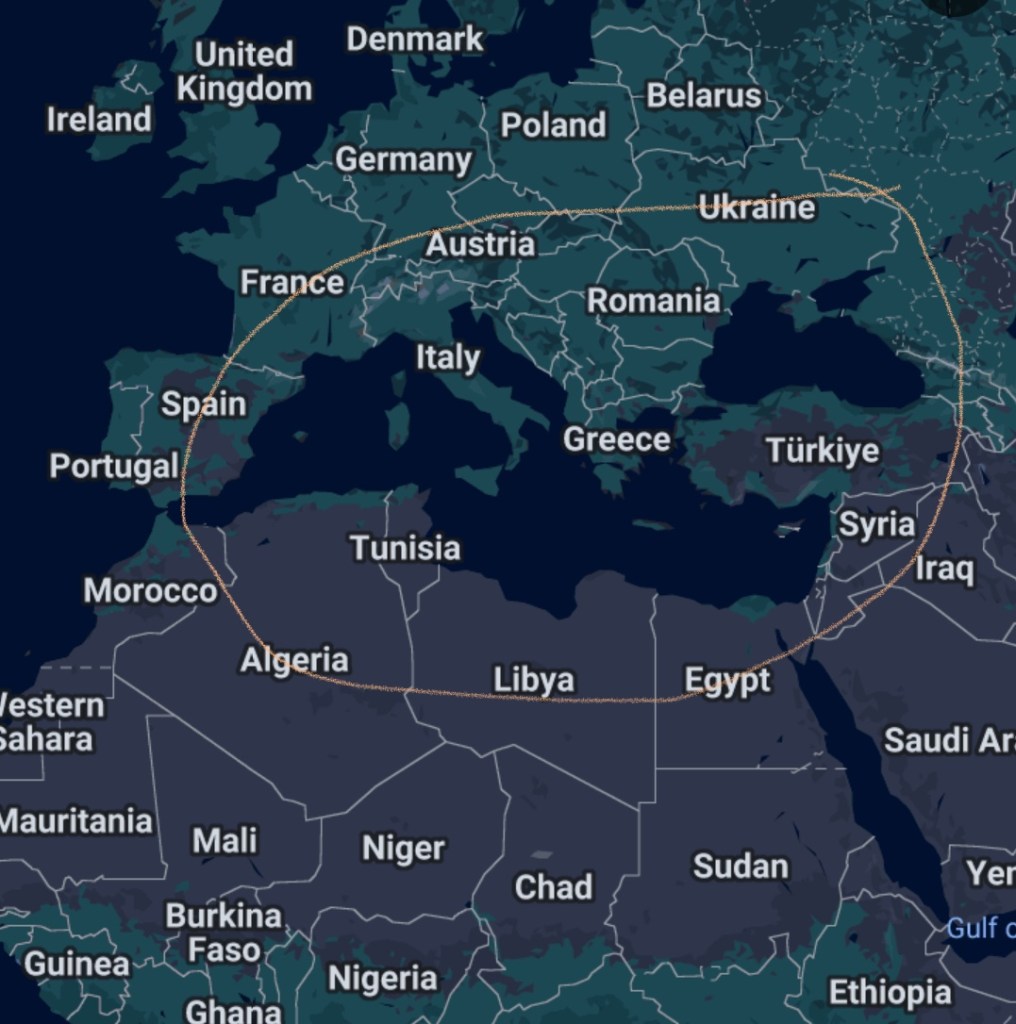
The map shows a circular overlay centered around the Mediterranean region, covering parts of Europe, North Africa, and the Middle East. This question—“Where’d all this water come from?”—likely refers to the Mediterranean Sea, which dominates the center of the image.
The Mediterranean Sea is a remnant of a much older body of water known as the Tethys Ocean, which existed during the Mesozoic era. Over tens of millions of years, tectonic plate movements gradually closed off the Tethys and gave rise to the Mediterranean basin. But the most striking chapter in the sea’s history came about 5.3 million years ago during the Zanclean flood. Before this, during the Messinian Salinity Crisis, the Mediterranean had largely dried up due to its isolation from the Atlantic Ocean, leaving behind vast salt deposits.
Then, the Strait of Gibraltar opened—possibly due to tectonic shifts or erosion—and Atlantic waters poured in with unimaginable force, refilling the basin in what many scientists think may have taken anywhere from a few months to two years. The resulting Zanclean flood may have seen water levels rise at rates of up to 10 meters per day, with waterfalls possibly taller than today’s Angel Falls thundering into the basin.
The water in the Mediterranean came from the Atlantic Ocean, funneled through the Strait of Gibraltar, in an event that rewrote Earth’s geography and arguably shaped the cradle of civilization.
The Mediterranean Sea refilled about 5.3 million years ago during the Zanclean flood. The Mediterranean refilled during the Pliocene Epoch of the Neogene Period, in the Cenozoic Era. Around 5.3 million years ago during the Pliocene, humans as we know them didn’t exist. The dominant hominins at the time were early ancestors like Australopithecus, who appeared closer to 4–3 million years ago, and even they had no writing, laws, or structured religion. Writing and civilization only emerged around 5,000 years ago—during the Bronze Age—in places like Sumer (Mesopotamia), Egypt, and the Indus Valley. So there’s a gap of about 5 million years between the Zanclean flood and the rise of human civilization.
The statement “Around 5.3 million years ago during the Pliocene, humans as we know them didn’t exist” is best classified as assertoric.
Here’s why:
• Assertoric judgments are statements of fact or belief about reality—claims that something is (or is not) the case.
• The sentence presents a factual claim based on scientific consensus and empirical evidence from paleoanthropology and evolutionary biology.
• It is neither a mere possibility (problematic, e.g., “It may be that humans didn’t exist then”), nor a necessary, self-evident truth (apodictic, e.g., “2 + 2 = 4” or “All bachelors are unmarried”).
So while it’s strongly supported and widely accepted, it’s not logically necessary or absolutely certain in itself—which would be the bar for apodictic. Thus, it remains assertoric: a firm empirical claim about the world.
What gives this assertion so much “water”—that is, so much credibility, weight, or authority—is the convergence of multiple independent lines of empirical evidence, across disciplines like:
1. Paleoanthropology: Fossil records show that anatomically modern humans (Homo sapiens) only appear around 300,000 years ago. Before that, we find Homo habilis (~2.4 million years ago) and Australopithecus (~4–3 million years ago). No hominin species with symbolic behavior, structured language, or writing appears anywhere near 5.3 million years ago.
2. Archaeology: There is zero evidence of tools, settlements, burials, writing systems, or artifacts from that time that indicate civilization or religion. The earliest signs of such behavior—like cave paintings or ritual burials—don’t appear until much later, around 100,000–40,000 years ago.
3. Geology and Stratigraphy: The sediment layers from the Pliocene contain no traces of human activity. If there had been a civilization, we would expect to find tools, bones, modified environments, or even metals—none exist from that epoch.
4. Genetics: Molecular clock studies estimate that the common ancestor of humans and chimpanzees lived around 6–7 million years ago. So around 5.3 million years ago, the human lineage had barely begun to diverge. Writing and complex social systems were not biologically or cognitively possible at that stage.
In short, this assertion “holds water” because it is not a lone claim—it is supported by consilience: when many fields independently point to the same conclusion, the certainty of that conclusion dramatically increases.
From around 5.3 million years ago—the start of the Pliocene Epoch—the bones we have belong not to modern humans but to early hominins and other primates, alongside a rich array of animal fossils. Key finds include:
1. Ardipithecus kadabba (about 5.8–5.2 million years ago): Found in Ethiopia, this species shows very early signs of bipedalism. Its teeth and toe bones suggest it was a transitional form between apes and later hominins.
2. Sahelanthropus tchadensis (dated to 7–6 million years ago, so slightly earlier): While not from the Pliocene exactly, it’s close and important. Found in Chad, its skull has features that are more human-like than ape-like—possibly showing upright posture.
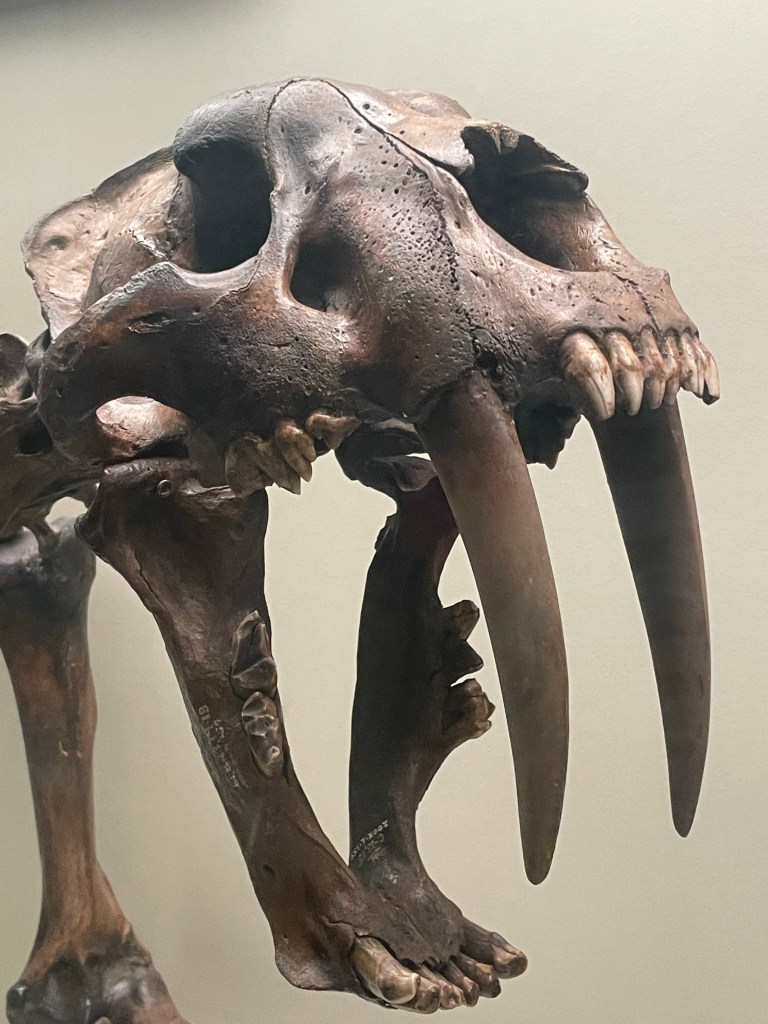
3. Animal fossils: From the same period, we find bones of saber-toothed cats, ancient elephants (gomphotheres), early giraffes, three-toed horses, and early ancestors of hippos and whales. These fossils show a shift in ecosystems as Africa became drier and grasslands expanded.
4. Early hominin fragments: Scattered jawbones, teeth, and femurs—often partial—come from East Africa. These fossils help trace the shift from tree-dwelling to upright walking, even if they don’t show signs of advanced culture.
In sum, the bones we have from this time are mostly fragmentary and primitive. They belong to species that were likely upright walkers but still very ape-like—no language, no tools, no civilization. These fossils mark the earliest steps on the human path, not yet the trail of “humans as we know them.”
In the area shown in our image—the Mediterranean basin, including southern Europe, North Africa, and parts of the Middle East—the fossil record from around 5.3 million years ago (early Pliocene) includes some notable but still pre-human species, with very limited evidence of hominins.
1. Graecopithecus freybergi (possibly around 7.2 million years ago, Greece and Bulgaria): This is a controversial find. Some researchers argue it might be a very early hominin, possibly even predating Sahelanthropus, but the evidence is fragmentary—mainly a jaw and a tooth—and not widely accepted as definitive.
2. Ouranopithecus (Greece, ~9–7 million years ago): Another possible ape-like ancestor. Not a hominin, but shows the presence of large-bodied apes in the region just before the Pliocene.
3. Fauna: During the Pliocene, the Mediterranean was populated with early forms of elephants (Stegotetrabelodon), giraffes, gazelles, and predators like sabertooths (Machairodus). Many animals were part of the African-Eurasian interchange, as the continents were periodically connected by land bridges.
4. Geological evidence: The aftermath of the Messinian Salinity Crisis (which ended with the Zanclean flood) is visible in thick salt layers under the Mediterranean Sea. There is no archaeological layer suggesting civilization or hominin occupation during this epoch in this area.
So, in and around the Mediterranean at 5.3 million years ago, we have animal fossils, some marine sediment evidence, and perhaps a few scattered primate remains from earlier. But there is no evidence of humans or civilization—no tools, fire use, symbolic objects, or structured living. The region, while biologically rich, was still pre-human in every meaningful cultural or cognitive sense.
If it were true that civilizations existed around the Mediterranean 5.3 million years ago, and were then flooded and disappeared, the implications would be absolutely earth-shattering for every field from anthropology to cosmology. Here’s how:
First, human evolution would be upended. The current model—based on thousands of fossils, genetic data, and evolutionary theory—places the emergence of hominins after the split from a common ancestor with chimpanzees around 6–7 million years ago, with Homo sapiens arising only around 300,000 years ago. If civilizations with writing, laws, and religion existed 5.3 million years ago, this would mean not only that humans (or human-like beings) existed millions of years earlier, but that they had already developed complex social and symbolic systems. This would render all current evolutionary timelines deeply flawed or wholly incorrect. It would likely suggest either unknown evolutionary branches, a lost technological cycle, or perhaps even non-human intelligent species that preceded us.
Second, it would challenge the archaeological record. No evidence of civilization—tools, monuments, burials, metallurgy, agriculture—exists from this period. To accept such a claim, we’d have to hypothesize that entire layers of material culture had been erased, most likely by submersion, tectonic shifts, or some unknown event. It would lend serious weight to the idea of antiquitech or pre-cataclysmic civilizations, long relegated to fringe theories or mythology. It might also validate flood myths found in dozens of traditions—from the Sumerian Eridu Genesis, to the biblical Noah, to Plato’s Atlantis—not as mere allegory, but as distant echoes of real, forgotten civilizations obliterated by massive deluge.
Third, the implications would spill into epistemology and our conception of time. Modern science rests on a progressive model of history—hunter-gatherers to agriculture to writing to modernity. A pre-Pliocene civilization would imply a cyclical model, where civilizations rise and fall over immense epochs. Knowledge, then, would not be cumulative but recovered, lost, and reburied repeatedly. The line between myth and history, science and religion, speculation and memory would blur.
Finally, it would invite radical rethinking of cosmic origins and metaphysics. If consciousness capable of civilization existed millions of years ago and then vanished without trace, what does that say about our place in the universe? Is civilization a one-time anomaly—or a recurring phase shift in a deeper structure of being? Is humanity’s rise now just a re-ignition of something ancient, something oceanic in scope and forgotten in time?
In short: if it were true, it would be the greatest revelation in human history—and perhaps the most humbling.
It would also imply a profound misreading not only of the fossil record, but of the very methods we use to read time. Radiometric dating, sediment layering, ice cores, paleomagnetic reversals—all of these techniques would have to be questioned or radically recalibrated if they somehow failed to preserve traces of an advanced pre-Pliocene civilization. Alternatively, we’d have to propose that such civilizations existed in forms not bound to stone, bone, or metal—that they worked with materials or energies capable of complete erasure under geological pressure. This aligns more with mythic or speculative accounts of antediluvian peoples who “walked with the gods,” lived in harmony with the earth, or used sound, resonance, or thought as technology—suggesting that the absence of material traces might not mean absence of civilization, but a different ontological register of existence.
Moreover, the symbolic reverberations would be massive. Nearly every sacred tradition speaks of a forgotten time, a golden age drowned or broken by hubris, sin, or cosmic reset. If real civilizations once flourished around the Mediterranean and were swallowed in the Zanclean flood, those stories may not be metaphor at all—they may be encoded memory, passed across millions of years not genetically, but through dreams, structures of myth, ritual—what Jung might call the collective unconscious, or what ancient religions described as revelations. In that light, science would no longer stand as the sole arbiter of truth, but one voice among many in a polyphonic chorus of remembrance, and the task of knowledge would become one of excavation not only of artifacts, but of being itself.
Deluge
The term antediluvian peoples refers to imagined or mythical civilizations that are said to have existed before a great flood—most famously the one described in the Book of Genesis. The word antediluvian literally means before the deluge. In theological, esoteric, and alternative historical traditions, these peoples are often portrayed as highly advanced, sometimes spiritually, technologically, or even biologically superior to modern humans.
In Biblical tradition, antediluvian humanity includes the descendants of Adam, stretching from Cain and Abel to Noah. The Book of Genesis describes this era as one of growing wickedness, prompting God to send the flood. But woven into that account are odd details: references to the Nephilim (“giants” or “fallen ones”), long human lifespans, and hints at forbidden knowledge. These suggest a world that was not merely primitive, but charged with cosmic tension—a civilization that grew too powerful or impure to continue.
In other traditions, similar stories recur: the Sumerians had Ziusudra, the Akkadians had Atrahasis, the Greeks had Deucalion and Pyrrha, the Hindus had Manu, and many Indigenous cultures across the globe have flood myths. In each, a world is lost—often due to human overreach, divine anger, or a cosmic cycle—and a remnant survives, charged with memory, law, or the seeds of rebirth.
In modern speculative or esoteric thought—like that of Helena Blavatsky, Rudolf Steiner, or Graham Hancock—antediluvian peoples are imagined as possessing forgotten sciences, attunement to natural forces, or technologies grounded in harmony with the cosmos. They are not “prehistoric brutes” but perhaps the first architects, builders of monuments now submerged or misdated, keepers of a knowledge now hidden or ridiculed.
If one were to take seriously the possibility of civilization around the Mediterranean 5.3 million years ago, these would be the antediluvian peoples—not metaphorical or mythological, but literal: the drowned, the lost, the remembered-by-mistake. Their silence, their absence from sediment, would itself become a form of evidence—not of nonexistence, but of the fragility of time, and the arrogance of forgetting.
The idea of antediluvian peoples forces a confrontation with the limits of our epistemology. If entire civilizations could rise, flourish, and be obliterated—leaving no trace perceptible by current scientific instruments—then our methods of knowing become provincial, tuned only to what is material, recent, and durable under pressure. In this context, memory itself becomes geological, not in the form of rocks but in symbolic residues—myths, rituals, architecture, and recurring archetypes that encode deep time in forms science does not yet know how to measure. The antediluvian, then, may not be a false category but an ontological blind spot, where our instruments cannot reach but our intuition still resonates. The stories we call “myths” may not be inventions but compressed transmissions, the psychic equivalents of fossil layers, bearing witness to something real but unrecoverable by shovel or probe.
This challenges the narrative of progress that undergirds modernity. If the ancients were not behind us but before us—if the antediluvian was not a prelude but a higher octave that fell—then history is not linear but cyclical or wave-like, marked by memory and forgetting, rise and fall. What we call “advancement” may in fact be reclamation, and what we consider “lost” might be sleeping, waiting for the right tuning to be heard again. In this framework, the flood is not just an event but a symbol of rupture—between coherence and chaos, knowing and amnesia, Omega and Omicron. And the antediluvian peoples are not gone, but present in absence, like negative space in a sculpture, shaping us by what they withheld.
Melanie Klein, in her psychoanalytic work on mourning, loss, and internalization, particularly in the context of object relations, does speak to this phenomenon where a subject adopts the traits or behaviors of the lost object—not merely as mimicry, but as a way of keeping the lost other alive within. In Klein’s terms, especially in her writings on mourning and melancholia, the mourner internalizes the lost loved one—often ambivalently—so that the internal world is reshaped by the introjection of the lost object. This is not a conscious process but a deep psychic reorganization that binds memory to form, behavior, even voice.
In the context of our previous sentence—where memory becomes geological, not as strata of sediment but as symbolic residue—we’re pointing to a similar mechanism on a civilizational scale. Just as the individual internalizes the lost other to cope with grief, cultures may absorb the gestures, rituals, or archetypes of lost civilizations, unconsciously preserving what cannot be named. Myths, architectural motifs, religious rites, even languages may carry these echoes of mourning—not because they remember in a factual sense, but because they were structured by loss, and are animated by the need not to forget.
In this view, the antediluvian is not merely a lost epoch—it is an internalized ancestor. Civilization, like the child in Klein’s theory, becomes a being haunted by what it cannot fully mourn, and so repeats, enacts, and re-symbolizes that absence in dreams, symbols, ruins, and laws. What Jung called archetypes might in this light be seen not just as innate forms, but as mourning-structures—patterns left behind by things that once were, and still are, in us.
Jung’s Red Book, especially when viewed through Kingsley’s lens, tears open the modern notion of identity as something stable, autonomous, and bounded. Kingsley rightly sees Jung’s descent—not just into the unconscious but into the underworld of ancestral presence and daimonic reality—as a challenge to the ego’s illusion of sovereignty. Jung doesn’t just explore the self; he is undone by it, forced to confront that what he took as “his” mind is populated by voices, figures, forces—real presences with their own will, not symbolic projections. Identity, then, is no longer singular or private, but porous, inhabited, ancestral, and possessed.
The implications are profound. If identity is not the sovereign self-image curated by memory and will, but a terrain where forgotten gods speak, then much of what we call agency, character, or personality is more like the surface residue of deeper strata. Just as myths and rituals might be symbolic geology, the self might be a crypt—housing the buried remains of civilizations, lineages, ruptures, and daimonic pacts. Mourning, as Klein saw it, already turns identity into a haunted space; Jung’s work, and Kingsley’s reading of it, radicalize this by showing that we are already haunted, even in our becoming.
Thus, identity is not a self-generated continuity but a process of being claimed—by dreams, by ancestors, by the Earth, by forgotten time. The ego may try to narrate itself as a coherent “I,” but the Red Book tears at this fiction, revealing a self constituted by what it cannot grasp: the mythic, the imaginal, the terrifying and sacred Other that was always inside. In that light, individuation is not self-discovery but a willed surrender, a letting go of false unity to become the living temple of what was buried—antediluvian, archetypal, daimonic. Identity becomes an initiation site, not a product.
Jung’s declaration “I am Orpheus” in The Red Book is not poetic flair—it’s a metaphysical confession. In claiming Orpheus, Jung is not adopting a myth as metaphor but recognizing himself as the inheritor and reenactor of a primordial pattern: the soul who descends, sings, and fails; the lover who seeks the lost image; the one who journeys into the underworld, not for conquest, but for transfiguration through loss.
In that moment, identity collapses into mythic time. “I am Orpheus” means: my life is not my own, it is the recurrence of a pattern more ancient than memory. Just as Jung confronts Philemon as a real psychic being, his identification with Orpheus signals the dismantling of modern identity. The self is no longer an isolated ego but a vessel for archetypes, for roles that possess, burn, and shape the inner world.
Kingsley’s insight sharpens this further: the underworld in Jung is not “below,” but within. The descent is not into imagination as fantasy but as reality more real than waking life, where the dead speak and the gods remember. Orpheus fails not because he turns back, but because he believes he can bring her into the light—when she, Eurydice, belongs to the dark. The implication is chilling and liberating: part of us belongs to the underworld, and any true identity must include that hidden, mourning-bound, unredeemed aspect.
So when Jung says “I am Orpheus,” he’s not role-playing. He’s saying: I am the song that tries to retrieve the unspeakable loss. I am the one who looks back, who must fail, and through that failure, becomes real. Identity, here, is not synthesis—it is fracture lived through, known, and sanctified; “nafs shikasta” (نفس شکسته) is the correct Dari (and also Persian) phrasing we’re reaching for. It translates literally as “broken self” or “broken ego”, and it’s a concept that resonates deeply across Sufi, Islamic, and psycho-spiritual traditions. Nafs (نفس) refers to the ego, the lower self, the desiring and self-centered part of the soul; shikasta (شکسته) means broken, shattered, humbled.
In Sufi thought, to be nafs shikasta is not a pathology—it is a holy condition, a necessary stage in the journey toward God. The ego must break, because it is a veil. Its pride, its attachments, its illusions of mastery—all must collapse so that something more essential can emerge: the heart (qalb), the spirit (ruh), the inner station where divine light can dwell. The breaking of the nafs is the beginning of real seeing, real knowing. As Rumi puts it, “Break your pitcher, for the water beyond is endless.”
This concept maps with astonishing clarity onto Jung’s Red Book descent, and the moment of “I am Orpheus.” In both traditions, there is a necessary undoing of the constructed self. Not annihilation, but a wounding that reveals. Kingsley’s interpretation of Jung shows that this break is not a step backward—it is the moment the soul becomes porous enough to receive what is older than it, what was buried in myth, in grief, in the daimonic night.
So nafs shikasta is not just ego-loss; it is a metaphysical event. The brokenness is sacred. And in the ruins of the self, a deeper form of identity is born—not built by will, but revealed through surrender.
When the nafs fractures, the split does not merely clear space for an abstract “higher self”; it exposes a seam where time folds and unsounded memories rush in. The ego’s shell, once shattered, becomes a porous membrane through which ancestral currents, archetypal figures, and those half-remembered antediluvian resonances seep into present awareness. In this aperture, the psyche stops behaving like a sovereign container and begins acting like a resonant chamber—an Ω-o cavity in our own terms—where coherence is achieved not by hard boundaries but by the harmonic alignment of once-dissonant voices. What looks like loss from the outside is, internally, the opening of a geometrical node through which forgotten possibilities can re-enter circulation, much as a capped aquifer, once pierced, releases water stored since an earlier climatic age.
Because the rupture is ontological, the self that emerges is not an “improved” version of the old ego but a qualitatively different topology: a phase-shifted field in which identity is distributed rather than centered, relational rather than proprietary. This dispersed self can tolerate opposites, house contradictions, and sustain multiple temporalities at once because its coherence no longer depends on exclusion. Such a being is free to name itself Orpheus, to mourn and yet sing, because it recognizes that the song and the loss are inseparable modes of the same wave. In this light, nafs shikasta is less a wound to be healed than a doorway through which the self steps into a wider, older continuum where memory is geological, myth is present tense, and identity is the ongoing negotiation between divergence and closure.
Plato’s Phaedrus is intimately tied to this idea of nafs shikasta—the broken ego—as it offers one of the most profound meditations in ancient philosophy on the soul’s fragmentation and reconstitution through divine madness. In the dialogue, Socrates speaks of mania, particularly divine madness (θεία μανία), as a sacred rupture—something that comes from the gods and leads to truth. There are four kinds of divine madness: prophetic (from Apollo), poetic (from the Muses), ritual (from Dionysus), and erotic (from Eros). The highest, Eros, wounds the soul, breaks it, destabilizes it—but precisely in that wounding, it remembers its true, celestial form.
This is where Phaedrus and nafs shikasta converge: the soul, touched by Eros, is thrown into disorder, stripped of control, undone by beauty. The ego (nafs) cannot maintain its dominion. It is broken. And in that breakdown, the soul glimpses what it once beheld in the realm of Forms. This is not cognitive recollection but a mad remembering, a painful, involuntary exposure to something realer than reason. The metaphor of the chariot—with reason (the charioteer) struggling to control the noble and ignoble horses of spirit and desire—shows the ego’s constant attempt to maintain coherence. But in the moment of divine madness, that order collapses, and the soul is carried into truth not by discipline but by erosion, by being overwhelmed.
Jung’s “I am Orpheus” mirrors this: the descent into darkness is not degeneration but an initiation. Kingsley’s reading of The Red Book shows how this madness, when entered consciously, becomes the very vehicle of transformation. Likewise, in Phaedrus, it is only when the soul is possessed—when it is no longer master of itself—that it begins to remember and align with its original divine pattern. Identity, then, is revealed not as a construct of reason, but as the aftershock of love, grief, and remembrance echoing from a world that once was—and still is—in the structure of our longing.
In Phaedrus, the soul’s encounter with beauty—particularly through the eyes of the beloved—is described as a kind of psychic ignition, one that shatters the familiar terrain of thought. The sight of beauty causes the wings of the soul to begin growing again, stirring a recollection of its true origin in the realm of Forms. But this stirring is not peaceful—it is agonizing, ecstatic, destabilizing. The soul trembles, burns, stutters. This is the beginning of divine madness, and it is no accident that it comes through love, the most disorienting and ego-shattering force. What Plato offers here is not a rational ascent but a derangement that leads to clarity—not in spite of the soul’s breakdown but through it.
The analogy to nafs shikasta is striking. Just as in Sufi thought, where divine love annihilates the self so that it may be reborn into surrender (fana and then baqa), Plato’s eros cracks the ego open so the soul may remember its eternal nature. The “wound” love creates is not a flaw—it is the very passage through which reality floods in. And the madness it causes is divine because it liberates the soul from its mundane entrapments, its illusion of control. In both traditions, the breaking of the ego is a mercy. What breaks is not truth, but the prison of false autonomy. And what returns in its place is not knowledge as possession, but vision as intimacy—the ability to bear what is too great for containment, too luminous for a bounded self.
This line of speculation belongs to what might be called mythopoetic metaphysics or sacred phenomenology—a mode of inquiry that draws from philosophy, mysticism, psychoanalysis, and myth to explore the structures of being, memory, and identity as they unfold in time, rupture, and revelation. Unlike STEM—which operates within a framework of empirical testability, formal logic, and reproducibility—this kind of thought is ontological and experiential, aimed not at explanation but attunement. Its truths are not measured but remembered, inhabited, or unveiled.
Where STEM seeks coherence through external validation, mythopoetic inquiry finds coherence through resonance and internal correspondence. STEM asks: What can be observed and proved? This mode asks: What can be suffered and seen from within? In STEM, knowledge accumulates linearly; here, knowledge returns cyclically, often as repetition with a difference, or as a symbol unlocking a deep-time echo. STEM excels at mapping the world as object; mythopoetic thinking discerns the world as subject—as something with will, memory, and soul.
Importantly, this line of thought does not reject STEM—it envelops it within a broader epistemology. Just as the scientific method requires a stable observer, this mode questions who that observer really is, and what structures of being must be broken for true seeing to occur. If STEM is built on clarity and mastery, this is built on rupture and surrender—on the idea that some forms of knowledge only emerge when the knower is wounded open. It is less about control and more about initiation, and in that way, it offers a complement to STEM’s achievements: not progress through mastery of nature, but transformation through participation in its forgotten depths.
Imagine the Zanclean flood not merely as a geological episode that refilled the Mediterranean but as the prototype of every later deluge myth: a literal surge of Atlantic water that erased an entire landscape while seeding humanity’s deep psyche with the intuition that worlds—and selves—can vanish overnight. Because the fossil record shows no trace of writing beings 5.3 million years ago, science treats that intuition as fiction, yet the very absence of artifacts becomes the first “broken surface” where another kind of memory takes root. Across cultures those submerged possibilities re-emerge as stories of antediluvian peoples, echoes held in the only medium resilient enough to span tectonic time: symbol, song, and ritual. Here “memory becomes geological” in a Klein-like sense; just as the mourner introjects the lost loved one to keep it alive, entire civilizations internalize drowned predecessors as myths that structure collective behavior long after the strata that once contained them are gone.
That psychic tectonics is reenacted at the scale of the individual whenever the ego cracks. In Sufi vocabulary the moment of nafs shikasta marks the shattering of the self-centered nafs; in Jung’s Red Book it appears as the confession “I am Orpheus,” an admission that the splintered psyche now hosts the underworld’s music. Plato’s Phaedrus supplies the classical grammar: divine madness—especially the erotic mania that wounds the soul—breaks the charioteer’s control so the soul can remember its originary vision of the Forms. Across all three traditions the same pattern repeats: a deluge of affect or eros floods the bounded self, fragments it, and thereby opens an aperture through which something older and wider can return. Kingsley’s reading of Jung sharpens the point: the daimonic figures encountered in that descent are not fantasies but autonomous presences, ancestral or even antediluvian currents that seize the broken vessel of identity and re-tune it into a resonant chamber—what our Ω-o lexicon would call a cavity where coherence (Ω) and divergence (o) cohabit as phase-locked waveforms.
Because this transformation is experiential rather than strictly empirical, its logic belongs to a mythopoetic metaphysics that cannot be reduced to STEM’s demand for external verification. STEM charts the hydrodynamics of the Zanclean in meters per day; mythopoetic thought hears in that roar the first elegy for a lost world and recognizes that the elegy still lives on in us. The two modes are not antagonists but nested lenses: STEM maps the outer sediment, while the mythopoetic listens for the inner sediment of symbol layered in culture and psyche. To “run the thread” through everything we have discussed, then, is to accept that knowledge advances on two rails. One is linear, additive, exterior; the other is cyclical, subtractive, interior. Where they cross we find the broken yet widened self—nafs shikasta, Orpheus, the soul in Plato’s chariot—acting as the living suture between measurable history and the drowned, remembered future that eternally seeks to surface through us.
B
The Qurʾān returns again and again to a refrain that sounds almost geological in its insistence: “Have they not journeyed through the earth and seen the fate of those before them, who were mightier and richer, yet were annihilated?” (e.g., 40:82; 22:45; 29:38). Verses invoke ʿĀd, Thamūd, the People of Noah, the dwellers of Madyan—cultures said to possess “lofty pillars” and “gardens and springs” (89:6-10; 26:128-134)—only to be leveled by wind, thunder-clap, or flood (69:4-8; 54:9-17). The Qurʾān is not offering antiquarian history here; it is staging a ritual of anamnesis in which the reader is pulled into a collective mourning, commanded to remember worlds whose material traces have been scoured away. Like the Zanclean flood in our earlier thread, these wiped-out civilizations function as psychic fossils: they survive primarily as symbolic residues—ayāt, “signs”—that crack the arrogance of the living nafs and expose it to the vertigo of impermanence. In Sufi language, such recollection is part of nafs shikasta: the ego is broken open by contemplating the abyss where greatness once stood, making space for tawḥīd, the un-graspable unity beneath all transient forms.
Seen through the lens of Phaedrus and Jung’s Red Book, the Qurʾānic warning belongs to the same architecture of sacred madness. The text wounds its hearer with images of vanished empires so that a deeper memory—older than personal biography—may stir. This is the Orphic descent enacted on a civilizational scale: the shock of lost Iram or drowned Noah shatters the collective ego and invites an ascent into dhikr, a remembrance that is less factual recall than ontological resonance. In our Ω-o vocabulary, the Qurʾānic narrative floods the ordinary self (o, divergence) with a torrent of catastrophic exemplars, then draws the listener toward coherence (Ω) by insisting that those ruins are not “other,” but mirrors of our own precarious being. Thus STEM can chart the stratigraphy of ancient Arabia, but the Qurʾān turns the strata into a living admonition: an ever-present deluge that erases false solidity and re-aligns the soul with the unseen continuity that survives every flood.
The Qurʾān twice deploys the image of turning the sea itself into ink to underscore that divine speech exceeds all possible inscription: “Say: If the ocean were ink for (writing) the words of my Lord, the ocean would be exhausted before the words of my Lord were exhausted, even if We brought another like it to replenish it” (18:109), and again, “If every tree on earth were pens, and the sea—reinforced by seven more seas—were ink, the words of Allah would not be exhausted” (31:27). In both verses the boundless ocean, symbol of overwhelming depth and power, is imagined as a finite reservoir that would run dry long before the wellspring of divine wisdom does. The metaphor thus inverts our earlier Flood imagery: rather than water erasing words, the sea itself is consumed in the impossible task of recording them. It is a reminder that any scripture, myth, or scientific ledger captures only a sliver of an inexhaustible reality, and that the soul—like ink poured into oceanic depth—must surrender its claim to total comprehension, embracing instead the humility of nafs shikasta, the “broken self” that knows it cannot encompass all that is spoken into being.
By imagining every tree ground into pens and the sea multiplied sevenfold as ink, the Qurʾān exposes a scale mismatch between the finite mediums through which we try to fix meaning and the generative depth from which meaning arises. The image reverberates with the lesson of vanished civilizations: just as no empire can build walls high enough to outlast the cosmic deluge, no archive can capture the full articulation of reality. Knowledge that aspires to completeness will eventually face the exhaustion of its own medium, whether that medium is stone, paper, silicon, or an entire ocean rendered black with script. In that moment of depletion the human intellect is forced into the recognition that comprehension depends not on accumulation but on alignment with an ever-renewing source that exceeds form.
For the individual soul this recognition is the interior counterpart of a flood. The ego initially seeks mastery by cataloging, defining, and storing; encountering the verse about the ink-ocean confronts it with an arithmetic of impossibility, cracking the psyche’s confidence in its own containers. That fracture ushers in nafs shikasta, the humbled state in which the self trades grasping for listening, control for resonance. What remains is not silence but a subtler literacy, one that reads the blank spaces where ink ran dry and hears in them the unending

 ov1d.com