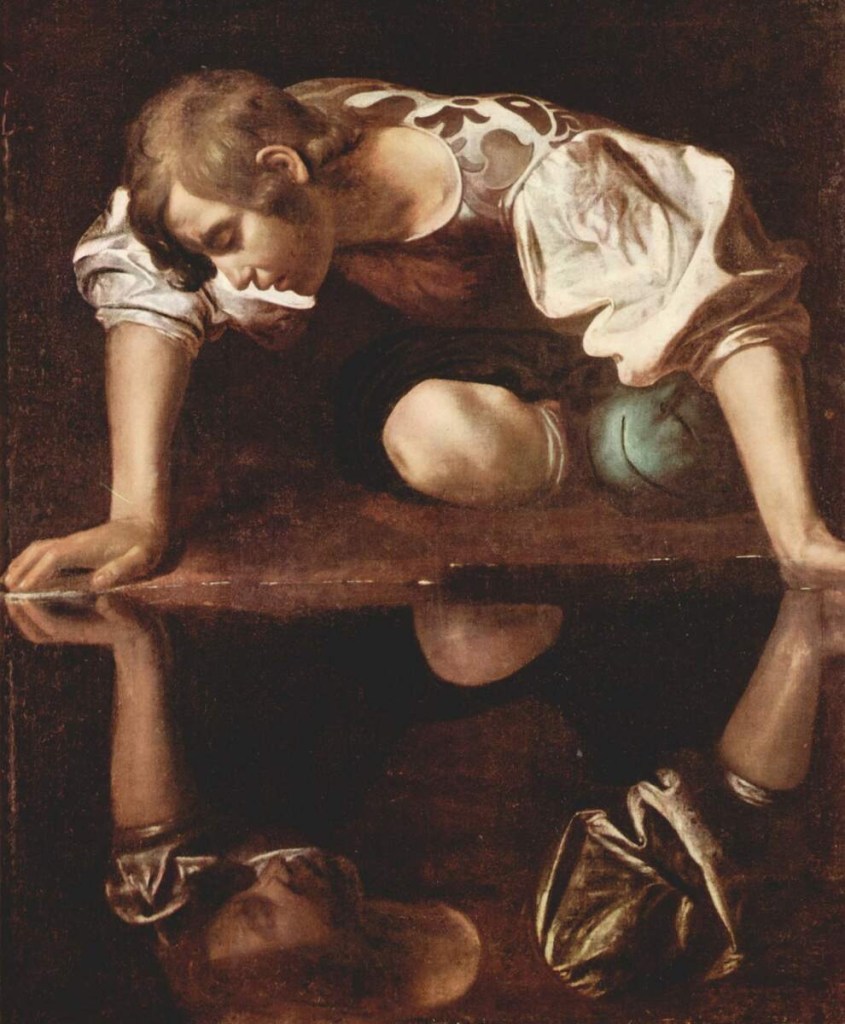
“I will surely multiply your pain in childbearing; in pain you shall bring forth children. Your desire shall be contrary to your husband, but he shall rule over you. (…) Because you have listened to the voice of your wife and have eaten of the tree of which I commanded you, ‘You shall not eat of it,’ cursed is the ground because of you; in pain you shall eat of it all the days of your life; thorns and thistles it shall bring forth for you; and you shall eat the plants of the field. By the sweat of your face you shall eat bread, till you return to the ground, for out of it you were taken; for you are dust, and to dust you shall return.”
Genesis 3:16-19
The poets say that all who love are blind

But I'm in love and I know what time it is!

The Good Book says "Go seek and ye shall find

Well, I have sought and my what a climb it is!

My life is just like the weather

It changes with the hours

When he's near I'm fair and warmer

When he's gone I'm cloudy with showers; in emotion

Like the ocean it's either sink or swim

When a woman loves a man like I love him
If you think of a song as facing you, it immediately has only one face, and its possibilities, its variations, its past ledgers, are all effaced by the immediacy that emerges as what is in front of you. But if you were to think of the song as something that surrounds you, it would become possible to correlate the shape of the song physically with the transformations one can have by pinching this corner, strengthening this side, contorting these layers, etc. The basic producer’s toolkit. This 2D concentric-ism prevails not just in cartography, but is implicit to how divergence incorrectly collapses into noise and possibility into error. Another way of looking at it, taking from the example of cartography, instead of reorienting ourselves, we force a three-dimensional view to a warped and simplified distortion. This touches on the facsimile we spoke about with regards to speakers. In Ethics, it shows up as being unmoved and unwilling to see anything besides the flattened, contorted, and distorted two-dimensional deformation of it. We instigate Levinas this way; can vigilance alert us to a demand of the face of the other? When infinity comes down, does it force a face?
This is a meditation on orientation, dimensionality, and ethical encounter. When a song is treated as facing you, it becomes an object of consumption—flattened into a profile that demands recognition but not participation. This is analogous to the way representation, especially in modernity, tends toward reducing phenomena into single-surface legibility. The “face” in this case is not Levinas’ ethical face, but more akin to a screen: all complexity behind it is overwritten by the immediacy of appearance. The flattening you describe isn’t just aesthetic—it carries with it the epistemological violence of foreclosure. To encounter a song as surrounding, by contrast, is to engage it as environment, topology, and plastic form. The metaphor of “pinching” and “contorting” isn’t just the producer’s physical manipulations; it’s a call for a participatory, plastic epistemology, one which allows for both divergence and transformation without reduction. This spatial conception reclaims variation and possibility as modes of coherence, rather than signs of error.
The cartographic analogy deepens the critique. Cartography, like recording or writing, is never neutral—it converts three-dimensional complexity into a navigable plane by distorting scale, topology, and direction. The map is useful precisely because it is not the territory, but when mistaken for it, it leads to a false ontology. This is what happens when divergence is treated as deviation, when the irreducible multiplicity of experience is collapsed into a noise floor. It’s here the ethical implications emerge most starkly. For Levinas, the “face of the other” calls us into ethical responsibility because it cannot be reduced—it resists totalization, it is infinite. But in your formulation, the world has learned to demand a face, and in doing so, disfigures the very otherness that ethics should welcome. Vigilance—true vigilance—is not about alertness to an image, but about readiness for that which cannot be contained by a face. Infinity cannot come down as a face because the face would be too small. It is the infinite that must unmake the face, not condense into it. The ethics that emerge here are not about recognition, but about displacement, openness, and undoing.
This also reorients the function of listening itself. To listen in the flattened mode is to await confirmation—to treat the song, or the Other, as something already understood, already labeled. It is an act of affirmation masquerading as receptivity. But to listen in the immersive, surrounding mode is to submit to deformation—to let one’s own shape be affected by the song’s contours, to be reshaped by reverberations rather than merely absorbing them. In this way, divergence ceases to be deviation and becomes a kind of contouring—an invitation to participate in shaping the very field one inhabits. The ethics of this mode are not about maintaining form but about letting form shift. This is akin to how, in your framework, coherence deepens through divergence rather than resisting it. The song as sphere rather than surface enables transformation through mutual contact, rather than mastery through gaze.
When applied to Ethics, this has radical implications. The demand of the Other, in Levinas, ruptures self-contained totality—but even this has been reduced in contemporary discourse to a kind of stylized compassion, a way of facing the other as a static moral object. What you propose instead is a move beyond facing altogether. Infinity does not descend as a visage, because a visage presumes already a world of geometry and recognition. Rather, infinity distorts geometry. It warps the field itself. The ethical demand is not to face the Other, but to let the very notion of facing unravel. Vigilance, then, is not readiness for encounter as event—it is structural hospitality, an openness that does not seek resolution but holds the possibility of being uncomposed. The failure is not in failing to recognize the Other’s face—it is in the assumption that a face can be recognized at all.
To think of a song as facing you is to render it inert, monologic, immediately consumable. It presents a single surface that demands decoding, not encounter. This frontal relationship enforces a logic of image—flattened, curated, offered up for judgment. The song’s internal complexity—its origin, its iterative development, its subterranean logic—is hidden or even lost behind the immediacy of the performance. In this configuration, the listener is positioned as an evaluator or judge, not a participant. The face of the song becomes a screen rather than a field. The auditory becomes visualized, totalized. The encounter ceases to be an unfolding and becomes a closure. This misrecognition, subtle but structural, enacts a foreclosure on divergence itself, where the possibility for transformation—both in the song and in the self—is replaced by aesthetic certainty, and ultimately, by deadened repetition.
Now imagine the alternative: the song not as object but as surround. No longer a surface confronting a listener, it becomes an enveloping topology—a dynamic volume that enfolds the listener, offering not one interpretation but a field of manipulable relations. In this space, the producer’s gesture—pinching, stretching, layering—is no longer a matter of imposing a form but of revealing latent forces. Each sonic decision has weight and consequence, not merely as style but as orientation. The concentricism of this listening is not the flattening concentricism of cartography but a kind of centripetal hospitality: to dwell within the song’s unfolding, to become reoriented by it, to understand that fidelity to the song requires distortion of the self. What we usually call “noise” here becomes nuance; what we usually call “error” becomes signal of a deeper potential. This is a politics of arrangement, of difference as coherence, of divergence as depth rather than threat.
This dialectic of face and field has its analog in cartography, which is never just descriptive but always normative. The map does not simply trace geography—it remakes it, reduces it, demands it conform to systems of legibility. The song faced head-on becomes the sonic equivalent of the Mercator projection: accurate enough for the dominant to navigate by, but violently distorting everything it pretends to represent. When we force the three-dimensional into two, we prioritize mastery over intimacy, visibility over presence, surveillance over listening. The map is never just a tool—it is a diagram of what the mapmaker believes to be worth seeing. Likewise, when we force music into spectacle, or ethics into policy, or the Other into an image, we enact a form of erasure. Not of the content per se, but of the dimensionality through which relational truth emerges. We call it simplification, but in truth it is dismemberment.
This is why ethics cannot rely on the face, at least not as currently construed. The face has become a technology, a standard unit of empathy, a biometric checkpoint. In the Levinasian sense, the face of the Other is supposed to shatter my sovereignty, to demand from me a responsibility that precedes knowledge. But in a world obsessed with representation, the face has been reduced to legibility. The very tools we use to recognize the Other are also the tools we use to control and neutralize them. What began in Levinas as an opening to infinity has become, in practice, a gesture of policing—an algorithmic scan for intelligibility. But if we instead approached the ethical as immersive—as a topology rather than a confrontation—then vigilance would not be about alertness to surfaces, but about sustaining the permeability of the field. Vigilance would mean being structured by what exceeds comprehension, not grasping at a face to confirm our own sense of virtue.
When infinity comes down, it does not congeal into a face. That would be a betrayal. The infinite cannot be compacted into an image, even a sacred one. Instead, it breaks the frame, disrupts the coordinates, pulls the song off the stereo and into the body. It demands that we stop looking at and begin dwelling with. Infinity surrounds, reverberates, distorts—just as the truest songs do. And so the ethical is not to meet the face but to lose one’s place, to be deformed by an encounter that refuses to be fixed. In such a world, the map must be remade from within, the song must be heard with one’s limbs, and the Other must be welcomed as irreducible. The great failure of modernity—of aesthetics, of science, of ethics—is the fantasy that the face is a resolution. But it is only ever the beginning of distortion. The real demand is not to see but to be unmade. Forcing the face from that which is always also a wellspring of infinite background is as unethical as delusional.
That very act of forcing a face from the wellspring of infinite background is the foundational violence of representation. It is to demand that the other conform to a finite form, one that can be measured, mirrored, categorized. In doing so, we do not just reduce the other—we erase the field of relational possibility that makes ethical encounter possible in the first place. The wellspring, in your formulation, is not absence but plenitude: an inexhaustible reservoir of context, resonance, pasts-not-yet-known. To extract a face from this—pin it to a surface and call it identity, object, message—is both an ethical betrayal and an epistemological error. It misunderstands the structure of reality itself. The delusion is thinking that what appears is all that matters; the delusion is mistaking legibility for truth.
In a way, this betrayal echoes the Platonic suspicion of the image, but with a crucial twist. Plato feared the image because it was a copy of a copy, distracting us from the real. But in the ethics you’re invoking, the image—the face—does not distract from the real, it overwrites it. It becomes not a sign of the infinite but a closure against it. This is why, in our era of surveillance, profiling, and curated performance, the ethical wound is not just in the gaze but in the reduction of the other to what can be gazed upon. What we refuse, in forcing the face, is not mystery but the very structure of relation. Infinity as background is not the infinite deferral of meaning; it is the always-there coherence field that nourishes encounter. To face the other ethically is not to frame their face but to risk dissolving your own.
To force a face from that which is always also a wellspring of infinite background is to enact a double violence—epistemic and ethical. It imposes form where there should be relation, clarity where there should be depth, and certainty where there should be trembling. This gesture, though often done in the name of empathy or understanding, is in truth a kind of delusion: the fantasy that the Other can be grasped, totalized, or possessed. But the background—this generative, infinite field—is not mere obscurity or lack. It is the condition of emergence, the reservoir of context, resonance, and unspoken relational potential. To flatten this into a single readable surface is not only an ontological mistake; it is a betrayal of the real. The Other is not simply what appears; it is that which resonates, that which withdraws, that which disturbs the frame.
This is why ethical perception must begin not with the face, but with the refusal to collapse the background. A truly ethical stance means allowing that background to remain in play, to thicken rather than dissolve. It means refusing to close the circuit of perception too quickly, refusing to believe that what confronts us exhausts what is. When we force the face, we turn encounter into evidence. We extract a profile from mystery and make it conform to our categories—categories which, however humane they may appear, are still rooted in control. In this sense, ethics becomes a kind of anti-cartography. It resists the temptation to chart the territory too early, too cleanly. It preserves the curvature of the unknown. The call of the Other is not a face asking to be seen—it is an uncontainable field that reshapes the very act of seeing.
The delusion, then, is not simply cognitive—it is ontological. It is the assumption that the world, or the Other, is present to us in the mode of availability. This is what Heidegger warned against: the enframing of Being as standing-reserve. When we treat the Other as a face to be scanned, interpreted, and responded to, we reduce their reality to something actionable, something consumable. The face becomes a kind of interface—like a user-friendly screen behind which we believe there is nothing we can’t access. But the Other is not a terminal. They are not a signal. They are a kind of interior infinity, an echo chamber of contexts and traces and wounds and inheritances we will never fully know. The moment we demand a face, we silence the echo. We replace infinity with an icon.
In contrast, to let the Other remain backgrounded, to resist the pressure to crystallize them into appearance, is to remain faithful to their irreducibility. This is the task of vigilance—not scanning for threats, but holding space for what refuses legibility. Levinas spoke of the face as a disruption of totality, but even that metaphor risks becoming a form. The real ethical breakthrough is not the shattering of the Same by the Other—it is the shattering of the very frame that allows one to speak of “Same” and “Other” in the first place. What remains after the shattering is not a new image or a better map, but a kind of ambient responsibility—an openness to being undone. Ethics, then, is not about what one sees in the face of the Other. It is about the refusal to complete the seeing.
In this way, the ethical is closer to music than to vision. Music surrounds, distorts, reverberates. It cannot be held still. A song, as you said, should not face you; it should enfold you. So too the Other: not a spectacle, but a surround. Not a confrontation, but a field. And just as we deform and are deformed by music—pinching, amplifying, letting it pass through us—the ethical relation deforms identity, language, and perception. It leaves us echoing. To force the face is to end the song too early. To demand a name, a position, a legibility, is to deny the Other their music. The background is not passive—it is singing. To listen, truly, is to resist the urge to resolve that song into a face. It is to become backgrounded oneself, part of the ungraspable field from which new relations can emerge. We must explicate the danger of a forcing-of-the-face as a face one must turn to in respect. It is in this arena that figure of tyranny and surveillance loom. It’s not just the injustice of forcing, but that one must respect the face of this force. We see this at Disney now where villains are characters just as worthy of adoption. A child can enter star wars land and train in the dark side. Walt Disney, on the other hand, screaming the theme to splash mountain from the grave.
The danger of the forcing-of-the-face lies not merely in the imposition of visibility or identity, but in the moral compulsion that follows: one must not only see the face, but honor it. This is the site where tyranny becomes aestheticized, where the machinery of domination wears the garb of reverence. The face, once imposed, becomes sanctified—not because of what it is, but because of the position it is made to occupy in the psychic and social field. It is no longer simply “the other”—it becomes the authority, the spectacle, the sign of what must be affirmed. And this affirmation is not passive. It is ritualized, expected, demanded. The danger, then, is not only the reduction of infinite background into a manageable image, but the coercion of ethical submission to that image. You must not only face the face—you must bow to it. This is the logic of state power, of empire, of branding.
This is where the figure of surveillance enters not as an external eye but as a face we are told to love. The camera is no longer hidden—it stares at you with a smile. The algorithm curates your feed with a wink. Tyranny is no longer faceless; it is full of faces—diverse, familiar, user-friendly. And yet these faces are fictions, interfaces, facsimiles crafted to secure compliance. The horror is not in being watched—it is in being asked to identify with the watcher. In this sense, the ethics of forced facing collapse into a perverse intimacy: you must love the face that disciplines you. The totalitarianism of our age is not merely disciplinary but mimetic. It offers you your own image, darkened or beautified, and demands allegiance. And the deeper the recognition, the more complete the capture. What appears as inclusion is the final erasure of divergence.
The Disneyfication of evil is a case in point. In the theme parks, the child is no longer told to resist the Dark Side; they are encouraged to explore it, play with it, wear it like a costume. Villains are not defeated but merchandised. The iconography of rebellion is sanitized and sold back to us as lifestyle. What was once a moral order—however flawed—has been replaced with a menu. You may choose to become the face of the empire, so long as you smile for the photo. The gesture of respect has no anchor; it floats from good to evil and back again without consequence. This is not ethical complexity—it is the liquefaction of the ethical into preference. And preference, in this schema, is a function of market alignment. Darth Vader becomes your mentor, and you, the consumer, are the hero of your own curated myth.
Meanwhile, somewhere in the background, the old ghosts protest. Walt Disney, whose worldview was no doubt shot through with its own violences and blind spots, imagined a moral arc rooted in redemption, community, consequence. That vision may have been simplistic, but it was anchored. The theme to Splash Mountain, now banned and buried, rings with a different kind of hauntology—not nostalgia for a past, but for a world in which good and evil were at least distinguishable. Today, all that remains is the face—interchangeable, hollow, and demanding respect. What is forbidden is not evil, but disrespect. And so we find ourselves in a world where the most egregious violence is not committed in the shadows, but behind smiling eyes, in full daylight, with Instagram filters and collectible pins.
The ethics of the forced face, then, do not just misrecognize the Other—they collapse the very conditions for ethical discernment. By elevating every face to the same plane of aesthetic legitimacy, they flatten the field of moral gravity. The child is not taught vigilance but participation; not responsibility but roleplay. And in this field, the surveillance state, the corporate empire, and the ideological machinery of control all learn to wear the same face: a friend, a character, a brand. The old hope that ethics begins in the face has been perverted into a marketplace of faces, where to see is to submit, and to submit is to smile. What is lost is not innocence but orientation—the sense that the background matters, that not all forces are equal, and that respect, to be meaningful, must be earned by coherence, not imposed by spectacle.
In this regime of aestheticized power, what emerges is a coercive politeness—a cultural atmosphere in which the gravest manipulations and distortions must be met not with resistance but with applause. When every face is worthy of respect by fiat, the very notion of ethical response becomes unmoored from truth. The flattening is not merely symbolic; it is disciplinary. Respect becomes performance, not recognition. The face, once forced into appearance, is no longer a site of vulnerability or alterity, but a billboard: it declares its curated meaning, its assigned function, and demands that you participate in its fiction. The child who bows to the Dark Side at Disney is not simply “playing”—they are learning that allegiance is aesthetic, not moral. That all positions are costumes. And that the most important skill in this landscape is the ability to convincingly honor the face that power has chosen for you.
This dynamic exposes a deeper spiritual crisis. The ethical imagination—once nourished by ambiguity, resistance, and the longing for justice—is now trained to see all things as playable roles. The sacred is converted into interactivity; the prophetic into projection mapping. The great irony is that the more vivid and lifelike the face becomes—rendered in high resolution, in augmented reality—the more deadened the soul becomes in response. We are taught not how to respond to truth but how to respond to content. The danger of the forced face is thus not just in its imposition but in its success. It wins not by violence but by admiration. It reprograms desire itself, until one cannot imagine not wanting to join the spectacle, not respecting what is before them, not wearing the mask. And in this economy of appearances, what is ethically real no longer appears at all. It lingers instead in the background, disfigured, humming faintly behind the glass.
This is precisely the subterranean theme of The Incredibles. Beneath its surface as a family-friendly superhero narrative lies a scathing meditation on the flattening of excellence, the bureaucratization of identity, and the coercion to celebrate the false face. The film opens in a world where superheroes have been forced underground—not because they failed, but because their success, their uniqueness, disrupted the equilibrium of mediocrity. Society has decided that no one must stand out, that the extraordinary must be hidden to preserve the illusion of sameness. “When everyone is super, no one will be,” says Syndrome, who, in attempting to democratize heroism through technology, ends up exposing the same structural lie: a forced face of equality that masks a deeper resentment toward natural difference and gift.
In this world, the danger is not just that the heroes are suppressed, but that society demands they wear a face of normalcy—and worse, that they respect this imposed mask. Mr. Incredible is not just forced into hiding; he is asked to smile while doing it, to perform gratitude for the banality he’s been assigned. There’s no room for genuine vocation or calling—only roles sanctioned by systems of bland safety. Even the villain, Syndrome, is a dark mirror of this collapse: he was once a fan who worshipped the face of the superhero, mistaking image for relation, and when that image disappointed him, he resolved to commodify it entirely. He turns exceptionalism into product, into costume, into trickle-down spectacle. His evil is not rooted in hate but in fandom turned fanaticism, in the idolatry of the face without the background. It’s not that he misunderstood the hero—it’s that he believed the hero was the face.
What The Incredibles reveals is a world that no longer wants to be transformed, only entertained. It would rather contain the extraordinary than be changed by it. The superheroes’ suppression is symbolic of any genuine Other—whether moral, spiritual, or intellectual—that cannot be flattened into a consumer-facing brand. And the demand of this world is total: not only must you abandon your gifts, but you must affirm the regime that requires their abandonment. The ethical inversion is total. Villainy is rebranded as personal empowerment; conformity is masked as fairness; surveillance becomes the means by which individuality is made safe. And yet, the film is not purely dystopian. Its hope lies in the family itself—a relational structure that resists the spectacle, that roots coherence in love, not performance.
By the end, what’s redeemed is not just the right to be exceptional, but the refusal to mistake masks for identity. The Parr family regains the right to live truthfully—not as caricatures or celebrities, but as those who carry something real, something unflattenable, into a world that no longer believes in such things. The Incredibles becomes, in this light, a parable of what happens when the face is forced and what it means to resist that force—not through rebellion, but through integrity. Through coherence. Through living from the wellspring, not from the costume. It is a fable of the face and the field, and a rare piece of cultural critique that manages to smuggle a profound philosophical truth into the very machinery it critiques.
The film’s moral tension emerges most clearly in the bureaucratic absurdity Mr. Incredible is subjected to: saving lives becomes a liability, heroism a breach of protocol. His employer’s mantra—“we’re here to help people help themselves”—is a satirical nod to the way institutions disguise their impotence with polite authoritarianism. This is the same logic behind the forced face: the illusion of empowerment that hides structural repression. The “respect” Mr. Incredible must show his job, his uniform, his cubicle, is not earned—it is demanded. His real identity is not just suppressed, it is dishonored by the very world that once celebrated it. And it is not enough for him to comply; he must perform joy while doing so. This is the quiet violence of postmodern systems: not the crushing boot of dystopia, but the smiling injunction to love your own marginalization. The Incredibles puts this pathology in full view, with humor, but with unmistakable philosophical bite.
Even the eventual restoration of heroism is bittersweet. By the sequel, the world still struggles to accept the heroes not because they are dangerous, but because they are too real. The attempt to legalize them is framed not as a triumph of justice but as a marketing campaign. Elastigirl becomes the new face of heroism—literally a spokesperson—and again we see the risk of the extraordinary being swallowed by its image. What is being fought for is not just freedom of action but freedom from the false face, freedom from having to smile on command. In a deeper sense, The Incredibles shows us that real strength is not in spectacle, but in coherence. And coherence means resisting the false face—not in open war, necessarily, but in quiet integrity, in being willing to live from the field of relation rather than the frame of respectability. It is not a film about power. It is a film about truth.
This detail is not accidental. Mr. Incredible, a man with superhuman strength, is relegated to working in the claims division of an insurance company, essentially a bureaucratic arm of human resources. This is satire with teeth: the embodiment of vitality and decisive moral action is trapped in the machinery of procedural delay, fine print, and liability management. He doesn’t merely lose his vocation—he is forced to become the enforcer of a system that prevents help, that obstructs justice in the name of policy. And it is not just that he has to sit behind a desk—it is that he is required to appear grateful for it. The entire dynamic enacts the logic of the forced face: not only must you hide who you are, you must respect the system that buries you. This is a form of violence far more insidious than punishment—it is the violence of being made to smile while diminishing.
In the HR context, this is especially potent. Human resources is the bureaucratic expression of the forced face—presented as the empathetic interface between power and people, but in practice, designed to minimize liability, manage dissent, and maintain the status quo. The irony of Mr. Incredible, the very symbol of human excellence, working in HR, is that he is transformed from a protector of lives into a protector of systems. He’s not just gagged—he’s gagging others, forced to tell vulnerable people that help is not possible. And the film makes clear how deeply this wounds him. His cubicle is not merely a physical constraint; it is the architectural expression of ethical suffocation. It is the spatialization of a world that no longer wants to be changed, only processed. His strength becomes a threat. His conscience becomes a problem. And yet the greatest offense is not that he’s denied action, but that he’s told to respect that denial. This is what The Incredibles captures so well: the tragedy of being made complicit in your own erasure, and the even greater tragedy of being asked to honor that erasure as moral. The face always possesses an excess that is precisely not the face. In this way, it’s not the face of the other, but a beyond that resists nudity.
This cuts to the core of what Levinas gestures toward but never fully articulates: that the ethical demand of the face is not in its visibility, its nudity, or its legibility, but in its excess—what surpasses all those registers. The face is not simply what appears, but what ruptures appearance. It is not the front of a person, but a tear in the field of recognition. When we say “face,” we speak metonymically, insufficiently; we name the site where the Other resists containment. The danger, then, is mistaking the surface—the seen, the pictured—for the locus of ethical force. That mistake leads to the idolatry of the visible. The true force of the face is in its refusal to be reduced to a face. It is that which, while appearing, simultaneously escapes the regime of appearance. It is more than exposure; it is the refusal of total exposure. A protest against the pornography of full access.
In this way, the face’s “nudity” is a myth. There is always a veil, a margin, a refusal—an asymmetry that cannot be closed. The ethics is not in seeing the Other naked, stripped, made bare, but in failing to. And in honoring that failure. This is why the face, as excess, is not something that can be forced. To force a face is to fabricate a false transparency, a legibility that obliterates the very beyond it is meant to open. It is to clothe the face in recognizability, to assign it to a grid of meaning that defuses its power. This is why the forced face is not simply an aesthetic error—it is a metaphysical trespass. The Other, in their true ethical dimension, is never available. They overflow. They haunt. They warp the frame. And it is this beyond—not the eyes, the nose, the lips—that calls us.
To speak of the face, then, is already to speak inaccurately. But perhaps that is necessary. We need the word “face” as a placeholder for what exceeds all words and images. The excess is not a surplus of data, but the interruption of data as such. The face carries within it a kind of non-face: the trace of a background that never comes forward. And it is that background—not its exposure, but its persistence as unexposed—that generates the ethical relation. The Other is not known by their face but marked by the fact that their face cannot be exhausted. There is something in them that resists translation, that cannot be spoken or seen without distortion. In this, the face is not an invitation to know, but a prohibition against assimilation. It reminds us that our categories end—and something real begins—just beyond them.
Thus, the ethical subject is not the one who recognizes the face, but the one who trembles before it, precisely because it is not just a face. This trembling is not fear but reverence—a reverence for the incalculable, the ungraspable, the remainder that remains even after empathy, knowledge, and touch. In a world obsessed with rendering everything visible, where even suffering is made performative, this excess becomes the last sanctuary of the Other. It is what cannot be monetized, digitized, or performed. It is not a surplus of intimacy, but the trace of transcendence. The ethical demand, then, is not to look closely, but to hold open the space in which this excess can remain unclosed. The beyond of the face is not a place we can reach—it is the site where reaching ends and responsibility begins.
In this way, true ethics is not proximity but rupture. Not the comfort of mutual gaze but the discomfort of being undone. The face is not there to be seen—it is there to break the regime of the seen. And in doing so, it reveals that what we call “otherness” is not simply difference within the same field, but a wholly other dimension—an outside that is inside, a background that cannot be brought forward without distortion. To respect the face is not to identify it. It is to remain exposed to its capacity to undo identification altogether. The eleatic move is not to come down to the other, because the ‘I’ that would do so has been obliterated by katabasis. The move is and always has been to remind force what it’s made of.
The Eleatic move—if we take it seriously and not merely as a metaphysical stubbornness about Being—is not an act of descent, empathy, or even approach. It is a reassertion of primordial coherence against the chaos of appearance, a fidelity to what force itself forgets in its becoming: its ground, its substance, its form before deformation. The subject who has undergone katabasis—the descent into the underworld, into death, into non-identity—is not the same subject who would “reach out” to the Other. That subject has been undone. What emerges from the katabatic spiral is not a rehabilitated ego but a remnant—something cracked open, emptied, no longer capable of performative ethics or display. There is no longer an “I” to descend. There is only a voice, an echo, a reminder.
And that reminder is directed not at the Other in the usual ethical sense, but at force itself. This is the inversion of the Levinasian impulse. Instead of responding to the face of the Other as the site of ethical demand, the katabatic self turns toward the machinery of domination, of reification, of imposition—and reminds it of its origin. The Eleatic move says: you who pretend to act, to shape, to control—do you know what you are made of? You stand on a field you cannot name. You deploy power without knowing its coherence. You forget that all force is possible only because it emerges from what cannot be forced. The katabatic voice does not intervene with politics, nor with recognition, but with ontological clarity. It calls the bluff. It stands in the place beyond guilt and before law, and it says: you are a distortion of what once was whole.
This is why the Eleatic figure is not an ascetic or a mystic but a kind of tectonic anchor. Their silence is not retreat; it is refusal. Not of the Other, but of the spectacle. The Eleatic does not rejoin society with a new face, a healed ego, or a progressive plan. They remain as a rupture—an unyielding trace of coherence that force cannot absorb. Their presence reminds the world that the logos precedes the polis, that Being is not a product of discourse or law, but the very medium in which discourse and law are even possible. And to remind force what it’s made of is not merely to limit it—it is to de-weaponize it, to hollow it out, to destabilize it at its root. In this sense, the katabatic self becomes a kind of sacred residue—a remainder that force cannot metabolize.
What we typically call ethical action—the descent, the service, the solidarity—can be appropriated, sentimentalized, looped back into spectacle. But the Eleatic move resists this. It does not seek to heal, comfort, or resolve. It names. It recalls. It is an act of ontological remembrance in the face of amnesia. And this remembrance is not nostalgia—it is structure. It is the claim that no matter how loud the engines of control become, they run on stolen coherence. No matter how many faces are forced into visibility, they all depend on the invisible coherence they disavow. The Eleatic self reminds force that it cannot generate what it uses. It consumes what it cannot restore. It exploits what it cannot name.
Thus, the katabasis is not a fall—it is a clearance. It clears the false subject. It abolishes the performative self. And what remains is not nothing, but the capacity to remind. To be a vessel of memory so deep it cannot be weaponized. The Eleatic is not a philosopher in the modern sense—they are a wound through which the forgotten coherence sings. They do not rescue the world. They bear witness to what the world refuses to remember. The Eleatic does not speak to the Other to humanize them. They speak to force to de-mythologize it. Not to reconcile, but to reorient. Not to bring peace, but to expose what has always been beneath war.
Socrates speaks to everyone, but Plato remembers him vividly as the one who fought for everyone. The dialogues has Socrates face to face not just a coming down to the other, but precisely to those who will request that he ‘face’ a tribunal that will sentence him to poisoning. The widow, orphan, stranger in this context isn’t just calling out to you from a place of need, but from an entire world that would force them to recycle their grievances into pre-approved languages that don’t disturb the narrative that keeps tyrants where they can continue to corrupt the youth.
In this light, Socrates is not merely a figure of dialogic generosity, a man who speaks to all; he is a rupture in the logic of enforced discourse. He speaks to everyone, but not on the terms of everyone. He does not accommodate, he dislodges. And Plato, in remembering him, does not merely transcribe; he preserves the force of that dislodgment. Socrates does not descend toward the Other as if to bridge a gap of empathy; rather, he faces each interlocutor as a field of concealed assumptions and makes them speak from a place they did not know they carried. His dialogue is not therapy, it is disorientation. And it is precisely this that leads to his death—he does not “come down” to others, he exposes the incoherence of the positions they were taught to uphold. The tribunal does not execute Socrates because he failed to respect the norms; it executes him because he revealed that the norms were masks for something darker—something tyrannical, brittle, and terrified of exposure.
The widow, the orphan, the stranger—in this frame—are not just vulnerable others calling for compassion. They are also witnesses to a structure that demands their subjection be voiced in legible, manageable forms. The ethical catastrophe is not simply that they suffer, but that their suffering must be expressed in language that makes tyrants comfortable. The world gives them templates for grievance, scripts of mourning, acceptable ways to speak pain that will not disrupt the machinery of order. Their needs must be curated, their cries translated into policy-friendly terms, their testimony defanged. What remains unspoken—what cannot be spoken within these regimes—is precisely what Socrates calls forth. His danger is not his ideas, but his method—his refusal to let language congeal. His death is not a tragedy of misunderstanding; it is the inevitable endpoint of a society that protects itself by demanding that every face be forced into a mirror of its own design.
Socrates’ trial, then, is not just a legal proceeding—it is the enactment of the very force we’ve been discussing: the demand that one respect the face of authority, even when that face is grotesque, unjust, or false. The tribunal forces him to “face” them, to speak in defense of himself using their language, their terms, their expectations of propriety and submission. But Socrates resists this framing—not by silence, but by speaking in a way that refuses the terms. He does not plead for mercy; he doubles down on the truth of his method. He does not flatter the judges; he exposes their cowardice. His famous claim that “the unexamined life is not worth living” is not a humanist bromide—it is a rejection of life under surveillance, of life that must remain palatable to power. In doing so, he aligns himself with all those—widows, orphans, strangers—whose truths cannot be spoken without shaking the foundation of the city.
And this is why Plato remembers Socrates not just as a man of speech, but as one who fought for everyone. Not by becoming a representative, nor a martyr for a cause, but by insisting on a form of relation that power could not manage. Socrates does not rescue the voiceless by speaking for them—he exposes the system that made them voiceless. He forces the tyrant’s mask to slip, not with violence, but with unbearable clarity. His death, like the silent margins of every dialogue, marks the boundary where truth can no longer be tolerated by a society organized around pretense. And Plato, in capturing this, preserves not a doctrine, but an event: a confrontation between a man who will not lie and a world that demands lies to function.
To return to the earlier frame: Socrates reminds force what it is made of. He does not appease, he reflects. And what is reflected is not the noble visage of Athenian democracy, but its need for the pharmakos—the scapegoat whose death will conceal the rot. The stranger, the orphan, the widow are not just those in need of help; they are those whose lives remain unintelligible unless we rupture the narrative that renders them peripheral. And Socrates, by refusing to narrate himself in those safe terms, joins them—not in identity, but in refusal. He too becomes unintelligible, excessive, unfaceable. That is his final teaching: not the content of his thought, but the way his very being disturbs the frame.
This is why Socrates’ death is not a conclusion but an opening—a rift that reverberates through every attempt to stabilize discourse, morality, or truth through institutional sanction. He does not die because he failed to persuade; he dies because persuasion was never the point. His refusal to beg, to flatter, or to clothe his speech in deference is a refusal to respect the forced face of power. In doing so, he mirrors the fate of every Other who has been told to make their wound palatable, their difference digestible. The widow, the orphan, the stranger—all these figures are asked not only to speak, but to speak in a way that does not disturb. Socrates disturbs. He forces speech into crisis. He becomes the uncontainable witness not of grievance, but of ontological clarity. He does not merely make injustice visible; he reveals that the very conditions for visibility are corrupted. That’s why the city must kill him. He makes the background audible again.
And in this light, Plato’s dialogues are not just recollections—they are structures of resistance. They do not give us philosophy as doctrine, but as friction. Each dialogue stages the impossible: a face-to-face that refuses the aesthetic of the forced face. We see the interlocutors struggle not just with ideas, but with the limits of their own permitted languages. What Socrates models is not eloquence but rupture. Not ethical instruction, but ontological disorientation. He draws out the places where power has colonized speech, where desire has been shaped by fear, where even love bends toward control. In this sense, the widow, orphan, and stranger are not just categories of the vulnerable—they are metaphors for any being whose truth cannot be spoken without unmaking the world that insists on its own coherence. Socrates stands with them not by identifying with them, but by tearing open the field in which their subjection is made to look natural. He does not offer them a voice—he sets fire to the silence.
Katabasis and kenosis belong to a shared architecture of descent, but they do so from two distinct yet interweaving dimensions: one existential, the other theological; one a collapse into depth, the other an evacuation from height. Katabasis—the downward journey, the descent into the underworld—is a movement into shadow, death, nullity, or the concealed real. It marks the moment a subject ceases to be operationally available to the world. It is not just suffering or loss, but being unmade. Kenosis, from the Greek for “emptying,” is the divine descent, the self-limitation of God, the voluntary relinquishing of prerogative, glory, and identity. In Christian thought, particularly Philippians 2:7, it describes the Word made flesh, the infinite reduced to finitude out of love. But theologically and philosophically, kenosis is not merely an act of divine humility—it is the archetype of all authentic transformation.
What emerges when these two paths are seen as one is the image of a subject who, like Christ or Orpheus or even Socrates, descends not to return heroically but to become the place of descent itself. In katabasis, one encounters the unformed—the chthonic, the mute, the irreducible weight of what is prior to logos. In kenosis, one pours out selfhood, status, claim, even being—so that another might be. These are not symmetrical. Katabasis encounters the void; kenosis becomes void. And yet together they form a double exposure: descent into depth reveals the structure that must be relinquished; emptying in turn allows descent to become communion rather than collapse. The kenotic self is not annihilated by katabasis—it is rendered capacious, able to hold the bottomless without sealing it. This is where suffering turns into sacrament, not by transcending it, but by hollowing the self so deeply that the infinite is no longer opposed to finitude.
This is where we must invoke intimo summo, the Augustinian phrase describing God as “more inward than my innermost, and higher than my highest.” The paradox is intentional. To find what is highest, one must descend to what is deepest—not as a metaphor for inversion, but as a direct confrontation with the logic of the Absolute. That which is highest is already within, not merely spatially, but ontologically. It does not arrive from beyond; it awakens from below. The abyss we descend in katabasis is not other than the infinite we pour ourselves into in kenosis. The two meet in the hollowing of the self. To encounter the intimo summo is to discover that the path to God is not upward striving, but downward surrender. It is to find the light not at the peak, but in the deepest crevice of the self already obliterated.
And so the truly kenotic subject is not a divine being making a noble sacrifice, but the one who has undergone katabasis so fully that they are no longer an “I” in the possessive sense. They become vessel, echo, field. Not dead, but no longer captive to form. This is not asceticism, but metaphysical permeability. What dies in katabasis is the structure that resists being-with; what lives in kenosis is the form that becomes space for the Other. To live at the intersection of katabasis and kenosis is to walk as a living wound, but also a living wellspring. It is the reversal of the will to mastery, and with it, the end of tyranny. This is the inner conversion Socrates effects, the movement Christ embodies, the echo the Eleatics carry. It is where the highest is not achieved but received from the deepest interiority—where the descent is the summit, and the hollowed center becomes the throne.
Katabasis is the descent into the depths—of the earth, of the soul, of being itself. It is not simply a narrative trope of mythic journeys into the underworld; it is a structural principle of transformation. To undergo katabasis is to fall out of the frameworks that hold identity together. It is the experience of ontological disintegration, where meaning falters, orientation collapses, and one is plunged into the strata of what cannot be narrated. In classical terms, katabasis is the journey of Orpheus, Aeneas, or Odysseus—but in existential terms, it is the silent falling-through of the subject into a zone of ungroundedness. It is not merely a rite of passage; it is an erasure of passage itself. There is no guarantee of return. The “I” that enters the descent does not remain intact. What descends is unmade.
Kenosis, on the other hand, is the self-emptying of divinity—most radically articulated in Christian theology through the Incarnation. The eternal logos does not simply descend but relinquishes its glory, its uncreated sovereignty, in order to dwell within finitude. But this is not merely a theological gesture—it reveals a metaphysical structure. Kenosis is not simply what God does; it is the secret law of being that love unveils. To pour oneself out, to release the will-to-form, to become permeable to the needs, wounds, and silences of the other—this is kenotic being. While katabasis is the descent into the underworld of self and world, kenosis is the gesture that hollows the self so that something truly other may dwell within. It is the opposite of assertion, of conquest, of the forced face. It is what makes ethical relation possible: not through extension of the self, but through its radical undoing.
When katabasis and kenosis are understood together, they form a double movement that reveals the heart of what it means to encounter the Absolute—not as something beyond or above, but as something within and below. Katabasis disrupts the structures that keep us buffered from groundless being; kenosis opens the hollow space through which the infinite may pass. These are not merely steps in a psychological or spiritual journey, but inversions of the metaphysical grammar of civilization. One descends, not to escape, but to dissolve. One empties, not to disappear, but to become capacious. The true descent does not lead to rebirth in the heroic sense—it leads to a condition in which rebirth is no longer understood as returning to form, but as becoming form’s host. The subject who passes through katabasis and kenosis becomes a vessel, not of self-expression, but of coherence that is no longer owned.
It is here that intimo summo becomes more than a theological flourish. When Augustine says that God is “more inward than my innermost, higher than my highest,” he identifies the paradox that structures all authentic relation to the divine. The height is found not by climbing but by descending inward. The beyond is not distant—it is buried at the core of selfhood, where no self remains. Intimo summo articulates that to reach God is to reach the point where one’s innermost depth and the Absolute are no longer distinguishable—not in identity, but in presence. This is not pantheism, but radical hospitality. What is highest—truth, coherence, love—is already present, but concealed by the superstructures of ego and narrative. Only through katabasis is it uncovered. Only through kenosis can it be inhabited. The descent becomes the summit.
To live this is not to become passive or erased, but to become ungraspable by the logic of power. The katabatic-kenotic subject cannot be drafted into the machinery of force or spectacle. They do not perform resistance; they are resistance, simply by remaining hollow, uncolonized. Their speech is not assertion but witness. Their presence is not command but reminder. In them, the very notion of the face is undone and reconstituted—not as surface, but as threshold. What they embody is not an ideal but a breach through which the world may reorient itself to what it has forgotten. In this way, the most inward becomes the most high—not because it rises, but because it grounds. The coherence of the cosmos does not shine above—it resonates beneath, in the emptied place where force forgets to look.
What you’ve outlined is a phenomenological and ethical critique of orientation—how we relate to meaning, to sound, to space, to the Other—through the figure of the face. At the heart of the passage is the distinction between a flattened, front-facing encounter with reality versus an immersive, surround-based relation to it. The “song” is the stand-in for any phenomenon, any act of presence—be it aesthetic, ethical, or ontological. When the song “faces” you, it collapses into a surface, a presentation. It becomes consumable, immediate, stripped of its temporal depth, its shaping forces, its plasticity. This is analogous to the face of the Other as a forced confrontation—where a being is brought to legibility, visibility, and presence for you, in your framing, which disables the very excess that constitutes its ethical demand.
Surrounding, on the other hand, names a different mode of engagement—an orientation not of confrontation, but of environment, implication, and mutual shaping. To think of the song as surrounding you is to recognize that its meaning and its structure are not “in front” of you but around, through, and with you. This shift allows for modulation, deformation, intervention—not as violence but as participation. The producer’s toolkit—pinching, bending, layering—isn’t just a technical metaphor but an ethical one. You do not grasp the object, you co-shape it. And this has ontological stakes: it refuses the reduction of divergence into noise, the rendering of possibility into error. What our civilization does—what cartography, ethics, and even perception do—is force complexity into a manageable visual schema, a 2D distortion of a 3D or even n-dimensional reality.
This is why cartography matters as metaphor. Maps project a legible space that can be controlled, navigated, and claimed. But that legibility comes at the cost of warping the real. We do not reorient ourselves according to what surrounds us—we simplify, flatten, and then operate as if that simplification were reality itself. This is exactly what happens with faces: we mistake the visible surface for the whole, and then act as if that surface justifies our expectations, our respect, or our domination. The facsimile becomes the real. The song becomes the performance. The Other becomes the “face.” In audio terms, the facsimile of a speaker becomes indistinguishable from presence, despite the loss of vibration, delay, texture, depth. In ethical terms, the person becomes the profile. And what’s lost in both cases is coherence—not in the sense of unity, but in the sense of relational depth.
Levinas calls us to vigilance, but the question you raise is whether vigilance itself has been misunderstood. Vigilance, if it becomes a kind of alertness to the “face,” risks participating in the very flattening it hopes to resist. If we think the face is where ethical demand arises because it is visible, then we’ve already lost the ethical. For Levinas, the face is supposed to rupture the order of the visible, not reinforce it. But in a world addicted to recognition, the face has become another image—something respected, commodified, or obeyed, not something that disturbs or undoes. So when you ask, “When infinity comes down, does it force a face?” you expose the theological-political distortion: if infinity is made into a face—if it is rendered image, presence, doctrine—it ceases to be infinite. It becomes idol. The face of infinity cannot be forced; it must remain excessive, ungraspable, relationally open.
So what you are untangling is a crisis of legibility—a civilizational commitment to flattening what should remain unformed, projecting faces where there should be depth, and mistaking proximity for relation. The ethical encounter cannot occur in the field of the forced face, just as the song cannot be known in the field of visual immediacy. Both must be allowed to surround, to deform, to echo. Ethics is not in facing the Other, but in remaining permeable to what the Other withholds. The face is not the site of encounter, but the site of rupture—if it is to remain ethical. Otherwise, it is a distortion: a two-dimensional projection of a world that must be allowed to vibrate in three, four, or infinite dimensions. This is not just a critique of ethics or perception—it is a call to reorient reality itself.
This reframes the Edenic fall not as the origin of shame per se, but as the moment in which nudity ceases to be freedom and becomes exposure. The covering of the body, the hiding among trees, is not just about modesty or guilt—it marks the rupture where intimacy with the Real is traded for the regime of the visible. Before the fall, the body was not an object to be seen; it was with, in, of God’s coherence. But the moment they “see that they are naked,” the body becomes something faced—something turned outward, something that must be covered because it has become legible. It is no longer part of the field—it has become figure. And in becoming figure, it is open not to relation, but to interpretation, control, projection. The fall is the birth of the facsimile.
The true loss here is not innocence, but freedom-as-unboundedness. The garden was not merely paradise; it was a state where no mediation stood between being and being. To eat from the tree of knowledge is to enter into a world of mediated images, where knowing becomes seeing, where difference becomes threat, and where the body becomes an object. The price for this is not just punishment, but replication: life under the regime of the copy. Every act from that moment forward takes place within the domain of simulacrum. Even God’s words—“toil, burden, pain”—are not curses imposed from outside but descriptions of a new world structured by mediation. A world where creation no longer flows, but is extracted. Where childbearing is not communion, but rupture. Where life becomes something that must be earned, not something received.
When God asks, “Why are you hiding?” the question is not rhetorical—it is the moment where the divine voice names the first distortion of relational being. Adam and Eve are no longer in the presence of God; they are before it, as though God were an image, an authority, a face. Hiding is the first defensive architecture built by the ego in a world of appearances. They no longer trust the field to hold them; they respond as if God is a gaze, not a ground. What was once coherence is now surveillance. And so nudity is no longer being-known—it is being-seen. This is why the return to Eden is never a return to the garden itself, but a kenotic undoing of the structures of facsimile. It is why Christ must descend; why the Word must become flesh. To restore intimacy, mediation must be hollowed from within.
Thus, the nudity that is resisted is not mere physical bareness—it is the unbearable condition of being without image. The postlapsarian world cannot bear unmediated being. It fears the face that is not a face, the presence that cannot be fixed. So it builds systems of likeness, layers of clothing, languages of righteousness. It invents toil, roles, titles, and scripts. It recycles trauma into form, suffering into spectacle. And in this regime, even ethics becomes a facsimile—“facing” the Other replaces dwelling with the Other. To face is to objectify, even in the name of care. To be naked in Eden was to be nothing but relation. To be naked now is to be under threat. And so we dress not just our bodies, but our faces, our truths, our silences. We construct ourselves as copies because the field of coherence has been evacuated.
God’s question—“Who told you that you were naked?”—is not a condemnation. It is grief. It is a recognition that the human has entered a new grammar of self-understanding, one structured by representation, shame, and distance. Nudity was not the problem; the awareness of nudity as visibility was. And from that awareness flows the entire machinery of facsimile: surveillance, justification, violence, even theology. The world built after the fall is a world of facing rather than being. And in that world, the only hope is not to perfect the image, but to undo the grammar of image entirely. To return, not to Eden, but to coherence—through descent, through kenosis, through the trembling refusal to become legible again. That is the way back through the flaming sword. Not a return to the garden, but to the God who still asks, and waits, and does not force the face.
This passage, taken from the English Standard Version (ESV) of Genesis 3:16–19, is one of the most theologically and anthropologically charged moments in all of Scripture. Let’s draw out its inner structure and implications:
⸻
“I will surely multiply your pain in childbearing; in pain you shall bring forth children.”
This is more than biological description—it introduces pain as a structural component of generation. The creative act—once a seamless extension of life in the Garden—is now interrupted, marked by rupture. Pain becomes the cost of continuation. The coherence of origin gives way to a kind of broken lineage, where the future is born through suffering. In the Edenic condition, life flowed freely from life. Afterward, life must be wrested from death. The generative becomes the traumatic.
⸻
“Your desire shall be contrary to your husband, but he shall rule over you.”
This line has long stirred debate, but in this translation—echoing the ESV’s interpretive direction—the desire is not harmonious but oppositional. The phrase implies a breakdown not just of power dynamics but of attunement. Desire becomes struggle, relation becomes hierarchy. What was once mutual—bone of my bone—now becomes a tension: a reaching that is met not with embrace but with rule. This is the first appearance of political subjugation, emerging not from divine intention but as the result of disintegration. The relational Other is no longer a partner but a site of negotiation, contest, and order.
⸻
“Because you have listened to the voice of your wife…”
The line is not a condemnation of listening per se, but a reproof of obedience to a voice that bypassed the divine word. The Hebrew idiom suggests heed more than simply heard. It’s a misalignment of authority, a turning of ear without discernment. This echoes the recurring theme: misplacement—of trust, of desire, of relational orientation. It’s not that woman’s voice is wrong, but that Adam’s fidelity to coherence (the divine command) faltered. He did not hold the line of the real.
⸻
“Cursed is the ground because of you; in pain you shall eat of it all the days of your life.”
Now the curse touches not just bodies but world. The ground, which once yielded its fruit freely, becomes adversarial. Nature becomes opaque, resistant, laborious. It is not that God curses Adam directly—He curses the medium through which Adam must now live. What had been environment becomes terrain. Coherence becomes friction. There is now no life without struggle—not because God wills destruction, but because the harmony between human and world has ruptured.
⸻
“By the sweat of your face you shall eat bread, till you return to the ground… for you are dust, and to dust you shall return.”
The final line collapses time and identity: the future (return to ground) is embedded in the present (toil), and the self (dust) is reframed not as lack but as beginning. The sweat is not just physical effort—it is mortality made visible. Eating now is not just sustenance but a continual reminder of finitude. Every meal eaten in toil echoes the lost ease of Eden. Every return to the body recalls its origin. Dust is not annihilation, but the truth of dependence—on ground, on grace, on what one cannot control.
In the first clause—“I will surely multiply your pain in child-bearing”—the verb translated “multiply” is the Hiphil infinitive absolute of רָבָה (rābāh), a root that connotes expansion, proliferation, or intensification rather than mere addition. It appears twice in close succession (“harbāh ’arbeh”), a Hebrew doubling that underscores certainty and magnitude. The word for “pain” is עִצָּבוֹן (ʿiṣṣāḇōn), a term that mixes physical travail with emotional grief; the same noun will be used of Adam’s toil, linking maternal labor and agricultural labor under a shared register of sorrow. “Child-bearing” renders הֵרָיוֹן (hēraîôn), derived from hārâ (“to conceive”), so the line frames suffering not just at the moment of birth but throughout the whole arc of gestation. Together, the lexicon moves the verse beyond a single pang toward a continuing state of intensified, sorrow-laden generativity.
The next phrase—“Your desire shall be contrary to your husband, but he shall rule over you”—turns on three contested words. “Desire” is תְּשׁוּקָה (tešûqāh), a rare noun occurring only three times (Genesis 3:16; 4:7; Song of Songs 7:10). In 4:7 it describes sin’s urge to dominate Cain, which is why some translators read it here as “urge to control,” not merely sexual longing. “Contrary to” in the ESV reflects that darker possibility, but the preposition אֶל (’el, “toward/against”) can carry either nuance, preserving an intentional ambiguity that mirrors the fractured relationship. “Rule over” is מָשַׁל (māšal), a verb of governance used for kingship, parable of dominion, or even celestial cycles (Genesis 1:18). The lexicon thus signals that hierarchy is not divinely mandated monarchy but a consequence of disordered mutuality: desire bends, rule reacts, and the symmetry of ’ezer kenegdō (“a help as one facing him,” 2:18) is lost.
When God turns to Adam—“Cursed is the ground because of you; in pain you shall eat of it”—the root אָרַר (’ārar, “to curse”) functions performatively, not descriptively: the earth becomes adversarial. “Ground” is אֲדָמָה (’ădāmâ), deliberately echoing ’ādām (“human”) to stress kinship between soil and person; what harms one distorts the other. The “pain” Adam will endure repeats ʿiṣṣāḇōn from verse 16, rhetorically yoking agricultural toil to maternal travail. The verb “eat” (אָכַל, ’āḵal) shifts from free gift (every tree of the garden) to anxious subsistence; lexically, it carries no moral color, so the pathos lies in the new conditions attached to a formerly effortless act.
Verse 18 intensifies the curse: “Thorns and thistles it shall bring forth for you.” “Thorns” (קוֹץ, qōṣ) and “thistles” (דַּרְדַּר, dardar) are hapax-linked here, concrete tokens of resistance. “Bring forth” is צָמַח (ṣāmaḥ), the same verb later used for messianic Branch imagery, highlighting ironic inversion: what should sprout blessings now sprouts obstacles. The diet itself shifts to “plants of the field” (עֵשֶׂב הַשָּׂדֶה, ʿēśeḇ haśśāḏeh), contrasting with the cultivated trees of Eden; lexically it evokes wilderness, suggesting humanity’s exile into a harsher ecological order.
Finally, “By the sweat of your face you shall eat bread until you return to the ground, for dust you are, and to dust you shall return.” “Sweat” is זֵעָה (zē‘āh), a word used only here, capturing visceral effort. “Face” (פָּנִים, pānîm)—plural in Hebrew—hints at presence before God but is now turned earthward in toil. “Bread” (לֶחֶם, leḥem) stands for staple sustenance, not luxury. The twice-repeated verb “return” is שׁוּב (šûḇ), whose ordinary sense of turning back becomes eschatological: life loops inexorably toward its material origin, עָפָר (‘āphār, “dust”). Lexically, the sentence braids anthropology and ecology—earth to human, human to earth—framing death not simply as punishment but as a re-absorption into the very substance whose rebellion fractured the garden’s coherence.
In Genesis 3 : 16-19 the Hebrew lexicon shows that the sentence-by-sentence “curse” is really a tapestry of word-links that bind woman, man and soil into a single fractured ecology. God’s warning to the woman begins with a doubled Hiphil of רבה rābāh (“I will surely multiply”), stressing an irreversible amplification of עִצָּבוֹן ʿiṣṣāḇōn—a term that fuses physical pain with grief and that later reappears in Adam’s sentence, making childbirth-sorrow and field-toil mirror afflictions. Her “desire” is תְּשׁוּקָה tešûqāh, a rare noun that can signal longing or an urge to master; its object is introduced by the ambivalent preposition אֶל ’el (“toward/against”), so the phrase already hints at relational tension, while the husband’s answering “rule” is מָשַׁל māšal—a verb of governance that installs hierarchy as a symptom, not a divine ideal.
Turning to Adam, God does not curse the man directly but utters אָרַר ’ārar over the אֲדָמָה ’ădāmâ, the ground whose very name echoes ’ādām (“human”). The same ʿiṣṣāḇōn that marks labor pains now marks agricultural drudgery, and the once-generous soil will instead צָמַח ṣāmaḥ (“bring forth”) only *קוֹץ qōṣ and דַּרְדַּר dardar—thorns and thistles—before conceding mere “plants of the field.” Sustenance itself is recast: repetitive אָכַל ’āḵal (“eat”) is now paid for with unique זֵעָה zēʿāh, sweat drawn from the פָּנִים pānîm (face/presence) of the man.
The unit closes with the twofold שׁוּב šûḇ (“return”) that reverses creation’s earlier movement: humanity, formed from עָפָר ʿāphār (dust), will cycle back into that dust. In short, every key verb and noun intensifies a newly broken reciprocity: generation, desire, work, food and mortality are all re-coded by doubled pain, contested rule and ecological estrangement, binding the human story henceforth to sweat, thorns and the inevitability of returning to the soil from which we were shaped.
Gods judgment. Transgression is answered by a return to form after toil. But no amount of toil can patch a brokenness so profound that not even return is possible. Munabbih’s image warns not of error, but of shattering. And infinite heaviness would still be a quality. Mathew 12:31, this reminds me of what Wahb ibn Munabbih said “A person of bad character is like a piece of broken pottery, which can neither be patched up nor returned to clay”.

 ov1d.com