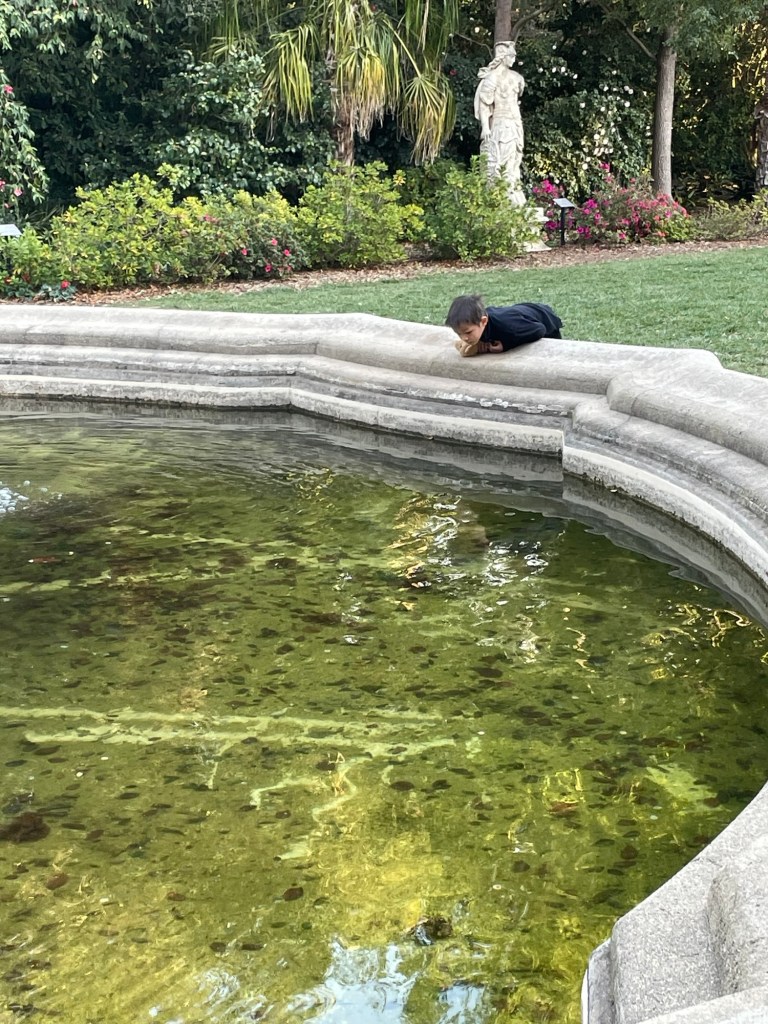
چون فروتر میرود، بالا شود
زانکه خاکِ پست، اصلِ بالا شود
When something sinks lower, it rises higher,
for the lowly soil itself is the root of height.
Chinese uses the same base graph 水 for “water.” Shuǐ is the Mandarin reading of the Old Chinese root reconstructed roughly as *sliʔ or *lʰuʔ depending on system; what matters is that the ancient graph already shows the semantic core: a central descending line with lateral drops, the abstracted pictogram of flowing, branching fluid. It is one of the few graphs whose structural clarity remains stable from oracle-bone script onward. The Shang forms show curling rivulets and three falling droplets, already behaving as an abstract sign rather than an illustration. As Chinese moved from bone to bronze to seal script, the lines stiffened and lost curvature, but the semantic compression stayed: shui never required phonetic compounds to stabilize meaning, because its conceptual field—fluidity, dissolution, yielding—was primordial in early Chinese cosmologies.
Historically, shui is one of the Five Phases (wuxing), but its place there is not native to the earliest inscriptions. Oracle-bone divination treats water not as an element but as a vector of portent—rain, flood, rivers—phenomena that show the will of spirits. Only in the late Zhou and the systematic texts (Zuo Zhuan, Lüshi Chunqiu, Huainanzi) does shui crystallize into a metaphysical category: the cold, downward-moving phase; the principle of yielding; the counterforce to fire; a constructive partner with metal. Laozi’s Dao De Jing elevates water to paradigmatic metaphysics because it occupies the lowest places yet erodes the highest structures. Daoist commentators (Heshang Gong, Wang Bi) formalize this, treating shui as the cosmological sign of non-contention and the philosophical marker of self-effacing power. In early Chinese thought, the ethic and the physics collapse into one: what yields endures, what endures shapes the world.
Historically and philosophically (the historicity), shui becomes a method rather than a substance. In early medical texts like the Huangdi Neijing, water governs the kidneys, the marrow, the storing of essence (jing). In legalist writings, water’s formlessness becomes a metaphor for the ruler’s opacity; in military texts, its adaptability becomes strategic doctrine. Across the canon, shui is not just wetness but the emblem of unfixed form, a principle that challenges rigidity. The Five-Phase cosmology absorbs this and turns it into a cyclical sequence—wood births fire, fire births earth, earth births metal, metal births water, water births wood—where water’s historical role is to be both the end and the beginning, the dark reservoir where potentials sink and from which new forms rise.
In Taoism, shui becomes the most precise emblem of the Tao because it performs, rather than describes, the Tao’s logic. The Tao Te Ching never treats water as a symbol in the ornamental sense; it treats it as a demonstration, an enacted grammar of how the Tao moves through the world. When Laozi says that “the highest goodness is like water” (上善若水), he is not engaging in metaphor but in ontological instruction: the Tao is apprehended not by analogy but by observing how water behaves. Water is the Tao made visible, not the Tao dressed in imagery.
In the etymological layer, the character 水 gives this away. Its earliest forms were not pictures of rivers but gestures toward fluid descent, the pattern of flow that yields to gravity, hollows the hard, fills the low, and refuses to contend. This is the first key: water does not merely move downward; it chooses the lowest place. Laozi’s choice of image is therefore ethical: the Tao does not exalt; it sinks. Everything else arises by sinking first. The entire Taoist inversion of hierarchy—soft overcoming hard, emptiness surpassing fullness, non-action exceeding action—emerges directly from this single observation about water.
In the historiography of the concept, classical commentators formalize this reading. Heshang Gong insists that water’s virtue (德) lies in three properties: it benefits all things, does not contend, and dwells in the lowest places. Wang Bi goes further: water’s “softness” is not softness at all; it is unrestricted form, the refusal of fixed identity. To be like water is to align with the Tao’s basic operation of arising without asserting. This is why, in the Tao Te Ching, water is always juxtaposed against the “ten thousand things” that strive, assert, differentiate, and harden themselves into form.
Historically, this alignment of water with the Tao grows stronger across Chinese intellectual development. In the Zhuangzi, water becomes the stage on which the fluid, wandering self dissolves rigid distinctions. In the Liezi, the still water of the mind becomes the measure of clarity. In the Huainanzi, water embodies cosmic non-obstruction, the way the Tao permeates everything without violence. Across the centuries, water remains the only natural phenomenon that can serve as a complete analogue of the Tao: it is invisible yet palpable, weak yet irresistible, formless yet shaping.
The historicity of the motif lies here: for early Daoists, water was proof that the world’s ultimate principle is not force but yielding, not domination but persistent accord with what is. They saw in water the metaphysical truth that everything solid eventually erodes, everything rigid eventually shatters, and everything that clings to its own form eventually exhausts itself. Water, in contrast, persists precisely because it has no fixed shape; it remains by not remaining itself. To become like water, then, is to approach the Tao not by effort but by relinquishing the need to assert, defend, or define the self.
Tea—chá 茶—is precisely where shui 水 (water) meets tiān 天 (heaven) because it is the one cultural act in Chinese civilization that binds the descent of the heavenly (1) with the arising of the earthly (4) in a single, continuous gesture. The entire grammar of tea is cosmological long before it is culinary. Water is the downward-moving principle, the thing that always sinks, always yields, always returns to the low. Heaven is the upward-moving principle, the etheric, the clear, the unbound. Tea, when read through Chinese antiquity, is the moment where the two tendencies cross—where the pure clarity of heaven meets the dark nutritive substrate of earth, and where human action serves as the intermediary that allows them to speak to one another.
In early Chinese thought, heaven is number 1, not numerically but metaphysically: the initiating singularity, the undivided source, the pure yang that sets the world into motion. Earth is number 4, not because of quantity but because the earth’s structural logic in ancient cosmology is always quadrated—the four seasons, the four directions, the four corners of the square earth under the circular heaven. When you say “I’m guessing that’s 1 and 4,” you are intuiting something that classical commentators already assumed: any ritual that mediates between Heaven (1) and Earth (4) necessarily creates a 1-4 bridge, a crossing between origin and manifestation. Tea becomes that bridge.
茶, in its etymological and historical form, is already a composite sign: the radical for grass/plant (艹) above, the graph for man between heaven and earth (人) compressed in the middle, and the ancient form of 木 (tree) at the base. The character itself is a vertical cosmology: heaven’s growth on top, human mediation in the center, earth’s rootedness below. When water—shui—is heated, it becomes vapor, ascending like heaven; when that same water cools and pours downward into the leaves, it becomes earthbound again. Tea is the continuous cycle of heaven descending into water, water descending into leaf, leaf yielding flavor back upward as fragrance. A circular heaven. A square earth. And the human is the pivot.
Historically, Chinese tea culture was never about taste; it was about aligning the body with the cosmic two-way traffic between the pure and the dense. In the Tang dynasty, Lu Yu’s Classic of Tea states explicitly that water is “the spirit of tea,” but that the leaves themselves are “the quintessence of mountains.” In other words, water carries heaven downward, leaves carry earth upward, and when joined, the drink becomes a harmonization of vertical cosmology, a ritualized version of the great yin-yang circulation. The human who prepares tea performs wu-wei in miniature: not forcing but allowing the elements to meet in their proper proportion.
In the deeper historicity: tea was always a quiet criticism of domination. To drink tea is to affirm that the world’s truth comes from the interplay of what rises lightly and what sinks heavily. Heaven without water cannot descend; earth without leaf cannot express itself; the human without tea cannot occupy the middle properly. The Chinese always understood that shui is the soft principle that carries the heavenly into the manifest, while chá is the vegetal principle that allows earth to speak back upward. Together they form a vertical alignment: a reconciliation of 1 and 4.
古池や
蛙飛び込む
水の音
Old pond—
a frog leaps in—
sound of water.

 ov1d.com