
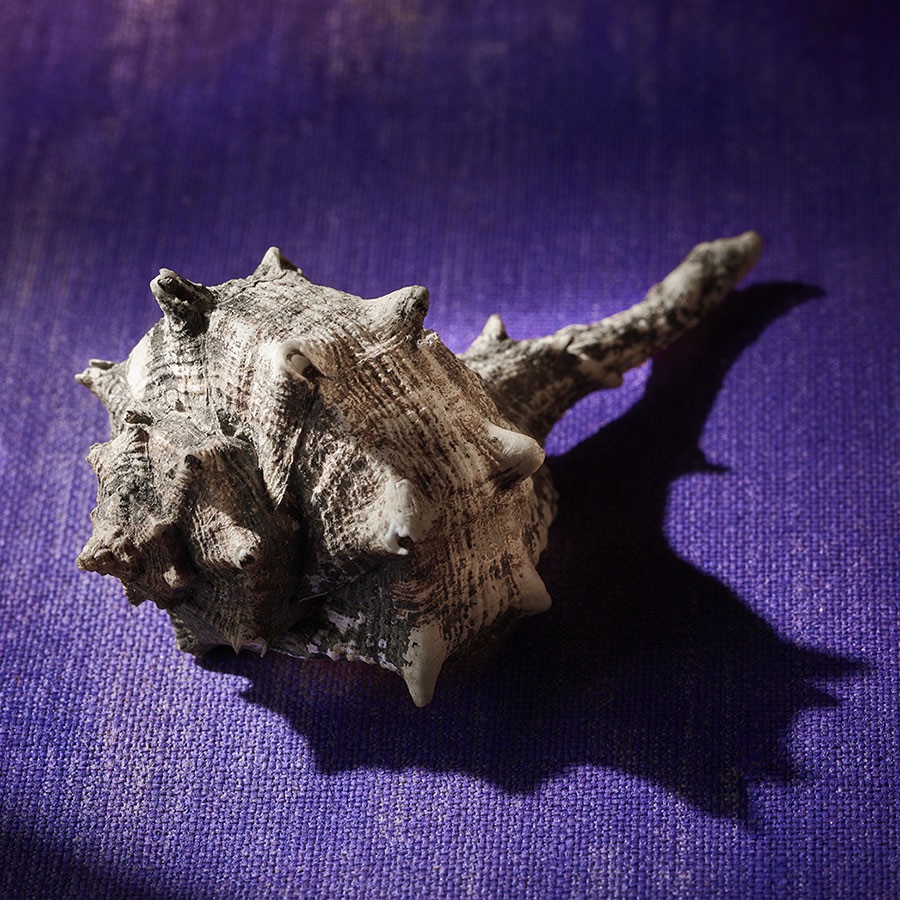
Tyrian purple—sometimes misrendered as “Pyrian” in later manuscripts—takes its name from the Phoenician port of Tyre, whose dyers mastered a secret extraction of color from the hypobranchial gland of Mediterranean murex snails. The process required thousands of Murex brandaris or Murex trunculus, broken while still alive, their glands mixed with brine and exposed to sunlight so that a translucent mucus oxidised through green and indigo to a deep violet-crimson. Because each mollusc yielded only a pinhead of pigment and the vats exhaled an acrid stench, the dye cost more than its weight in silver; contemporary writers likened the shoreline workshops to alchemical kitchens where decay transmuted into brilliance. Chemically the hue derives from 6,6’-dibromo-indigo, whose bromine atoms refract light to produce a saturation no vegetal tincture could match, rendering the cloth resistant to fading even under Levantine sun. Imperial Rome and, later, Byzantium turned this rarity into a juridical marker of sovereignty. Sumptuary edicts reserved the uncut porphyra bolt for the emperor; senators might don a narrow purple stripe (clavus), while commoners risked death for wearing the full tincture. The very word porphyrogenitus—“born in the purple”—denoted princes delivered in the porphyry-lined chamber of the Great Palace, swaddled at birth in the same dye that would halo their regnal portraits. Byzantium’s vestiarion kept precise accounts of purple silks, and eunuch officials like the prōtovestiarios guarded them with a zeal equal to that shown the regalia itself, for to control the dye was to police the visible boundary between ruler and ruled. Long after synthetic aniline dyes rendered snail-purple obsolete, its mythic aura persisted, a reminder that color, in the ancient Mediterranean, was not merely visual but ontological—an index of command, theology, and the mysterious primacy of matter over form.

Amber lamplight flickers over palatial thresholds where histories convene like conspirators, and in that tremor between shadow and fire the eunuch first takes shape—at once custodian and cipher. From the glazed brick courtyards of ancient Babylon to the porphyry halls of Constantinople, his altered body negotiates the anxieties of succession, converting personal loss into imperial leverage. This essay traces that long metamorphosis: how the knife that silenced lineage became an instrument of governance; how mute attendants in Mesopotamia evolved into fiscal magi of the late Roman treasury; how, in the sixth century, a slight Armenian named Narses translated wardrobe keys into battlefield tactics and restored Italy to the eastern throne. Layer by layer, sources of clay, papyrus, marble, and parchment reveal a practice less about cruelty than about architecture—an architecture of power whose hinges are bone and scar. By following those hinges, the narrative uncovers the paradox that an empire’s most trusted agents were men barred from posterity, and yet upon their bloodless shoulders rested the future of crowns, cities, and creeds.
Byz
“Byzantine” descends from the Greek toponym Βυζάντιον, Latinized as Byzantium, the ancient colony at the Bosporus reputedly founded by Megarian settlers under Byzas in the seventh century BCE. Late Latin Byzantinus at first simply meant “of Byzantium,” but once Constantine refounded the city as Constantinople in 330 CE the adjective all but vanished from contemporary usage; inhabitants called themselves Rhomaioi and their realm Basileia Rhōmaiōn, the Roman Empire. The modern term revives in the mid-sixteenth century, when the Augsburg humanist Hieronymus Wolf titled his 1557 Corpus Historiae Byzantinae and thereby coined “historia Byzantina.” Du Cange’s vast seventeenth-century glossary and the Corpus Scriptorum Historiae Byzantinae of Niebuhr’s Bonn circle (1828 – 97) fixed the label in European scholarship, while Enlightenment polemicists such as Gibbon exploited “Byzantine” to denote decadence and intrigue, planting the pejorative sense still current in colloquial speech. Historiographically, the empire’s self-designation as Roman long clashed with Western narratives that dated authentic Rome’s eclipse to 476 CE. Nineteenth-century classicists, working amid nationalist currents, accepted a civilizational rupture and framed Byzantium as an orientalized, autocratic successor—an image later nuanced by Vasiliev, Ostrogorsky, Mango, and Cameron, whose studies stressed administrative continuity, economic resilience, and cultural synthesis. Current Byzantine studies interrogate the term’s ideological freight, arguing for a spectrum of identities—Roman, Greek, Christian, and local—refracted through shifting frontiers and theological controversies. The field’s source-critical turn, aided by sigillography, numismatics, and digital prosopography, has complicated older teleologies that marched straight toward 1453. In historical actuality the polity governed the eastern Mediterranean for over a millennium, from Constantine’s new capital to Mehmed II’s conquest. It survived Arab expansion by fortifying Anatolia, weathered Iconoclasm, reclaimed much of the old Roman basin under Basil II, endured the Latin occupation after 1204, and persisted as a truncated but literate micro-state until the fifteenth century. Codifying Roman law in the Corpus Iuris Civilis, diffusing Orthodox Christianity among Slavs, and transmitting classical manuscripts to Italy, it shaped both Islamic and Renaissance worlds. Byzantine governance, theology, and art were neither static nor uniformly “decadent”: they evolved through the very crises that posterity once marshaled as proof of decline, leaving a record whose complexity belies the caricature encoded in the adjective that names it. Hieronymus Wolf, a humanist trained in Augsburg and versed in Greek at a moment when that language was still a rarity north of the Alps, gathered and printed in 1557 the Corpus Historiae Byzantinae at Basel. His single folio volume drew together Latin translations he had prepared of six late-antique and medieval Greek historians—most prominently Procopius, Agathias, Menander the Protector, and Nicephorus Gregoras—supplemented by ample marginalia that cross-referenced events and clarified chronology. Wolf’s philological aim was twofold: to rescue eastern Roman narrative sources from manuscript obscurity and to furnish Western scholars with a continuous political history that picked up where classical authors ended. In baptizing the collection Byzantina, he effectively coined a neologism that detached Constantinople’s millennium from the undifferentiated res publica Romana, framing it as a discrete, Greek-speaking polity deserving its own historiographical shelf. The work was reprinted repeatedly, fed later compilations by Du Cange and Niebuhr, and set the template for the vast Corpus Scriptorum Historiae Byzantinae of the nineteenth century; its etymological innovation, its historiographic partitioning of “Roman” from “Byzantine,” and its transmission of primary evidence together explain its decisive historicity in shaping the field. Edward Gibbon, writing the History of the Decline and Fall of the Roman Empire (1776–1788), inherited Wolf’s terminological firewall and turned it into a moral geography. Wherever his narrative crosses the Bosporus, he substitutes “Byzantine” for “Roman” and adopts a tone of elegant disdain: the adjective becomes shorthand for labyrinthine bureaucracy, sterile theological disputation, eunuch politics, and a populace addicted to spectacle. By stressing court ritual, palace coups, and interminable Christological quarrels, Gibbon casts the eastern empire as a decadent after-echo of classical virtue, a brilliantly lit theater of intrigue whose very survival appears a rebuke to civic energy. The rhetorical move serves his broader Enlightenment thesis that civic freedom, martial spirit, and rational religion decline in proportion to superstition and despotism; Constantinople thus functions as the negative foil against which the lost vigor of republican Rome is measured. Later scholarship has complicated and in many respects overturned this caricature, but Gibbon’s lapidary prose fixed “Byzantine” in modern vernacular as a synonym for convoluted decadence—an exploit of language as potent as any explicit thesis in the Decline and Fall. The prōtovestiarios, whose name literally means “first of the wardrobe,” began as the eunuch charged with guarding the emperor’s vestiarion, the storeroom that held robes, regalia, and assorted treasures. Because every public appearance of the ruler required exact costuming, control of the wardrobe quickly translated into control of access, and by the ninth century the prōtovestiarios functioned as a chief chamberlain who could relay petitions, broker appointments, and even command field armies in the emperor’s absence. The quaestor, revived from late-Roman precedent, served as the empire’s senior jurist: he drafted new laws, issued authoritative legal opinions, and supervised the urban prefecture’s courts, so that nearly every novel in Justinian’s Corpus bears a subscription “data per manus quaestoris.” A logothetēs—literally a “word-setter” or accountant—headed one of several fiscal departments: the logothetēs tou genikou managed general revenues, the logothetēs tou dromou oversaw the imperial post and foreign intelligence, and by the twelfth century the megas logothetēs acted as a de facto prime minister. Together these offices illustrate the layered but functional bureaucracy that Gibbon reduced to a “labyrinth.” Conciliar acts are the verbatim minutes, doctrinal definitions, and disciplinary canons recorded during an ecumenical or provincial council; they preserve who spoke, how each clause was debated, and the formula finally promulgated, making them indispensable for tracing shifts in Christological language. Synodika (singular synodikon) are the formal letters or tomes issued by a council or patriarchate to announce those conciliar decisions to other sees; the most famous, the Synodikon of Orthodoxy, is still chanted each first Sunday of Lent to affirm icons and anathematize heresies. A florilegium, literally a “gathering of flowers,” is a dossier of excerpted patristic passages arranged by topic—Trinity, Incarnation, icon veneration—so that a theologian could cite authorities at speed during polemical exchanges. These compilations, copied and expanded across centuries, supplied the raw ammunition for the very disputes Gibbon caricatured as sterile, yet they also anchored doctrinal continuity by tethering new arguments to an inherited chorus of authoritative voices. Gibbon’s charge of a “labyrinthine bureaucracy” draws on the intricate hierarchies that crystallized after the seventh-century fiscal-military reforms. Titles such as prōtovestiarios, quaestor, or logothetēs proliferated, each governing a narrow dossier while answering to overlapping courts—palatine, financial, military, and ecclesiastical. The surviving seals, Notitiae dignitatum, and tenth-century Klētorologion substantiate a system thick with ceremonial precedence and duplicated jurisdictions, a mesh that to Enlightenment eyes signified paralysis rather than resilience, even though modern prosopography shows it could mobilize armies, mint coinage, and provision cities across three continents for centuries. “Sterile theological disputation” caricatures the intensity of the fourth- to ninth-century Christological and iconoclastic controversies. Councils from Nicaea to Chalcedon, the Tome of Leo, and the iconodule tracts of John Damascene generated mountains of conciliar acts, synodika, and florilegia. While Gibbon treats these debates as hairsplitting over metaphysical minutiae, recent scholarship traces their political stakes: defining orthodoxy underwrote imperial legitimacy in a confessional state where liturgy, taxation, and diplomacy hinged on doctrinal conformity. Far from sterile, the machinery of doctrinal arbitration fused provincial loyalties and mediated relations with the Umayyad and Abbasid courts, Rome, and the emerging Slavic churches. “Eunuch politics” targets the rise of castrated officials who, barred from dynastic ambition yet entrusted with intimate palace duties, became indispensable brokers of access. Sources from the Chronographia of Theophanes to the eleventh-century memoirs of Michael Psellos record eunuch generals such as Narses and court managers like Joseph Bringas steering successions and wars alike. Their prominence reflected a calculus of trust in a society where kinship often equaled conspiracy: by removing reproductive stakes, the crown could elevate talent without empowering rival houses, an expedient now read by social historians as a sophisticated solution to succession risk rather than a moral aberration. Finally, the “populace addicted to spectacle” invokes the Hippodrome factions—the Blues and Greens—whose chariot races and acclamations formed a barometer of urban mood. Chroniclers recount riots, most famously the Nika revolt of 532, when crowd chants escalated into civil war and nearly toppled Justinian. Yet the stadium also served as a civic forum where emperors heard petitions and rehearsed legitimacy through triumphal entrances, military trophies, and ritual largesse. Theatricality was not escapist decadence but a political technology that kept a vast, multilingual capital legible to its rulers. Taken together, these four motifs furnished Gibbon with a foil to republican virtue, but the archival record reveals adaptive institutions whose very complexities enabled an empire to navigate war, plague, and economic contraction for more than a millennium.
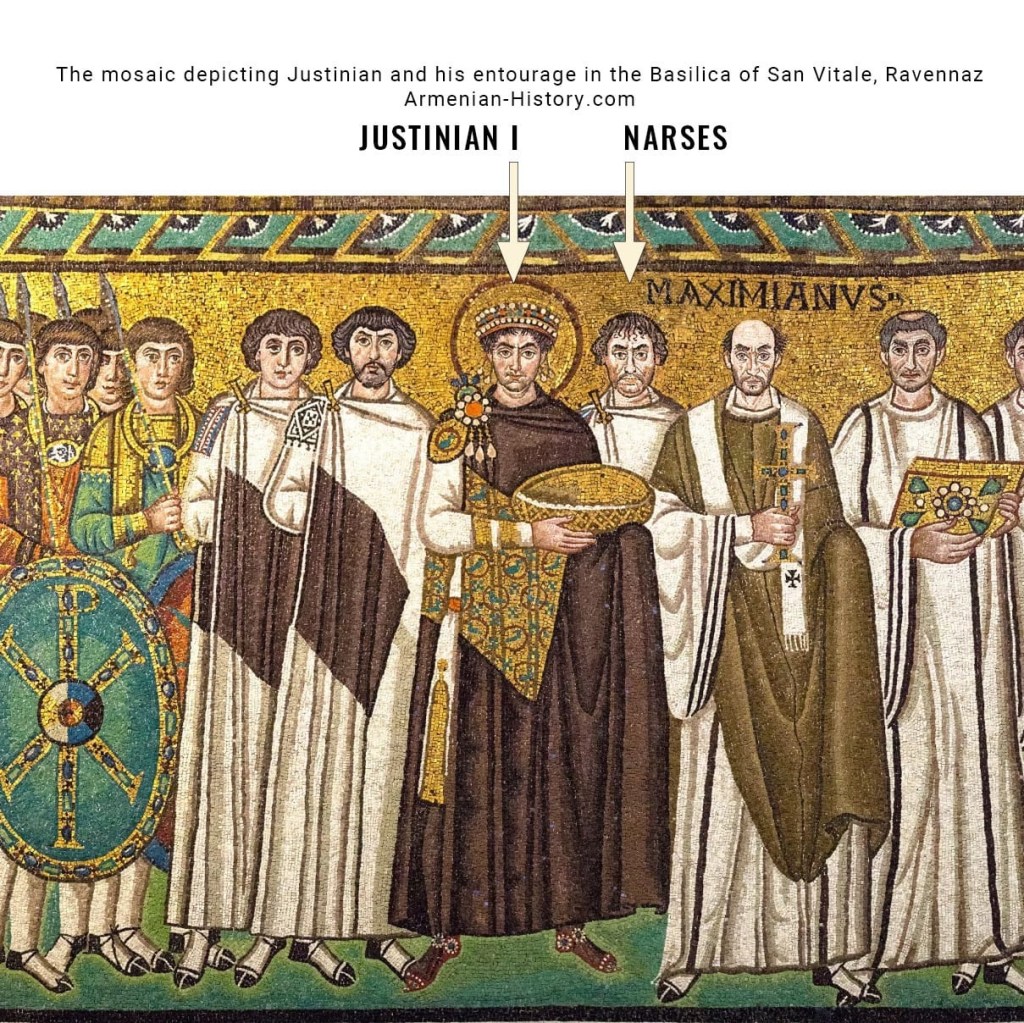
Narses entered the historical record almost as an absence: court chroniclers identify him first and foremost as a eunouchos of the imperial bed-chamber, leaving only scattered hints about the decades before he surfaces at Constantinople. Modern prosopography locates his birth around 478 CE, likely in the district of Persarmenia that straddled the Sasanian frontier; Armenian nakharar names recur among his early dependants, and his grasp of both Greek and Armenian suggests a bicultural childhood in the orbit of the great satrapies. Castration must have taken place well before puberty, for Procopius later remarks on his short stature and “childlike” voice—physical traits that in court ideology marked an official both trusted and, paradoxically, rendered harmless to dynastic succession. By the reign of Justin I (518 – 527) he was already cubicularius in the sacred palace, keeper of the purple wardrobe whose bolts of silk and bullion cloth functioned as coin of political access. When Justinian ascended in 527, Narses’ logistical gifts found wider stage. He directed treasury consignments to the Balkan armies, supervised recruitment from Isaurian and Armenian highlands, and in 532 emerged from the shadows to help crush the Nika revolt, pouring sacks of gold into the Blues’ faction at the Hippodrome to divide the rioters. Reward followed swiftly: the title praepositus sacri cubiculi placed him at the apex of the household hierarchy, while fiscal oversight of the scrinia made him indispensable to the emperor’s western ambitions. In 538 Justinian dispatched him to Italy with a modest guard and an enormous war-chest; his orders were to coordinate with Belisarius yet keep the older general’s pride in check. Their partnership dissolved in quarrel, but Narses proved a deft coalition builder, buying Lombard, Herulian, and Armenian contingents whose mobility offset Belisarius’ dwindling infantry. Recalled in 540 amid recriminations, he spent a decade reconstituting imperial finances before returning to the peninsula in 551 as magister militum per Italiam, now in sole command. The campaign that followed made a eunuch pensioner the most successful field commander of the age. At Taginae (552) his mixed infantry held the centre until a feigned retreat lured Totila’s Ostrogothic cavalry into a flanking envelope; Totila fell on the field, and the road to Rome opened. At Mons Lactarius (553) Narses encircled the last Gothic king Teia in the heights above Naples, grinding down the defenders in a two-day slog that Procopius compares to the Punic sieges. Subsequent expeditions pushed up the Po valley, rolled back Frankish incursions at Casilinum, and restored the whole peninsula—shattered aqueducts, civic councils, senatorial estates—under Byzantine law. Ammianus had once quipped that eunuchs “brandish the pen, never the sword”; Narses forced posterity to amend the maxim. Administration proved harder than conquest. As virtual viceroy he attempted to finance fortifications and church restorations through the eastern model of supertaxatio, alienating Roman landholders already bankrupt from war. Pope John III fled to Nuceria in protest. After Justinian’s death (565) the new emperor Justin II, eager for popularity in the capital and wary of an ageing but undefeated general, recalled Narses to Constantinople, where hostile rumor pictured the eunuch “weaving women’s wool” in disgrace. Whether the tale hides a quieter retirement or a palace purge, sources agree that he died soon after, perhaps in 573, and—remarkable for a man who never sired heirs—received burial in the Church of the Holy Apostles among members of the imperial family. Historiographically, Narses’ career was long filtered through the prejudices Gibbon later crystallized: the court eunuch as sinister manipulator. Close reading of the Chronicon Paschale, Agathias, and the Strategikon fragments instead reveals a strategist whose grasp of supply lines, frontier diplomacy, and multi-ethnic recruitment allowed a fiscally strained empire to project power across the Mediterranean one last time. His lifespan—nearly ninety years if the Armenian birth date holds—demonstrates that the eunuch’s body, often derided as deficient, could anchor a political life of extraordinary durability.
Why was he made a eunuch? What was the purpose of this practice? And I can’t help but feel that, albeit the reality of eunuchs, these titles, especially in Irene’s world, were permissions to give women men’s work
Castration in late-antique and medieval courts was a political technology before it was a moral question. An adult male who could never father a dynasty could be stationed at the emperor’s bedroom door, handle the regalia, or command armies without posing the hereditary threat inherent in elevating a great family’s son. Byzantium banned the mutilation of freeborn subjects under Constantine, yet the law contained its own loophole: boys could be purchased or taken as captives beyond imperial borders, gelded in Phrygian or Cappadocian workshops, and then returned as “foreign” slaves. The result was a steady inflow of Armenian, Slavic, and occasionally Germanic youths whose emasculation predestined them for the palace. The court rewarded that sacrifice with unique leverage: eunuchs could hold the golden key of the koubouklion, supervise the treasury, or, like Narses, rise to magister militum when talent and imperial need aligned. Their bodies signaled both intimacy and safety—allowed near the purple without endangering succession. The practice therefore answered two intertwined problems: logistical trust and dynastic security. By removing reproductive stakes, the crown could promote sharp administrators over tribal or senatorial magnates whose offspring might convert office into patrimony. At the same time, a eunuch’s ambiguous status—neither fully male in legal terms nor female in social role—enabled him to straddle domains otherwise cordoned by gender propriety. He could share the imperial bedchamber’s physical space, tutor princes, audit provincial accounts, or negotiate with patriarchs, each without violating the segregations that framed Byzantine etiquette. Far from being a symbolic humiliation, the condition conferred a badge of proximity that freeborn males often coveted but rarely obtained. When Empress Irene ruled in her own name (797-802), eunuchs became the hinge on which female sovereignty turned. Conventional Roman law barred women from presiding at military parades, minting coin in their likeness, or sitting unescorted in the Hippodrome’s kathisma. Irene circumvented these taboos by delegating the visibly male functions of war finance, troop review, and foreign diplomacy to eunuch ministers such as Staurakios and Aetios. Their sexed bodies could perform “men’s work,” yet their legal incapacity to found houses neutralized anxieties that a woman on the throne was merely advancing a rival lineage. In that sense the eunuch hierarchy did not so much license women to do men’s work as furnish the female ruler with a pliable, dynastically safe instrument through which the outward forms of masculine governance could be enacted. The same mechanism, viewed from another angle, preserved patriarchal logic by interposing a desexed buffer between imperial femininity and the arenas of swords and horsehair standards.
It’s glaring to say the least that Irene wasn’t enjoying being around castrated men, given the situation
Contemporary chronicles offer no glimpse of Irene’s private sentiments toward eunuchs, only the political calculus that bound her to them. After blinding her son Constantine VI in 797, she stood alone at the apex of a state whose ceremonial and logistical sinews were coded as masculine. Eunuch courtiers such as the logothetēs tou genikou Staurakios and his rival Aetios supplied the bodily proxy the ritual order required: they could ride at the head of pay convoys, receive embassy gifts, or preside over military inspections without violating seclusion norms that barred full males from a woman’s intimate chambers. Their incapacity to sire heirs neutralized suspicion that the empress was smuggling an alien lineage into the purple, yet the same incapacity sharpened their appetite for power within the only arena still open to them—the court hierarchy itself. Theophanes records how Staurakios amassed estates and patronage networks that soon rivaled Irene’s own authority, prompting her to clip his influence in 799 and elevate Aetios, only to face a new factional imbalance. What later moralists construed as Irene’s distaste for “castrated men” is better read as exasperation with chamberlains who, despite physical unsexing, became fully political actors once the imperial aegis legitimated their ambitions. The spectacle of a female monarch flanked by eunuchs thus unmasks the asymmetry at the heart of Byzantine gender politics. Eunuchs were drafted precisely to stabilize dynastic legitimacy, yet their loyalty was contingent on continued access to the ruler; any perception of waning favor drove them to forge alliances with generals, patriarchs, or urban factions, turning the very safeguard into a vector of instability. Irene’s reign illustrates the paradox: the eunuch corps both enabled her unprecedented sovereignty and furnished the instruments of her eventual eclipse when Nicephorus I, backed by disgruntled military officers and sidelined eunuch cliques, seized the throne in 802. The historical record therefore shows less an empress discomfited by emasculated courtiers than a skilled operator navigating a court architecture whose structural hinges—because they were eunuchs—could pivot in directions she could not always predict. The word “eunuch” reaches English through Latin eunuchus and Greek εὐνοῦχος, a compound of εὖνή (“bed”) and ἔχειν (“to hold, guard”). The earliest attestations in Homeric glosses already carry the sense of a trusted chamber attendant, though the semantic core is less the surgical fact of castration than the social function of watching the ruler’s sleeping quarters. Semitic cognates—Akkadian ša rēši, Hebrew sārīs—likewise denote a palace officer rather than an anatomical condition, suggesting that the office long preceded, and later guaranteed, the bodily modification. Greek usage narrowed during the Hellenistic courts where castration became an eligibility clause; Roman writers adopted the Greek term directly, distinguishing the imported eunuchus from the indigenous spado (“gelded animal or man”). After the fourth century the Christian East retained the Greek form, while the Latin West absorbed it into vernaculars as eunucco, eunuc, and eventually the English “eunuch.” Historiographically, eunuchs oscillate between fact and polemic. Classical authors such as Herodotus describe Persian and Median courts staffed by “castrated guardians,” yet frame them as markers of oriental despotism. Byzantine chroniclers, by contrast, treat eunuch ministers—Eutropius under Arcadius, Narses under Justinian, Staurakios under Irene—as indispensable fixtures, recording titles, stipends, and diplomatic missions with bureaucratic matter-of-factness. Enlightenment historians revived the orientalizing lens: Montesquieu’s Esprit des lois and Gibbon’s Decline and Fall cast eunuchs as emblems of decadence corroding civic virtue. Twentieth-century social historians shifted emphasis from moral judgment to institutional analysis, using sigillography, fiscal registers, and Chinese dynastic biographies to trace how castration policies in Byzantium, Tang China, Abbasid Baghdad, and Ottoman Topkapı solved recurrent problems of palace security, succession management, and information control. Recent bio-archaeological studies on skeletal markers of pre-pubertal castration now supply empirical baselines that textual sources obscured. Historicity complicates the caricature. Across Eurasia, eunuchs served as treasurers, generals, tutors, and envoys precisely because their altered bodies broke the usual link between office and hereditary clan. Numbers remained small—rarely exceeding a few thousand in even the largest courts—yet their leverage was magnified by proximity to the sovereign and by mastery of palace procedure. While surgical methods were often brutal and the practice fueled slave markets on imperial frontiers, many castrati amassed fortunes, founded monasteries, and left testamentary patronage that rivalled aristocratic houses. The institution thus emerges not as an exotic aberration but as a durable technology of governance, one that successive empires recalibrated to balance intimacy, loyalty, and political risk.
Beneath the blazing brickwork of Assyria and Babylon, where royal thresholds reeked of cedar and bitumen, the first guardians of the bedchamber emerged—shaven boys whose mutilation annulled the line between servant and hostage. Their presence, so the stone reliefs hint, hushed the clamour of patrilineal rivalries: a body robbed of posterity could linger near the sovereign’s pillow without sowing tomorrow’s coup. Across the high plateaus of Persia the practice hardened into protocol. In the Achaemenid palaces at Susa and Persepolis, silk-swathed eunuchs filtered petitions and measured silence; Herodotus watched them glide like shadows behind Xerxes’ litter, as indispensable—and as ornamental—as the lotus-headed sceptre they bore. Alexander’s storm of iron scattered those courts yet carried their customs. In the marbled echo of Hellenistic capitals—Alexandria, Antioch, Pergamon—the gelded chamberlain became a lingua franca of power. Seleucid decrees and Ptolemaic tax rolls alike record stipends for “keepers of the royal couch,” proof that the conqueror’s heirs found utility in the same amputation they publicly deplored. Rome, when it spread its eagle across the Mediterranean, first scorned then absorbed the institution. Augustus banned the knife, but by the age of Elagabalus Syrian traffickers were funnelling bright-eyed captives through Cilician ports, their futures traded for pepper and amethyst. Latin needed two words now: spado for the mere gelded creature, eunuchus for the courtly species that whispered beside emperors. With Diocletian’s tetrarchic frost the palace thickened its walls of etiquette, and the eunuch—ever plastic to circumstance—slipped into new crevices of authority. Constantine’s legislators, hearts aflame with Christian mercy, outlawed the surgery on Roman soil yet winked at its import from the marches. Cappadocian workshops hummed at night. By the fifth century the cubiculum was a clearing where law, liturgy, and finance intertwined, and eunuchs held the keys. The praepositus sacri cubiculi orchestrated access to the imperial body; the spatharios carried the sword of ceremony; the silentiarius governed speech itself, deciding when pages might breathe in the throne room’s gold-leaf dusk. The sixth-century court of Justinian perfected the dialectic of trust and terror. Imperial widows, sterile as the marble Madonnas that lined their chapels, favoured servants who mirrored their childlessness; generals eyed quartermasters whose estates would crumble with their bones. Eunuchs became the empire’s movable joints—bending without breaking, never fathering, never quite sons. Into this architecture stepped Narses, Armenian by rumor, clipped in boyhood somewhere east of the Taurus, his voice eternally hovering in the register of clarinets. First he guarded wardrobes whose amethyst clasps clicked like dice in the dark; then he fed gold to Hippodrome factions, tilting a city’s fate with a purse’s mouth; finally he translated his intimacy with silks into mastery of spearheads, unfolding stratagems across Italy as if he were rebuttoning the emperor’s cloak. Thus, from Mesopotamian dawn to the mosaicked nave of Ravenna, the eunuch evolved from mute insurance policy to eloquent hinge of empire. Each incision on a boy’s body redrew a contour on the map of power, until in Narses one beholds the practice’s culminating irony: a man rendered ostensibly harmless who carried in his bloodless loins the future of cities, laws, and crowns.
like and subscribe

 ov1d.com