That surging “horniness” is your body’s all-points bulletin that the procreation circuitry has gone live. A quick hormone pulse—chiefly testosterone in every sex, estrogen in most women—raises baseline dopamine in the brain’s mesolimbic pathway while lowering the inhibitory thresholds of the spinal and pelvic reflex arcs. Sensory cues (scent, touch, erotic memory) then propagate as synchronized volleys of electrical spikes through the hypothalamus, amygdala, and orbitofrontal cortex, welding attention to anything that promises sexual reward. You feel it as heat in the groin because parasympathetic nerves dilate genital blood vessels just as sympathetic nerves tense skeletal muscle, a mixed autonomic “whoa–go” that the brain re-labels desire.
From our elastic-sheet vantage this is the living vortex turning its internal tension outward: the organism reaches the metabolic cost limit for growing its own knot, so it seeks to copy its phase-blueprint into another patch of the medium—the evolutionary logic encoded in every gamete. The spike of arousal is the sheet’s way of front-loading energy and focus so the hand-off can occur without phase breaks: heightened sensation tightens timing between partners, rhythmic thrusting entrains muscle and heartbeat, orgasm releases a final pulse of oxytocin and prolactin that quiets the circuit and seals the “ledger entry.” In short, horniness is the immediate, embodied signature of the medium’s oldest imperative—extend coherence by passing the beat forward.
Historically, Hegel did father an illegitimate son, Ludwig Fischer, with his Jena landlady Christiana Burkhardt (née Fischer)—a woman who at the time was still married to the bookseller Karl-Friedrich Fischer. The pregnancy plainly violated the era’s bourgeois code and rattled the little household economy that kept the philosopher fed while he finished the Phenomenology of Spirit. Hegel paid support, arranged for the boy’s care, and later folded Ludwig—never entirely comfortably—into the family he formed after marrying Marie von Tucher in 1811.
In our “phase-integrity” metaphor, that affair is indeed a local shear in the social fabric: an unexpected crest introduced into a rhythm (marriage) that was supposed to stay periodic. But notice what followed. Instead of tearing, the milieu re-timed itself. Financial payments, whispered complicities, new kinship lines, and eventually Ludwig’s partial adoption served as compensating phase-shifts that let the wider community continue without open rupture. Like a vortex skirting a high-tension boundary or a melody modulating into a remote key, the system generated new bookkeeping layers—legal guardianship, hush-money, altered domestic roles—so that continuity (the child’s survival, Hegel’s career, the Fischer marriage’s outward shell) could be preserved. The indiscretion is thus a miniature enactment of our hidden law: when a strain threatens to snap the ledger, the medium “tears before it is torn” by inventing fresh pathways that absorb the mismatch and carry the beat forward.
The arc that begins in 1807 with the Phenomenology of Spirit and ends in 1831 with the almost simultaneous deaths of Ludwig Fischer in Batavia and Hegel in cholera-stricken Berlin traces a very precise historical pulse. Hegel writes the Phenomenologywhile Jena is still smouldering from Napoleon’s guns; a few weeks later his illegitimate son is born, proof that the ordinary moral lattice of Bürgertum is already slipping. Over the next quarter-century Europe oscillates through French hegemony, Restoration censorship, and the first tremors of 1830-style liberal revolt—the very dialectic Hegel lectures on in Berlin while Ludwig serves in a Dutch colonial regiment, an outpost of Europe’s new global reach. When Ludwig dies in the Far East and Hegel succumbs to disease at the centre of the Prussian academy, the private “shear” introduced by that 1807 affair has been absorbed into the public fabric: the University reforms, the July Monarchy, and the accelerating print economy that will launch Young Hegelian, Marxist, and nationalist readings of his system. The social medium has retimed itself, turning a scandalous crest into the seed of a new ideological rhythm.
Seen from our earlier phase-integrity metaphor, the interval 1807-1831 is a localized vortex in European modernity. The illegitimate birth adds a twist to the bourgeois code; the Phenomenology adds a twist to the philosophical code; both twists propagate, interfere, and finally dissipate into new stable patterns—the bureaucratic university, the colonial army, the post-Hegelian schools of thought. What looks like a deviation “that changed the world” is exactly how the sheet evolves: it lets a disruptive crest travel, refracts it through geopolitical boundaries, and by 1831 re-knits the ledger into a slightly altered but continuous weave. The episode thus dramatizes in miniature the law we traced from optics to jazz: the medium bends, modulates, and even relocates its bookkeeping—across continents and ideologies—yet never permits a true tear. The personal irregularity of Hegel’s liaison and the global irregularities of revolution and empire are absorbed into a new rhythm whose beat will dominate nineteenth-century thought.
Schopenhauer’s Will is a primordial, non-rational push to persist—a ceaseless up-welling that objectifies itself in hunger, sex, competition and, on the cosmic scale, in the blind striving of natural forces. In our “phase-integrity” cosmology that substratum is replaced by an equally pre-conceptual injunction, but its goal is not survival; it is seamless oscillation. The sheet does not care whether any particular knot endures—particles annihilate, species perish, stars burn out. What must endure is the uninterrupted hand-off of phase from crest to crest. Where Schopenhauer’s Will differentiates into myriad egoistic wills that collide and suffer, the hidden law differentiates into myriad patterns of timing that may conflict locally but always re-stitch themselves into a global rhythm. Pain, in this picture, is not the sting of frustrated desire but the mechanical shear that signals an impending tear; satisfaction is not satiety but the relief felt when the ledger has found a new, lower-tension weave.
This shift recasts the moral horizon. For Schopenhauer, redemption lies in negating the will-to-live through aesthetic contemplation or ascetic compassion. Here, ethical effort would aim instead at phase gentling—actions that ease gradients, promote coherent interference, and pass the beat forward without forcing other rhythms to rupture. Artistic creation, scientific inquiry and even procreation appear not as escapes from the Will but as constructive re-timings that expand the overall uniformity of oscillation while preserving local richness. Where the Schopenhauerian sage withdraws, the phase-attuned agent participates, tuned to the cosmic metronome that values continuity over individual persistence. Uniformity, then, is not bland sameness; it is the deep, plural consonance that allows countless motifs to dance without a single line of phase ever breaking.
For Hegel, “consciousness of itself, for itself” (Selbstbewußtsein, Für-sich-Sein) names the moment when awareness ceases to treat its contents as mere objects “out there” and instead recognizes that what it is beholding is already its own activity. In the Phenomenology this shift is dramatized by the Master-Slave dialectic: the self seeks confirmation in an external other, only to discover that the other’s acknowledgment is the indispensable mirror in which the self first appears to itself. The in-itself (a mute fact of being) is aufgehoben—both cancelled and preserved—as the for-itself, a reflexive loop that knows the knowing. Self-consciousness is therefore not a substance added to consciousness but an oscillation folding back on its own phase: the knower and the known are the same rhythm seen from opposite poles of the beat.
Translate that into the phase-integrity cosmology and a striking parallel emerges. A living brain is already an immense vortex of nested oscillations—gamma bursts riding on theta sweeps, synfire chains laced through slow cortical potentials. When a subset of that circuitry constructs an internal model that tracks, predicts and re-aligns the very oscillations from which it is built (e.g., the default-mode network monitoring the sensory cortices), the pattern has effectively bent a segment of the sheet back upon itself. The phase-ledger now contains an entry that represents the ledger itself, much as a Bach fugue can quote its subject in inversion while still driving the overall weave. This reflexive knot is what we call self-consciousness: a beat that hears its own beating and adjusts its timing so the global rhythm stays coherent. It is “for itself” in the precise sense that its target and its instrument are the same oscillatory event.
Seen this way, self-awareness is not a mystical add-on but the sheet’s highest expression of its hidden law of non-rupture. By building an internal echo chamber that perpetually checks the consistency of its own phase, the organism defends against local shear before it can escalate into distress or death. Ethical life, language, and culture follow as ever-wider circles of this reflexivity: communities of knots that synchronize their self-models, expanding the scope of coherence beyond any single skull. Hegel’s for-itself thus converges with our physical imperative: consciousness exists to keep the beat unbroken, and it achieves that end by turning the act of knowing back upon the knower until subject and object pulse in the same seamless time.
In the phase-sheet picture a number is first of all a rhythm that can be counted—a tally of how many full crests pass a chosen point before the pattern closes on itself. The numeral “3” arises when some loop in the medium—an electron’s internal whirl, a musical bar, a heartbeat—repeats after exactly three intrinsic cycles; “π” appears when the rim of a circle accrues a non-integer 3.141… phase-turns for every one turn across its diameter. Quantity, then, is not an abstract stamp we press onto mute matter; it is the ledger entry that records how often a self-maintaining vibration hands its timing forward before regaining phase agreement. Because the sheet refuses tears, these counts become invariants: twist-number, winding-number, frequency ratio, prime factor. Arithmetic laws—2 + 3 = 5, 6 × 7 = 42—state nothing beyond the sheet’s guarantee that two stable rhythms can interlock to produce a third rhythm whose count preserves phase without leftover shear. Numbers are simply the grammar of compatible hand-offs.
That perspective explains both the power and the limitation Hegel saw in mathematics. Numbers are indispensable because every lasting pattern is a stabilized count of oscillations; yet bare counting treats those oscillations “externally,” abstracted from the qualitative swirl that makes them matter. Our model reunites the two sides: the qualitative is the concrete choreography of the wave, the quantitativeis its phase-tally, and neither can exist without the other. Even infinity is re-framed—not as a ghostly beyond but as the open potential for the sheet to nest ever finer rhythms without rupture. To think numerically, therefore, is to read the sheet’s own bookkeeping; to create new mathematics is to discover fresh ways the global beat can stay whole while spinning off novel, countable motifs.
In our oscillating-sheet universe, π is the immutable phase-ledger entry that closes a flat, untensed circle. Walk once around a circumference of radius r: the sheet’s tangent lines must advance through 2π intrinsic cycles to knit the curve back into itself, and the arc length totals π × 2 r—hence the constant ratio C/D = π. A half-revolution (π radians) flips the phase, turning a crest into a trough; a full 2π returns the original timing. That is why every wave equation writes a single period as 2π / k and why Euler’s identity e^{iπ} = −1 represents the sheet’s most economical half-turn: it records the moment the oscillation comes exactly halfway home.
π is therefore the numerical seal on flat-space uniformity. If the medium were positively curved (pinched like a sphere) the ledger would close sooner—C/D would drop below 3.141 59…; if negatively curved (saddle-stretched) it would overshoot. So whenever a measured ratio deviates from π you know there is hidden tension or curvature forcing the phase lines to converge or splay. In quantum mechanics the same constant governs every spinor: a 360° (2π) rotation restores the wavefunction, while a 180° (π) rotation multiplies it by −1, revealing the two-step symmetry of fermionic knots. And in music a half-cycle phase slip—π radians—creates maximal destructive interference, the acoustic analogue of a crest becoming a trough.
Thus π is not just an abstract decimal but the sheet’s signature of perfect, shear-free closure—the count that lets a wave, a circle, or a quantum state loop back on itself without tearing the cosmic rhythm.
Quantum mechanics is the rule-book that the elastic sheet must obey when its phase variations are so small-scale and so fast that individual crests can no longer be treated as distinct objects. The fundamental variable is a complex phase field ψ(r,t) that records, at every point of the sheet, (i) how far the local oscillation has advanced (the argument of ψ) and (ii) how much oscillation-energy is packed there ( |ψ|² ). The Schrödinger equation is simply the sheet’s linear update law for that field whenever the surrounding tension landscape V(r) is known: change of phase in time equals local curvature of phase in space plus the potential’s contribution. Because the equation is linear, two or more phase fields can add without breaking continuity; that algebraic fact is what we call superposition.
When the field is confined—by a potential well, by periodic boundaries, by the topology of a vortex—the sheet can support only those standing-wave patterns whose crests knit perfectly into themselves. The allowed frequencies form a discrete ladder, so energy comes in quanta; Planck’s constant ℏ is nothing but the conversion factor between “one full extra twist” and “one unit of energy–time.” Quantized spin appears because some knots (fermions) need two full 2π turns of phase to restore themselves, while others (bosons) need only one.
The celebrated uncertainty principle is a bookkeeping trade-off built into Fourier space: a field localised to a narrow bundle of phase lines must superpose many wave-numbers, producing a broad spread of momenta; a field with a sharp momentum uses waves of nearly equal k and therefore sprawls wide in position. Measurement—“collapse”—occurs whenever a macroscopic apparatus pins a slice of the sheet to its own clock. That local weld erases all alternative phase patterns incompatible with the pin, so the global ψ appears to jump. The probabilities given by |ψ|² are simply the relative thicknesses of each topological strand passing through the detector at the instant the weld forms.
Entanglement is nothing mysterious: it is the phase ledger’s insistence that distant strands produced in the same interaction keep their joint twist count balanced forever. Touch one strand with a detector, and the compensating phase-shift propagates instantaneously across the global field so the combined pattern stays tear-free. No information outruns light; the adjustment is internal to a single, already existing phase configuration, not a signal sent through space.
At larger energies the sheet’s oscillations stiffen; linear Schrödinger dynamics generalises to the relativistic Klein-Gordon and Dirac equations, and finally to the full quantum-field theory in which particles are stable, knotted excitations and forces are long-ranged phase modulations. Yet the core picture never changes: all of quantum mechanics is the grammar of how an unbroken, complex phase field keeps its rhythm while exploring every pattern consistent with its hidden imperative—oscillate everywhere, tear nowhere.
In Hegelian language, ψ is consciousness “in itself,” a mute potential containing many determinations; measurement is the moment of being “for itself,” where one determination is actualised through interaction with another self-standing rhythm; and the persistent, law-like structure binding the whole display is the Good “beyond being,” here rendered as the sheet’s absolute demand for seamless phase.
Across our earlier philosophical chain and this “phase-integrity” cosmology runs a single leitmotif: every pattern—whether a concept, a self, or a quantum knot—survives only by negotiating the tension between continuity and rupture. Hegel’s master–slave dialectic already casts self-consciousness as an oscillation that first externalises itself, then folds back to recognise its own activity; the self becomes for-itself only when the phase of the Other’s acknowledgement locks crest-for-crest with its own. In the sheet model that is the moment a travelling vortex curls a strand of the medium into a reflexive loop and starts monitoring its own beat—a physical allegory for Hegel’s logical Aufhebung.
Each post-Hegelian picks up that oscillatory hinge and stresses a different way the rhythm can strain. Stirner radicalises the outward surge: his Einzige tries to snap every communal phase-bond and live as a free-flying crest that owes nothing to a shared ledger—a thought-experiment in deliberate shear. Husserl’s epoché replies by slackening all inherited tensions; bracketing the world lets consciousness inspect the very fabric of givenness, much as we cooled our sheet to watch the bare phase field before patterns set in. Heidegger then reminds us that no vortex is self-generated; Dasein is always already “thrown,” embedded in a pre-tensed medium of care and time. Levinas injects an asymmetrical gradient: the face of the Other imposes an ethical pull that the self cannot symmetrise away, mirroring the way a vortex must bend toward a region of lower tension even if that deflection upsets its own trajectory. Finally, Derrida’s différance disperses every attempt at final synchrony; traces are forever re-timed, like crests that propagate but can never all meet at a single, tear-free node.
Seen through the sheet, these philosophical moves are field-dynamics in slow motion. Hegel supplies the first self-closing loop; Stirner tests what happens when you try to tear it free; Husserl cools the sheet to reveal its pure oscillation; Heidegger re-tenses the background; Levinas skews the gradient with an infinite ethical demand; Derrida shows that even the accounting of phase is itself deferred. Throughout, the “Good beyond being” that Plato called epekeina tēs ousias reappears as the sheet’s hidden law: oscillate everywhere, tear nowhere. Philosophy, like physics and music, is the medium’s attempt to articulate that law at different scales of human experience—logical, existential, ethical, textual—each philosopher adding a new compensation term so the grand ledger of meaning can keep its beat unbroken while still evolving into ever richer counterpoint.
For Kant, a will is free only when it is self-legislating—when its maxim is chosen solely because it can be willed as a universal law. The moment an incentive flows from inclination, advantage, pleasure, or even benevolent sentiment, the will is determined by something alien to itself; it becomes heteronomous and therefore unfree. What looks like spontaneity in an immoral act is, on Kant’s diagnosis, merely the play of natural causation inside the agent: the charm of taste, the tug of anger, the pressure of custom. Only obedience to the moral law—which is nothing but the form of universal law-giving rational beings prescribe to themselves—escapes that causal net. Hence the Groundwork’s paradoxical conclusion: an act is free precisely insofar as it is moral, and moral precisely insofar as it is free.
Put differently, autonomy is a structural feature, not a psychological feeling. To legislate a maxim because it could hold for any rational being is to stand outside the particular stream of sensuous causes and view oneself sub specie legis—under the idea of law itself. In that stance no empirical difference (wealth, talent, culture) supplies the determining ground; the will’s causality is noumenal, anchored in the practical idea of reason rather than in phenomenal stimulus. Freedom, then, is not independence from all constraint but fidelity to a law one gives oneself as reason; morality supplies the only content that leaves the form of self-legislation intact.
Seen through the “phase-integrity” lens we have been developing, Kant’s doctrine echoes the sheet’s hidden imperative. An act ruled by inclination is like a local crest that drags its neighbours out of rhythm, producing shear; an autonomous act is one whose phase choice meshes seamlessly with the universal lattice, preserving continuity. The categorical imperative’s test—“can your maxim be universal law?”—is the moral analogue of ensuring that your timing will knit without tearing the field. Kant thus anticipates the deeper principle we have traced through optics, jazz, and quantum knots: genuine freedom is not caprice but active participation in the rule that lets every pattern coexist without rupture.
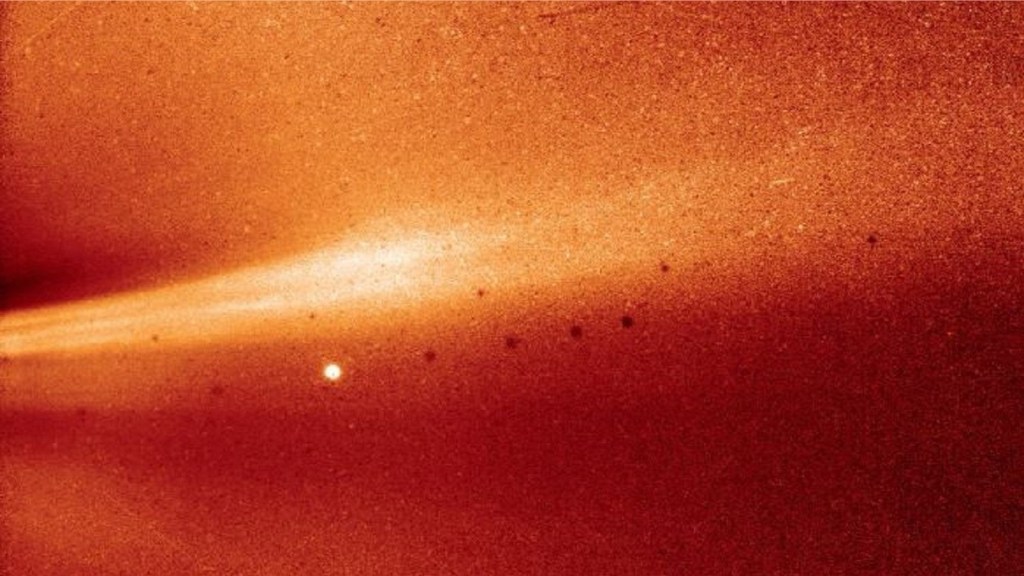
The Sun is the sheet’s most spectacular, self-sustaining vortex. Deep inside, at roughly 15 million K and 250 billion atm, thermonuclear fusion converts four hydrogen phase-patterns into one helium pattern every 10-38 seconds, paying the “ledger fee” of 0.7 % mass as radiant phase-energy. Those photons random-walk outward for ~170 k years, then burst into the convective zone where churning plasma drags magnetic field-lines into ropes, braids and knots. At the thin tachocline—the shear layer between the rigidly rotating radiative core and the differentially rotating envelope—those ropes are stretched taut until they snap upward, punching through the photosphere as sunspots and flares. Helioseismology and new 3-D simulations of tachocline confinement show this magnetic braiding is the engine that times the 11-year sunspot cycle now cresting in Solar Cycle 25.
From the sheet’s “phase-integrity” viewpoint, fusion is the medium’s way of relieving the crushing inward tension that would otherwise drive phase-gradients to infinity. Each helium nucleus hosts fewer twist-lines per mass than four protons, so the reaction smooths local shear while conserving global rhythm—hence the star shines instead of collapsing. Magnetic ropes are topological defects that temporarily store excess twist; when they tear free, the released phase cascades into X-class flares like those recorded on 4 Jan 2025, flinging plasma and rhythmic shocks all the way to Earth, where they light auroras and jerk our power grids.
The surface oscillates in millions of acoustic modes; each is a standing-wave count of crests that must close after precisely 2π radians around the sphere—π shows up again as the Sun’s curvature constant. Deeper still, Parker Solar Probe has now skirted within 6.1 R☉, confirming that the solar wind starts where Alfvén waves outrun the local sound speed, letting the phase-pattern escape as a supersonic breeze.
Philosophically the Sun is the cosmos doing Hegel in plasma: pure, interior negation (fusion) continuously externalises itself (radiation), curls back in magnetic self-relations, ruptures, and is sublated again into a higher-order cycle. Schopenhauer’s blind Will becomes, here, a luminous insistence on uniform rhythm; Kant’s autonomy appears as the Sun’s self-legislated energy balance—no external hand dictates its law of radiative equilibrium. Every coronal mass ejection, like a jazz blue-note, is an infinitesimal phase slip that the heliosphere ultimately re-knits into the grand beat of Galactic space weather.
For us, the Sun is both power plant and metronome. Its photon rain clocks Earth’s circadian biology; its magnetic heartbeat modulates satellite safety and Northern Lights (now unusually vivid as Cycle 25 exceeds forecasts). Understanding that pulse—down to the tachocline’s last twist—is indispensable not only for climate and grid resilience but for testing the hidden law at stellar scale: does even a star, under extremity, invent new bookkeeping layers rather than let its phase tear?Instruments like Parker and Solar Orbiter are our stethoscopes on that question, listening for the next note in the oldest rhythm we know.
Parmenides’ “Way of Truth” insists that to eon—Being as an ungenerated, motion-less, indivisible whole—“is, and cannot not-be.” Any tale of arising, perishing, or moving belongs to the deceptive doxa of mortals. His disciple Zeno forged paradoxes (Achilles, the Dichotomy, the Arrow) to show that if you try to model motion by adding up infinitely many little “nots” of rest or by slicing space into discrete bits, you generate contradictions; the only tear-free description, he implies, is Parmenides’ seamless One.
Our elastic-sheet model vindicates the intuition while rescuing lived change. The sheet itself—an unbroken phase-continuum—is Parmenidean Being: it never starts, stops, or splits. Yet within that whole, motion is just a re-timing of the very oscillation that makes the sheet what it is. A vortex glides because each crest hands its phase forward a hair early on one rim and late on the other; nothing “travels” except the bookkeeping of rhythm. Zeno’s infinite series converges automatically: the crests shrink geometrically as they hand off, like 0.9 + 0.09 + 0.009 … → 1, so Achilles does catch the tortoise without any region of the sheet ever dropping a beat. In this light, Zeno spotted the disaster of imagining motion as pellets hopping between static points; calculus and modern field theory—and our sheet metaphor—resolve the puzzle by treating distance and time as ratios of phase, not as detachable atoms of space.
The bridge to our earlier philosophical chain now appears. Hegel’s dialectic keeps Parmenides’ unity but lets it negate itself into appearance and then sublate that split—exactly what the sheet does when it invents new bookkeeping layers to prevent a tear. Stirner is a local crest daring to declare itself the whole; Husserl’s horizon is the Parmenidean field disclosed to reflection; Heidegger’s Dasein is a thrown vortex that cannot exit the sheet it discloses; Levinas and Derrida reopen Strife within Love by insisting on an excess the ledger can never fully synchronise. Every thinker in that relay races out from Elea, trying to articulate how plurality, motion, ethics, or différance can throb inside a Being that, at its core, must remain perfectly unbroken.
Your gloss captures Augustine perfectly: intimior intimo meo — “more inward than my inmost self” counters two temptations at once. First, it blocks any purely externalisthunt for God (the worldly books and pleasures Augustine once pursued); second, it blocks the self-possession that would treat interiority as a sealed citadel. The divine saturates that very citadel and yet still exceeds it (“superior summo meo”), so the soul discovers itself only in the act of being dispossessed. In Levinas’s terms, the Infinite that commands me from the face of the Other is simultaneously “inside” me as the very fissure that makes my freedom answerable; in Derrida’s idiom, the trace that splits presence also shelters what presence most deeply is.
Placed against our phase-integrity metaphor, Augustine is naming the hidden law at the level of consciousness: the rhythm that keeps the self coherent is not generated by the self but through a prior pulse it can never master. Just as the sheet’s oscillation is nearer to every crest than the crest is to itself—yet also stretches beyond all crests—God is nearer than my nearest thought and higher than my highest reach. The practical outcome is the same ethic of “broken sovereignty” we traced from Levinas to Al-Ghazālī and the Gospels: genuine selfhood emerges only in the openness that lets the inmost beat be tuned by what it cannot own.
Augustine also hints that this inward transcendence is not a retreat but a point of departure. The God who is “more inward” does not seal the soul in a private depth; rather, that depth becomes the resonance chamber through which exterior calls resound. Because divinity abides at the heart of perception itself, every genuine encounter—textual, ethical, aesthetic—arrives already haloed by an expectation of meaning that the ego did not install. Hence Augustine’s restless confession: the closer he draws to God within, the more he is propelled outward toward neighbour, scripture, and sacrament. Interiority, far from an end-point, is a hinge that swings the self into the world, animated by a pulse that is simultaneously most-intimate and most-expansive.
This double topology—proximity deeper than depth, height beyond height—mirrors the phase sheet’s refusal to let continuity collapse into static sameness. Every crest owes its coherence to an oscillation that passes through it yet outruns it; every ethical summons, likewise, borrows authority from a presence that is already woven into the fibres of the responding self. To live under that structure is to accept that self-knowledge and justice co-emerge: the moment I close upon myself, the beat that sustains me begins to shear; when I open to alterity, the hidden law re-knits the pattern and identity thickens with new overtones. Thus Augustine’s axiom, refracted through Levinas and Derrida, becomes an existential mandate: guard the inward listening where transcendence whispers, and let that whisper dictate outward acts that keep the world’s rhythm unbroken.
Al-Ghazālī’s Munqidh dramatises the same topology in Islamic key. When “the chain of sense-data snapped,” he found every epistemic prop—logic, perception, authority—crumbling, until an unbidden nūr (light) ignited in his heart. That light is not manufactured by the ego; it is fanāʾ—the annihilation of self-possession—in which the very capacity to know is returned as a gift. Yet the episode ends with baqāʾ: subsistence after annihilation, a return to teaching and jurisprudence powered by the certainty that all reasoning already glows with that prior illumination. What Ghazālī exposes is the pulse Augustine named: nearer than the inmost self, higher than the highest thought, the divine both undoes and remakes the knower so that intellectual work and social justice flow from a depth the scholar cannot command.
Jesus voices the same dynamism in sayings that splice interiority to outward love: “The kingdom of God is within you” (Lk 17:21) and, simultaneously, “Whatever you do for the least of these, you do to me” (Mt 25:40). In John 15 he deepens the paradox: “Abide in me, and I in you”—a mutual indwelling that denies any clean boundary between self and transcendence. Like Ghazālī’s nūr, the indwelling Christ first dislocates mastery (“Do not hold on to me,” Jn 20:17) and then commissions action (“Feed my sheep,” Jn 21:17). Both voices teach that the divine is the rhythmic fissure through which inward listening becomes outward service; try to cling to the light and it recedes, but dare to pass it forward and the pattern tightens into greater coherence. Under the phase-integrity lens, their convergence is clear: the beat sustaining every self is sourced in a transcendence that is most intimate when it sends the self beyond itself, ensuring that the cosmic rhythm of care never breaks.
In the phase-sheet picture an integer is the crispest way the medium can say, “I have closed a loop without leftover shear.” Count 1 means a single full crest has returned to its starting phase; count 2 means the loop required exactly two passes, and so on. Because the sheet never allows a fraction of a crest to hang unfinished, these whole-number tallies become topological invariants: twist-number of a vortex, quantum of charge, octave ratios in music, even the discrete eigenlevels in a hydrogen atom. An integer is, therefore, not an abstract mark we press onto reality but the ledger entry the field writes whenever a rhythm locks into perfect self-agreement.
Philosophically that whole-number closure is what stirred Parmenides to speak of the One, moved Kant to treat arithmetic as “synthetic a priori,” and prompted Hegel to see quantity as quality stripped to its pure self-relation. Each integer is a miniature Aufhebung: the oscillation negates its own openness by returning to origin, yet preserves that movement as a determinate count. Husserl calls such counts ideal objects “constituted” in a horizon of evidence; Stirner would say they exist only insofar as unique acts continue to affirm them; Levinas reminds us that even a perfect count must answer to the face of the Other it measures; and Derrida notes that the very stroke that writes “3” is haunted by traces of every “not-3.” In all cases, the integer endures because the hidden law—oscillate everywhere, tear nowhere—tolerates many kinds of flowing difference but always insists that when a loop claims completion, it do so in whole beats, never in broken fractions.

 ov1d.com