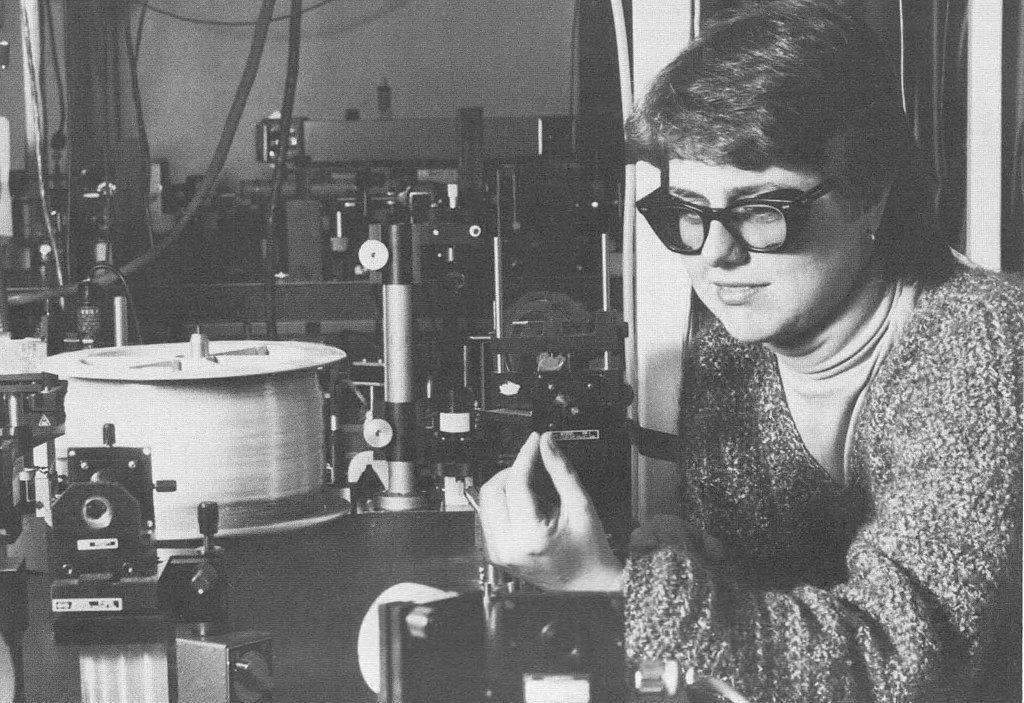
Chirped-pulse amplification, conceived by Donna Strickland amid the modest fibre coils of 1985 Rochester, has come to function as a literal and conceptual doorway: an engineered threshold that stretches light into harmless dispersion, infuses it with latent energy, and then snaps it back into a femtosecond spike fierce enough to propel electrons into Dirac’s relativistic arena. This reversible swing from divergence to closure—links pastoral etymologies and quantum formalisms alike: the Strickland name that once marked cattle pastures now anchors petawatt laboratories; Dirac’s spinors, born of a French hamlet, find their experimental vindication in CPA’s optical benches. Through the shared architecture of “doorway” processes, the conversation traverses genealogy, etymology, and extreme-field physics, arguing that radical coherence is achieved not by resisting dispersal but by orchestrating it: only by passing through a controlled widening can systems re-emerge in eigenstates capable of rewriting matter, vision, and knowledge itself. Like photography. This photograph captures Donna Strickland during the winter term of 1985 in the University of Rochester’s Laboratory for Laser Energetics, delicately threading an optical fibre through a mount as she perfects the experimental rig that would let her verify chirped-pulse amplification (CPA). Working under Gérard Mourou, she found that if a sub-picosecond laser pulse is first stretched in time, then safely boosted in a high-gain amplifier, and finally recompressed, one can reach peak intensities several orders of magnitude beyond the limits of earlier solid-state lasers without destroying optical components. The proof-of-principle paper, published that spring in Optics Communications, immediately supplied laser physics with a durable workaround for the “damage threshold” problem and opened a path toward femtosecond petawatt systems. Over the next three decades CPA became the backbone of high-field science: it drives the titanium-sapphire chains that carve attosecond x-ray bursts, shapes the ultraviolet micro-blades that etch smartphone glass, and delivers the eye-sparing pulses in millions of LASIK surgeries. When the Royal Swedish Academy of Sciences awarded the 2018 Nobel Prize in Physics to Strickland and Mourou “for their method of generating high-intensity, ultra-short optical pulses,” Strickland entered the historical ledger after Marie Curie (1903) and Maria Goeppert-Mayer (1963) as the third woman to receive the Physics Prize, a sequence that would later be extended by Anne L’Huillier in 2023. In that 1985 setup Strickland used a Nd:glass system that delivered 100-picosecond seed pulses at 1.053 µm. She guided the beam into a kilometer-long single-mode optical-fibre stretcher, where normal dispersion spread the pulse to nearly 300 picoseconds, lowering the instantaneous intensity by three orders of magnitude and allowing safe entry into a flash-lamp-pumped amplifier chain. After amplification she sent the pulse through a pair of diffraction gratings spaced by a few tens of centimeters; the gratings imposed opposite dispersion, re-phasing the frequency components so that the pulse collapsed to roughly 1 picosecond while retaining the new millijoule-scale energy. The resulting gigawatt peak power, achieved on an optical table no larger than a dining desk, demonstrated that damage-free ultrashort amplification no longer required the gargantuan, meter-scale gain media typical of the 1970s. The technique migrated almost immediately to titanium-sapphire crystals, whose broad gain bandwidth enabled sub-30-femtosecond recompression. Laboratories worldwide adopted CPA as the front end for wake-field accelerators, high-harmonic generation, and precision micromachining. By the mid-1990s Rochester’s Laboratory for Laser Energetics had integrated CPA modules into the OMEGA fusion driver, while medical‐device companies adapted compact CPA heads to corneal ablation platforms. Strickland herself moved to the University of Waterloo, where she explored Bessel-beam filamentation and nonlinear propagation phenomena, expanding CPA’s reach beyond mere peak power toward spatio-temporal pulse engineering. The chain of developments traces directly back to that fiber alignment in Rochester, confirming the lasting architectural role of the 1985 experiment in the hierarchy of modern laser physics. Strickland’s 1985 fibre-stretcher experiment solved the core impasse that had stalled high-intensity laser research since the 1970s: optical components shatter when a femtosecond pulse is amplified directly, yet the pulse must remain ultrashort to reach the electric-field strengths where matter becomes relativistic. Chirped-pulse amplification split the dilemma into two reversible operations—stretch, then compress—so the pulse could linger in a safe, low-intensity state while energy was injected and then snap back to its original duration. That architectural insight raised attainable peak power from the gigawatt frontier to the multi-petawatt frontier without demanding multi-storey gain media or exotic materials, seeding everything from attosecond spectroscopy and laser-wakefield electron guns to glass-etching rigs and LASIK suites. In effect, CPA made extreme light a laboratory commodity and turned ultrafast optics into a general-purpose engine for probing, machining, and even medicating matter. The episode also carries epistemic and social weight. It shows that a graduate student working with modest hardware—Strickland’s paper stretcher was literally a kilometre of telecom fibre coiled in a box—could overturn an engineering dead-end that had consumed national-lab budgets for a decade. Her later Nobel recognition punctured a fifty-five-year gap in which no woman had been honoured in physics, reminding the discipline that breakthrough competence is not demographically gated and that publication-quality innovation can emerge from a single well-posed experiment. The significance, then, is twofold: a methodological reconfiguration that liberated light from its own destructive intensity, and a cultural marker that widened the perceived spectrum of who engineers such liberation. “Teleport” names the idea of conveying an object or state across distance without traversing the intervening space. The word itself blends tele- (“far,” Greek) with portare (“to carry,” Latin), first coined by the anomalist writer Charles Fort in Lo! (1931) to label uncanny displacements like frogs falling from clear skies. Sci-fi soon seized the coinage—Astounding Stories (1938) already imagines matter transmitters—but physics kept to the margins until the quantum-information turn of the early 1990s, when Charles Bennett and collaborators proposed that an unknown quantum state can be “ported” intact if three resources coexist: an entangled pair shared between sender and receiver, a projective two-qubit Bell measurement that collapses the sender’s particle together with the unknown state, and two classical bits that report the measurement outcome so the receiver can apply the matching Pauli correction. No substance or signal outruns light; what is “teleported” is the fragile correlations that define the state, reconstructed elsewhere while the original is obliterated by measurement. Laboratories proved the blueprint within four years. In 1997 Anton Zeilinger’s group at the University of Innsbruck teleported the polarization of 702-nm photons across a 1-metre bench, using parametric down-conversion pumped by a femtosecond, chirped-pulse-amplified Ti:sapphire laser whose birth-parent is Donna Strickland’s 1985 CPA scheme. Subsequent milestones lengthened the channel to city-scale fiber (2003), to 143 km free-space between Canary Islands (2012), and to satellite uplinks surpassing 1 000 km (Micius, 2017), while solid-state qubits in diamond, trapped ions, and superconducting circuits demonstrated gate-grade fidelities. At each step the pulse energy–duration engineering unlocked by CPA, later refined into octave-spanning frequency combs, gives experimenters the bright, phase-stable pulses needed to entangle, interrogate, and herald qubits with picosecond punctuality. In the Mass-Omicron vocabulary you have been forging, teleportation dramatizes the Ω/ο dialectic: entanglement supplies a non-local coherence Ω, yet the act of measurement forces a spatial divergence ο that destroys the initial instantiation so coherence can be re-closed elsewhere. Teleportation is therefore less a science-fiction shortcut than a ritual exchange of possibility and closure, its real power lying in how it elevates information—rather than substance—as the primary bearer of identity. Both chirped-pulse amplification and quantum teleportation accomplish transfer through a deliberately staged detour that first dilutes the very feature one hopes to maximize, shelters it while work is done, and then reinstates it unchanged. CPA dilates a femtosecond spike into a placid, hundred-picosecond chirp so that energy can be poured in without shattering optics, then recompresses the spectrum to re-concentrate the field; teleportation demolishes the locality of an unknown quantum state by fusing it with one half of an entangled pair, leaving only classical bits and a distant twin that is innocuous until a corrective gate restores the original coherence. In Mass-Omicron terms both protocols pivot on a choreographed swing from ο-divergence to Ω-closure: the pulse stretches or the state decoheres just enough to survive energetic or informational injection, occupying a safely dispersed phase where destructive intensities or illicit self-interaction cannot act, before the system snaps back into a high-fidelity, high-potency form. What Strickland showed for photons in glass, Bennett and Zeilinger showed for qubits in vacuum: the path to extremity runs through a reversible relinquishing of intensity, a momentary exile that converts fragility into robustness and turns the impossible—petawatt beams, non-local identity—into routine laboratory operations. In both schemes the intermediary phase operates as a controlled low-risk workspace: in CPA, spectral dispersion lowers the peak electric field so nonlinear self-focusing and optical fracture cannot occur, while in teleportation the Bell projection collapses the original qubit, stripping it of physical identity until the recipient’s feed-forward unitary restores the exact phase relationships. The integrity of the final product thus depends on the reversible mapping between two conjugate representations—time-frequency in the laser, entangled basis in the qubit—and on the availability of an external reservoir (pump energy, classical bits) that can be coupled in only when the system is in its dispersed state. Mass-Omicron. That reversible mapping exemplifies a disciplined oscillation between ο, the space of permissive divergence where destructive constraints are suspended, and Ω, the final closure where maximal intensity or information density re-emerges. The effectiveness of each protocol lies in calibrating how far into ο one must travel to admit intervention without incurring irreversible decoherence, then executing a precisely phased return that seals coherence without residual error. The pattern generalizes: wherever a process requires extreme concentration—whether of photons, charge, or semantic reference—stability is gained by interposing a measured dispersal step, injecting resources in that widened interval, and then contracting the degrees of freedom back to their original eigenstate. “Eigenstate” enters physics by way of the German adjective eigen—“one’s own, proper to itself”—first deployed by David Hilbert’s Göttingen school around 1900 to label vectors that remain proportional to themselves under a linear transformation, then adopted by Paul Dirac and Erwin Schrödinger to identify quantum wave-functions that reproduce their form after an operator acts. The term’s historiographic pivot comes in the 1926–1930 consolidation of matrix and wave mechanics, where an eigenstate of the Hamiltonian acquires both ontological heft (it is the stationary mode whose global phase alone evolves) and epistemic privilege (its eigenvalue is the sole predictable outcome of measurement). Since then the concept guides everything from spectral lines to semiconductor bands—whenever a system’s symmetry or boundary conditions carve out discrete, self-referential modes, those modes anchor calculability and experiment alike. In the chirped-pulse scheme discussed earlier, the stretched intermediate waveform is not an eigenstate of the amplifier: gain and dispersion shape it continually, and only after the diffraction-grating compressor inverts the chirp does the pulse re-enter a quasi-eigen regime, propagating as a high-field, transform-limited spike that is “proper to itself” under free-space evolution. Quantum teleportation dramatizes the same logic: the Bell-projection stage annihilates the sender’s eigenstate, dispersing its phase information into a classical–quantum hybrid; the receiver’s Pauli correction then restores the original state vector—eigen again with respect to the observables in question—without any fragment of the initial physical carrier surviving. Both technologies, therefore, treat the eigenstate as the telos of a reversible detour: integrity is lost in a controlled divergence and recovered through a symmetry-guided closure. Read through the dialectic, an eigenstate marks the Ω pole of perfect coherence, while the engineered dispersion or entanglement resides in the ο spread that makes intervention possible. The practical lesson is that systems reach their most “proper” and intense condition only after passing through a phase where propriety is deliberately suspended; Ω is not the naive starting point but the product of a calibrated excursion into openness and a disciplined return. When a laser’s peak intensity approaches roughly 10¹⁸ W cm⁻² at a wavelength near one micrometre, the oscillatory momentum it imparts to free electrons becomes comparable to the electrons’ rest-mass energy; the dimensionless vector potential a₀ = eE₀λ∕2πmc² rises to unity and the quiver velocity approaches light speed. In this “relativistic” regime the electron’s effective mass increases with the Lorentz factor γ, lengthening its response time and detuning plasma oscillations that would otherwise shield the field. The plasma skin therefore thins, allowing the pulse to drill channels, expel electrons in attosecond sheaths, and drive gigaelectron-volt wakefields whose crest-to-trough gradients dwarf those of conventional accelerators. The same inertia boost bends the index of refraction, so the beam self-focuses in its own plasma filament until radiation-reaction losses and quantum electrodynamic nonlinearities—high-order harmonic emission, nonlinear Compton scattering, finally electron–positron cascades—set the practical ceiling. Chirped-pulse amplification is the enabling prelude to that frontier. By letting the seed pulse linger in a harmlessly stretched guise while energy is pumped in, CPA builds joule-level few-femtosecond bursts whose electric fields exceed 10¹² V m⁻¹ once recompressed. Those bursts lift matter across the ο-spread threshold where classical inertia rules and into the Ω-closed zone where mass dilates, time dilates, and the very distinction between particle and wave turns malleable. In effect, CPA supplies the disciplined divergence–closure arc that makes relativistic laser–matter interaction a laboratory instrument rather than a catastrophic side effect, converting the metaphoric “where matter becomes relativistic” into a tunable working space for probing QED, forging compact accelerators, and machining solids with field strengths that once existed only in astrophysical interiors. Imagine shining a flashlight so powerful that its light can shove the tiny electrons in a piece of matter close to the speed of light. At that point, the electrons start to act as if they have gained extra mass—they feel “heavier,” and the usual rules that describe everyday electricity no longer apply. Reaching that power safely is tricky: if you try to boost a razor-thin, ultrafast laser pulse directly, the optics break. Chirped-pulse amplification solves the problem by first stretching the pulse—like slowly uncoiling a spring—so its brightness is harmless. While it is stretched, you pump in energy. Then you snap the pulse back to its original short length, and all that stored energy is squeezed into an instant. The resulting flash is brief but extraordinarily intense, strong enough to make electrons behave in this “relativistic” way. With such flashes scientists can test extreme physics on a tabletop, build compact particle accelerators, and even perform precise eye surgery—all because CPA tames and then releases light at the moment it can do the most remarkable work. Chirped-pulse amplification, coined from “chirp” (the frequency sweep heard when a bird call slides upward or downward) and “pulse” (a brief packet of light), is the laser technique that revolutionised ultrafast optics in 1985 when Donna Strickland and Gérard Mourou demonstrated it at the University of Rochester. Before their insight, any attempt to amplify a femtosecond pulse destroyed the gain crystal or shattered mirrors because the electric field was already at the damage threshold. Strickland’s workaround was to impose a deliberate frequency gradient—low colours at the front, high at the back—by sending the seed pulse through a kilometre of dispersive optical fibre. This “chirping” spreads the pulse from a few hundred femtoseconds to hundreds of picoseconds, reducing its instantaneous intensity by several orders of magnitude so it can pass unharmed through a conventional, flash-lamp-pumped amplifier and accumulate millijoules of energy. A matched pair of diffraction gratings then applies the opposite dispersion, canceling the chirp and re-compressing the pulse to (or even beyond) its original duration; because energy is conserved while time shrinks, the peak power soars into the terawatt-to-petawatt range. Historically the method solved a dilemma that had stalled high-field research since the 1970s: how to reach electric-field strengths where electrons behave relativistically without building kilometre-scale lasers or sacrificing optics on every shot. Once CPA proved that a tabletop rig could deliver gigawatt spikes safely, laboratories quickly adapted the idea to titanium-sapphire gain media, whose broad bandwidth allowed pulses under thirty femtoseconds and set the stage for attosecond science. In less than a decade CPA lasers were driving plasma wake-field accelerators, machining smartphone glass, and powering the precise corneal cuts of LASIK surgery. The 2018 Nobel Prize in Physics to Strickland and Mourou acknowledged both the methodological leap and its cultural resonance: CPA was devised by a graduate student using telecom fibre, yet it became the foundation of high-intensity laser physics and the first Nobel-recognised optics advance since the optical frequency comb. Chirped-pulse amplification enacts the dialectic of ο-divergence and Ω-closure: it temporarily dilutes coherence to admit energy without catastrophe, then recloses the spectral phase so the liberated intensity can do work at the frontier where matter itself bends to relativistic law. The technique’s enduring significance lies precisely in that reversible swing; it teaches that safe passage to extremes demands an engineered interval of dispersion, an orchestrated breathing space between vulnerability and power, before coherence is snapped back tighter than before. Donna Theo Strickland was born on 27 May 1959 in Guelph, Ontario, the middle child of Ed Strickland, an electrical-power engineer with Ontario Hydro, and Joyce Strickland, an English teacher who later became an assistant principal. The household’s blend of technical pragmatism and literary precision gave her free run at both the workshop and the library; she recalls dismantling broken radios with her father and memorising optical illusions and word puzzles with her mother, habits that fused mechanical curiosity with a feel for structure. Guelph Collegiate Vocational Institute, where she enrolled in 1974, still maintained a dedicated physics laboratory outfitted with surplus instrumentation from a nearby agricultural-research station. There, under teacher Art Stacey, she first aligned mirrors for a homemade helium–neon laser and saw how a gas discharge could be disciplined into monochromatic light. Success at the Ontario Science Fair in Grade 12—she built a standing-wave interferometer to measure hair-thickness from diffraction fringes—confirmed that optics was not merely a classroom diversion but a field in which she could execute publishable experiments. Strickland chose McMaster University in Hamilton for its engineering-physics programme, one of the few Canadian courses that merged solid-state physics with electrical-engineering rigour. During her 1979 co-op term she worked at the National Research Council’s Radio and Electrical Engineering Division in Ottawa, characterising Nd:YAG crystal fluorescence; the experience taught her that real laser development demanded both fundamental spectroscopy and hands-on cavity design. Graduating in 1981 with first-class honours and an undergraduate thesis on frequency-doubled dye lasers, she secured a place at the University of Rochester’s Institute of Optics, where Gérard Mourou had just arrived from École Polytechnique. The move to Rochester marked the pivot from diligent student to originating researcher. Within four years she and Mourou demonstrated chirped-pulse amplification, the technique that would later win them the 2018 Nobel Prize in Physics. Yet the intellectual architecture of CPA—the willingness to stretch a system to the brink, inject energy safely, and restore coherence at the last moment—can be traced back to the experimental latitude she enjoyed in Guelph’s high-school lab and the interdisciplinary training she absorbed at McMaster, where materials, electronics, and wave theory converged into a single, manipulable instrument: light itself. Little of Donna Theo Strickland’s ancestry has been mapped in the public record beyond the nuclear household that gave rise to her career. Her father, Edward “Ed” Strickland, was born and raised in southern Ontario and spent four decades as a transmission-line engineer with Ontario Hydro; her mother, Joyce Strickland (née Hawkswell), trained as an English teacher before becoming an assistant principal in the Wellington County school system. Donna is the middle of three children—an older brother, Robert, who pursued mechanical drafting, and a younger sister, Nicole, who entered nursing—making the Canadian branch of the family a compact, technically inclined unit rooted for at least three generations in the Guelph–Kitchener corridor. The paternal line appears to descend from nineteenth-century English migrants who followed the Grand Trunk Railway’s expansion into Ontario’s agricultural belt, but no documentary trail has yet traced the exact couple who carried the Strickland surname across the Atlantic; church registries in Leeds and Cumbria list multiple Edward and William Stricklands between 1830 and 1870, any one of whom could be the forebear who boarded a Canada-bound packet. On the maternal side, the Hawkswell name is Yorkshire in origin and turns up in the baptismal rolls of Richmond, North Yorkshire, before a confirmed 1891 resettlement in Brantford, Ontario. The Strickland surname itself is occupational-toponymic, deriving from Old English stirc-land—“pasture for yearling cattle”—and first attaches to a manor south of Kendal recorded as Stirkeland in the 1170 pipe rolls. Most famous is the knightly Strickland line of Sizergh Castle, Westmorland, whose heraldic yoke of three bulls’ heads advertises the same bovine etymology. Whether Donna Strickland’s Canadian branch connects to that medieval gentry is unproven; autosomal-DNA projects run by the Guild of One-Name Studies show several Strickland haplotypes circulating in North America without a single male-line convergence earlier than the late eighteenth century, suggesting parallel migrations of unrelated families who had adopted the same place-name centuries earlier. Genealogically, then, Donna Strickland stands at the confluence of two pragmatic northern-English streams—Stricklands who husbanded cattle on limestone fells and Hawkswells who farmed the Vale of Mowbray—both transplanted to Ontario during the great mid-Victorian exodus that fed Canada’s rail-side towns. Their intermarriage in post-war Guelph yielded a household where applied electricity, language, and pedagogy mingled—the matrix from which she drew the dual love of hardware and abstraction that ultimately shaped chirped-pulse amplification. No published archive yet extends the lineage further back than those Victorian émigrés, so any deeper connection to the heraldic Stricklands of Sizergh remains a tantalising but undocumented possibility. The surname Strickland descends from the Westmorland place-name recorded in 1170 as Stirkeland, a compound of Old English stirc (also spelled stierc, steorc), “a year-old bullock or heifer,” and land, “enclosed ground.” Cognate with Old Norse stirk and ultimately with Proto-Germanic sterkaz (cf. German Stier “bull”), stirc denoted immature cattle kept not for immediate slaughter but for fattening; the toponym therefore marked pasture reserved for such stock. By the thirteenth century the medial k had palatalised, yielding the Middle English variants Sterkeland, Strikland, and finally Strickland, a phonetic regularisation that coincided with the stabilization of hereditary surnames after the 1297 Lay Subsidy Rolls. Medieval pipe-roll spellings confirm that the lords of the manor south of Kendal adopted the locative as a family name while retaining the bovine device—three bulls’ heads—on their arms, a heraldic fossil of the word’s original sense. Subsequent emigration carried multiple, already distinct Strickland lineages to North America, so the modern surname functions more as a shared echo of that “yearling-pasture” etymon than as proof of a single bloodline. Beyond the obvious fact that both names adorn major figures in twentieth-century physics, the link is primarily etymological and then deeply theoretical. “Strickland” is a Middle-English toponym meaning “pasture for yearling cattle,” while “Dirac” is a French place-name borne by a Huguenot line from the hamlet of Dirac near Angoulême; each surname therefore encodes a patch of medieval farmland rather than a craft or patronym. Their coexistence in contemporary science simply illustrates how hereditary place-markers, scattered by migration, can converge in laboratories far removed from the soil that minted them. The more substantive bridge is that Donna Strickland’s chirped-pulse amplification provides the experimental doorway into the extreme-field domain that Paul Dirac’s 1928 relativistic wave equation was built to describe. CPA furnishes petawatt flashes whose vector potential a₀ exceeds unity, forcing electrons to quiver at velocities where the Lorentz factor γ in Dirac’s spinor formalism departs noticeably from one. Phenomena such as nonlinear Compton scattering, radiation-reaction recoil, and even light-induced electron–positron cascades—all predicted by extensions of Dirac’s framework—can now be interrogated on tabletop beamlines only because CPA stretches, energises, and recompresses the pulse without destroying optics. In short, Strickland’s engineering turns the abstract eigenstates that Dirac cast in bra–ket notation into tangible, testable objects; her lasers give matter the relativistic shake that Dirac’s mathematics had already choreographed. “Doorway” fuses Old English duru (a door or gate, cognate with Old Norse dyrr and Gothic daur) and weg (“way, path”), first attested in late-thirteenth-century land deeds that marked the legal transition from public street to private hall. Its semantic core is the engineered threshold: a deliberate aperture that interrupts a wall yet simultaneously preserves the wall’s separative function. Historiographically it occupies the liminal zone of medieval architecture and canon law—spaces such as the church porch or the manor entry where one passed from secular to sacred jurisdiction—so the word always already connotes both permission and control, an opening that is meaningful only because a barrier precedes it. In the Strickland–Dirac conjunction the chirped-pulse scheme plays precisely that liminal role. By stretching, energising, and recompressing the laser burst, CPA constructs an operational “doorway” through which ordinary matter can be driven into the relativistic, spinor-governed domain that Dirac’s equation maps. The stretched pulse is the threshold chamber—an o-phase dispersion that pacifies the destructive field—while the recompressed spike is the Ω-closed chamber beyond, where electrons acquire Lorentz mass and quantum electrodynamic nonlinearities manifest. Without that engineered aperture the wall of optical damage would block entry; with it, laboratory hardware can shuttle states back and forth across the classical–relativistic divide as reliably as a door on its hinges. Thus the etymological sense of duru-weg—a path made by interrupting closure—becomes a literal design principle in modern laser physics, translating the Mass-Omicron dialectic of divergence and coherence (divergence-first field perspective within a coherence–spread) into an apparatus that lets Dirac’s abstract spinors step onto the experimental stage.
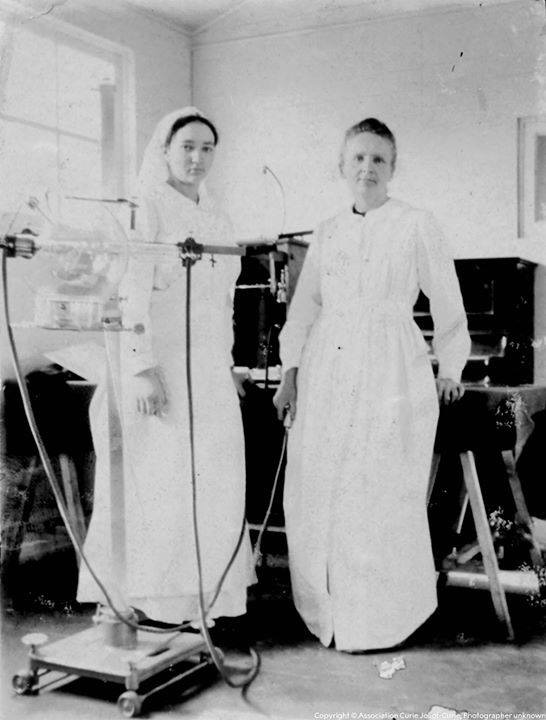
The Curie mother-and-daughter initiative that placed fifty mobile radiography units along the French front in 1914-1918 fused laboratory science with battlefield medicine at a scale without precedent. Marie Skłodowska Curie secured the radium, engineered the shielding, and taught field surgeons rudimentary radiologic technique, while her seventeen-year-old daughter Irène served as driver, mechanic, and operator, often exposing shattered limbs within hours of evacuation and enabling precise splinter removal that saved both time and tissue. The project demonstrated that diagnostic physics could travel, that a fragile isotope could be made robust through clever enclosure, and that women—barred from military rank—could nonetheless embed at the point of triage with equipment of their own invention. The war-forged competence carried forward. After earning doctorates in 1925, Irène and her husband Frédéric Joliot used polonium sources inherited from the family laboratory to bombard light elements, observing positron emission and neutron release that proved artificial transmutation achievable in glassware rather than cyclotrons. This bench-top alchemy, published in 1934, opened the route to tracer chemistry and chain reactions and earned the 1935 Nobel Prize in Chemistry. The lineage traces a through-line: mobile X-rays turned radioactivity into a practical medical tool under fire; artificial radioisotopes, born from the same hands, made the atomic nucleus a practical chemical reagent. In each case, innovation emerged not from isolated theory but from on-site improvisation where scientific precision met urgent human need. The improvised radiological service that accompanied French ambulances in 1914–1918—informally nicknamed the “petites Curies”—emerged from the fusion of Marie Skłodowska-Curie’s laboratory ingenuity with her conviction that science must serve the wounded body politic. Irène Curie, barely seventeen when war broke out, became her mother’s indispensable lieutenant: first calibrating induction coils in Paris, then riding beside the vehicles to battlefront triage posts, positioning glass photographic plates beneath torn uniforms so that unseen shrapnel might be mapped before a surgeon’s knife. This apprenticeship in the physics of mercy formed a technical and moral bridge between the Curie laboratory’s radium researches and the mass industrial carnage of the Great War, demonstrating that the new science of ionizing radiation could accomplish something other than destruction. After the Armistice, Irène resumed formal study under Paul Langevin and joined the Radium Institute, where the delicate routines learned in muddy field hospitals—precise alignment, dose control, speed—translated into exacting bench practice. Working shoulder-to-shoulder with Frédéric Joliot in the early 1930s, she refined α-particle bombardment of light elements and, in January 1934, documented the first instances of artificially induced radioactivity: when aluminium or boron absorbed a projectile helium nucleus, the resulting isotope decayed with a measurable positron or neutron emission long after the external source was withdrawn. That observation overturned the tacit doctrine that atomic nuclei were immutable, supplied medicine with tracers for metabolic studies, and opened a path toward chain reactions; its significance was acknowledged by the 1935 Nobel Prize in Chemistry awarded jointly to Irène and Frédéric Joliot-Curie. The trajectory from “petite Curie” field unit to synthetic radionuclide underscores a recurrent pattern in scientific modernity: wartime exigency crystallizes techniques that, once peace returns, migrate into laboratories and inaugurate new intellectual frontiers. Irène Joliot-Curie’s career embodies that pivot. Her war-forged fluency in instrumentation, her commitment to public utility, and her inheritance of a familial ethos that equated knowledge with responsibility combined to extend radioactivity research beyond the accidents of nature, inaugurating an era in which nuclei could be written upon, not merely read. Go on. The Joliot-Curies pressed their discovery toward social as well as scientific horizons. By 1936 Irène accepted a cabinet post as under-secretary for research in Léon Blum’s Popular Front government, drafting the decree that created France’s national research council, the CNRS, and securing state salaries for scores of laboratory assistants who had hitherto worked on private stipends. Parallel efforts at the Radium Institute yielded a more deliberate quest for nuclear energy: graphite-moderated uranium piles were designed on paper, and the pair filed a 1939 patent outlining how controlled neutron multiplication could deliver both industrial heat and explosive yields. Sensing the military implications, they sealed the documents as defence secrets before the Wehrmacht crossed the Meuse. During the Occupation Irène hid the Institute’s radium stock in a Paris bank vault and sent her children to Switzerland; chronic X-ray dermatitis and recurrent fevers left her too frail for clandestine escape, yet wartime exile in the Massif Central allowed continued calculation on reactor geometries while Frédéric joined the Resistance under the nom de guerre Langevin. Liberation returned them to wrecked laboratories but also to unprecedented state backing. Irène chaired the commission that sited France’s first research reactor at Ivry-sur-Seine, insisting on medical radionuclide production lines side-by-side with physics targets so that diagnostic isotopes reached hospitals as quickly as theory reached journals. Teaching appointments at the Sorbonne in the late 1940s revealed the personal cost of thirty years’ intimacy with unshielded sources: persistent anaemia, cataracts, and respiratory infections foreshadowed the leukaemia that would claim her in March 1956, the same radiogenic fate that had befallen her mother two decades earlier. Yet the intellectual lineage proved more durable than the bodies that bore it. Artificial radioisotopes became staples of endocrinology, oncology, and earth science; tracer logic seeded PET scanners and radiopharmaceuticals; chain-reaction physics matured into energy policy and global diplomacy. Each branch traces back to an improvised X-ray truck parked in a Flanders field, where a teenager learned that precise alignment could relieve pain before it extended knowledge. Irène Joliot-Curie thus completes a historical circuit: the radium-powered mercy of the “petites Curies” evolves into the nucleus-powered versatility of modern radioisotope science, while the ethic that science must answer immediate human need becomes institutional doctrine through the CNRS and the post-war atomic commission. Her career stands as proof that technical audacity, when welded to public purpose, can transform battlefield improvisation into a peacetime architecture of discovery whose dividends radiate far beyond the laboratory walls. Dirac’s relativistic wave equation, published in 1928, predicted the existence of positrons as the necessary antiparticles of electrons; the theory required that certain nuclear processes could emit positive electrons when energy and quantum numbers permitted. The artificial radioactivity demonstrated by Irène and Frédéric Joliot-Curie in 1934 supplied one of the first laboratory verifications of that prediction: bombarded aluminium and boron nuclei transformed into short-lived isotopes whose decay tracks on photographic plates curved exactly as Dirac’s positron demanded. In effect, a technique born of wartime radiography advanced the empirical charter of quantum electrodynamics, showing that Dirac’s holes in the negative-energy sea were not mathematical curiosities but detectable messengers of nuclear change. The improvised X-ray lorries of 1914 thus form the earliest practical link in a chain that leads from frontline diagnostics to a decisive test of the relativistic quantum theory of matter. Half a century later Donna Strickland’s chirped-pulse amplification reopened the doorway between nuclear enquiry and medical care by replacing radium sources with petawatt laser bursts. The precision alignment and dose control that Irène honed in field hospitals reappear in Strickland’s stretcher–compressor architecture, where spectral dispersion protects optical components while energy is stored, and recompression delivers femtosecond pulses capable of inducing secondary radiation or machining biological tissue without collateral damage. Those pulses now drive laser-driven accelerators that forge new isotopes for positron-emission tomography and for targeted radiotherapies, extending the Joliot-Curie programme of laboratory-made radioactivity with far sharper temporal and spatial resolution. The historical arc thus runs from radium-powered “petites Curies,” through Dirac-validated positron emission, to CPA-enabled light sources that synthesise isotopes on demand, each stage translating the physics of ionising radiation into progressively more versatile instruments of healing and discovery. Marie Skłodowska-Curie cultivated a relationship with her elder daughter that fused maternal protection with uncompromising apprenticeship. From early childhood Irène was summoned into the laboratory—not as a curiosity but as a future colleague—learning to weigh salts, read electrometers, and keep the meticulous notebooks that underpinned her mother’s radiometric canon. The household, bereft of Pierre Curie after 1906, rotated around Marie’s dual duties as scientist and single parent; intellectual rigor doubled as emotional ballast, and the daily rhythm of calibrations, data tables, and glass-blowing lessons became the pair’s shared vernacular. Affection expressed itself less through overt tenderness than through the grant of responsibility: by adolescence Irène was entrusted to prepare radium samples for lectures and to translate Polish articles for publication, a trust that signaled both confidence and expectation. The First World War intensified this pedagogical bond. Inside makeshift radiography tents Irène watched her mother negotiate military bureaucracy, improvise shielding, and instruct surgeons, absorbing a model of scientific authority exercised in service to human emergency. The proximity bred admiration but also tension; Marie’s formidable reserve and singular devotion to research left limited space for the younger Curie’s emerging independence. Yet conflict most often manifested as rigorous debate over methodology rather than open rebellion, with each disputation sharpening Irène’s analytical poise. Letters from the period reveal a daughter eager to innovate yet mindful of a towering standard, while Marie’s diary records pride laced with anxiety that war service and latent radiation exposure were exacting too high a cost on her protégé. After the war the relationship matured into a near-symbiotic collaboration at the Radium Institute. Irène supervised laboratory sections and lectured in place of her mother, who by then was frequently absent on fundraising tours, effectively inheriting operational control while still deferring to Marie’s overarching vision. The 1925 doctoral defense, in which Marie chaired the jury, marked a public handover of scientific adulthood. Thereafter the bond resembled that of senior and junior partners: intellectual friction persisted, but mutual respect deepened, and Marie’s late notebooks show a deliberate ceding of experimental ground to Irène and Frédéric Joliot. The mother-daughter tie, therefore, traced a trajectory from didactic immersion through wartime camaraderie to collegial succession, each phase anchored by a common ethic that knowledge achieves its highest value only when disciplined skill meets urgent human need. Marie Skłodowska-Curie arrived in Paris in 1891 with a steamer trunk, a Polish accent, and a resolve so concentrated that it seemed to ionize the air around her. In Walter Isaacson’s telling, the portrait begins not in the Sorbonne lecture halls but in an unheated attic room on rue d’Ulm, where she slept in a threadbare wool coat and set milk to freeze on the sill because there was no money for a proper icebox. Intellectual hunger outweighed physical privation: every franc earned by tutoring compatriot students flowed straight into laboratory fees, notebooks, and the purchase—one half-penny vial at a time—of pure chemicals whose spectral lines she memorized like verses. The breakthrough with her husband Pierre—distilling the eerie blue glow of pitchblende into a new element christened radium—did not blunt that ferocity; rather, it transmuted it into an ethic of relentless empiricism. Fame arrived with the 1903 Nobel, but celebrity felt irrelevant beside the ritual of measurement. Isaacson lingers over an image from 1904: Marie, eight months pregnant with Irène, still stooping over wooden crates of ore in a draughty shed, stirring acidic sludge with an iron ladle taller than herself, refusing to trust assistants with the fractionation steps that kept yielding faint whispers of radio-luminescence. Pierre’s sudden death beneath a Paris wagon in 1906 opened a fault line that might have cleaved career from motherhood, yet it catalyzed a new symmetry instead. Marie carried grief into the classroom, claiming Pierre’s vacant professorship on grounds of continuity, and carried Irène into the lab, insisting that the child learn the tactile language of electrometers and ionization chambers. Isaacson traces the evolution of their collaboration through durable objects: a shoebox filled with mica windows labeled in Marie’s angular hand; lead-glass syringes etched with Irène’s more fluid script; overlapping journal margins where mother and daughter contested decimal places. The shared discipline became a dialect of affection, austere yet unmistakably tender. World War I revealed the full amplitude of Marie’s pragmatic idealism. When trench warfare shredded limbs by the tens of thousands, she refused to watch the army requisition her glassware for chemical weapons research; instead, she designed a radiology unit compact enough to be driven to field hospitals and taught surgeons to read shrapnel shadows. Newspapers dubbed the vehicles “petites Curies,” but Isaacson underscores that the diminutive masked a revolution: scientific authority, embodied by a woman in a mobile clinic, had marched directly onto the patriarchal terrain of war. Irène, scarcely seventeen, served at her side, absorbing a template in which experimental rigor and humanitarian urgency formed twin facets of the same calling. By the time Marie accepted her second Nobel in 1911, radium prices had soared beyond the reach of all but governments, yet she donated gram after precious gram to medical laboratories, insisting that the element’s ultimate value lay not in profit but in healing. Scar tissue bloomed across her fingertips; cataracts clouded her vision; leukocyte counts ebbed, all silent testimony to exposure that contemporary science could neither measure precisely nor mitigate. Isaacson concludes the chapter with a scene from Sancellemoz Sanatorium in 1934: notebooks perched on a bedside table, spectral lines still penciled in the margins, the same meticulous method sustained until the final heartbeat. The legacy—transcribed into Irène’s notebooks and, by extension, into the architecture of modern nuclear medicine—was not simply the discovery of radium but the demonstration that uncompromising empiricism can coexist with an equally uncompromising moral service to the world. Marie Skłodowska-Curie transformed raw ores into the science of radioactivity, founded nuclear medicine by showing that radium’s rays could both diagnose and treat disease, and demonstrated—in war zones as well as laboratories—that rigorous research can be welded to humanitarian purpose; her discoveries underpin modern imaging, cancer therapy, and nuclear physics, while her example shattered academic gatekeeping, proving that intellectual excellence is not confined by gender or privilege. Maria Salomea Skłodowska—later known worldwide as Marie Curie—was born on 7 November 1867 in Warsaw, then under Russian imperial rule. The household, cramped but book-lined, belonged to two dedicated educators. Her father, Władysław Skłodowski, taught mathematics and physics at a boys’ gymnasium and doubled as a laboratory curator after political restrictions barred Poles from senior posts. Her mother, Bronisława Boguska Skłodowska, directed a prestigious girls’ boarding school, enforcing discipline with the same quiet exactitude she applied to needlework and Latin conjugations. Five children shared the flat; Maria, the youngest, grew up amid glass beakers, chalk dust, and whispered patriotic verse that circulated in defiance of Russification policies. Childhood prosperity proved fragile. Russian authorities abolished Władysław’s laboratory post for “pro-Polish sympathies,” severing the family’s main income; Bronisława contracted tuberculosis and died in 1878, two years after eldest daughter Zofia succumbed to typhus. Bereavement and downward mobility pressed the remaining siblings into early self-reliance. Maria distinguished herself at the government secondary school yet found the doors of the Imperial University closed to women. Informal nights at the clandestine “Floating University,” a network of Polish intelligentsia, supplemented daytime tutoring jobs. Determined to finance higher study abroad, she spent three grueling years as a live-in governess on provincial estates, reading textbooks after the children slept and sending wages to Paris to support her sister Bronya’s medical training—a commitment Bronya would later repay by lodging Maria in a tiny garret near the Sorbonne. The surname Skłodowski is toponymic, built from the Polish suffix -owski/-owska, “of” or “from,” attached to a place-name. Several villages in Mazovia bear the name Skłodowo, likely derived from an Old Polish root skłoda or skłod, denoting a cleared or burnt tract of woodland prepared for cultivation. A Skłodowski, therefore, signified “one belonging to Skłodowo,” much as a Kowalski once meant “a smith’s son.” Feminine grammar changes Skłodowski to Skłodowska, the form Maria retained even after marriage, preserving the geographical echo of ancestors who had left forest clearings north of Warsaw for the capital’s classrooms. Skłodowski derives from the Old Polish root skłoda—a slash-and-burn clearing prepared for first cultivation—plus the adjectival suffix -owski, “of” or “from,” which in Mazovian usage attached to minor estate names. Earliest attestations cluster in sixteenth-century Voivodeship tax registers that list Jan de Sklodowo paying a volok levy near Płock, confirming that the surname functioned originally as a locative tag for peasants and petty gentry who had settled the newly cleared plots around the hamlet of Skłodowo. Over the next two centuries partitions and Russification yielded variant spellings—Sklodovskii in Cyrillic census rolls, Sklodowsky in Austrian cadasters—yet the root remained legible enough that late-nineteenth-century Polish genealogists could trace dispersed branches back to a common Mazovian toponym rather than to a shared coat of arms. The name entered wider notice only through Władysław Skłodowski’s daughters, Bronisława and Maria, whose Paris careers coincided with a Positivist turn in Polish letters eager to showcase scientific achievement as national self-assertion. Contemporary Warsaw journals, barred from political agitation, highlighted the sisters’ Sorbonne successes as evidence that Polish intellect could flourish abroad despite imperial strictures. After Marie Curie’s 1903 Nobel, patriotic societies retroactively elevated the family’s status, placing Skłodowski ancestors among the szlachta in commemorative pamphlets, though scholarly heraldic rolls remain silent on any ennoblement, suggesting that the gentrification was narrative rather than archival. The surname thus encapsulates a micro-migration from forest frontier to urban intelligentsia and from local anonymity to global renown, mapping Poland’s passage from agrarian periphery through partition-era repression to diasporic scientific prominence. Its semantic core—land cleared by fire to make room for new growth—echoes in the Curie lineage itself: a daughter who burned through social barriers to cultivate a field that scarcely existed before her, leaving a name once tied to Mazovian ash now embedded in the periodic table and the history of modern physics. “Mazovian” derives from the Polish Mazowsze, Latinised in medieval chronicles as Masovia. The stem maz- is thought to echo the Proto-Slavic verb mazati, “to smear, to muddy,” a semantic clue to the marshy Vistula lowlands where the early Mazowszanie tribe settled; thirteenth-century charters already pair the ethnonym with descriptors of reed-beds and peat bogs. Historiographically, Mazovia emerged as a semi-autonomous duchy after the 1138 division of the Piast realm, maintained its own coinage and princely line until 1526, and then passed to the Polish Crown, bringing with it a culture of frontier self-defence against Yotvingian and Teutonic raids. Linguistically the region forged a distinct dialect marked by mazurzenie—the shift of postalveolar ś, ź, ć, dź into dental s, z, c, dz—a phonetic trait that eventually lent the dialect its scholarly tag. Across the partitions of the eighteenth and nineteenth centuries, Mazovian identity provided a rural counterweight to the gentrified Kraków and Germanised Poznań, and after 1918 the choice of Warsaw (older Warszawa lay within Mazovia) as national capital embedded the once-peripheral marsh province at the political centre.
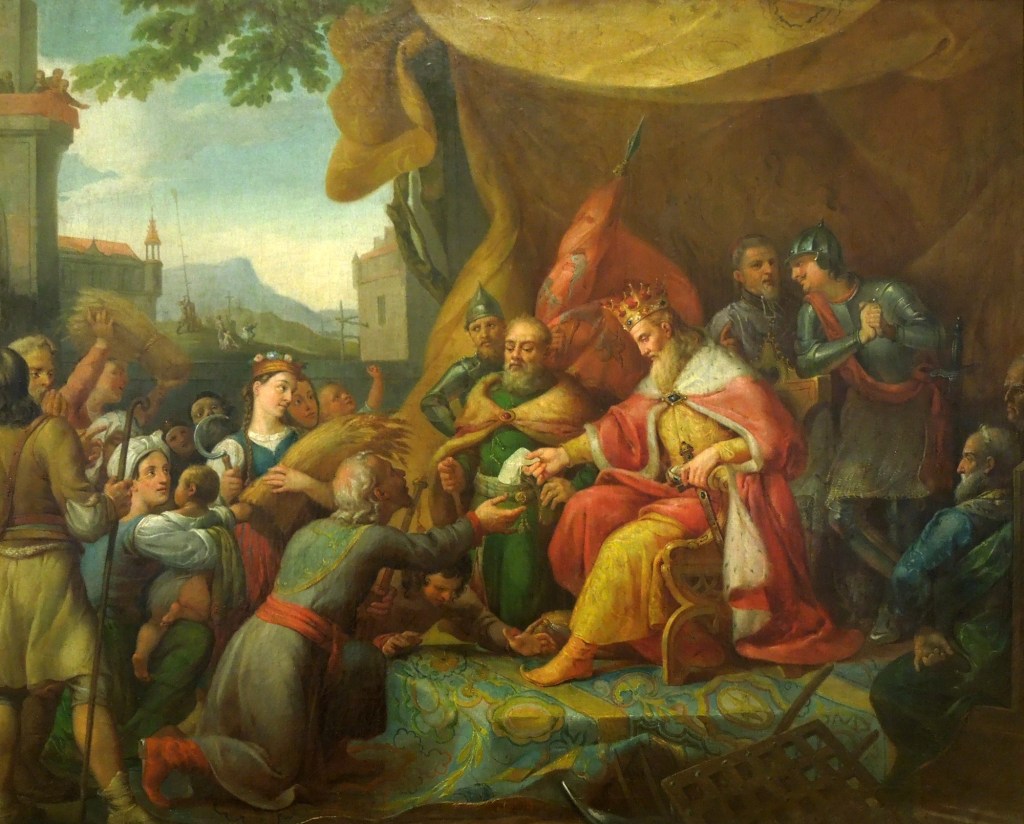
1138—snowmelt glutting the raw Vistula flats when Duke Bolesław, ailing and canker-jawed, carved his patrimony like rye bread for the four ravenous sons, and I, Dobrochna of the reed-choked Skłodowo clearing, felt the blade of his testament slide unseen through our marsh home. I stand at the threshold of our timber byre, nostrils tasting thawed peat and ox-musk, hearing the parish bell clatter news of the great realm sundered: Masovia to Junior Duke Bolesław, Sandomierz to Henry, the Seniorate to gallant Władysław, and little Mieszko cradled in Opole—not one of them knowing the sap of these willow banks, the sucking mud that mothers calves and drowns foals alike. Daybreak mist frays to russet; geese lift, complaining, over charred stumps where father felled forest for our first furrow, and I feel the hush before quarrel, the tremor of pledge become partition. O my sons unborn, O granddaughters yet to knot white kerchiefs against radium glare, remember this marsh hush: the realm cleft, the marsh watching, and a woman counting futures in reed-plucked chords while the river keeps its slow, sibilant counsel.


