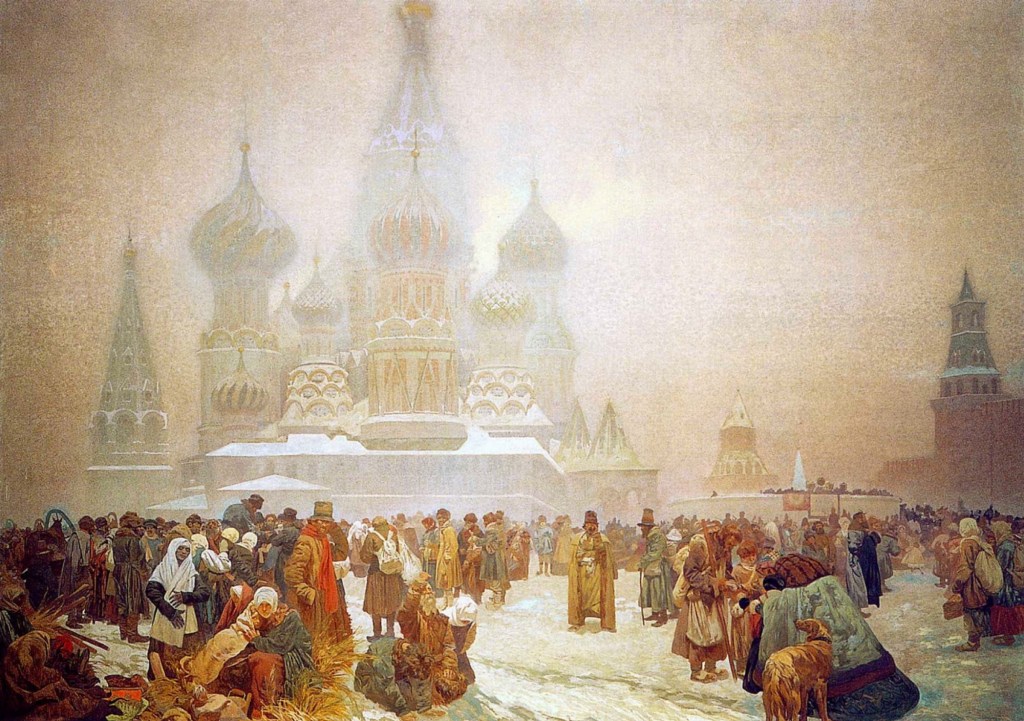
St. Petersburg, 13 March 1881 (old style), the city still held in winter’s grip as if unwilling to release its iron. Snow lay in compressed layers along the embankments of the Catherine Canal, not clean but greyed by soot and the passage of boots and wheels, so that the capital seemed less a city than a surface slowly being written and overwritten by movement. The air was still enough that sound carried with unnatural clarity: the iron scrape of carriage wheels, the distant cry of a hawker, the abrupt bark of a soldier’s command dissolving into cold.
The Tsar’s carriage moved through this order of appearances with practiced regularity. Alexander II had taken this route many times. The rhythm of imperial motion had its own kind of logic, not unlike prayer repeated until meaning becomes indistinguishable from habit. Inside the carriage there was warmth, muffled upholstery, the subdued presence of an aging man who had once reshaped the fate of millions with the stroke of emancipation. That act—so large in historical memory—now existed in him as fatigue more than triumph, as if history had already moved past its author and left him with only its afterimage.
On the streets, other lives continued in parallel, indifferent and yet structurally entangled. A baker adjusting his stall cloth. A student whose thoughts were not yet fully formed into doctrine but already sharpened by resentment. A police officer scanning faces not for individuals but for deviations from pattern. In Tolstoy’s sense, none of them were secondary; each was a vector of necessity and accident, converging without coordination.
The first explosion did not announce itself as destiny. It was merely sound breaking continuity. A concussive rupture near the carriage, snow and iron and flesh rearranged into sudden disorder. Smoke rose in an awkward column, as if uncertain whether it belonged to earth or sky. The horses recoiled, muscles refusing instruction, and for a moment the system of motion—the imperial procession, the ceremonial route, the confidence of repetition—ceased to function as a system at all.
From the smoke emerged the possibility of continuation. The Tsar, still alive, was urged to leave, to withdraw, to preserve what remained of continuity. There is always, in such moments, a return of order—not because order is strong, but because habit persists even in catastrophe. He did not leave at once. Something in the structure of authority resists its own interruption; it attempts to reassert form over rupture, as if the world itself had made an administrative error that could be corrected by proceeding correctly.
A second man appeared at the edge of this damaged geometry, moving not with the grandeur of historical symbolism but with the awkward precision of someone committed to an idea that has outgrown its origin. There was no dialogue in the sense that novels prefer. Only proximity, decision, and the narrowing of space between bodies. The second explosion was not repetition but confirmation: that the first had not been accident, that continuity had already been revoked.
When the smoke settled more fully, the canal resumed its quiet indifference. Snow continued its slow accumulation, unbothered by interpretation. Somewhere, a bell rang, not in mourning but in schedule. The imperial order, which had seemed so continuous from within, was already being redistributed into rumor, dispatch, and retrospective meaning.
Later, history would assemble causality: emancipation, repression, radical circles, revolutionary theory, security failures, ideological extremism. It would place Alexander II at the center of explanations as if a center were what had been missing. But in the moment itself there was no center, only a sequence of bodies moving through cold air, each obeying its own small necessity, until one sequence ceased and another began.
.
The nineteenth and early twentieth centuries in the Russian Empire can be read as a slow conversion of administrative geography into political crisis. What begins as a problem of managing diversity within an imperial perimeter—religious, ethnic, and economic difference concentrated in borderlands like the Pale of Settlement—gradually becomes a question of legitimacy itself. The emancipation of the serfs in 1861 opens a horizon of reform without resolving the underlying structure of inequality, producing new expectations inside a still-autocratic system. By the late nineteenth century, radical ideologies circulating through Europe, including Marxist and populist thought, enter this already unstable field, reframing social discontent as systemic contradiction rather than local grievance. Assassination, repression, and episodic violence begin to function less as disruptions than as recurring expressions of structural strain.
Within this unfolding sequence, state authority increasingly loses its capacity to translate coercion into consent. Pogroms, revolutionary conspiracies, and counterrevolutionary movements emerge not as isolated phenomena but as symptoms of a shared breakdown in the mediation between center and periphery, law and custom, ruler and population. The Black Hundreds, the Kishinev pogrom, and the assassination of Alexander II each mark distinct points where informal violence and formal authority begin to overlap rather than oppose one another. By the time of Rasputin’s rise and the First World War, the imperial court itself becomes a site where legitimacy is negotiated through rumor, charisma, and perceived spiritual intervention rather than stable institutional trust.
The Russian Civil War (1918–1921) therefore appears not as an abrupt rupture but as the consolidation of these accumulated pressures into open conflict. With the collapse of the Romanov monarchy and the failure of provisional governance to stabilize the state, multiple competing projects of order—revolutionary, restorationist, nationalist, anarchic—contend across a fragmented imperial space. The civil war is the moment in which the question that had been building for more than half a century—how a vast and diverse empire can be governed at all—ceases to be theoretical and becomes violently immediate.
Serf
The pogroms against Jews in Eastern Europe, especially in the Russian Empire during the nineteenth and early twentieth centuries, arose from a combination of religious prejudice, economic tensions, political instability, and government policies that treated Jews as outsiders.
The word pogrom comes from Russian and means “devastation” or “violent destruction.” While anti-Jewish violence had existed in Europe for centuries, the major wave of pogroms in Eastern Europe began after the assassination of Tsar Alexander II in 1881. Although the assassins were not acting on behalf of Jews, rumors spread that Jews were responsible. Riots erupted across parts of present-day Ukraine, Poland, Belarus, and Russia. Jewish homes, businesses, and synagogues were looted and destroyed, and many Jews were beaten or killed.
Religious hostility played a major role. For centuries, Christian traditions in parts of Europe had portrayed Jews as rejecters or killers of Christ. These beliefs did not always lead directly to violence, but they created a cultural environment in which Jews could be blamed during crises. Myths such as blood libel—the false accusation that Jews murdered Christian children for ritual purposes—continued to circulate.
Economic resentment also contributed. Jews were often concentrated in certain occupations because legal restrictions excluded them from many professions and from owning land. As a result, some Jews became merchants, traders, moneylenders, or shopkeepers. During periods of poverty, crop failure, or economic downturn, local populations sometimes directed their anger toward visible Jewish communities, even when Jews themselves were poor.
Political authorities frequently encouraged or tolerated anti-Jewish sentiment. In the Russian Empire, most Jews were confined to the Pale of Settlement, a vast region where they were legally permitted to reside. Government officials often portrayed Jews as a foreign element within the empire. During periods of unrest, authorities sometimes found it useful to let public anger focus on Jews rather than on the government itself.
A second major wave of pogroms occurred between 1903 and 1906. The Kishinev pogrom of 1903 became internationally famous because of its brutality. During the revolutionary turmoil of 1905, anti-Jewish violence spread widely. Some ultra-nationalist groups, such as the Black Hundreds, actively organized attacks and received varying degrees of support or protection from local authorities.
The deadliest wave occurred during the Russian Civil War (1918–1921). Multiple armies and militias—Ukrainian nationalist forces, White armies, local warlords, and others—carried out massacres of Jewish communities. Historians estimate that tens of thousands of Jews were killed during these years, making it one of the worst episodes of anti-Jewish violence before the Holocaust.
The consequences were enormous. Millions of Eastern European Jews emigrated, especially to the United States, Canada, Argentina, South Africa, and Palestine. The experience of repeated pogroms also influenced the growth of modern Zionism, socialism, labor movements, and other political responses within Jewish communities.
In short, the pogroms were not caused by a single event or characteristic of Jewish communities. They emerged from a longstanding tradition of anti-Jewish prejudice that became explosive when combined with economic hardship, nationalism, political unrest, conspiracy theories, and governments willing to tolerate or encourage violence against a vulnerable minority.
The emancipation of the serfs in 1861 under Tsar Alexander II marked a structural rupture in the Russian Empire: tens of millions of formerly bound peasants were legally freed, but without adequate land redistribution or economic infrastructure. The result was not immediate liberation in a modern sense, but a destabilized countryside, rising mobility, and intensified pressure on cities already straining under rapid demographic change. Alexander II followed this with a series of cautious reforms—judicial modernization, limited local self-government (zemstvos), and military restructuring—while simultaneously confronting revolutionary underground movements that increasingly saw the autocracy itself as illegitimate. In this ferment, radical intellectual currents emerged, including those influenced by Karl Marx, whose critique of capitalist development and class struggle was being translated and debated in Russian revolutionary circles even before Marxism became politically dominant. These tensions culminated in the assassination of Alexander II in 1881 by members of the Narodnaya Volya (“People’s Will”), an act intended to trigger broader revolution but which instead produced the opposite political reaction: intensified repression and the consolidation of reactionary nationalism under Alexander III.
In the aftermath, the empire hardened its internal boundaries. Jews, who had been legally confined to the Pale of Settlement and already subject to periodic discrimination, became an increasingly visible target for displaced social anger and state-tolerated violence. The pogroms that followed 1881 were not centrally orchestrated as a single program, but they unfolded within an environment where official rhetoric often framed Jews as alien economic intermediaries or suspected subversives, especially in a climate where revolutionary ideas—some loosely associated in public imagination with Marxist doctrines—circulated as explanations for instability. The state’s inability or unwillingness to consistently protect Jewish communities allowed local violence to proliferate, embedding anti-Jewish riots into the broader crisis of empire.
By the early twentieth century, this atmosphere of collapse and ideological saturation deepened further. Figures like Grigori Rasputin would later emerge in the imperial imagination as symptoms of courtly decay rather than causes of it—his influence over the Romanov household becoming a symbol of spiritual and political disintegration. At the same time, revolutionary movements radicalized, and Lenin, building on Marxist theory but adapting it to Russia’s uneven development, helped shape a new revolutionary vanguard that would ultimately overthrow the old order in 1917. Tolstoy, meanwhile, stood somewhat apart from both court and revolution: a moral critic of state violence, wealth, and institutional hypocrisy, whose spiritual anarchism offered a different diagnosis of Russia’s crisis, rooted not in class struggle alone but in the ethical failure of civilization itself.
These intertwined trajectories—imperial reform and collapse, revolutionary theory from Marx to Lenin, mystical decay around Rasputin, and moral dissent from Tolstoy—form the backdrop to the later mythologization of the Romanov world. Much of this is reflected, heavily stylized and historically distorted, in Disney’s Anastasia, which compresses the fall of the Romanovs and the Bolshevik seizure of power into a fairy-tale narrative of survival and identity. The real history, however, is less a single narrative of disappearance than a prolonged disintegration of imperial structures under the pressure of modernization, ideology, and violence, beginning with emancipation and ending in revolution.
The key misunderstanding is this: freeing the serfs in 1861 did not resolve the system of exploitation—it rearranged it. To many peasants and radicals, it felt less like liberation and more like a delayed, partial reform that preserved the core inequalities under a new legal form. The serfs were no longer legally owned, but they often received insufficient land, had to pay “redemption payments” for years, and remained economically bound to the same landlords and village structures. So resentment did not disappear; it shifted shape.
At the same time, the Russian Empire was politically rigid. Even after reforms under Alexander II, there was no meaningful national representation, and the secret police and censorship remained strong. This created a paradox: modernization was partially happening (industrial growth, urbanization, education), but without corresponding political participation. That gap is where radical movements grew. Young intellectuals, students, and exiles began to argue that incremental reform under the tsar was structurally incapable of producing real justice. Some were influenced by socialist and proto-Marxist ideas, others by anarchism and populist theories. The most extreme of these groups concluded that the system itself—not just specific policies—had to be removed.
The assassination of Alexander II in 1881 did not come from the peasantry as a whole or from “the exploited masses” in a direct uprising. It came from a small revolutionary organization, Narodnaya Volya (“People’s Will”), which believed targeted political violence could destabilize autocracy and trigger a broader revolution. They had already attempted several attacks before succeeding. Their logic was strategic, not spontaneous: they treated the tsar as the symbolic and functional center of the system. In their view, if the center collapsed, the structure would follow.
What makes it seem paradoxical is that Alexander II was relatively reform-minded compared to his predecessors. But in revolutionary logic, partial reform can actually intensify opposition. Reform acknowledges the system is changeable, but if it does not go far enough or fast enough, it can validate the belief that only total transformation is possible. After 1861, expectations rose; when those expectations were not fully met, disappointment could become more radical, not less.
There is also a structural point: the state itself became the primary object of political imagination. In an autocracy, the tsar is not just a leader but the embodiment of the system. So even reforms attributed to him do not fully separate him from responsibility. For radicals, he remained the axis of a structure they believed produced suffering regardless of his intentions.
Finally, the aftermath matters. The assassination did not produce revolution. Instead, it led to intensified repression under Alexander III and the spread of pogroms, as the state and local actors redirected instability toward minorities and dissenters. So the event sits at a pivot point: reform created expectations, unmet expectations fed radical theory, radical theory produced targeted violence, and the state response hardened the system further rather than dissolving it.
The Russian tsar (Czar) sat inside a European system of monarchies that were at once interrelated, competitive, and suspicious of one another. In the nineteenth century, royal families across Europe were often literally connected by blood—marriage networks tied the Romanovs in Russia to the Hohenzollerns in Prussia/Germany, the Habsburgs in Austria, and the British royal family (especially after Queen Victoria’s descendants spread across Europe). So at a personal-dynastic level, there was familiarity and shared aristocratic culture: court rituals, diplomacy, and elite education all overlapped. But that surface unity masked intense geopolitical rivalry, especially between Britain, Russia, Austria-Hungary, and the emerging German Empire.
Russia’s position was especially tense because it was simultaneously a continental land empire and an expanding Asian power. In Europe, Russia was deeply involved in the “Eastern Question”—the slow collapse of the Ottoman Empire and competition over the Balkans and access to warm-water ports. This put Russia in recurring friction with Britain and Austria-Hungary, because Britain feared Russian expansion toward the Mediterranean and India, while Austria-Hungary feared Slavic nationalist movements destabilized by Russian influence. Prussia/Germany under Bismarck sometimes tried to balance these tensions, even briefly coordinating with Russia, but alliances were fluid.
The Anglo-Afghan wars you’re thinking of were part of a broader British-Russian imperial rivalry in Central Asia known as “The Great Game.” This is roughly the same historical atmosphere, but not a single unified war between them. Britain fought in Afghanistan (First Anglo-Afghan War 1839–1842, Second 1878–1880, Third 1919) primarily to secure the Indian frontier. Russia, meanwhile, was expanding southward into Central Asia—absorbing khanates like Khiva, Bukhara, and Kokand. The British fear was that Russian influence might eventually threaten India, the crown jewel of the British Empire. The Russian fear was British containment of its southern expansion. So while Russia and Britain rarely fought directly, they treated each other as strategic adversaries across Asia.
By the time of Tsar Alexander II (reigned 1855–1881), Russia had just lost the Crimean War (1853–1856) against an alliance that included Britain, France, and the Ottoman Empire. That defeat shaped Russian foreign policy for decades. It pushed Russia toward military reform, internal modernization (including the emancipation of the serfs), and a cautious recalibration of its European ambitions. So Alexander II’s reforms are partly downstream of that geopolitical humiliation and restructuring.
So in summary: the tsar was embedded in a dynastic European system of monarchies with shared aristocratic ties, but politically he operated in a landscape of strategic rivalry. Britain was the key imperial competitor in Asia during the Great Game and the Anglo-Afghan conflicts, while Austria-Hungary and Germany shaped the European balance. Russia was neither isolated nor fully integrated—it was a central but unstable pole in a continent-wide system of competing empires.
In practice, Britain and Austria-Hungary were not pursuing a policy of “removing the tsar,” and there is no solid historical evidence of a coordinated strategy by either empire to assassinate or directly depose him. That idea belongs more to later conspiratorial interpretations than to documented statecraft. What they did pursue were narrower, realist aims: limiting Russian influence where it threatened their interests.
For Britain, the primary concern was not regime change in Russia but containment of Russian expansion toward India and the warm-water routes of the Mediterranean. In the “Great Game,” British strategy focused on buffer states (like Afghanistan and Persia) and diplomatic balancing in Europe to prevent Russia from becoming dominant in Central Asia or the Near East. A weaker Russia was desirable in a general sense, but Britain’s tools were diplomacy, war in peripheral regions, intelligence operations, and alliance-building—not assassination of the tsar. A stable, predictable Russia was often preferable to revolutionary chaos, because instability could produce even more unpredictable threats to British imperial routes.
For Austria-Hungary, the situation was different. Its core anxiety was internal: it was a multi-ethnic empire (Germans, Hungarians, Czechs, Slovaks, Croats, Serbs, Romanians, etc.) under constant pressure from nationalist movements. Russia positioned itself as a protector of Slavic peoples, especially Serbs and other South Slavs in the Balkans. That made Russia an ideological and geopolitical rival in southeastern Europe. Austria-Hungary wanted to limit Russian influence in the Balkans, especially where it could inspire separatism inside the Habsburg Empire. But again, this did not translate into a coherent policy of removing the tsar. The Habsburg monarchy actually preferred a conservative Russia ruled by an autocrat to a revolutionary Russia exporting radical ideas westward.
There is a broader structural point: nineteenth-century great powers generally preferred predictable rivals over collapsed states. Monarchs, even competing ones, formed part of a shared system that helped stabilize diplomacy. The Concert of Europe after Napoleon was built on that logic: balance of power, not elimination of major dynasties. Removing the tsar would have risked triggering precisely the kind of revolutionary instability that elites across Europe feared after 1789 and 1848.
So if we translate the question into what Britain and Austria-Hungary actually wanted, it becomes this: they wanted to contain Russian expansion, preserve their own imperial spheres, and maintain a stable European balance of power. Weakening Russia diplomatically or militarily in specific theaters was acceptable; destabilizing or eliminating its monarchy was not a realistic or desirable strategic goal for either empire in that period.
The Great Game
Napoleon is not “responsible” in a direct causal sense for nineteenth-century Russian unrest or the later European imperial rivalries, but he is a major structural hinge in the political climate that followed him. His wars (1796–1815) dismantled older dynastic orders, spread mass conscription, accelerated nationalism, and forced every European monarchy to reorganize itself in response. The Russian Empire, Austria, Prussia, and Britain all adapted inside a post-Napoleonic system that was trying to stabilize what Napoleon had destabilized.
In Russia specifically, Napoleon’s invasion of 1812 was decisive. It produced what Russians call the “Patriotic War,” which fused aristocratic loyalty, peasant suffering, and emerging national consciousness. The Russian state under Alexander I and later Nicholas I interpreted Napoleon not just as a foreign invader but as a carrier of revolutionary modernity: secular administration, merit-based promotion, legal rationalization, and mass mobilization. After defeating him, Russian elites absorbed a paradox: they had beaten revolutionary Europe militarily, but the techniques of that Europe had proven extraordinarily powerful.
This led to a defensive modernization. The Decembrist uprising of 1825—officers influenced by Enlightenment and post-Napoleonic constitutional ideas—was the first major crack inside the Russian elite itself. Nicholas I responded with intensified autocracy, censorship, and secret police structures, precisely because the state associated reformist ideas with the revolutionary wave that had begun in the Napoleonic era. So Napoleon indirectly helps create the ideological polarity inside Russia: either rigid autocracy or revolutionary transformation, with less space for gradual constitutional compromise.
Across Europe, Napoleon also spread the language of nationalism while trying to suppress it. His conquests unified administrative systems in places like Germany and Italy, but his domination also provoked nationalist resistance. After his defeat, the Congress of Vienna (1815) tried to restore dynastic legitimacy and balance of power, but it could not erase the social and ideological changes that had already been set in motion: mass politics, national identity, and the idea that sovereignty might belong to “the people” rather than just monarchs.
That is where the longer chain connects to later tensions. By mid-century, European states are managing populations that now understand themselves in national and ideological terms, not just as subjects of dynastic rulers. Marx emerges in this context, interpreting industrial capitalism and class conflict as the next stage of historical struggle inside societies already reshaped by revolutionary and Napoleonic upheaval. Russia receives these ideas later and more explosively because it is trying to modernize without fully liberalizing.
So Napoleon’s role is indirect but foundational: he accelerates militarized mass politics, spreads administrative modernization, intensifies nationalism, and forces monarchies—including the Russian tsarist system—to become more centralized and security-oriented in response. The later autocracy–revolution dynamic in Russia, and the broader instability of nineteenth-century Europe, sits downstream of that transformation more than of any single diplomatic decision.
War and Peace is essentially Tolstoy’s attempt to show Napoleon’s wars as the gravitational center of that entire historical shift, but in a way that resists the idea that history is driven by “great men” alone.
The novel is set during the Napoleonic Wars, especially the 1805 campaign (Austerlitz) and the 1812 invasion of Russia. Napoleon is constantly present as a symbolic figure—admired, feared, and debated—but Tolstoy’s key argument is that he is not actually the cause of events in the deep sense people assume. Instead, Tolstoy treats Napoleon as someone riding on vast forces: troop movements, logistics, morale, weather, supply lines, and the accumulated momentum of entire societies. Napoleon believes he is directing history, but Tolstoy repeatedly undercuts that illusion.
The Russian side of the story, especially the 1812 invasion and retreat from Moscow, is where this becomes most explicit. Kutuzov, the Russian commander, is portrayed less as a genius strategist and more as someone who understands when to stop pretending control is absolute—he yields space, lets the French overextend, and allows material conditions (winter, hunger, distance) to do what planning alone cannot easily reverse. Tolstoy frames this as a philosophical critique: history is not authored by singular wills like Napoleon’s, but by innumerable small actions and constraints.
Where this connects to your earlier thread is indirect but important. The Napoleonic Wars are the moment when Russia fully enters modern European geopolitics as a central power, not a peripheral one. The trauma and prestige of defeating Napoleon in 1812 becomes part of Russian national self-understanding in the nineteenth century. That victory strengthens the legitimacy of the tsarist system, but it also intensifies the centralization and militarization of the state, which later reforms and revolutions are reacting against.
So yes, War and Peace is directly about Napoleon and Russia, but it is also a philosophical dismantling of the idea that political history can be explained by the intentions of rulers alone. It’s a long argument that the “Napoleonic moment” looks like agency at the top, but behaves like mass causality from below.
Anna Karenina is Tolstoy shifting from the public battlefield of War and Peace to the internal battlefield of modern life: marriage, sexuality, social legitimacy, and moral breakdown inside the Russian aristocracy after the Napoleonic era.
Where War and Peace is about empire, armies, and historical force, Anna Karenina is about what happens when that same aristocratic world has settled into peace and becomes psychologically unstable. The novel is set in the decades after 1812, during the reign of Alexander II and the reforms you mentioned earlier (including emancipation of the serfs). Russia is modernizing unevenly: railroads, bureaucracy, and legal reform are emerging, but social norms remain rigid and inherited from older aristocratic structures.
Anna herself is a noblewoman trapped inside a system where marriage is both a moral institution and a social contract. Her relationship with Vronsky is not simply “romance versus society,” but a collision between individual desire and a world that treats legitimacy as structural. Once she violates that structure—by leaving her husband and living openly with Vronsky—she becomes socially unplaceable. She is not simply judged; she becomes incoherent within the system’s categories.
Parallel to Anna’s story, Tolstoy places Levin, who functions as a philosophical counterweight. Levin is searching for meaning in land, labor, family life, and religious experience. His arc is less dramatic but more structurally important: it represents Tolstoy’s attempt to ask whether meaning can be rebuilt outside aristocratic performance and intellectual abstraction. Levin’s agricultural reforms and anxieties about serfdom’s aftermath also connect the novel back to the 1861 emancipation—showing how the old landed order is still metabolizing its collapse.
The key structural idea is that society itself becomes a kind of moral machine. Unlike War and Peace, where history seems to exceed individual intention, Anna Karenina shows how institutions quietly enforce outcomes: divorce law, inheritance rules, reputation systems, gender norms, and gossip operate like a distributed enforcement mechanism. No single person destroys Anna; the system renders her life increasingly unsustainable once she steps outside its acceptable forms.
The famous opening line—“Happy families are all alike; every unhappy family is unhappy in its own way”—signals this shift. Tolstoy is no longer analyzing grand historical uniformity (like Napoleon’s campaigns), but the fragmentation of private life under modern social pressure.
So in continuity: War and Peace shows the birth of modern mass historical forces; Anna Karenina shows those forces internalized into everyday life, where the battlefield is no longer Moscow or Austerlitz, but marriage, reputation, law, and the psychology of belonging.
Grigori Rasputin (1869–1916) was a Siberian peasant-turned-religious mystic who became influential in the final years of the Russian Empire, mainly through his proximity to Tsar Nicholas II and especially Tsarina Alexandra.
He was not a formal political actor or minister. His power came from court access and perceived spiritual authority. Around 1905–1907 he entered the imperial orbit because Alexandra believed he could help her son, Alexei, who suffered from hemophilia—a condition that causes uncontrolled bleeding. Rasputin appeared, at least in key episodes, to calm or stabilize Alexei during crises. Whether this was through prayer, suggestion, or simply coincidental natural fluctuation is debated, but the imperial family interpreted it as miraculous intervention.
That perceived ability gave Rasputin unusual access to the royal household. Over time, especially as Nicholas II was often away commanding armies during World War I, Alexandra increasingly relied on Rasputin for advice on appointments and political decisions. This created enormous resentment in Russian elite circles—aristocrats, church officials, and bureaucrats—who saw him as an uneducated outsider manipulating the monarchy.
His reputation became a symbol of broader imperial decay. Allegations of sexual misconduct, drunkenness, and corruption circulated widely, some exaggerated, some possibly rooted in real behavior. But politically, what matters is less the truth of every claim and more the function he came to serve in public perception: he embodied the idea that the court was no longer governed by stable aristocratic or bureaucratic norms, but by personal influence, mysticism, and perceived irrationality.
During World War I, as Russia suffered military defeats, food shortages, and inflation, Rasputin became a convenient focal point for elite anger. Ministers changed frequently, the Duma (parliament) was unstable, and the monarchy appeared increasingly disconnected from reality. In this context, Rasputin was assassinated in 1916 by a group of nobles led by Prince Felix Yusupov and Grand Duke Dmitri Pavlovich. The conspirators believed removing him might stabilize the regime; in practice, it came too late to reverse the collapse.
He was killed just months before the February Revolution of 1917, which forced Nicholas II to abdicate. Rasputin is often remembered as a cause of the empire’s fall, but more precisely, he is a symptom: a figure who became politically charged because the system itself was already weakening. He concentrated elite fears about legitimacy, governance, and spiritual authority into a single person.
In the broader narrative you’ve been tracing—Napoleon, Tolstoy, Alexander II, Marx, Lenin—Rasputin sits at the terminal stage of imperial strain: where institutional authority no longer convinces even its own ruling class, and legitimacy becomes something people try to locate in charisma, mysticism, or conspiracy rather than stable governance.
The Pale of Settlement was a legally defined region of the Russian Empire, established in the late eighteenth century and lasting until 1917, in which Jewish residence was largely permitted—and outside of which it was mostly restricted. It was not a single contiguous block but a broad western border zone of the empire, covering parts of present-day Lithuania, Belarus, Ukraine, Moldova, and Poland (then under Russian control after the partitions of Poland).
Its origin is tied to the partitions of the Polish–Lithuanian Commonwealth in the 1770s–1790s under Catherine the Great. The Russian Empire suddenly inherited a large Jewish population that had long lived under Polish-Lithuanian legal structures, which were different from Russian Orthodox imperial norms. Instead of integrating Jews uniformly across the empire, the state chose restriction: Jews were generally barred from moving into the Russian interior (Moscow, St. Petersburg, and most of Great Russia), with limited exceptions for certain categories (wealthy merchants, military veterans, skilled professionals, and later some students).
In practice, the Pale functioned as both containment and concentration. It confined Jewish economic and cultural life to specific regions, many of which were already economically strained and ethnically mixed. Jews in the Pale often lived in shtetls—small towns where they formed significant portions of the population—and worked in trade, crafts, local commerce, and intermediary roles within largely agrarian economies. Because land ownership and many professions were restricted, occupational clustering was partly a result of legal structure, not cultural preference alone.
By the nineteenth century, especially after the emancipation of the serfs in 1861 and the uneven modernization of the empire, the Pale became increasingly unstable. Population pressure, limited economic mobility, and periodic state restrictions on movement created conditions where Jews were visible participants in local economies but also structurally vulnerable. This visibility without full legal protection is one of the key conditions that made pogroms possible: social proximity without equal civic status.
The Pale was also ideologically important. For Russian imperial authorities, it marked Jews as a distinct administrative category—neither fully foreign nor fully integrated. This ambiguity allowed Jews to be alternately treated as internal subjects and external others, depending on political need. In moments of crisis—assassinations, economic downturns, revolutionary agitation—this ambiguity made it easier for local populations and sometimes officials to frame Jews as scapegoats for broader systemic instability.
By the late nineteenth and early twentieth centuries, mass migration out of the Pale began in large waves, especially after the pogroms of 1881–1882 and 1903–1906. Millions left for the United States, Western Europe, and Palestine. The Pale itself was formally abolished after the February Revolution of 1917, when the Russian Provisional Government declared legal equality for Jews.
The Pale is not just a geographic restriction but a governance technology: a way of managing religious, ethnic, and economic difference within an empire that lacked modern citizenship equality. It sits at the intersection of imperial administration, social stratification, and the conditions that later produced both mass migration and episodes of violent unrest.
The Kishinev pogrom of 1903 took place in the city of Kishinev (now Chișinău, Moldova), then part of the Russian Empire’s Bessarabia Governorate. It became one of the most infamous outbreaks of anti-Jewish violence in modern European history, not because it was unprecedented in scale alone, but because it was widely reported, documented, and politically consequential.
The immediate trigger was a local incident involving the murder of a Christian boy in nearby Dubăsari. A sensationalized rumor spread—echoing the long-standing “blood libel” myth—that Jews had killed him for ritual purposes. The accusation had no evidentiary basis, but it circulated quickly through local newspapers and public discourse, inflamed by an atmosphere already charged with economic tension and nationalist agitation.
On Easter Sunday (April 6, 1903, old style calendar), violence erupted in Kishinev. Over the course of two to three days, mobs attacked Jewish homes, shops, and synagogues. The violence was not spontaneous in the sense of pure chaos; it unfolded with patterns of participation, passivity, and selective intervention. Some local authorities failed to act decisively to stop it, and police response was widely criticized as insufficient or delayed. The result was widespread destruction of property, physical assaults, sexual violence, and killings.
Contemporary estimates vary, but roughly 49 Jews were killed and hundreds injured, with extensive property damage affecting thousands. While numerically smaller than later mass atrocities of the twentieth century, the pogrom’s symbolic impact was enormous because of the visibility of the violence and the perception that it occurred with at least partial state tolerance or negligence.
International reaction was immediate and intense. Reports circulated in European and American newspapers, provoking outrage and protests. Kishinev became a rallying point for Jewish intellectuals, activists, and emerging political movements. It strengthened Zionist arguments that Jews could not rely on protection within European states and accelerated emigration debates. It also intensified revolutionary and socialist critiques of the Russian autocracy, which was seen as either complicit in or incapable of preventing such violence.
The Russian imperial government officially condemned the pogrom and conducted inquiries, but the effectiveness and sincerity of these responses were widely disputed both at the time and afterward. For many observers, the deeper issue was structural: the combination of legal inequality (including restrictions like the Pale of Settlement), local social tensions, and the absence of reliable civil protections for minority populations.
Historiographically, Kishinev is often treated as a turning point because it crystallized several overlapping dynamics: the fragility of imperial order in multi-ethnic border regions, the role of rumor and myth in mass violence, the limits of autocratic governance in controlling local unrest, and the growing internationalization of human rights outrage in the early twentieth century. It is less an isolated event than a concentrated expression of the broader instability of late imperial Russia.
The Black Hundreds (Черносотенцы) were a loose network of ultra-nationalist, monarchist, and religiously conservative groups active in the Russian Empire in the early twentieth century, especially between roughly 1905 and the 1917 revolutions. They were not a single unified party but an umbrella term for organizations such as the Union of the Russian People, the Russian Monarchist Party, and various local militant associations.
Their ideological core combined three elements: absolute loyalty to the tsar, Russian Orthodox religious nationalism, and a doctrine of “triune Russian peoplehood” (Great Russians, Little Russians/Ukrainians, and Belarusians as a single nation). Within this framework, Jews were frequently cast as an alien, destabilizing force associated with revolution, capitalism, and cosmopolitanism. This made antisemitism a central and recurring feature of their political culture, though not all members expressed it in identical ways.
The Black Hundreds rose to prominence during the 1905 Revolution, a period of mass strikes, peasant unrest, military mutinies, and political demonstrations following Russia’s defeat in the Russo-Japanese War. The tsarist regime responded with limited constitutional concessions (the creation of the Duma) but also with repression. In this unstable environment, Black Hundred groups often functioned as street-level counterrevolutionary forces. They organized rallies, published propaganda, and in some cases participated in or incited violent attacks against perceived revolutionaries, liberals, and Jewish communities.
Their relationship to the state was complex rather than formally hierarchical. They were not officially the government, but they often operated with tacit approval from certain police officials, governors, or conservative factions within the bureaucracy, especially when their activities aligned with restoring order or countering revolutionary movements. This ambiguous relationship is part of why their role in violence is historically controversial: they were simultaneously popular grassroots movements in some regions and instruments of unofficial state-aligned coercion in others.
The Black Hundreds were strongly implicated—directly or indirectly—in the wave of pogroms during 1903–1906, including the aftermath of Kishinev and the broader unrest of 1905. In many cases, they did not act alone; violence emerged from a mixture of local grievances, rumor, opportunism, and organized agitation. But their propaganda and mobilization helped create an environment in which such violence could be justified as patriotic defense of the tsar and Orthodoxy.
Politically, they represented the most reactionary response to modernization inside the empire: rejection of liberal reform, hostility to socialism, and opposition to parliamentary constraints on autocracy. After the failure of the 1905 Revolution to fully overthrow the tsarist system, their influence persisted but gradually declined as the regime attempted a more controlled constitutional order under the Duma system. However, their ideological legacy—especially the fusion of nationalism, authoritarianism, and conspiratorial antisemitism—remained part of the volatile political landscape leading up to 1917.
The Black Hundreds are important not only as actors in street violence but as a symptom of late imperial polarization: a society where state legitimacy was under strain, political identity was hardening into extremes, and violence increasingly appeared as a legitimate instrument for defending or overturning the existing order.
The Russian Civil War (1918–1921) is the moment when the long nineteenth-century tensions you have been tracing cease to be latent structure and become open fragmentation. It follows directly from the collapse of the Romanov monarchy in 1917, but its deeper origins extend back through the emancipation of the serfs, the uneven modernization of the empire, the failures of constitutional reform after 1905, and the radicalization of political thought under pressure from war and industrial strain. When the imperial center disappeared, what remained was not a unified political alternative but multiple competing claims to legitimacy operating across a vast, heterogeneous territory.
The conflict is usually described as between “Reds” and “Whites,” but this binary flattens the actual complexity. The Bolsheviks (Reds), led by Lenin and organized through a highly disciplined party structure, sought to consolidate power in the name of proletarian revolution and state transformation along Marxist lines adapted to Russian conditions. The White forces were not a single army but a loose coalition of monarchists, republicans, liberals, military officers, regional separatists, and foreign-backed interventions, united primarily by opposition to Bolshevik rule rather than a shared positive program. In addition to these, there were nationalist movements (in Ukraine, the Caucasus, and Central Asia), peasant insurgencies, anarchist formations such as Nestor Makhno’s forces, and localized militias that shifted alliances over time.
The war was not simply a political contest but a collapse of administrative continuity. Rail networks, food supply chains, taxation systems, and conscription regimes became weapons of control and survival. Cities such as Petrograd and Moscow were dependent on grain requisitioning from the countryside, which in turn intensified peasant resistance. Violence functioned both strategically and systemically: executions, hostage-taking, and mass repression were employed by multiple sides, not as anomalies but as instruments within a disintegrating state apparatus.
Foreign intervention further complicated the conflict. Britain, France, the United States, Japan, and others supported various anti-Bolshevik forces, though often with limited coordination and uncertain objectives. These interventions were motivated less by a desire to restore the tsarist order than by fears of revolutionary contagion, the protection of wartime stockpiles, and geopolitical positioning in the aftermath of World War I. Their impact was real but not decisive; the scale of internal fragmentation within Russia remained the dominant factor.
By the early 1920s, the Bolsheviks emerged as the dominant force, not because they controlled all regions uniformly, but because they achieved a higher degree of centralized coordination, military discipline, and administrative reconstitution than their opponents. The White movement suffered from internal divisions, inconsistent political vision, and weaker integration with peasant populations, many of whom were primarily concerned with land redistribution and survival rather than ideological alignment.
The human cost was catastrophic: millions died from combat, famine, disease, and displacement. Entire regions were depopulated or destabilized. The civil war also accelerated the institutionalization of coercive governance practices that would define the early Soviet state, including the expansion of the secret police, centralized economic control, and suppression of political pluralism.
The Russian Civil War functions as the closure of the imperial cycle you began with the Pale of Settlement and the emancipation of the serfs. What started as a problem of uneven modernization within an autocratic empire ends as a full-scale reconstitution of sovereignty under revolutionary conditions. The tsarist system did not simply “fall”; it decomposed into competing forms of order, and the Bolshevik state emerged as the most effective mechanism for reassembling fragments of empire into a new ideological structure.
The arc runs from containment (Pale of Settlement), to reform without resolution (emancipation), to ideological acceleration (Marxist and revolutionary movements), to symbolic crisis (Rasputin and court instability), and finally to systemic rupture (revolution and civil war). The Civil War is not an endpoint in the sense of closure, but a threshold after which the terms of politics themselves are rewritten: from imperial governance to revolutionary state formation.
.
In Will and Ariel Durant’s treatment of this era, the Russian upheavals are not isolated moral dramas but chapters in a broader pattern: the recurring instability of civilizations under the pressure of rapid change, uneven distribution of power, and the lag between institutional form and social reality. They tend to emphasize continuity beneath apparent rupture—how revolutions do not erase older structures so much as reconfigure them under new ideological vocabularies, and how violence often expresses accumulated tensions that reform failed to absorb.
Seen in that light, the Russian Civil War closes less like a narrative resolution than like a compression of long historical delay. The empire that once tried to manage diversity through legal restriction, territorial containment, and autocratic centralization ultimately encounters the limits of those techniques when modernization accelerates faster than political adaptation. What follows is not simply the victory of one faction over another, but the selection of a new organizing principle—revolutionary state power—capable of imposing coherence on a fractured landscape at immense human cost.
Durant’s deeper implication is that such moments rarely permit clean judgments. The same forces that produce collapse—education, industrialization, ideological circulation, military expansion—are also the forces that make alternative orders possible. The Civil War therefore appears as both destruction and synthesis: the destruction of the old imperial equilibrium and the synthesis of a new, harsher form of centralized authority that inherits the burdens of the very system it replaces. In this sense, history does not end its crises; it metabolizes them.
What remains after the violence is not clarity but structure. The questions that animated the nineteenth century—how to govern plurality, how to reconcile reform with stability, how to contain ideological extremity without suppressing transformation—do not disappear with the fall of the Romanovs or the triumph of the Bolsheviks. They are carried forward in altered form, embedded in the institutions that survive catastrophe. In Durant’s register, this is the recurring condition of historical life: civilizations do not resolve their contradictions so much as outgrow them into new configurations of the same tensions, until the next cycle of strain begins.

 ov1d.com