from the Code of Hammurabi through the Twelve Tables, the Justinian codification, Magna Carta, the English Bill of Rights, the United States Constitution, and finally the Universal Declaration of Human Rights can be read not simply as institutional development, but as a progressive transformation in the structure of legal consciousness
Introduction
To speak of law historically is already to presume a certain movement of spirit: a passage from immediacy to reflection, from customary order to explicit normativity, from the embeddedness of justice in myth and sovereign decree toward its articulation as universal principle. Yet this passage is not merely chronological. It suggests a deeper structure in which law becomes progressively aware of itself as law—that is, as something that must justify its authority not only through force or tradition, but through reasoned universality. It is this inner dynamic that invites a Hegelian reading of legal history as the unfolding of freedom.
In Hegel’s Philosophy of History, history is not a neutral sequence of events but the self-realization of Geist: the gradual coming-to-consciousness of freedom as the essence of spirit. Law, on this view, is never merely regulatory; it is the objective form in which a people understands itself. Each legal order therefore expresses a determinate stage in the consciousness of freedom it is capable of sustaining. What appears as juridical structure is, at a deeper level, metaphysical disclosure.
Yet such a reading risks imposing a false closure upon historical plurality unless it is supplemented by a phenomenological sensitivity to the lived horizons within which law appears meaningful. Husserl’s concept of horizon-consciousness provides precisely this corrective. Every legal formation is embedded within an implicit field of sense: a background of assumptions about authority, personhood, divinity, nature, and community that are not themselves fully thematized within the law but nonetheless condition its intelligibility. Law does not simply evolve; it is always already situated within horizons that both enable and constrain what can be recognized as “just” in the first place.
From this dual perspective, the sequence from the Code of Hammurabi through the Twelve Tables, the Justinian codification, Magna Carta, the English Bill of Rights, the United States Constitution, and finally the Universal Declaration of Human Rights can be read not simply as institutional development, but as a progressive transformation in the structure of legal consciousness itself. What begins as the inscription of divine-sovereign command gradually becomes the articulation of rights-bearing subjectivity and ultimately approaches a universal horizon in which humanity itself is posited as the bearer of dignity.
This trajectory may be described, cautiously, as a teleological apotheosis: not in the sense of a completed end of history, but as the increasing explicitness of freedom as the implicit content of law. Each juridical moment both inherits and disrupts its predecessors, carrying forward sedimented meanings while expanding the horizon of what counts as a legal subject, a legitimate authority, and a claim to justice.
The task of this essay is to trace that movement without reducing it to inevitability. It will treat each foundational text as both a historical artifact and a phenomenological disclosure: a site where a particular configuration of world-understanding becomes legible in juridical form. In doing so, it will ask not only how law develops, but how the very horizon of legality is transformed—how spirit learns to recognize itself in increasingly universal shapes of freedom.
Hegelian and Husserlian Perspectives on Foundational Legal Documents
Executive Summary: This report examines seven foundational legal texts – the Code of Hammurabi; Rome’s Twelve Tables; Justinian’s Corpus Juris Civilis; the Magna Carta (1215); the English Bill of Rights (1689); the US Constitution (1787) and Bill of Rights (1791); and the UN Universal Declaration of Human Rights (1948) – through Hegel’s and Husserl’s philosophies. Each document’s historical context and core content are outlined, then analyzed in light of Hegel’s idea of a world‑historical Geist unfolding toward freedom and Husserl’s notion of horizon-consciousness (the evolving background of possible meaning). We trace how law and rights evolve teleologically (even apotheotically) while noting ruptures and contingent breaks. Comparative tables and a mermaid timeline are provided to map the “movement of the World Spirit” and changing horizons across these texts. The analysis shows how modern constitutionalism and human-rights theory emerge from these layered histories of law.
Figure: The Code of Hammurabi stele (c.1754 BCE), in which King Hammurabi (standing) receives laws from Shamash (seated). Hammurabi’s Code, inscribed on this basalt pillar, contains 282 case laws on economics, family law, and more. It is “the most complete record of ancient law in existence”, illustrating the “oriental” stage of world‑history (absolute monarchic law from the king). Husserl’s notion of a world‑horizon applies here: Hammurabi’s laws emerge from a context where divine and cosmic justice define what is imaginable.
Historical Context and Core Content
- Code of Hammurabi (c.1754 BCE): Inscribed on a Babylonian stele, this early Mesopotamian code lists 282 laws on trade, family, labor, etc. It was proclaimed as kingly justice (rather than a “people’s law”). In Hegelian terms, it reflects an “oriental” stage: law is the king’s will justified by divine sanction. Husserlian horizon: the text presupposes a world of gods (Shamash) and cosmic order; its meaning carries a “world horizon” of religious and moral assumptions.
- Twelve Tables (c.451–449 BCE): The Roman Republic’s first written law code, created by a consul-appointed commission, ratified by the assembly in 449 BCE, and inscribed for all in the Forum. It covers private law (contracts, property), public law, and procedures, consolidating patrician and plebeian customs. Historically it ends patrician secrecy in law. In Hegelian terms this marks the classical stage: Rome’s law codifies citizenship and private property as rational rights (a thesis) while responding to plebeian pressures (antithesis), yielding a more universal Roman legal order. Husserl: The horizon here includes Roman civic religion, family values, and a dual social structure; the Tables make explicit what was previously only implicit custom.
- Corpus Juris Civilis (Justinian’s Code, 529–534 CE): A comprehensive codification of Roman law by Byzantine Emperor Justinian. It includes the Code (imperial edicts), the Digest (jurist writings), and the Institutes (student textbook). It was designed to be the sole legal authority (“no reference to prior texts”) and later became foundational for continental law. Hegel would see this as part of the universal Empire stage: Roman law achieves an abstract, systematic form (synthesis of prior roman-legislative heritage). Husserl: Its horizon blends classical Roman law, Christian ethics, and imperial bureaucracy – a context of church‑state integration and philosophical law.
- Magna Carta (1215): A charter forced on King John by English barons, asserting that even the monarch is subject to law. Key clauses include “No free man shall be…imprisoned or dispossessed except by the lawful judgment of his peers or by the law of the land” (Clause 39) and “We will not sell, deny or delay right or justice to anyone”. It embodies feudal concessions (tithes, rights of inheritance) but importantly establishes due process and no arbitrary punishments. Hegel might locate this in the Germanic stage: the feudal monarchy (thesis) is checked by aristocratic rights (antithesis), foreshadowing constitutional order (synthesis). Husserl: The horizon includes feudal bonds, Church canon, and the concept of “free men”. Magna Carta expands the conceivable political world: rights are no longer purely the king’s gift. *Figure: One of the original 1215 Magna Carta manuscripts (British Library). The Charter declares, for example, that *“No free man shall… be deprived of his liberty or property except by the law of the land”, introducing due process and rule-of-law principles. Hegel would view this as the spirit of freedom emerging: baronial resistance concretizes legal limits on monarchy. Husserl’s horizon shift: law now carries the implicit universal that even rulers are constrained.
- English Bill of Rights (1689): Passed after the Glorious Revolution, it declared Parliament’s supremacy over the Crown. It forbids “excessive bail… excessive fines… cruel and unusual punishments”, affirms free elections, frequent parliaments, and prohibits a standing army without consent. It helped enshrine individual rights in the English constitution. Hegelian angle: the overthrown Stuart absolutism (antithesis) yields a constitutional monarchy (synthesis) in a movement toward rational freedom. Husserl: the horizon includes Protestant vs. Catholic conflict, emerging Enlightenment ideas, and evolving concepts of consent; these textually fix expectations of governance and personal liberty.
- US Constitution (1787) + Bill of Rights (1791): The Constitution established a federal republic with separation of powers (legislature, executive, judiciary) and enumerated powers. For example, Article I, §8 empowers Congress on taxation, war, etc., and Article VI declares the Constitution as “supreme Law of the Land”. The Bill of Rights added fundamental protections: e.g. “Congress shall make no law… abridging the freedom of speech, or of the press, or the right of the people peaceably to assemble” (First Amendment); and, importantly, that “powers not delegated… are reserved to the States or the people” (Tenth Amendment). This is the climax of Enlightenment constitutionalism. Hegel would hail the US Republic as a realization of freedom: popular sovereignty and rights (thesis) resolved colonial monarchy (antithesis) into a liberal constitution (synthesis). Husserl: the horizon here includes Locke‑Lockean rights, republican virtue, and the experiment of federalism, making explicit the balance of liberty and order as a conscious project.
- UN Universal Declaration of Human Rights (1948): Adopted by the UN General Assembly, it proclaims in Article 1 that “All human beings are born free and equal in dignity and rights”. Its 30 articles enumerate rights to life, liberty, security, education, etc., without regard to nationality or status. Hegel might view this as the (posthumous) apotheosis of world spirit: rights achieved a universal, global articulation. However, Hegel’s Eurocentrism complicates this (he died in 1831). From Husserl’s perspective, UDHR signifies a shift to a global horizon: after the catastrophe of World War II, a new universal framework emerges. It presupposes a secular, intercultural consensus – a world horizon of rights – that was impossible in earlier epochs.
Teleology and Weltgeist (Hegel)
Hegel saw history as the “progress of the consciousness of freedom”. He famously wrote that “individual peoples, appearing on the stage of world history, receive their truth and their definition” with each people realizing a moment of the World Spirit. Interpreting our seven documents teleologically: earlier legal codes (Hammurabi, Twelve Tables) manifest early stages of Recht (abstract right), while later ones (Magna Carta, Bills of Rights, Constitution) represent the realization of freedom as self-consciousness. In this view, each breakthrough (e.g. Magna Carta’s due process) is a dialectical step: for instance, baronial demands (antithesis) force royal concessions (synthesis) to achieve a higher law-governed state (thesis).
Hegelian Geist here suggests a necessary unfolding: for example, the absolutist monarchy of the medieval period eventually yields to parliamentary systems that honor the will of the people. One can trace “thesis/antithesis/synthesis” in historical law: the English monarchy (thesis) versus Parliament (antithesis) yields constitutional monarchy and common law protections (synthesis). However, Hegel’s strict teleology also clashes with contingencies. Wars and revolutions (e.g. 1215 or 1776) show history’s ruptures. Yet Hegel might argue even these are “necessary” in realizing freedom, ultimately subsumed by world‑spirit’s dialectic.
Across the documents, Hegel’s world-historical stages can be associated as follows: Hammurabi (Oriental/despotic law), Twelve Tables (Classical state law), Justinian (Roman/Christian imperial law), Magna Carta & English BoR (Germanic constitutionalism), US Constitution (modern rational state), UDHR (cosmopolitan humanity). This is an idealized lineage of progress – one which Hegel prefigured. The timeline below and the comparative table later map these ideas.
Husserlian Horizon-Consciousness
Husserl’s horizon concept in Phenomenology means that any object/experience appears against a background of implicitly present possibilities and meanings. Analytically, each text is both constituted by and moves the horizons of law. For instance, Hammurabi’s Code assumes a horizon where cosmic order and kingly authority make sense; within that context, the text opens future possibilities (e.g. more systematic law). By Magna Carta, the legal horizon has expanded: rights are conceived beyond absolute sovereignty. In Husserlian terms, each document both presupposes and reconfigures its legal-world horizon.
Concretely, Husserl would have us read these documents with attention to what they take for granted. The Twelve Tables presume a Roman polity of patricians and plebeians; its horizon includes religious rituals and clan obligations. Magna Carta presupposes a Christian feudal order where kings have divine sanction; yet the document extends the horizon by implying that even a king’s will is subject to law. The English Bill of Rights presupposes older royal prerogatives (like suspending laws), then rejects them (Clause 12: no suspending laws without Parliament). Husserl’s method reveals the implicit presuppositions – e.g. the God-given king in medieval charters, or natural rights in modern constitutions – and shows how each text carries a “world horizon” that evolves.
Husserl also distinguishes static and genetic horizons: what remains constant in our legal thinking versus what changes. For example, the idea of “property” persisted across epochs, but its justification shifted from divine right (Hammurabi) to social contract (US Constitution). Our reading identifies both continuities (a horizon of personal security in law) and breaks (emergence of human dignity in UDHR). This resonates with Hegel’s dialectic too: Husserlian horizons can be the unspoken “thesis” of each era, against which latent challenges (antitheses) arise, leading to new horizons (syntheses).
In sum, Husserl allows us to see how each constitution opens up new realms of meaning even as it remains anchored in an inherited worldview. For instance, the UDHR expands the horizon to consider rights across cultural and national divides – an implicit leap of consciousness from any single national context.
Comparative Analysis
The following tables organize the development of law in time and in philosophical terms. Document Date(s) Key Features and Impact Code of Hammurabi c.1754 BCE 282 case-laws inscribed on a stele; laws on commerce, family, injuries, etc. (e.g. “eye for an eye”); king’s justice as divine. First comprehensive code. Twelve Tables 451–449 BCE Rome’s first written law (12 bronze tablets); covered debt, legal procedure, family law. Made law public to all citizens. Foundation of Roman civil law. Corpus Juris Civilis 529–534 CE Emperor Justinian’s codification of Roman law in Code, Digest, Institutes. Basis of civil-law tradition in Europe and Canon law, unifying centuries of Roman legal thought. Magna Carta 1215 CE King-subjects contract: established rule of law, due process (e.g. Clause 39 “law of the land”), limits on feudal taxation, prohibition on sale of justice. A cornerstone of constitutional rights. English Bill of Rights 1689 CE Ended divine-right monarchy: affirmed parliamentary sovereignty, free elections, frequent parliaments. Stated liberties (no cruel punishments, no taxation without consent). Model for later rights charters. US Constitution + BoR 1787/1791 CE Established federal republic with separation of powers; enumerated rights (speech, trial by jury, etc.). Protected individual liberties (“Congress shall make no law…abridging the freedom of speech…”, etc.) and states’ rights (Tenth Amend). Culmination of Enlightenment constitutionalism. UDHR (UN) 1948 CE Global declaration: 30 articles of universal rights. Proclaims all people are “born free and equal in dignity and rights”. Extended rights discourse to all humanity beyond nationality, race, or status. Landmark of international human-rights law.
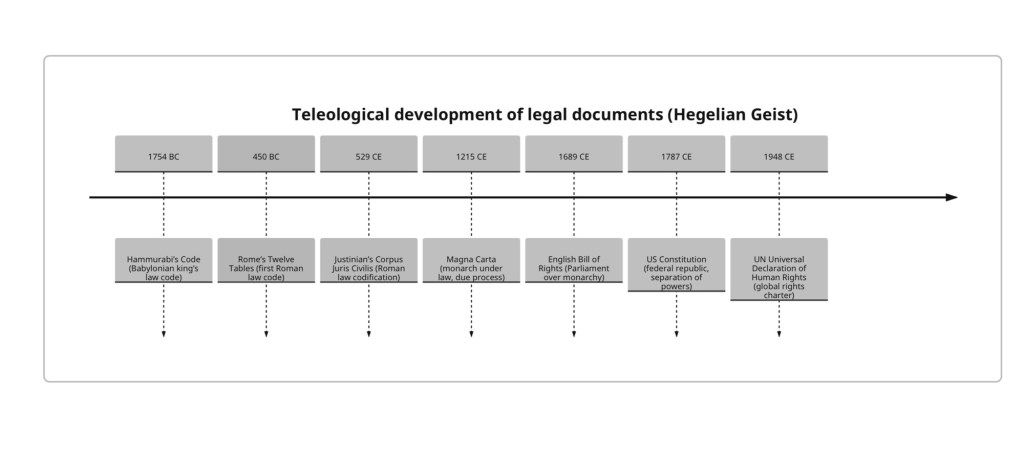
The timeline above (a mermaid chart) visualizes the chronological emergence of these texts, reflecting a Hegelian notion of historical “progress of freedom.”
Below is a comparative table mapping Hegel’s dialectical categories and Husserl’s horizon concept onto each document.
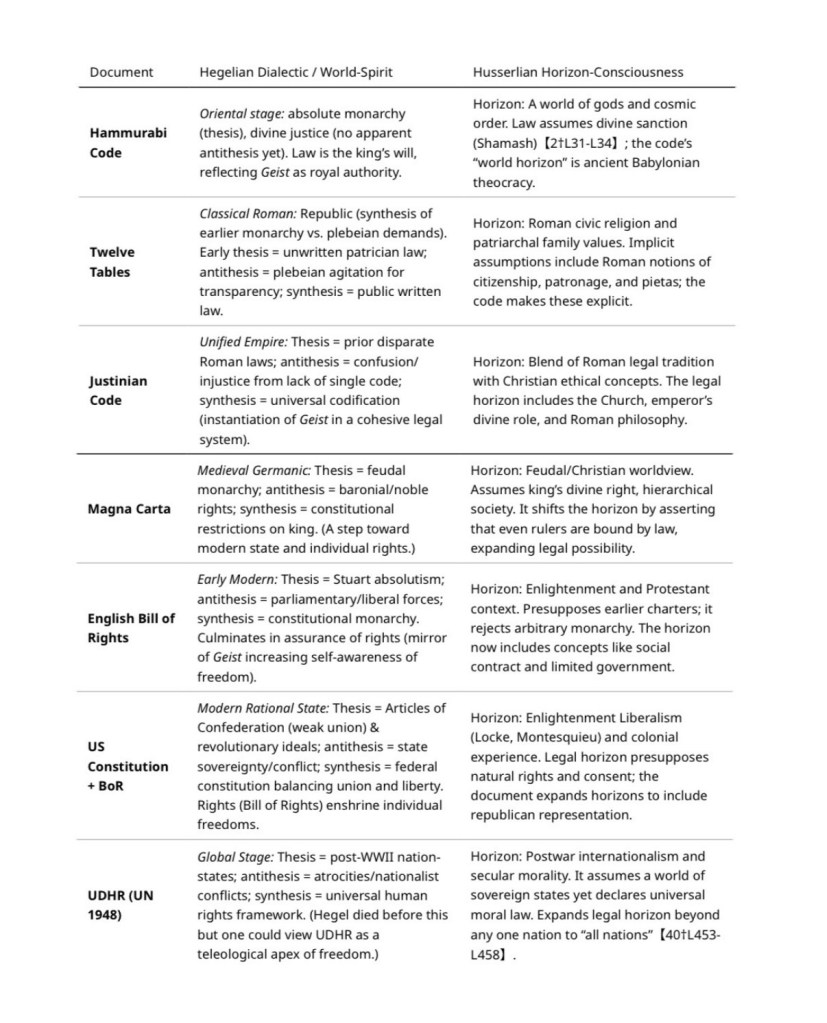
The table highlights continuities and contrasts. For example, Hegel’s “world-spirit” flows from Hammurabi’s theocracy to secular constitutions; each people (“individual peoples”) defines a piece of this Spirit via law. Husserl’s horizon shows the implicit background of each era – from divine monarchy to human dignity – changing with each text. Where Hegel emphasizes a forward drive toward freedom (see above quote ), Husserl alerts us to the prejudices each code carries (the “world horizon” behind every law) and how new laws extend that horizon.
Implications for Modern Constitutionalism and Human Rights
Together, these frameworks suggest that modern constitutional and human-rights ideas rest on this layered past. Hegel’s view casts today’s liberal-democratic state as the apotheosis of law’s development, while Husserl invites humility: each stage had its own blind spots. Indeed, tension exists: teleological narratives of progress (rights ever-improving) often overlook the ruptures – revolutions, regressions, cultural differences – that complicate any simple ascent. We see this in the dialectic: Locke’s natural rights arise from a struggle against tyranny; Marx’s and others’ critiques would call Hegel’s “freedom” an ideological synthesis masking conflict. Similarly, Husserl’s horizons remind us that current human rights (e.g. UDHR’s universality) still rest on the horizon of 1948’s context and need continual reconstitution (e.g. inclusion of social and collective rights, digital-era rights).
Conclusion: The evolution from Hammurabi’s stele to the UDHR embodies both continuity and change in law’s history. Hegelian analysis underscores a broad trajectory of freedom’s realization, albeit one with dialectical twists. Husserlian horizon-consciousness reveals how each document emerges from, and reshapes, the backdrop of human expectations. Together they offer a rich comparative lens: the law is both a “history” of spirit and a shifting horizon of meanings. For modern constitutionalism and human-rights theory, this implies that today’s ideals are both the inheritors of an unfolding spirit and contingent on current horizons – and thus always open to deeper reform or radical challenge.
Sources: Authoritative texts, translations, and scholarship on each document (see citations). Hegel and Husserl are cited via recognized editions and expert commentary. Tables and the timeline summarize these analyses and help visualize the dialectical and horizon shifts described above.
Conclusion
What emerges, across this arc of juridical formations, is not a simple narrative of improvement but a transformation in what law is allowed to mean within human self-understanding. From Hammurabi’s stele, where justice is inseparable from divine sovereignty, to the modern articulation of universal rights, law gradually ceases to appear as something merely imposed upon life and becomes instead a medium through which life understands itself as free. Yet this “becoming free” is never a clean passage from illusion to truth. It is a reconfiguration of the very horizon within which truth, authority, and personhood can appear at all.
In Hegelian terms, this movement can be read as the increasing adequation of Geist to itself: spirit externalizing itself in institutions, only to recover itself within them as their implicit rationality. Each juridical order is thus not merely a stage in historical succession, but a determinate shape of freedom—partial, bounded, and internally conflicted—striving toward explicit universality. The modern constitutional state and the language of human rights do not terminate this process so much as render its stakes explicit: freedom is no longer simply enacted through law, but thematized as the very justification of law.
Yet from a Husserlian perspective, this teleological reading must remain structurally incomplete. Every legal formation is sustained by a horizon of taken-for-granted meanings—of what counts as a human being, what counts as harm, what counts as binding obligation. These horizons are not shed as history progresses; they are re-sedimented, transformed, and partially obscured within new configurations. The Universal Declaration of Human Rights, for all its universality, still presupposes a particular historical horizon in which dignity, personhood, and global community have become intelligible as juridical categories.
The “apotheosis” of law, if such a term may still be used without metaphysical overreach, is therefore not a final reconciliation but an ongoing intensification of self-interpretation. Law becomes progressively more reflective, more universal in its claims, and more explicit about its grounding in freedom—but never fully exhausts the horizons that make such articulation possible. What appears as culmination is, phenomenologically, a deepening openness.
Thus the trajectory traced here—from ancient code to global declaration—should not be understood as the closure of history in a final form, but as the continual reconstitution of the space in which law and freedom can appear to one another. If there is a telos, it is not an endpoint but a demand: that each juridical order remain accountable to the expanding horizon of what it means to be free.
further reading:

 ov1d.com