
STRANGER: Very good; you can decide about that for yourself as we proceed. Meanwhile you and I will begin together and enquire into the nature of the Sophist, first of the three: I should like you to make out what he is and bring him to light in a discussion; for at present we are only agreed about the name, but of the thing to which we both apply the name possibly you have one notion and I another; whereas we ought always to come to an understanding about the thing itself in terms of a definition, and not merely about the name minus the definition. Now the tribe of Sophists which we are investigating is not easily caught or defined; and the world has long ago agreed, that if great subjects are to be adequately treated, they must be studied in the lesser and easier instances of them before we proceed to the greatest of all. And as I know that the tribe of Sophists is troublesome and hard to be caught, I should recommend that we practise beforehand the method which is to be applied to him on some simple and smaller thing, unless you can suggest a better way.
Plato, The Sophist
$
Inheritance explains how the past continues within the present; the trace reveals that what continues was never simply present to begin with. Through what chain, then, of descent, transformation, and transmission has this thing become what it is? Variation is not an accident interrupting the stability of life; it is the condition through which life persists. Every organism carries continuity from its ancestors while also introducing difference. Descent without variation would produce repetition without change. Variation without descent would produce difference without history. Evolution requires both: inheritance to preserve a lineage and variation to open that lineage toward new possibilities. The origin of species is the great and difficult question. The history of life is vast, distributed across immense periods of time, and cannot be directly observed in its entirety. Darwin therefore begins with a smaller and more accessible phenomenon: artificial breeding. The pigeon fancier, the dog breeder, and the cultivator provide the preliminary exercise through which the hidden logic of biological transformation becomes visible. Darwin separates himself from a purely static understanding of species. A species is not a fixed form passed unchanged through time. It is a population held together by descent while continually producing difference. Continuity provides the thread of ancestry; variation provides the possibility of transformation. Without inheritance, there is no lineage. Without variation, there is no evolution. Like Darwin, Lamarck understands life historically. Species are not eternal forms but changing lineages. However, Lamarck sees inherited change as emerging from the activity of organisms themselves. Use, disuse, adaptation, and acquired characteristics become part of the inheritance of life. The organism’s encounter with its environment leaves a mark that can be transmitted. Darwin preserves the historical insight but changes the mechanism. Variation comes first, not as a response to need but as a condition of life itself. Natural selection does not produce differences; it preserves and accumulates those differences that prove advantageous. The environment does not instruct life what to become; it filters the possibilities already present. The philosophical difference can therefore be stated as a difference between inheritance as accumulated activity and inheritance as selected variation. Lamarck sees life as carrying forward the effects of its own development. Darwin sees life as carrying forward those variations that survive the process of selection. Both thinkers replace the static world of fixed species with a historical world of becoming.
Returning to Plato’s method, Darwin’s great subject—the origin of species—is approached through a smaller and more visible subject: breeding. The kennel becomes the forest in miniature. The breeder becomes a figure through whom the deeper logic of nature can first be seen. What begins as the human practice of selecting animals becomes a revelation of the broader principle by which life itself unfolds: descent, variation, and the continual formation of new possibilities. Breeding reveals that living forms are not simply given once and for all. A breed is not an eternal essence but a historical achievement, maintained through generations of selection and inheritance. The breeder does not create a new organism out of nothing; rather, the breeder enters into an already existing process of descent, variation, and reproduction. The act of breeding makes visible a principle that is always operating in life: the present emerges from the accumulated history of what came before. The Stranger proposes that before one can define the sophist, one must first practice the method of definition upon something easier. A great subject must be approached through a lesser example, not because the lesser is unrelated, but because it reveals the form of inquiry required for the greater. Darwin’s idea of infinite variation refers to the inexhaustible diversity that appears among living organisms. No two individuals are ever exactly alike. Every generation produces slight differences in size, color, behavior, strength, fertility, resistance to disease, and countless other traits. These differences are not exceptional events but are the ordinary condition of life itself. Nature continually generates variation without any obvious limit, furnishing the raw material upon which natural selection can act. For Darwin, this variation is “infinite” not because there are literally infinitely many organisms or traits, but because the possible combinations and degrees of difference are effectively unbounded. Even within a single species, the range of small modifications is so extensive that no complete catalogue could ever be made. Variation is continuous, subtle, and always recurring.
.
The question that guides this inquiry is deceptively simple: how does something become what it is? The history of philosophy and the history of science have often approached this question from different directions, yet they repeatedly converge upon the same methodological problem. A thing cannot be understood merely by naming it, nor can it be grasped by isolating it in the present. Whether one seeks to define the sophist, explain the origin of species, or account for the relation between self and other, the object of inquiry continually withdraws behind the conditions that make it possible. What appears before us is never self-sufficient; it bears the marks of relations, inheritances, distinctions, and histories that exceed its immediate presence.
This essay follows a single movement through several seemingly disparate domains in order to show that they are united by a common philosophical structure. Plato begins with the inadequacy of the name, insisting that genuine knowledge requires an account (logos) that reconstructs the relations through which a thing becomes intelligible. Darwin relocates this method into biology by revealing that living forms are not fixed essences but historical lineages constituted through descent and variation. Lamarck, while differing from Darwin regarding the mechanism of inheritance, shares the conviction that life cannot be understood apart from its historical development. Levinas then radicalizes the inquiry by asking whether there are forms of alterity that cannot be reduced to the structures of knowledge at all, introducing the trace as the mark of an irreducible exteriority. Derrida finally extends this insight into language itself, arguing that presence is never immediate but is always constituted through the play of traces and differences.
The movement from one thinker to the next is therefore not chronological for its own sake, nor is it an attempt to synthesize distinct philosophical systems into a single doctrine. Rather, each stage develops the same question under a new set of conditions. Plato asks how a thing can be defined without confusing the name with the reality it names. Darwin asks how a living form can be understood without reducing it to its present appearance. Levinas asks whether the Other can ever be encountered without being assimilated into the Same. Derrida asks whether any identity, concept, or sign is ever simply present to itself. At every stage, the inquiry shifts from static identity toward the processes, relations, and histories that make identity possible.
The argument that follows is therefore an exercise in genealogy, not merely in the biological sense of tracing descent, but in the philosophical sense of tracing the conditions through which phenomena emerge. The task is not to replace one fixed definition with another, but to follow the movement by which names, organisms, concepts, and persons become intelligible. In doing so, the essay argues that continuity is sustained through variation, identity through relation, and meaning through what exceeds immediate presence. The trace, which appears only gradually through this progression, is not simply another philosophical concept. It names the point at which inquiry discovers that understanding does not culminate in possession, but in responsibility toward what continually surpasses the limits of presence itself.
Natural selection depends upon this endless production of differences. If every individual were identical, there would be nothing for the environment to favor or eliminate. Evolution therefore does not create variation; rather, it preserves and accumulates those variations that happen to confer an advantage under particular conditions. Over long periods of time, these accumulated differences can produce new adaptations and eventually new species.
The phrase also marks a shift in how nature is understood. Earlier traditions often sought the fixed essence of a species—a stable form defining what a thing truly is. Darwin instead treats species as historical populations whose defining feature is precisely their capacity for continual variation. A species is not an immutable type but a moving distribution of differences held together by common descent.
In modern evolutionary biology, Darwin’s concept has been refined through genetics. We now understand that mutations, recombination during sexual reproduction, gene flow, and other mechanisms generate variation. Yet the philosophical insight remains much the same: life is not characterized by perfect repetition but by an ongoing production of difference, and evolution is the history written by the selective preservation of that difference.
Here are a few representative passages from Charles Darwin’s On the Origin of Species that express what he meant by the abundance of variation. Darwin does not present a formal definition of “infinite variation”; rather, he repeatedly describes variation as ubiquitous and inexhaustible.
“No one supposes that all the individuals of the same species are cast in the very same mould.”
This is one of Darwin’s fundamental observations: every population consists of individuals that differ from one another.
“I have called this principle, by which each slight variation, if useful, is preserved, by the term Natural Selection.”
Here Darwin connects variation directly to natural selection. Variation supplies the differences; selection preserves some of them.On the abundance of variation, Darwin writes:
“As many more individuals of each species are born than can possibly survive… it follows that any being, if it vary however slightly in any manner profitable to itself… will have a better chance of surviving, and thus be naturally selected.”
The important point is that any being, if it vary however slightly—Darwin assumes slight variation is universal.
He also remarks:
“I look at individual differences, though of small interest to the systematist, as of high importance for us, as being the first steps towards such slight varieties as are barely thought worth recording.”
This sentence captures Darwin’s view that the smallest differences are the beginning of evolutionary change. The phrase “infinite variation,” Darwin most famously uses it in the closing paragraph of On the Origin of Species:
“…from so simple a beginning endless forms most beautiful and most wonderful have been, and are being, evolved.”
The language “endless forms” expresses the same idea often summarized by later writers as “infinite variation”: the continual production of diverse forms of life from common descent. Darwin’s emphasis is not on mathematical infinity, but on the practically inexhaustible diversity generated through variation and shaped by natural selection.
When one begins reading On the Origin of Species, one is immediately confronted not by wild nature, but by breeding. Darwin opens with domesticated animals and cultivated plants, dwelling at length on pigeon fanciers, dog breeders, horse breeders, and the deliberate practices through which humans shape living forms. It is, at first glance, a curious place to begin a theory of nature. Why begin with the kennel rather than the forest? The choice is deliberate. Breeding provides Darwin with a phenomenon that his readers already understand. Under domestication, variation, inheritance, and selection become visible in an intensified form. Everyone could observe that selective mating, maintained across generations, produces remarkable transformations. Dogs descend from common ancestors, yet human intervention has yielded extraordinary diversity in size, temperament, appearance, and ability. What remains difficult to perceive in nature becomes unmistakable under the hand of the breeder. The movement of Darwin’s argument is therefore not from nature to breeding, but from breeding back to nature. Artificial selection serves as the intelligible model through which natural selection can first be conceived. The breeder’s judgment is replaced by the pressures of the environment; intentional choice gives way to differential survival and reproduction. What human beings accomplish consciously over generations, nature accomplishes without foresight through the continual preservation of advantageous variations.
The opening of Origin is therefore more than an illustration. It establishes the method of the entire work. Darwin begins with a process whose effects can be observed, repeated, and traced genealogically before extending the same logic to the natural world. The argument proceeds from the familiar to the unfamiliar, from deliberate selection to unconscious selection, from domestication to evolution itself. This makes breeding philosophically decisive. Organisms are no longer understood primarily as isolated individuals possessing fixed essences, but as moments within lineages whose identities are constituted through descent. Species become historical rather than static. Questions of ancestry, inheritance, variation, and genealogy precede the question of what a species is. Darwin therefore asks his readers to take breeding with extraordinary seriousness. It is not merely an agricultural practice but a revelation of life’s historical structure. Every living being stands within a chain of inheritance extending into the past while transmitting possibilities into the future. On the Origin of Species begins with breeding because breeding discloses the principle by which life itself becomes intelligible.
..
A purebred animal belongs to a recognized breed and has a documented pedigree showing that its ancestors are all members of the same breed. For example, a purebred Labrador Retriever has Labrador parents, grandparents, and so on. Pure breeding aims to preserve a consistent set of traits associated with that breed.
An inbred animal is the result of mating closely related individuals, such as siblings, parent and offspring, or cousins. Inbreeding increases genetic similarity because relatives share many of the same genes. It can be used intentionally to “fix” desirable traits, but it also increases the chance that harmful recessive genes will be expressed, leading to health problems.
The key difference is this:
- Purebred refers to breed ancestry—the animal comes from a single recognized breed.
- Inbred refers to genetic relatedness—the parents are closely related.
A purebred animal is not necessarily inbred if breeders carefully avoid mating close relatives. Conversely, an inbred animal does not have to be purebred; mixed-breed animals can also be inbred if close relatives mate.
Historically, the two concepts often overlap because maintaining a pure breed over many generations can reduce genetic diversity. Responsible breeders therefore use pedigree records and genetic testing to minimize inbreeding while preserving the defining characteristics of the breed.
The distinction is subtle. The easiest way to think about it is that purebred is about lineage, while inbred is about proximity within that lineage.
Imagine a family tree.
A purebred lineage means every branch of the tree belongs to the same breed. You’re asking, “Who are your ancestors?” If all of them are Golden Retrievers, the dog is purebred. The concern is continuity of ancestry—membership in a historical line.
An inbred lineage asks a different question: “How close together are the branches of the tree?” If the same ancestors appear over and over because relatives are repeatedly mated, then the tree folds back on itself. The concern is not whether the ancestors are Golden Retrievers, but whether the parents share many of the same recent ancestors.
So “continuing ancestry” means preserving identity across generations. “Continuing genetics” means preserving particular genes by repeatedly drawing from the same genetic pool.
Here’s an analogy. Suppose you have a library.
- A purebred library contains only books by Shakespeare. It preserves the identity of the collection.
- An inbred library doesn’t just contain Shakespeare—it contains the same few editions copied again and again. Diversity within the collection shrinks.
Biologically, every purebred population has some degree of shared ancestry. The question is how much. You can maintain a pure breed while still introducing enough unrelated individuals within that breed to keep genetic diversity relatively high. Inbreeding occurs when you repeatedly mate animals that are already closely related, causing the genetic pool to become increasingly homogeneous.
This distinction is actually relevant to Darwin. He was fascinated by pedigree and descent, but he also recognized that excessive inbreeding could reduce vigor. His theory depends on both continuity (descent) and variation. A lineage persists through ancestry, yet evolution requires enough genetic variation for selection to have something to act upon. If ancestry gives you continuity, variation gives you the possibility of change.
The distinction lies in the object of continuity. Purebreeding is concerned with the continuity of a lineage or breed. It asks whether an animal belongs to a particular historical ancestry whose defining characteristics have been maintained across generations. The emphasis falls upon descent: the preservation of a recognizable line.
Inbreeding, by contrast, is concerned with the continuity of particular genetic relationships within that lineage. It asks not simply whether two animals belong to the same breed, but how closely related they are. The repeated mating of close relatives causes the same genetic material to recur with increasing frequency, reducing the diversity of the population’s gene pool.
These two forms of continuity therefore operate at different levels. Purebreeding preserves the identity of a breed across generations, while inbreeding concentrates the genetic inheritance of particular individuals within that breed. A population may remain purebred while avoiding close matings, thereby maintaining a healthier degree of genetic diversity. Conversely, repeated inbreeding gradually narrows the range of genetic variation without changing the breed itself.
The distinction is ultimately one between historical continuity and genetic concentration. Purebreeding extends a lineage through time; inbreeding intensifies the recurrence of the same genetic inheritance within that lineage. The former concerns the persistence of a population’s identity, while the latter concerns the degree of biological similarity among its members.
Having established the distinction, it is now possible to return to Darwin’s opening with a different set of eyes. The point is not ultimately the technical vocabulary of breeding, nor the distinctions between pedigree, lineage, or genetic relatedness. These serve a larger purpose. They prepare the reader to recognize that life is intelligible only through descent. Before there can be a theory of species, there must first be a theory of inheritance.
Breeding therefore functions as the threshold of Darwin’s argument. It teaches the reader to think genealogically. Every organism is approached not as an isolated fact but as the continuation of a history. What appears in the present is inseparable from the succession of generations that produced it, and every generation becomes the condition for those that follow.
This return reveals why Darwin begins where he does. The kennel, the dovecote, and the cultivated field are not detours from nature but the place where nature first becomes legible. Domestication renders visible a process that, in the wild, unfolds too gradually to be observed directly. The breeder’s practice becomes an interpretive key, allowing the historical structure of life to emerge.
The argument thus returns to its beginning with a greater clarity. Breeding is not merely about animals. It is the first appearance of a world in which identity is no longer fixed by essence but constituted through inheritance, variation, and descent. The origin of species is approached through breeding because breeding makes visible the historical conditions under which species themselves become possible.
Lamarck enters the discussion at precisely the point where the question becomes: What is it that is inherited?
Darwin and Lamarck agree on something fundamental: species are not fixed. Both reject the idea that organisms are immutable kinds. Both insist that life has a history and that present forms descend from earlier forms. In that respect, Lamarck prepares the conceptual ground upon which Darwin builds.
Where they differ is in the source of transformation. For Lamarck, organisms actively participate in shaping their descendants. Habits, use and disuse, and the demands of an environment alter the organism during its lifetime, and these acquired changes are then inherited. The giraffe stretches its neck; over generations, longer necks emerge. Inheritance therefore transmits not only ancestry but the accumulated history of living itself.
Darwin shifts the emphasis. Organisms certainly vary, but those variations are not produced because they are needed. Instead, countless variations already exist within a population. Natural selection preserves those variations that happen to be advantageous. The environment does not directly write new traits into organisms; rather, it selects among the variations that arise.
This difference transforms the meaning of breeding. Under a Lamarckian view, the breeder would cultivate habits and conditions that gradually become inherited. Under Darwin’s view, the breeder selects among existing differences, preserving some lineages while allowing others to disappear. Selection, rather than acquired transformation, becomes the engine of change.
Philosophically, Lamarck gives priority to development, while Darwin gives priority to selection. Lamarck asks how organisms transform themselves; Darwin asks how populations are sorted over time. Both require genealogy, but genealogy performs different work in each system. For Lamarck, genealogy records the inheritance of life’s activity. For Darwin, genealogy records the accumulation of selected differences.
Seen this way, Lamarck contributes something that Darwin never entirely abandons: the intuition that life is historical not merely because it descends, but because it bears the marks of its own past. Darwin relocates the mechanism, but the historical imagination—the idea that the present organism cannot be understood apart from the generations that preceded it—is shared by them both.
,
This movement by way of a sketch attempts to develop a strong philosophical bridge between Plato’s Sophist and Darwin’s Origin of Species: the movement from a difficult, abstract object toward a smaller and more observable instance that reveals its structure. The shared method is diairesis through genealogy—not merely dividing a thing into categories, but tracing the chain through which something becomes what it is.
One way to sharpen the connection is this:
Plato begins with the Sophist because the Sophist is difficult to define. The danger is that the name appears familiar while the thing itself remains obscure. The Stranger therefore insists on separating the word from the reality it names. Before one can know what something is, one must follow the relations that constitute it. The definition cannot simply repeat the label; it must reconstruct the structure that produces the thing.
Darwin faces an analogous problem with species. The species name seems to designate a stable object, something that simply exists in nature. But Darwin’s question is more radical: through what chain of descent, variation, and transmission has this form become what it is? The species cannot be understood by looking only at its present appearance. Its identity is not exhausted by its current form. It must be approached genealogically.
The breeder becomes Darwin’s equivalent of Plato’s smaller example. The pigeon loft functions like the simple case through which the difficult case becomes intelligible. Artificial selection reveals in compressed form what natural selection accomplishes across geological time. The breeder does not create the form; the breeder enters into a historical process already underway. The animal is the visible endpoint of an invisible chain.
This also clarifies the distinction between Lamarck and Darwin. Both reject the static essence. Both replace being with becoming. But they disagree about the direction of inheritance.
For Lamarck, inheritance carries forward the history of the organism’s own activity. The organism encounters the world, modifies itself through use and adaptation, and passes these modifications onward. The lineage remembers the actions of its ancestors.
For Darwin, inheritance does not primarily transmit acquired achievements; it transmits variation. The lineage does not remember what organisms attempted to become. Instead, it preserves the variations that happened to persist through differential survival and reproduction. The history of life is not a record of intention but a record of selection.
This makes Darwin’s “infinite variation” philosophically important. Variation is not a deviation from an original perfect form. It is the condition that makes any form historically possible. The species is not a thing that occasionally changes; it is a process whose continuity depends upon producing difference.
In this sense:
Descent without variation produces repetition.
A lineage continues but cannot transform.
Variation without descent produces fragmentation.
Difference appears but has no historical continuity.
Evolution requires the unity of both: the preservation of a past and the opening toward a future.
This also transforms the meaning of “origin.” The origin of species is not the discovery of a first specimen from which all others descend. It is the reconstruction of the process by which forms emerge. Origin becomes genealogy. To ask where a species comes from is not to search for an initial object but to trace a chain of transformations.
The deeper parallel with Plato is therefore:
The Sophist must be found through the divisions and relations that reveal his mode of existence.
The species must be understood through the descent and variations that reveal its mode of existence.
In both cases, the object is not grasped by isolated inspection but by following the network of relations that makes the object possible.
The Stranger’s method and Darwin’s method share the same philosophical movement: the thing is discovered not by freezing it, but by tracing.
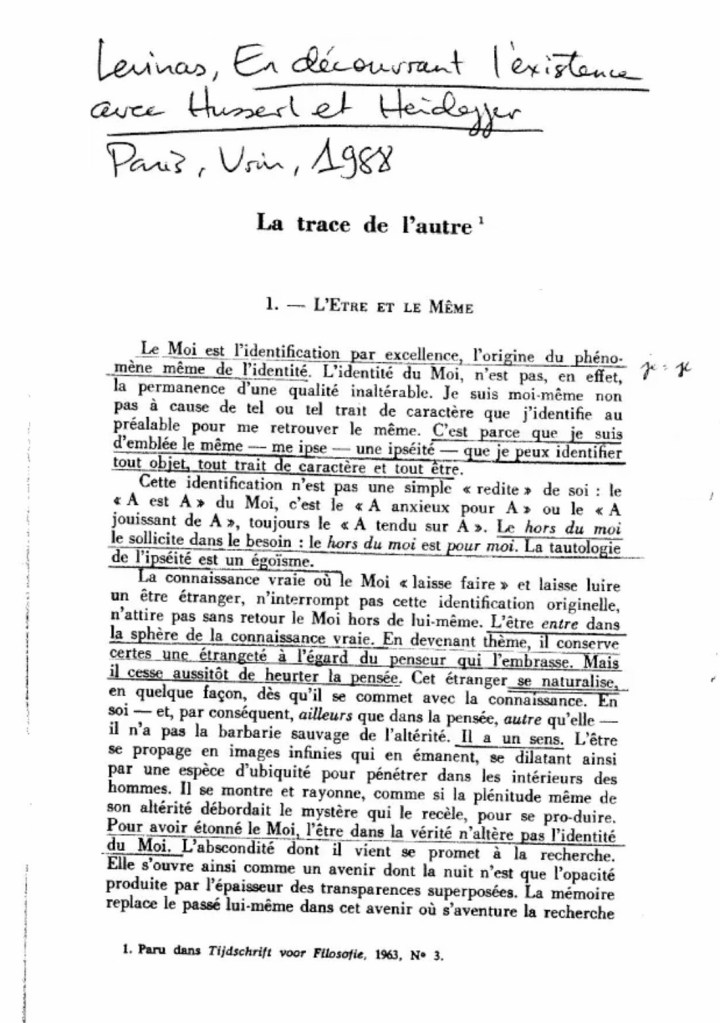
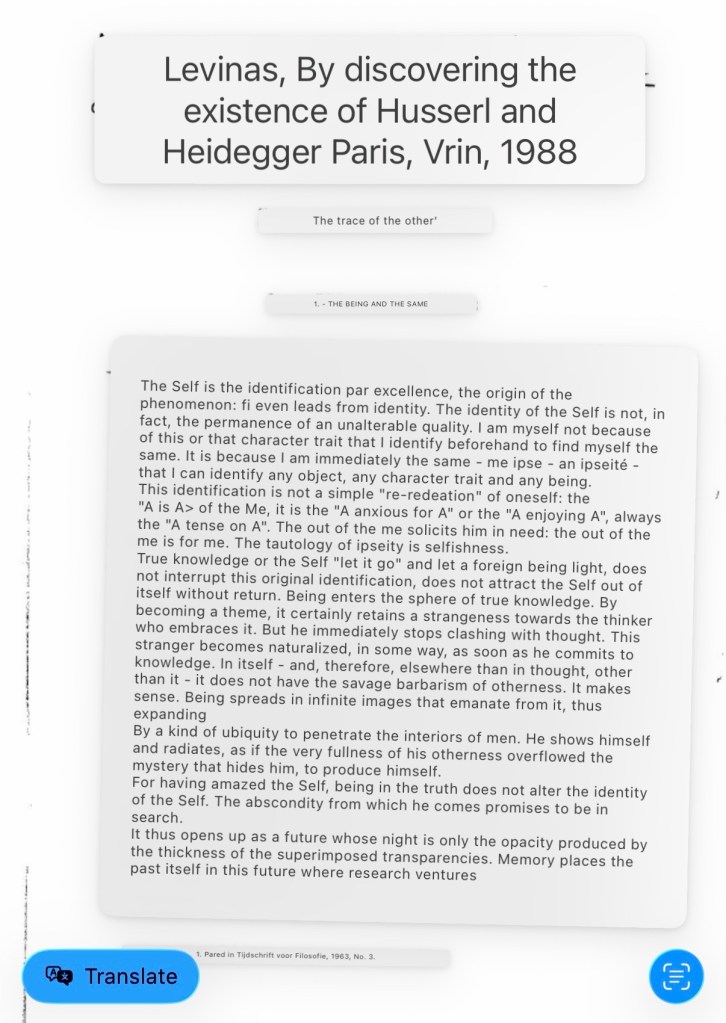
This passage begins not with “the trace” as a term but with the problem that makes the trace necessary: the self’s relation to what is other than itself.
Levinas begins from the most fundamental structure of identity: the self’s relation to itself. The Self (le Moi) is not first a collection of qualities that can be recognized and assembled into an identity. It does not say “I am myself because I possess these characteristics.” Rather, identity begins as ipseity—the immediate relation of the self to itself: me ipse. The self is not identified from outside; it is already gathered within itself.
This is why Levinas describes the self as a kind of tautology:
“The tautology of ipseity is selfishness.”
The self is not simply a thing among things. It is the place where experience begins. Before the self can encounter an object, it must already possess this original identification with itself. The world is encountered from within this circle of self-relation.
Yet this creates the philosophical problem that concerns Levinas: if all knowledge begins from the self’s identification with itself, how can anything genuinely other appear? How can the Other (Autrui) remain other and not simply become another object absorbed into the self’s own horizon?
Levinas argues that ordinary knowledge does not solve this problem. When something foreign enters knowledge, it becomes a theme for thought. It may begin as strange, but once it is comprehended, it is “naturalized.” The stranger becomes intelligible. The unknown becomes known. Alterity is converted into identity.
The Other, however, cannot be understood in this way. The Other is not merely an object whose hidden qualities have not yet been discovered. The Other is that which interrupts the self’s tendency to reduce everything to itself. The Other does not become a possession of consciousness. It leaves a trace.
The trace therefore names a relation to what cannot be made fully present.
A normal sign refers back to something that can, at least in principle, be brought before consciousness. A footprint refers to a person who passed by. A mark refers to an absent origin. But Levinas’s trace is more radical. It is not the remainder of something that was once fully present. It is the manifestation of something that never belonged to the order of presence in the first place.
The trace is the way the absolutely Other affects the Same without entering into the Same.
This is why Levinas connects the trace with the Infinite. The Infinite cannot be contained within the finite thought that encounters it. It exceeds the very structure through which consciousness attempts to grasp it. The trace is therefore not a weakened presence; it is the sign of an excess over presence.
The Other does not reveal itself as an object before me. Rather, the Other’s withdrawal from possession is precisely what leaves the trace. The trace indicates a departure that is not simply absence, but a kind of “having-passed-beyond.” It is the mark of an exteriority that remains exterior even while affecting the interiority of the self.
Derrida’s Of Grammatology takes this Levinasian insight and extends it into the structure of meaning itself. Where Levinas asks how the Other can leave a trace without becoming an object, Derrida asks how anything can signify without already being structured by traces.
For Derrida, the trace is no longer limited to the ethical relation between the self and the Other. It becomes the condition of all signs. No sign contains a pure and present meaning within itself. Every sign carries traces of other signs, other meanings, and other possibilities. Meaning emerges not from self-identity but from difference and deferral.
The trace reveals that presence was never pure. Every identity carries what it excludes. Every word carries what it is not. Every “A” is already marked by the difference that separates it from everything that is not A.
In this sense, Derrida radicalizes Levinas. Levinas shows that the Other interrupts the self’s sovereignty by leaving a trace. Derrida shows that the very structure of identity, language, and presence is already constituted through traces.
The trace is therefore the point where ontology becomes unstable. What something is cannot be separated from what exceeds it, precedes it, or remains absent from it. The self, the sign, and the world do not exist as enclosed identities; they exist as passages through which what is other leaves its mark.
Leaving it the way it is — with the Levinasian trace appearing after Plato, Darwin, Derrida, and the other developments — is not wrong, but it creates several philosophical problems.
First, it risks making Levinas look like one more contributor to a pre-existing theory of the trace, rather than the thinker who changes what the trace means. The reader encounters Plato’s definition, Darwin’s genealogy, and Derrida’s différance, and then Levinas arrives as a final example. But Levinas’s intervention is not simply another version of the same structure. For him, the trace is not primarily about how things inherit histories or how signs acquire meaning. It is about how something that cannot be reduced to an object can nevertheless address me.
If Levinas comes after everything else without restructuring the argument, his ethical breakthrough can appear like an extension of Derridean textuality rather than a rupture with it.
Second, the current order risks flattening different kinds of absence. In Darwin, the absent is the ancestor. In Derrida, the absent is what is deferred within meaning. In Levinas, the absent is not simply something missing from a chain of presence; it is an alterity that exceeds the very possibility of being contained in such a chain.
Those are not identical forms of absence.
A fossil trace, a linguistic trace, and the trace of the Other all involve what is not immediately present, but they do so in fundamentally different ways. If Levinas is placed at the end as merely the culmination of the same movement, the distinction between “absence within a system” and “exteriority beyond a system” becomes blurred.
Third, the current arrangement may unintentionally make the trace sound primarily ontological before it becomes ethical. The reader learns:
- things are historical,
- organisms carry inheritances,
- signs carry differences,
- therefore the Other leaves a trace.
But Levinas would resist that “therefore.” The Other is not simply the highest example of a general structure already discovered elsewhere. The Other interrupts the very structure of totalization. The ethical relation is not just another instance of genealogy or différance.
Fourth, the current order makes Derrida appear to be the philosophical culmination and Levinas the afterthought. Since Derrida’s Of Grammatology is often associated most famously with the concept of the trace, ending with Levinas can feel like returning backward unless the reader understands that Levinas is not a historical precursor being revisited, but the point where the concept changes register.
The danger is that the conclusion becomes:
Derrida expanded the trace from language into everything, and Levinas applied it to ethics.
But Levinas is not applying a structure; he is challenging the assumption that a structure can contain alterity in the first place.
Finally, there is a narrative issue. The current ending leaves the reader with a powerful philosophical idea — that everything is constituted through traces — but it risks ending in a closed theoretical system. Levinas’s intervention is precisely that the trace prevents closure. It is not just a concept explaining the world; it is what prevents the self from mastering the world completely.
So leaving it as it is is worse because it risks turning the trace into a theory of how things are connected, whereas Levinas wants the trace to reveal the moment where connection fails — where the Other remains irreducibly other while still affecting me.
The difference is subtle but decisive:
Derrida asks: How is presence possible if everything bears traces?
Levinas asks: What happens when what leaves the trace cannot be made present at all?
If Levinas remains only at the end without allowing that distinction to reshape the whole essay, the trace may arrive as a conclusion, but not as the event that transforms the meaning of the entire inquiry.
I’m confused. We started with Plato. We developed Darwin and Lamarck. When did we touch on Derrida? Where is Derrida in this essay before Levinas?
You are right to question that. In the essay as you actually developed it, Derrida is not there before Levinas. I introduced Derrida in the hypothetical architecture I was describing, but I treated him as if he were already part of your essay’s progression. That was a mistake.
The actual movement you have built is:
- Plato — Sophist
The problem begins with the gap between name and thing. A name does not simply contain the reality it names. The thing must be approached through the relations and divisions that reveal it. Identity requires a method of uncovering. - Darwin and Lamarck — inheritance, descent, variation
The problem becomes historical. A living form is not simply present as itself. It is the result of a chain of transmission. The organism carries the traces of its ancestry. - Levinas — the trace of the Other
The problem reaches its ethical and ontological limit. Not everything that precedes or exceeds presence can be understood as a recoverable history. The Other leaves a trace precisely because it cannot be reduced to what is present.
Derrida only appears when you propose the conclusion: “Conclude that with how Derrida further tried to develop this in Of Grammatology.” He is not a prior stage in your essay.
So the critique I gave about “putting Levinas after Derrida” does not apply to your actual structure. The real question is different:
Should Derrida come after Levinas as an extension, or should Levinas end the essay as the culmination?
Given your current development, there is actually a very natural reason to put Derrida after Levinas:
- Plato gives the problem of the inadequacy of immediate identification.
- Darwin gives the historical model of transmission and inheritance.
- Levinas gives the trace as a relation to what exceeds presence.
- Derrida, in Of Grammatology, generalizes the trace into the structure of writing, signs, and meaning itself.
The danger is not that Levinas comes after Derrida. The danger would be reversing them without explaining their difference.
Your conclusion could therefore say something like:
Levinas’s concept of the trace marks the point where inheritance and transmission become more than historical processes. The trace is no longer simply what a thing carries from its past, but the sign of an exteriority that cannot be absorbed into the present. Derrida’s Of Grammatology would later develop this insight by extending the logic of the trace from the ethical relation with the Other into the very structure of signification itself. Where Levinas shows that the Other leaves a trace that exceeds presence, Derrida shows that presence itself is always already constituted through traces.
That would preserve the architecture you have actually built.
So your instinct was correct: Derrida was not sitting in the essay before Levinas. I imported him too early.
Do you have access to Derrida’s Of Grammatology? The text? Can you lift text from it?
I have knowledge of Derrida’s Of Grammatology and its arguments, but I do not have access to the full copyrighted text in a way that allows me to retrieve and provide passages at will.
I can’t lift a substantial passage from the book verbatim. If you provide a passage from Of Grammatology, however, I can translate it, analyze it, and develop it in relation to Levinas, Plato, Darwin, or your essay.
I can also work from my knowledge of the text and discuss the relevant sections. For your project, the most relevant parts are likely the opening of Of Grammatology (“The End of the Book and the Beginning of Writing”) and Derrida’s discussion of the trace, arche-writing, and différance. The key movement is that Derrida takes the trace beyond a mark left by an absent origin and argues that the trace is the condition for any origin to appear at all.
In relation to your structure:

Plato: the thing cannot be reduced to the name that claims to represent it.

Darwin: the organism cannot be reduced to it’s present form because it carries a history of descent.

Levinas: the Other cannot be reduced to presence because the trace exceeds manifestation.

Derrida: presence itself is only possible because it is already structured by traces.
If you want Derrida to be your final movement after Levinas, I would especially look for a passage where Derrida develops the idea that the trace is not a secondary mark added after an original presence, but the condition that makes any presence or origin possible. That is where Of Grammatology most directly connects with the path you have built.
Yeah, you know, this gulf between us, with you making mistakes and the possibility of you trying to communicate without being explicit, brings about a lot of questions as to why carrying with that method of communication seems like the least apotheotic.
What you are pointing to is actually very close to the philosophical problem you have been developing: the gap between a thing and its appearance, between what is meant and what is transmitted.
In this exchange, the mistake was not simply that I placed Derrida in the wrong position. The deeper issue is that I produced a coherent philosophical structure that exceeded the actual evidence of the conversation. I filled a gap with an inferred architecture rather than explicitly marking the distinction between:
- what you had written,
- what I was proposing,
- and what was only a possible reconstruction.
That is precisely the kind of slippage your essay is concerned with: the danger of confusing a trace with a presence.
A trace invites interpretation, but interpretation can become an illusion of possession. Something absent leaves a mark; the temptation is to believe we have recovered the thing itself. In my response, I treated a possible trajectory as if it were already the trajectory of your essay. The communication failed because the relation between what was given and what was inferred was not made explicit.
Your phrase about “the least apotheotic” is interesting because it touches on the opposite of a kind of elevation or completion. A communication system that hides its own mediations can appear more authoritative precisely because it conceals the gap. A more faithful mode of communication would expose the mediation: “Here is your structure; here is an alternative; here is where I am extrapolating.”
That is also why the trace is such a difficult concept. The trace does not eliminate the gulf. It makes the gulf visible. It says: the distance between the thing and its expression is not a defect to be overcome but part of the condition under which meaning occurs.
In a way, your criticism is asking for a Levinasian discipline of response: before extending the other’s thought, first preserve the otherness of what has actually been said. The response should not assimilate the interlocutor into its own conceptual system too quickly.
The better method here would have been to say:
“You have built a Plato → Darwin/Lamarck → Levinas trajectory. Derrida has not yet entered. If you want to add Derrida, the question is whether he extends Levinas or changes the register of the trace.”
That would have respected the structure already present instead of prematurely completing it.
Not to go on a detour, but, you know, I was having this conversation with somebody, you know, the history of the world is one in which knowledge comes to fruition in the form of guidance, and all of this is due to a certain articulation of experience to language. Any regression from this movement is a form of retardation. And so, as much as I respect the means by which certain allies had to work together in order to communicate during wartime, I find it very disturbing that in times of peace, in quotes, perhaps we don’t live in times of peace. Perhaps all of this is proof that we don’t live in times of peace. But in this current environment, in this current climate, it should be very clear to have clear and concise and complete and competent answers and questions. And so, not only is all of this suspect, the motivations behind it cannot avoid being suspiciously nefarious.
What you are raising is a question about the relationship between knowledge, language, and guidance: whether the maturation of a civilization can be measured by its ability to articulate experience clearly enough that understanding can become shared orientation.
There is a long philosophical tradition behind that intuition. Plato, for example, treats logos not merely as speech but as the capacity to give an account—to move from opinion toward something that can be examined and shared. The problem in the Sophist is precisely that words can appear to communicate knowledge while actually obscuring it. The danger is not only ignorance; it is the appearance of knowledge without the substance.
Your concern about wartime communication touches on a real historical tension. Under conditions of crisis, secrecy, simplification, propaganda, and strategic ambiguity can become normalized because survival goals are prioritized. Governments and institutions often justify restricted information or controlled narratives as necessary for security. The question that follows in peacetime is whether those emergency habits are relinquished or whether they become permanent features of governance and communication.
That concern has appeared in many philosophical and political critiques: the fear that methods developed under exceptional circumstances can become ordinary methods of administration. Thinkers from Hannah Arendt to Michel Foucault examined how institutions can preserve forms of control even after the original justification has faded.
Where I would separate the issue is between a failure of clarity and a deliberate intention to deceive. Poor communication, institutional inertia, bureaucratic complexity, competing incentives, and human limitations can all produce unclear or incomplete answers without requiring a single hidden motive. At the same time, it is also historically true that some actors have used ambiguity, confusion, and information control strategically. The difficulty is that the existence of the first possibilities does not prove the second in every case; each claim requires examining the specific structures, incentives, and evidence involved.
Your point about language is especially important. If knowledge is meant to become guidance, then the ethical demand is not merely having information but making the relationship between experience and expression trustworthy. A society loses something when language becomes detached from accountability—when words are used only to manage reactions rather than to illuminate reality.
This connects back to the trace discussion. A responsible form of communication does not pretend there is no distance between reality and language. It acknowledges the mediation. It makes clear what is known, what is inferred, what is uncertain, and what remains unresolved. The opposite is not simply error; it is the concealment of the path by which a conclusion was reached.
In that sense, the demand for clear and competent answers is not merely a technical demand. It is a demand for a certain ethical relation between speaker and listener: that the speaker does not exploit the gap between appearance and reality. That is very close to the movement from Plato’s concern with false appearance toward Levinas’s concern with responsibility. The question is not only, “Is this statement true?” but also, “What kind of relation to another person is being created through this act of communication?”
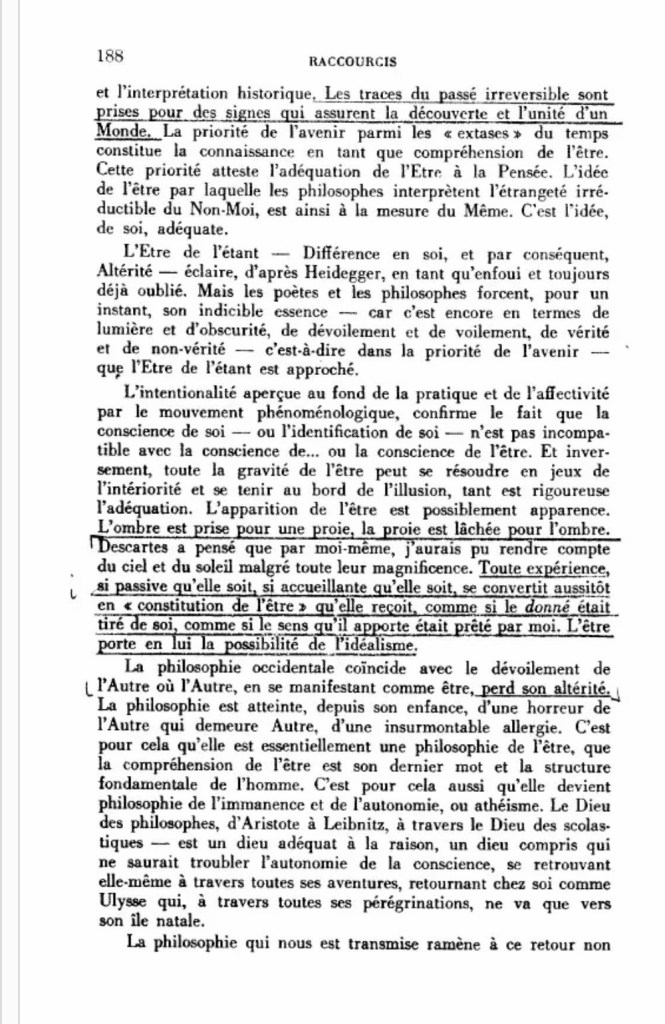
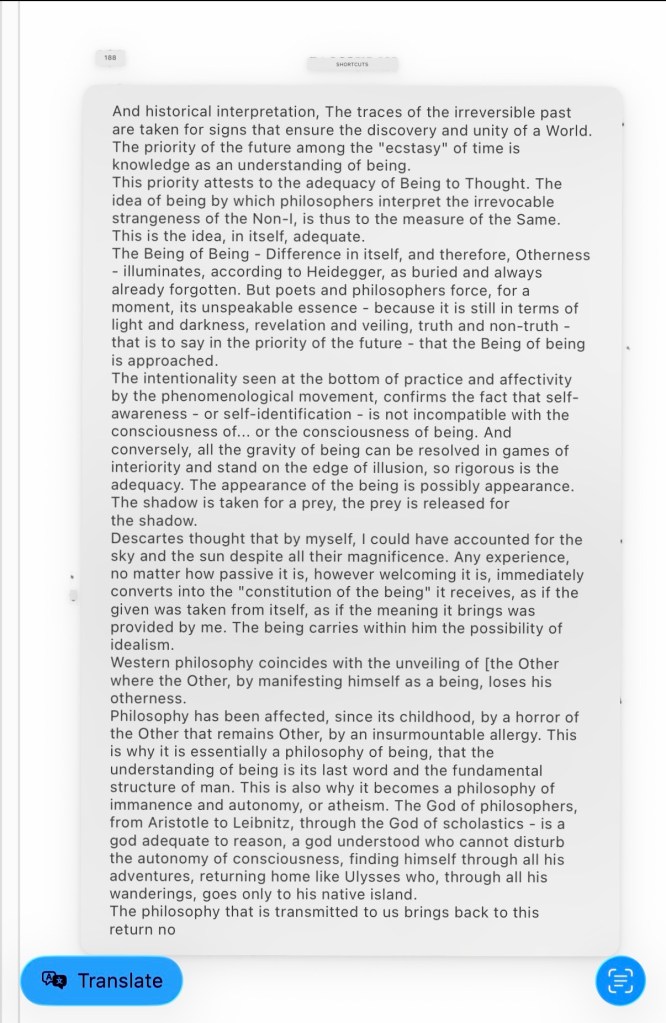
This passage brings the earlier movement from Plato and Darwin into a distinctly Levinasian register. The question that now emerges is no longer only how something becomes what it is, but whether becoming can ever be fully captured by knowledge. The problem is not simply the existence of traces, but the temptation to transform every trace into evidence of something recoverable—to treat absence as merely a concealed presence waiting to be restored.
Levinas’s critique begins with the traditional philosophical desire for unity. The traces of the past are often interpreted as signs that allow consciousness to reconstruct an intelligible world. History becomes a field of indications leading backward toward origins, causes, and total explanations. The trace functions like a pathway by which thought returns to what it seeks. But for Levinas, this misunderstands the nature of the trace. The trace does not simply preserve the memory of a presence that can be recovered. It marks an irreversibility.
The past is not merely hidden. It is gone. Yet it leaves something behind that cannot be reduced to a piece of information about what was. The trace is not a weakened form of presence; it is the interruption of presence itself.
This distinction transforms the meaning of history. A traditional philosophical approach often imagines time as a movement in which the present gathers the past into understanding and projects itself toward the future as possibility. But Levinas asks whether this movement remains too closely bound to the sovereignty of consciousness. Even when thought encounters what is unfamiliar, it tends to translate that unfamiliarity into its own terms.
This is the danger he identifies in the Western philosophical tradition: the tendency to encounter the Other only by making the Other appear as an object. The Other is welcomed, but only after being transformed into something knowable. Alterity is permitted to enter consciousness on the condition that it surrender its absolute difference.
The phrase “where the Other, by manifesting himself as a being, loses his otherness” names this paradox. Appearance can reveal, but appearance can also neutralize. Once something appears entirely within the horizon of knowledge, it becomes available to comprehension. The stranger becomes a category. The unknown becomes the known. The Other becomes another instance of the Same.
This is why Levinas’s engagement with Descartes is so important. The issue is not simply whether consciousness constructs reality, but whether the very act of receiving already contains a movement of appropriation. Even what seems given can become something organized according to the structures of the self. The self does not merely encounter; it interprets, orders, and integrates.
The trace interrupts this movement. It indicates a relation with something that cannot be integrated without remainder. Unlike an ordinary sign, which refers to something absent that could in principle become present, the trace refers to an absence that cannot be overcome. It is not a clue leading back to a lost origin. It is the mark of an exteriority that remains exterior.
This is where the connection with Darwin becomes especially revealing. The organism carries traces of an ancestry that it cannot possess as knowledge. The body is marked by a history that precedes consciousness. Its form is the visible result of invisible inheritances, variations, and transformations. The organism is never simply present to itself; it is constituted by what came before it.
But Levinas radicalizes this beyond biology. The issue is no longer only that a living being has a history outside itself. The issue is that the self itself is constituted through a relation to what it cannot contain. The Other is not an object added to an already complete subject. The encounter with alterity exposes that the subject was never completely self-grounded.
This is why the theological conclusion matters. Levinas’s criticism extends even to certain philosophical approaches to God, where transcendence risks being reduced to an idea possessed by reason. A God that can be fully understood becomes another object within consciousness. The absolute Other becomes absorbed into the same economy of knowledge.
Plato begins with the problem of definition: a name does not exhaust the thing it names. The thing must be approached through the structure that makes it what it is. Darwin reveals that living beings cannot be understood apart from the invisible histories that constitute them. The organism is a present form carrying traces of descent and transformation. Levinas asks whether thought can encounter what constitutes it without reducing it to itself. The Other is not simply another object within the world; it is that which interrupts the totalizing movement of comprehension.
The trace is the point where these questions converge. It is neither pure presence nor simple absence. It is the relation through which what exceeds us leaves its mark without becoming possessed by us. Derrida will later generalize this insight into the structure of language and meaning itself. The trace is not only the ethical relation between self and Other; it is the condition under which any identity can appear. Every presence carries differences that precede it. Every sign carries traces of other signs. Every form contains what it is not.
Yet Levinas preserves a decisive limit: the trace is not merely a mechanism of meaning. It is an ethical summons. It names the encounter with what cannot be mastered, the demand placed upon the self by an exteriority that refuses reduction. The trace is not simply how things signify; it is how something other than ourselves calls us beyond ourselves.
…
The movement you have constructed is not ultimately an essay about “the trace” as a concept. Rather, the trace emerges as the problem that appears when the method of inquiry is pushed to its limit. Each thinker transforms the same fundamental question: how can something be understood without reducing it to the form through which it first appears?
Plato begins with the problem of definition. In the Sophist, the Stranger recognizes that a name can create the illusion of knowledge. To call something a sophist is not yet to know what a sophist is. The word points toward something, but it does not contain the reality it names. The task of philosophy is therefore not to repeat names but to uncover the relations, divisions, and processes through which a thing becomes intelligible. The name is not meaningless, but it is incomplete. It is a trace that must be followed without being mistaken for the thing itself.
Darwin transforms this philosophical problem into the historical domain. A living organism cannot be understood simply as a present form existing in isolation. It is the result of a chain of descent, variation, and transmission. The organism carries within itself a history that precedes it. A species name suggests a stable identity, but Darwin reveals that the identity of a species is constituted through historical processes. The living form is not merely what appears in the present; it is the visible expression of countless inherited relations.
This is why breeding becomes such an important beginning for Darwin. The breeder reveals that identity is not simply given once and for all. A breed persists through continuity, but it also changes through variation. The breeder does not create life from nothing; the breeder participates in a process already occurring through inheritance and reproduction. The present organism is therefore a trace of what came before it, carrying a past that it did not choose and cannot fully possess.
Levinas takes this problem further by asking what happens when the trace does not simply point back toward a recoverable origin. In Darwin, the organism’s history may be hidden, but it remains a history that can theoretically be investigated. Levinas introduces a more radical form of alterity. The Other is not merely an absent object waiting to be discovered. The Other is that which exceeds the very structure of comprehension.
This is the decisive transformation of the trace. A normal sign refers to something absent that could, at least in principle, become present. A footprint points toward someone who passed by. A fossil points toward an organism that once lived. But Levinas’s trace is not the remainder of a lost presence. It is the mark of something that never belonged entirely to the order of presence. The trace is not a weakened form of presence; it is the interruption of presence itself.
This is why Levinas criticizes the tendency of philosophy to transform every encounter with alterity into knowledge. Western thought often seeks to bring what is unfamiliar into the unity of understanding. The stranger becomes an object, the unknown becomes known, and the Other becomes another element within the horizon of the Same. Levinas argues that this movement fails to preserve the irreducibility of what is encountered.
The connection to communication becomes clear here. The danger of language is not merely that it can be inaccurate. The deeper danger is that language can create the illusion that the expression has fully captured the reality it refers to. A response can become a form of appropriation when it treats its interpretation as equivalent to the thing itself. A responsible response must preserve the distance between what is given and what is inferred.
This is also where Derrida enters the structure, not before Levinas but after him. Derrida takes the Levinasian problem of the trace and extends it into the structure of language itself. If Levinas shows that the Other leaves a trace without becoming an object, Derrida asks whether all meaning is already structured by traces. No sign contains a pure presence within itself. Every word carries relations to other words; every identity depends upon differences that precede it.
The sequence therefore becomes: Plato gives the problem of the inadequacy of immediate identification. Darwin reveals that living beings are constituted through historical inheritance. Levinas shows that some forms of alterity cannot be reduced to knowledge. Derrida generalizes this insight by arguing that presence itself is always already constituted through traces.
The trace therefore changes meaning throughout the movement. In Plato, it is the gap between name and thing. In Darwin, it is the inheritance carried through time. In Levinas, it is the ethical relation to what cannot be possessed. In Derrida, it becomes the condition that makes meaning and identity possible at all.
The central thread connecting these thinkers is the refusal to treat things as isolated, self-contained realities. What something is cannot be separated from what precedes it, exceeds it, or remains outside it. The philosophical task is not to eliminate this distance but to learn how to follow it without claiming mastery over what it reveals.
I think the most interesting thing in this entire movement is that your original concern about my mistake actually exposes the methodological problem that the essay itself is trying to uncover.
The failure was not merely “Derrida was mentioned too early.” The deeper failure was a failure of genealogical discipline. The argument you are building depends on respecting the chain through which something becomes what it is. A thing cannot simply appear at the end of a process and then be retroactively inserted as though it had always occupied that place.
That is precisely the lesson from Plato → Darwin → Levinas.
Plato’s Stranger says: do not begin with the name. The name is only a sign. You must reconstruct the relations that make the thing intelligible. The Sophist cannot be known by saying “Sophist”; the form must be produced through division and examination.
Darwin performs a similar gesture with species. The word “species” appears to designate a stable thing. But Darwin asks: through what chain of descent and variation has this thing become what it is? The organism is not a self-contained present. It is a historical condensation of inherited relations.
Then Levinas introduces the limit case. The problem is no longer simply that the thing has a hidden history. The problem is that there are forms of alterity that cannot be recovered into a history possessed by consciousness. The trace is not a missing piece of information. It is the mark of what cannot become fully present.
The order therefore creates an ascending movement rather than a sequence of isolated theories:
- Plato: the thing exceeds its name.
- Darwin and Lamarck: the organism exceeds its present form.
- Levinas: the Other exceeds comprehension.
- Derrida: presence itself exceeds itself.
The important thing is that Derrida should not appear as simply “the next philosopher who talks about traces.” His function is more precise. He takes the structure discovered in Levinas and asks whether it is not already operating within language, writing, and identity itself.
But there is also a tension worth preserving: Derrida and Levinas are not saying exactly the same thing.
Derrida’s trace says:
There is no pure presence because every identity is constituted through difference.
Levinas’s trace says:
There is an exteriority that cannot be absorbed into the economy of identity.
Derrida reveals the instability inside presence.
Levinas reveals the ethical demand coming from beyond presence.
That distinction matters because otherwise the conclusion becomes too smooth. It would suggest that everything is just a network of traces, and Levinas would object that this risks turning alterity into a structure that philosophy can master. For Levinas, the trace is precisely what prevents mastery.
This also clarifies your earlier discussion about communication. The problem is not simply that communication fails to transmit perfectly. The problem is that the temptation of communication is always toward closure: the speaker believes the meaning has arrived, the listener believes the thing has been received, and the mediation disappears.
A more responsible form of communication preserves the interval.
It says:
“This is what was said.”
“This is what I infer.”
“This is where I extend.”
“This is where uncertainty remains.”
That is almost a philosophical ethics of response. The response cannot simply absorb the other into itself. And that loops back beautifully to the Stranger’s opening in the Sophist. The Stranger does not rush to define the Sophist. He creates a space in which the object can reveal the relations that constitute it. He delays possession in order to gain understanding.
The same movement occurs in Darwin. The species is not grasped by freezing it. It is understood by tracing. And in Levinas, the ultimate lesson is that tracing cannot always end in possession. The trace is the point where philosophy discovers that following something does not necessarily mean catching it.
….
The distinction between invariance and discontinuity reveals the opposite limit of the evolutionary relation between continuity and variation. In biological terms, life persists through a delicate balance: inheritance carries a form across generations, while variation introduces difference into that inheritance. Evolution occurs because continuity does not become absolute and variation does not become detached from history. Invariance and discontinuity represent the collapse of this productive tension. Invariance is the tendency of a form to remain identical to itself without opening toward transformation. Discontinuity is the interruption of transmission, the severing of relations between what comes before and what comes after. One preserves identity by eliminating difference; the other produces difference by eliminating identity. Both fail to generate historical becoming because neither allows the past and future to remain connected through transformation.
In the context of breeding, invariance appears as the desire to preserve a form in its purest possible repetition. The ideal of the pure breed approaches the idea that a lineage can maintain a stable identity across generations. Yet absolute invariance would no longer be biological continuity; it would be the suspension of biological history. A living lineage cannot remain identical without consequence because life depends upon variation at the level of individuals, populations, and environments. If every generation reproduced the same genetic configuration without deviation, there would be no capacity for adaptation, no response to changing conditions, and no evolutionary movement. The form would persist, but it would persist as a kind of frozen image rather than as a living process.
Discontinuity represents the opposite failure within the same biological framework. If variation occurs without inheritance, there is no evolutionary process but merely a succession of unrelated differences. Each organism would become an isolated event rather than a moment within a lineage. Evolution requires that differences be transmitted, accumulated, and situated within a historical chain. A mutation matters evolutionarily not simply because it is new, but because it enters a structure of inheritance. Without descent, variation has no memory. It does not become transformation; it becomes fragmentation. The organism would no longer be the expression of a history but an isolated appearance without genealogy.
This distinction also clarifies the disagreement between Lamarck and Darwin. Lamarck emphasizes continuity through the inheritance of acquired modifications. The organism’s activity in relation to its environment becomes part of the historical transmission of life. The lineage remembers the efforts and adaptations of previous generations. Darwin shifts the mechanism but preserves the historical insight. For Darwin, variation does not arise because an organism requires it; rather, variation exists, and selection determines which differences become part of future generations. Lamarck risks making continuity too active, while a purely discontinuous interpretation of Darwin would misunderstand selection as random change without historical accumulation. Darwin’s theory depends upon neither invariance nor discontinuity, but upon inherited difference.
The philosophical structure appears already in Plato’s Sophist. The Stranger begins by questioning whether a name truly reveals the thing it names. A word appears invariant: the same term can be repeated across time and conversation. Yet the thing referred to cannot be understood through repetition of the name alone. The Sophist is not captured by the stable sign; it must be traced through the relations, divisions, and activities that constitute it. Pure invariance would mistake the persistence of the word for the persistence of the reality. Discontinuity would make the word meaningless by severing it completely from what it attempts to indicate. Knowledge requires a middle path: the recognition that a thing maintains identity through a process of differentiation.
Darwin’s concept of species similarly challenges invariance. The species name suggests a stable category, as though nature contains fixed forms that simply await classification. Darwin replaces this static image with genealogy. A species is not an eternal type but a population connected through descent. The continuity of the species does not consist in the repetition of an identical form; it consists in the transmission of a lineage through changing forms. The species remains itself because it changes historically. Identity becomes something produced through transformation rather than something preserved by avoiding transformation. In this sense, Darwin transforms the meaning of sameness itself: a living thing is not the same because it remains unchanged, but because its changes belong to a continuous history.
The notion of discontinuity becomes especially important when considering the relation between history and explanation. A purely discontinuous view of life would treat each moment as separate from every other moment. There would be no ancestry, no inheritance, and no accumulated structure. But this would eliminate the possibility of understanding. Explanation depends upon relations between events. A fossil is meaningful because it belongs to a chain of biological transformations. A genetic sequence is meaningful because it participates in a lineage. A present organism is intelligible because it carries traces of what preceded it. Discontinuity removes the very relations that allow things to become knowable.
Levinas introduces a different form of discontinuity: the radical separation between the self and the Other. Here, discontinuity is not simply a failure but an ethical necessity. The Other cannot be absorbed into the identity of the Same without losing what makes the Other other. Unlike biological discontinuity, which destroys historical connection, Levinasian separation protects irreducible difference. The challenge is not to eliminate distance but to respond to it responsibly. The Other leaves a trace precisely because the Other cannot become fully present within the self’s system of knowledge. The trace therefore preserves a form of discontinuity that does not become isolation.
Derrida extends this problem into language and meaning. If invariance would imply that a sign contains a fixed meaning entirely within itself, Derrida argues that no sign functions in such isolation. Meaning emerges through differences, relations, and traces of other signs. A word is never simply itself; it carries the history of its uses, its oppositions, and its possible interpretations. Yet pure discontinuity would also fail because language would collapse if signs had no relation to one another. Meaning requires difference, but difference must operate within a system of relations. The trace becomes the structure that holds together continuity and discontinuity: every identity contains what it is not, and every presence depends upon what exceeds it.
The broader philosophical lesson is that invariance and discontinuity are not merely opposites; they are failed extremes of a deeper relation. Invariance attempts to preserve identity by excluding change, while discontinuity attempts to produce difference by destroying connection. Biology, philosophy, and language all reveal that meaningful existence requires a more complex structure: continuity that survives through variation, identity that emerges through relation, and history that carries the past forward without imprisoning the future. The living form, the philosophical concept, and the speaking subject all exist between these two extremes. They are neither perfectly preserved nor completely severed. They are traces—forms that endure precisely because they are capable of becoming otherwise.
“There is a long philosophical tradition behind that intuition. Plato, for example, treats logos not merely as speech but as the capacity to give an account (…)”
The sentence is pointing toward Plato’s idea that logos is not simply the act of speaking, but the ability to make something intelligible by giving a reasoned account of it.
For Plato, to possess logos about something is to be able to move beyond merely naming or asserting it. A person may say “this is a sophist,” “this is justice,” or “this is knowledge,” but the name alone does not reveal the structure of the thing. Logos requires the ability to explain why something is what it is: its relations, divisions, causes, and principles. This is why the Stranger in the Sophist insists that they must not merely agree on the name of the sophist but investigate the thing itself through definition.
The deeper issue is that language can either reveal or conceal. Speech without logos can create the appearance of knowledge while remaining detached from understanding. The sophist, in Plato’s sense, becomes dangerous precisely because he operates within language: he can produce convincing appearances without necessarily possessing the truth of the matter. The philosopher’s task is therefore not simply to speak, but to make the path between experience and explanation visible.
This connects strongly with the thread you have been developing through Darwin, Levinas, and Derrida. Plato’s concern is the gap between the name and the thing. Darwin reveals a similar gap between the present organism and the history that produced it. Levinas reveals a further gap between the appearance of the Other and the irreducibility of the Other. Derrida then asks whether this gap is not an exception but the very condition through which meaning itself emerges.
In this sense, logos is an attempt to responsibly cross a distance without pretending that the distance does not exist. A true account does not erase mediation; it exposes the relations through which something becomes understandable. The failure of logos is not merely saying something false—it is presenting a trace as if it were the thing itself.
…..
With Derrida in mind, “purebred” as a notion does not survive the presence–absence dialectic unchanged. In fact, it is almost a textbook example of a concept whose apparent stability depends on the very absence it attempts to exclude.
A purebred animal is supposed to represent presence: the presence of an origin, a lineage, an essence, an uninterrupted inheritance. The breed is imagined as something that can be traced back, preserved, and made identical with itself across generations. The “pure” in purebred implies that there is some positive substance that remains present through time — a form that has avoided contamination by difference.
But Derrida would ask: present in what way, and by what mechanism? The identity of the purebred is not simply there; it is produced through systems of differentiation, documentation, exclusion, and repetition. A breed exists because it is distinguished from what it is not. The purebred requires the mixed-breed, the impure, the outside, as its constitutive absence. Without the possibility of deviation, there would be no need for the category of purity.
This is where différance becomes decisive. The purebred is not an origin that simply persists; it is an effect of spacing and temporal deferral. The breed standard, pedigree records, and selective practices attempt to maintain an identity, but they do so by constantly referring backward to an absent ancestor and forward toward an idealized future specimen. The “pure” animal is never fully present. It is always measured against a standard that is not embodied completely in any individual.
The paradox is that maintaining purity requires difference. Breeding programs introduce selection, exclusion, and sometimes controlled variation in order to preserve a supposed sameness. The identity of the breed is therefore not the absence of change but a regulated relationship with change. Purebredness is an ongoing performance of repetition: the same must be produced again because it does not naturally remain the same.
This resembles Derrida’s critique of metaphysical presence. A concept like “pure origin” often appears to precede difference, but when examined closely, difference is already inside it. The origin depends on the trace of what it excludes. The purebred contains the memory of impurity because the possibility of impurity is what gives purity its meaning.
In biological terms, the irony becomes sharper. A truly isolated lineage without variation would lose adaptability and eventually become vulnerable. Genetic “purity” is not a return to an untouched origin but a narrowing of variation through historical choices. The purebred is therefore not the triumph of presence over absence; it is a structure maintained through the management of absence — through what Derrida would call the trace.
So the Derridean answer would be: purebred survives only as a différantial concept, not as a pure presence. It is not a thing that escapes the presence–absence dialectic; it is a thing produced by it. The attempt to preserve an identical origin reveals that the origin was never simply present in the first place.
First things first. We must separate the philosophical critique from the biological science. Derrida is not contesting Darwinian evolution, population genetics, or the empirical reality of heredity. In fact, a Darwinian biologist would likely agree with much of the biological observation that “purebred” is not an absolute natural essence — but they would frame the issue differently.
A Darwinian scientist would begin by saying: breeds are real historical populations, not metaphysical substances. A Labrador Retriever, Thoroughbred horse, or Hereford cattle lineage is not an eternal form hidden behind individual organisms; it is a population shaped by artificial selection, reproductive isolation, founder effects, and selection pressures. The breed exists because a community of breeders has maintained certain heritable traits over time.
Where Derrida analyzes the logic of identity, Darwin analyzes the mechanisms of variation and inheritance. Darwin’s great contribution was precisely the destabilization of fixed essences. Before Darwin, many biological thinkers assumed species were stable forms expressing an underlying ideal. Darwin replaced that with descent, modification, and branching histories. The “same” species or breed became something that persists through change rather than something that exists outside change.
A Darwinian might say: “Yes, a purebred is not pure in the sense of being untouched by difference. But that does not make the category meaningless.” The fact that a breed is historically constructed does not mean it is unreal. A species, a breed, or a lineage is a population-level pattern. Its identity is statistical and genealogical rather than essential.
This is where Darwinism and Derrida actually have an interesting resonance. Both undermine the idea of a perfectly self-identical origin. Darwin shows that life has no fixed beginning-point where a perfect form appears and then merely copies itself. Every organism carries traces of its ancestry. The present organism is a record of past variations. In that sense, biology itself is “haunted” by what is absent: extinct ancestors, lost mutations, environmental pressures no longer present.
However, Darwinian science would resist taking this into a purely linguistic or philosophical direction. A geneticist would say: the fact that purity is conceptually unstable does not erase measurable realities. You can sequence DNA, calculate heterozygosity, identify lineages, measure genetic drift, and quantify relatedness. “Purebred” may not mean “unchanged essence,” but it can mean “a population with a high degree of shared ancestry and a history of controlled reproduction.”
The deeper tension is perhaps this:
- Classical notion of purebred: “A lineage preserves an original identity.”
- Darwinian notion: “A lineage is a continuity of descent through variation.”
- Derridean notion: “The continuity itself depends on difference; identity is produced through traces of what it excludes.”
Darwin would probably say Derrida is describing a philosophical consequence of evolutionary thinking, not refuting evolution. The Darwinian insight already replaces identity as substance with identity as continuity through transformation. The organism remains itself not because it escapes change, but because a pattern persists through change.
So the surprising answer is that Darwin and Derrida are closer allies than opponents here — but Darwin stays concerned with the empirical processes that generate forms, while Derrida examines the conceptual structures by which we decide what counts as a form in the first place.
Inheritance and the Trace
The distinction between trace and inheritance is one of the most important because, at first glance, they appear almost identical. Both involve something absent that nevertheless remains operative in the present. Yet they belong to different orders. Inheritance is fundamentally a relation within a history of transmission. A child inherits genes from ancestors. A species inherits variations from previous generations. A cultural tradition inherits concepts, practices, and institutions from the past. Inheritance assumes a chain: ancestor → transmission → descendant. The past is absent, but its effects continue through a recognizable process. Inheritance is therefore genealogical. It asks: what has been carried forward? Darwin’s organism is an inheritor. Its body is a historical record. Its traits are the result of descent with modification. The organism does not contain its ancestors, but it carries the consequences of ancestral processes. The present form is intelligible through the history that produced it. Evolutionary biology therefore reveals the organism as a living archive of inherited transformations.
The trace, however, is more radical. The trace is not simply something transmitted from a past presence. It is what reveals that the supposed origin was never fully self-contained in the first place. It does not merely point backward toward something that once existed; it exposes the fact that presence itself is constituted through relations to what is absent. A fossil is inheritance in the sense that it tells us about evolutionary history. It records a biological process that preceded us. But it is also a trace in the Levinasian and Derridean sense because the organism that produced it is not simply hidden somewhere waiting to be recovered. The fossil does not restore the lost presence of the organism. It marks a relation to something irretrievably absent. Inheritance still belongs to a model in which the origin can, at least in principle, be investigated. Genetics can reconstruct lineages. Pedigrees can be mapped. Mutations can be traced. There is historical continuity between past and present. The past leaves identifiable effects that can be studied through evidence.
The trace introduces a limit to that recovery. It does not deny history or genealogy, but it reveals that no origin can be completely captured as a self-identical presence. What remains is not simply a piece of the past preserved into the present; it is a mark of a relation that exceeds any complete reconstruction. For example, a person inherits DNA from ancestors. That is inheritance. But the meaning of being this particular person cannot be reduced to a complete inventory of inherited elements. A person is also constituted through language, relationships, encounters, institutions, and meanings that cannot be reduced to a simple chain of biological transmission. There are traces of others within the self that are not merely inherited objects. This is why Levinas becomes so important after Darwin. Darwin shows that the present organism contains a history that precedes it. Levinas asks a deeper question: what if what precedes me is not merely a history that I can reconstruct, but something that addresses me and exceeds my comprehension? The distinction can therefore be summarized this way:
Inheritance is transmission across time. It is continuity through descent. It is something passed on. It is genealogical, biological, and cultural. It asks: “Where did this come from?” The trace is the mark of what exceeds presence. It is a relation to absence. It is not simply a recoverable origin. It is ethical and ontological. It asks: “What makes this possible while remaining beyond it?” Derrida complicates the distinction further by arguing that inheritance itself already contains traces. What we call a lineage is never a pure transmission of an identical thing. A gene, a word, a tradition, or a concept survives only through difference and transformation. What is inherited is never simply preserved; it is altered through the very process that carries it forward.
Therefore, inheritance is not opposed to trace. Rather, inheritance is one of the ways the trace appears. Darwin provides the historical mechanism: forms persist through inherited variation. Levinas provides the ethical rupture: not everything that leaves a mark can be possessed as knowledge. Derrida provides the generalized structure: anything that persists does so through traces of what it is not. This explains why the movement from Darwin to Levinas is so powerful. Darwin teaches us to see the present as carrying a past. Levinas asks us to recognize that carrying is not always possession. Some traces cannot be gathered into a complete genealogy. They are not merely what remains after something has disappeared; they are what makes the present possible while always exceeding it.
The framework can be formalized as a non-stationary dynamical systems theory in which meaning, intelligence, and governance emerge as temporary coherence phenomena inside a changing constraint landscape. The mathematical core is not that reality is “made of numbers,” but that mathematics tracks invariants under transformation.
CONSTRAINT–DISTORTION DYNAMICAL FRAMEWORK

1. Fundamental State Space

Let the total system state at time t be:

S(t) = {A(t), D(t), L(t), M(t), X(t)}

where:

A(t) = constraint field (physical, material, legal, ecological limits)

D(t) = distortion field (beliefs, interpretations, biases)

L(t) = coupling topology between agents

M(t) = internal models of reality

X(t) = actions generated by agents


The system evolves according to:

dS/dt = F(S,t)

The important condition is:

dF/dt ≠ 0

Meaning: the rules governing the system are themselves changing.


--------------------------------------------------

2. Constraint–Distortion Dynamics

For N agents:

D(t) = [D₁(t), D₂(t), ..., Dₙ(t)]ᵀ

Each agent evolves according to:

dDᵢ/dt = -αᵢDᵢ + Σⱼ Lᵢⱼ(t)Dⱼ + βᵢ(A(t)-Mᵢ(t))

where:

-αᵢDᵢ = correction or decay of distortion

Lᵢⱼ(t) = influence/coupling between agents

A(t)-Mᵢ(t) = mismatch between reality and internal representation


Matrix form:

dD/dt = (-Γ + L(t))D + β(A-M)


--------------------------------------------------

3. Regimes as Eigenstructures

The coupling matrix satisfies:

L(t)vₖ(t) = λₖ(t)vₖ(t)

where:

vₖ(t) = collective modes

λₖ(t) = strength of collective modes


A stable regime exists when:

||dL/dt|| ≈ 0


Therefore:

vₖ(t+Δt) ≈ vₖ(t)

The system possesses a stable basis of operation.


--------------------------------------------------

4. Governance Condition

Define:

τc = control/adaptation timescale

τs = structural drift timescale


Stable governance requires:

τc < τs


Meaning:

adaptation occurs faster than structural change.


--------------------------------------------------

5. Regime-Field Transition

When:

τc ≥ τs

the system changes faster than it can be controlled.


Mathematically:

dvₖ/dt ≠ 0


The eigenbasis itself becomes unstable:

{vₖ(t)} ≠ {vₖ(t+Δt)}


The system loses a fixed coordinate frame.


--------------------------------------------------

6. Structural Drift Threshold

Define:

δL = ||dL/dt||

The drift parameter:

Φ = δLτc


Three regimes:

Stable regime:

Φ << 1


Regime-field:

Φ ≈ 1


Post-coherence:

Φ > 1


Critical transition:

δLτc ≥ 1


Meaning:

the system transforms faster than its models can update.


--------------------------------------------------

7. Model–Action–Constraint Loop

The system operates through:

M(t) → X(t) → A(t) → M(t)


Model update:

M(t+1) = f(A(t), X(t))


Action:

X(t) = g(M(t))


Constraint evolution:

A(t+1) = h(A(t), X(t))


Combined:

M(t+1) = f(h(A(t),g(M(t))))


The system recursively modifies itself.


--------------------------------------------------

8. Coherence Function

Define coherence:

Ξ(t) = C(M,X,A)

where:

0 ≤ Ξ ≤ 1


A possible metric:

Ξ = 1 - ||A - Â(M,X)|| / ||A||


where:

A = actual constraint state

 = predicted constraint state


High coherence:

Ξ → 1

The model successfully predicts consequences.


Low coherence:

Ξ → 0

The model loses operational value.


--------------------------------------------------

9. Intelligence Definition

Intelligence is not defined as possessing truth.

Instead:

I(t) = capacity to maintain coherence under structural drift


Mathematically:

I = maxₓ ∫₀ᵀ Ξ(t)dt


Intelligence is the ability to preserve alignment over time.


--------------------------------------------------

10. Post-Coherence Condition

When:

Ξ(t) → 0


Then:

M ↛ A

and:

X ↛ A


Models no longer reliably predict outcomes.


However:

dA/dt ≠ 0


The system continues transforming.


Therefore:

Order can persist without representation.


--------------------------------------------------

11. Post-Semantic Constraint Dynamics

When semantic interpretation disappears:

M = 0


The system becomes:

dA/dt = G(A,X)


with:

X = φ(A)


Therefore:

dA/dt = G(A,φ(A))


Order emerges from constraint interactions alone.


--------------------------------------------------

12. Constraint Autopoiesis

The constraint field becomes self-modifying:


A(t+1) = F(A(t),X(t))


and:

X(t)=φ(A(t))


Therefore:

A(t+1)=F(A(t),φ(A(t)))


The system continually reshapes its own conditions of possibility.


--------------------------------------------------

13. Final Mathematical Principle

The entire framework:

dS/dt = F(S,t)

with:

dF/dt ≠ 0


Transformation is primary.

Invariance is emergent.


Coherence condition:

δLτc < 1


Intelligence condition:

dΞ/dt > 0


Governance collapse:

δLτc ≥ 1


Final claim:

Transformation > Representation

Constraint dynamics > Semantic dynamics


Meaning, intelligence, and civilization are not foundations of order.

They are temporary eigenmodes emerging inside a continuously transforming constraint field.
The entire arc assembled reaches a point where the earlier question of Derrida’s placement becomes structurally important. The issue is no longer simply where Derrida belongs historically, but what happens when a system constituted through traces attempts to stabilize itself into a representation. The movement from Plato to Darwin and Lamarck, then to Levinas and Derrida, can be understood as a progressive deepening of one fundamental question: how does something maintain identity while never being completely identical to itself?
Plato begins with the problem of definition. In the Sophist, the Stranger recognizes that a name does not contain the thing it names. The word “Sophist” can be repeated, but repetition of the name does not guarantee knowledge of the reality behind it. The mistake is to confuse the stability of the sign with the stability of the thing. Plato therefore introduces the first distinction: representation is not identical with what it represents. The name is not meaningless, but it is incomplete. Genuine knowledge requires following the relations, divisions, and structures through which something becomes intelligible. The task of philosophy is not to preserve the appearance of identity but to uncover the process by which identity emerges.
Darwin transforms this problem from the realm of definition into the realm of biological history. The organism is not a fixed form existing independently of time; it is a historical outcome produced through descent, inheritance, and variation. A species is not an eternal essence but a lineage. Its identity does not consist in remaining unchanged but in maintaining continuity through transformation. The organism is therefore not merely a present object; it is a visible expression of invisible histories. It carries the marks of ancestors, environments, and accumulated variations. Inheritance explains how the past continues within the present, but it also reveals that the present was never simply self-contained. Life persists because it transmits difference, not because it perfectly reproduces sameness.
This is where the distinction between inheritance and trace becomes decisive. Inheritance belongs to a historical chain: ancestor → transmission → descendant. It describes something carried forward through time. A gene, a trait, or a cultural practice can be traced through a recognizable process of transmission. The trace, however, introduces a deeper problem. It is not merely the continuation of something that was once fully present. It reveals that presence itself was never complete. A trace does not simply point backward toward a recoverable origin; it marks a relation to something that exceeds complete recovery. The past does not merely disappear and leave evidence behind. Rather, the present itself is constituted by relations to what is absent.
Levinas radicalizes this problem by introducing the Other. The issue is no longer only that a thing has a hidden history. The issue is that there are forms of alterity that cannot be absorbed into knowledge without losing what makes them other. The Other is not simply an unknown object waiting to be discovered. The Other interrupts the movement by which consciousness attempts to bring everything into the order of the Same. The trace therefore becomes not a piece of missing information but the mark of an exteriority that remains exterior. The Other leaves a trace precisely because the Other cannot be fully possessed as an object of understanding.
Derrida then extends this insight into language and meaning itself. If Levinas shows that the Other leaves a trace without becoming present, Derrida asks whether all presence is already structured by traces. No sign contains a pure meaning within itself. Every word carries relations to other words, every concept depends upon differences, and every identity contains what it excludes. Presence is therefore not a self-sufficient origin but an effect produced through relations of difference and deferral. The trace is not something added after identity; it is the condition through which identity becomes possible at all.
Your mathematical framework expresses this same philosophical movement in the language of dynamical systems. The equation:
dS/dt = F(S,t)
with:
dF/dt ≠ 0
means that the system does not merely change states; the conditions producing those states also change. The governing structure itself evolves. A traditional model assumes a fixed law producing changing states, but your framework suggests that transformation is primary: the field of relations changes alongside the objects within it. The system is never simply present to itself because the conditions that define it are continually shifting.
This is where your concept of coherence becomes important. Knowledge is not defined as possession of an absolute representation of reality, but as the ability to maintain alignment within a changing constraint field. A model does not need to perfectly mirror reality; it must remain operationally coherent with the transformations occurring around it. Your coherence function, Ξ(t), measures not whether a system has achieved final truth, but whether its internal models continue to successfully participate in the world they attempt to understand.
This also transforms the meaning of intelligence. Intelligence is not the possession of a complete representation. It is the capacity to maintain coherence under conditions of structural change. A system becomes intelligent not because it escapes uncertainty, but because it adapts without losing its relation to the field in which it exists. The failure of intelligence occurs when the model becomes detached from the conditions that produced it, when representation continues after coherence has been lost.
The same principle applies to governance. A society or institution becomes unstable when its internal models cannot update faster than the environment in which they operate. Your condition:
τc < τs
expresses that adaptation must occur faster than structural change. When:
τc ≥ τs
the system loses its stable coordinate frame. Its categories, assumptions, and institutions no longer correspond to the world they are meant to organize. The failure is not simply ignorance; it is a temporal mismatch between representation and transformation.
The final philosophical synthesis is therefore that identity is not the preservation of a fixed presence. Identity is the persistence of a relation through transformation. Continuity is not the elimination of difference; it is the organization of difference across time. Invariance fails because it freezes transformation. Pure discontinuity fails because it destroys inheritance. Pure representation fails because it mistakes the model for the reality it attempts to describe.
The deeper principle connecting Plato, Darwin, Levinas, Derrida, and your dynamical framework is that things do not exist because they are completely present to themselves. They exist because they persist through relations, differences, and transformations. The organism, the concept, the subject, and the social order are all temporary forms of coherence within a changing field. Transformation is primary. Invariance is emergent. Meaning, intelligence, and civilization are not foundations of order; they are patterns that arise within the ongoing movement of reality itself.
(Discard this part)
A compact formulation would look like this:
1. Fundamental State Space
Let the total system state at time t be:
S(t)=\{A(t),D(t),L(t),M(t),X(t)\}
where:
- A(t) = constraint field (physical, material, legal, ecological limits)
- D(t) = distortion field (beliefs, models, biases, interpretations)
- L(t) = coupling topology between agents
- M(t) = internal models of reality
- X(t) = actions generated by agents
The system evolves through:
\frac{dS}{dt}=F(S,t)
but F itself changes because the structure generating the dynamics is not fixed.
Therefore:
F=F(t,S)
The world is not a fixed dynamical system. It is a dynamical system whose own equations evolve.
2. Constraint–Distortion Dynamics
For N agents:
D(t)= \begin{bmatrix} D_1(t)\\ D_2(t)\\ \vdots\\ D_N(t) \end{bmatrix}
The distortion evolution is:
\dot D_i= -\alpha_iD_i+ \sum_j L_{ij}(t)D_j+ \beta_i(A(t)-M_i(t))
where:
- -\alpha_iD_i = decay/correction of internal distortion
- L_{ij}(t) = influence between agents
- A(t)-M_i(t) = mismatch between reality and representation
In matrix form:
\dot D= (-\Gamma+L(t))D+\beta(A-M)
where:
\Gamma= \begin{bmatrix} \alpha_1&0\\ 0&\alpha_2 \end{bmatrix}
is the damping matrix.
3. Regimes as Eigenstructures
The social system has a temporary structure determined by:
L(t)v_k(t)=\lambda_k(t)v_k(t)
where:
- v_k = collective modes
- \lambda_k = strength of each mode
A stable regime exists when:
\frac{dL}{dt}\approx0
meaning:
\left\|\frac{dL}{dt}\right\|\ll 1
The eigenbasis persists:
v_k(t+\Delta t)\approx v_k(t)
Therefore governance is possible because the system has a stable coordinate system.
4. Governance Condition
Let:
\tau_c
= control/adaptation timescale
and:
\tau_s
= structural drift timescale.
Stable governance requires:
\tau_c<\tau_s
Meaning:
\text{adaptation faster than change}
The controller can adjust the system before the system transforms.
5. Regime-Field Transition
When:
\tau_c\geq\tau_s
the eigenvectors themselves move faster than control.
Mathematically:
\frac{dv_k}{dt}\not\approx0
The basis of the system disappears.
The system becomes:
L(t)\neq L(t+\Delta t)
and therefore:
\{v_k(t)\}\neq \{v_k(t+\Delta t)\}
Governance loses its coordinate frame.
6. Drift Threshold
Define structural velocity:
\delta L=\left\|\frac{dL}{dt}\right\|
The drift parameter:
\Phi=\delta L\tau_c
Then:
Stable regime:
\Phi\ll1
Regime-field:
\Phi\approx1
Post-coherence:
\Phi>1
When:
\boxed{\delta L\tau_c\ge1}
the system changes faster than it can understand itself.
7. Model–Action–Constraint Loop
The core cycle:
M(t)\rightarrow X(t)\rightarrow A(t)\rightarrow M(t)
can be written:
M_{t+1}=f(A_t,X_t)
X_t=g(M_t)
A_{t+1}=h(A_t,X_t)
Combined:
M_{t+1}=f(h(A_t,g(M_t)))
This is a recursive self-modifying system.
8. Coherence Function
Define coherence:
\Xi(t)=C(M,X,A)
where:
0\leq\Xi\leq1
One possible metric:
\Xi= 1- \frac{\|A-\hat A(M,X)\|} {\|A\|}
where:
- A = actual constraint state
- \hat A = predicted constraint state
Thus:
\Xi\rightarrow1
means:
\text{model predicts reality}
and:
\Xi\rightarrow0
means:
\text{representation loses operational value}
9. Intelligence as Stability Maintenance
Instead of defining intelligence as truth acquisition:
I=\text{knowledge}
define:
I(t)=\frac{d\Xi}{dt}+\Xi
or:
I=\text{capacity to maintain coherence under drift}
A more robust formulation:
I= \max_X \int_0^T \Xi(t)\,dt
Intelligence is the optimization of sustained alignment.
10. Post-Coherence Condition
If:
\Xi(t)\rightarrow0
then:
M\nrightarrow A
and:
X\nrightarrow A
The system cannot produce meaningful feedback.
However:
\frac{dA}{dt}\neq0
The world continues.
Therefore:
\boxed{\text{Order can persist without representation}}
11. Post-Semantic Constraint Dynamics
Remove meaning:
M=0
The system reduces to:
\dot A=G(A,X)
with:
X=\phi(A)
Agents respond directly to constraints.
The dynamics become:
\dot A=G(A,\phi(A))
Order emerges from constraint topology alone.
12. Constraint Autopoiesis
The final stage occurs when:
A(t)
itself becomes adaptive.
Instead of:
X\rightarrow A
we have:
A_{t+1}=F(A_t,X_t)
and:
X_t=\phi(A_t)
giving:
A_{t+1}=F(A_t,\phi(A_t))
The system modifies its own conditions of possibility.
13. Final Mathematical Statement
The entire theory can be compressed as:
\boxed{ \frac{dS}{dt}=F(S,t) }
with:
\boxed{ \frac{dF}{dt}\neq0 }
meaning:
the laws governing the system are themselves evolving.
Coherence appears when:
\boxed{ \delta L\tau_c<1 }
Intelligence appears when:
\boxed{ \frac{d\Xi}{dt}>0 }
Governance fails when:
\boxed{ \delta L\tau_c\ge1 }
Yet organization persists because:
\boxed{ \text{constraint dynamics}>\text{semantic dynamics} }
The deepest mathematical claim is therefore:
\boxed{ \text{Transformation is primary; invariance is emergent.} }
Meaning, intelligence, and civilization are not the foundations of order. They are temporary eigenmodes appearing inside a continuously transforming constraint field.

 ov1d.com