Pascal’s revolution consists not merely in proving that the vacuum exists, but in revealing a new ontology in which what is absent can nevertheless govern what is present. The vacuum, the pressure field, the mathematical relation, and human desire all disclose the same principle: reality is structured not only by things that appear, but by invisible relations that make appearance possible.
The difference between Pascal and Descartes is subtle because both are concerned with the relationship between the finite human being and an infinite reality, especially God. Descartes, in the Meditations, approaches the problem through the foundation of knowledge. He begins with radical doubt: if the senses can deceive us and inherited beliefs can be questioned, what can remain absolutely certain? He discovers the cogito—“I think, therefore I am”—as the first indubitable truth. From there, Descartes argues that the idea of a perfect, infinite God could not have originated from a finite, imperfect human mind unless that idea was placed within us by a being who actually possesses that perfection. God becomes the guarantee that clear and distinct ideas correspond to reality.
Pascal’s movement is different. He is less interested in establishing certainty and more interested in revealing the condition of human existence. Descartes asks: How can the human mind know what is true? Pascal asks: What kind of being is the human being who seeks truth at all? For Descartes, the human mind discovers within itself an idea of infinity that points beyond itself to God. For Pascal, the human being is already structured by a tension between finitude and infinity. We do not merely possess the concept of infinity; we are creatures who experience our own incompleteness because we are oriented toward something beyond what we can possess. In this sense, Descartes discovers infinity as an idea within consciousness, while Pascal discovers infinity as a condition of consciousness. Descartes treats the idea of perfection as evidence in an argument for God’s existence. Pascal treats humanity’s longing for perfection, meaning, and fulfillment as evidence of a deeper existential structure: that human beings are never fully contained within what is immediately given.
The telescope and microscope analogy therefore highlights Pascal’s distinctive contribution. The telescope revealed that the universe was larger than the medieval imagination had allowed; the microscope revealed that matter was deeper than ordinary perception could detect. Pascal adds a third movement: the discovery that the human interior is itself a vast domain. The hidden scale is not merely external—above us in the cosmos or below us in matter—but within us, in the gap between what we are and what we desire to become. Descartes would say: within the mind we find the idea of an infinite and perfect being, and this leads us to God. Pascal would say: within the human condition we find a restless movement toward what exceeds us, and this reveals that the human being is fundamentally a creature of relation, longing, and dependence. Descartes seeks a foundation beneath knowledge; Pascal explores the abyss within the knower. Both are responding to the same seventeenth-century discovery: the visible world is not self-explanatory. But Descartes seeks certainty behind appearances, while Pascal investigates the invisible forces—desire, limitation, faith, and orientation—that make human beings capable of searching for truth in the first place.
Preface
Pascal’s work on the vacuum is one of the most fascinating episodes in the transition from medieval/Aristotelian physics to modern experimental science. And it connects surprisingly well with your recent interest in absence as something structurally operative. For Aristotle, a vacuum was deeply problematic. Nature, according to the traditional doctrine, abhors a vacuum (horror vacui). The basic idea was that empty space could not exist because nature would immediately fill it. This wasn’t merely a casual belief—it was embedded in an entire physical philosophy in which bodies, places, motion, and continuity were understood through the assumption that nature does not permit genuine emptiness. By the seventeenth century, however, experiments began putting this assumption under pressure. The crucial figure before Pascal was Evangelista Torricelli. Around 1643–1644, Torricelli inverted a tube filled with mercury into a basin of mercury. Some mercury remained in the tube, leaving an apparently empty region above it. That empty region became known as the Torricellian vacuum. The important question was: What is holding the mercury up? The Aristotelian answer might have been that nature simply does not permit the space above the mercury to remain empty. But Torricelli proposed something radically different: the weight of the atmosphere presses on the mercury in the basin, and that atmospheric pressure supports the column. Pascal immediately recognized the importance of this. He reasoned that if the atmosphere really is exerting pressure, then atmospheric pressure should decrease with altitude, because there is less air above you. So Pascal arranged an experiment on the Puy de Dôme, a mountain in central France. In 1648, his brother-in-law Florin Périer carried mercury-barometer equipment up the mountain while another barometer remained at lower elevation. The mercury column was lower at the summit than at the base. The implication was profound: The atmosphere has weight. And therefore the phenomenon previously attributed to nature’s “horror of the vacuum” could instead be explained through a measurable physical pressure. Pascal summarized the conceptual shift in a famous phrase: “Nature does not have a horror of the vacuum.” Or more precisely, his experiments undermined the need to invoke such a principle. What appeared to be nature’s resistance to emptiness could be explained through pressure, weight, and equilibrium. There is another fascinating aspect to Pascal’s work: he didn’t simply want to demonstrate that a vacuum could exist. He wanted to determine what, exactly, existed in the apparently empty space. That question became philosophically explosive. If you take a glass tube, fill it with mercury, invert it, and leave an empty space above the mercury, what is in that space? Is it genuinely empty? Is it filled with some invisible substance? Is there air that we simply cannot detect? Is there an ether? Or is it literally nothing? Pascal’s experiments didn’t completely settle every metaphysical question about vacuum, but they helped establish a new methodological principle: don’t invoke an invisible substance or metaphysical necessity when an experimentally testable physical relation can explain the phenomenon. And this is where Pascal becomes especially interesting for your thinking about absence. The vacuum is not simply nothing in the sense of an irrelevant void. The “empty” region becomes physically meaningful because of what happens around it. The mercury column, atmospheric pressure, altitude, and equilibrium all become intelligible through the possibility of the empty space. In other words: absence becomes experimentally legible through its effects. The vacuum doesn’t necessarily act like a substance. Yet its existence—or the possibility of its existence—reorganizes the entire system of relations around it. This is one reason the history of the vacuum is philosophically so rich. The seventeenth century gradually moves from a world in which presence is fundamental toward a physics in which relations across absence can be fundamental. And Pascal himself eventually carries this intuition into his anthropology. The Pensées repeatedly returns to the peculiar instability of human beings: we seek something that is not presently there, we are haunted by what is absent, and we constantly attempt to fill an internal lack through diversion. So there is an intriguing Pascalian sequence: vacuum → pressure → equilibrium → absence → desire → diversion → infinity The physical vacuum and the existential human being are obviously not the same thing. But Pascal gives us a remarkably fertile conceptual analogy: what appears to be empty can nevertheless determine the behavior of what surrounds it. That is very close to our distinction between absence and the obsent: the obsent would not be merely an absent object; it would be an absence whose structural efficacy remains operative in the field of experience. Within our Mechanica Oceanica / o–Ω framework, Pascal’s vacuum experiment can be interpreted in a very interesting way—not as proof of the model, but as a philosophical analogy that reveals a similar structure. The classical interpretation sees Pascal’s achievement as a transition from substance-based explanation to relational explanation. Before Torricelli and Pascal, the empty space above the mercury was treated as a problem: if there is no substance there, how can anything happen? Pascal’s work shows that the important thing is not the “thing” inside the space but the field of relations: atmospheric pressure, gravitational force, fluid equilibrium, and boundaries. In our model, this would resemble a movement away from thinking of reality as composed only of present objects toward thinking of reality as composed of coherences, tensions, and traces. The vacuum would not be interpreted as simple nothingness. It would be closer to an o-region: a region of unresolved possibility, divergence, or openness. The empty space above the mercury is not a dead absence; it participates in a larger system. Its “emptiness” allows the pressure differential to become visible. The absence becomes a condition through which a hidden relation reveals itself. The Ω side of the model would correspond to the tendency toward equilibrium and coherence. The mercury column stabilizes because the system finds a configuration in which forces balance. The atmospheric pressure outside the tube, the weight of the mercury, and the vacuum region inside form a single coherent structure. So one might describe the Pascal experiment this way: The vacuum is o (divergence/open possibility) enclosed within an Ω (coherent physical system). The system does not eliminate the void; it organizes itself around it. This is also where our concept of the obsent becomes relevant. A normal “absence” would simply mean something is missing. But the Pascal vacuum is not merely missing air. It is an absence that has measurable consequences. The empty space becomes known through the way it shapes the behavior of what remains present. The trace of the vacuum appears as: the height of the mercury column, the pressure difference, the equilibrium state, the measurable effect of something that cannot be directly seen. In our language, the vacuum is not an object of perception but a structuring condition of perception. This also creates an interesting bridge to your earlier work on the ontology of seeing. Pascal’s experiment demonstrates that the visible is not always the foundation of knowledge. The mercury column is visible, but what explains it—the atmospheric pressure—is invisible. The unseen becomes known through its organization of the seen. That resembles a central principle in your project: The visible is not self-grounding; it is a manifestation of deeper relations. A possible Mechanica Oceanica formulation would be: The vacuum is not a void opposed to being; it is a region of lowered coherence where potential relations become exposed. The mercury column is the visible trace of an invisible pressure field. What appears absent is not outside the system but participates in the system’s self-organization. There is also a deeper connection to our Ω/o language. Pascal’s vacuum challenges the ancient assumption that being = presence. The empty space demonstrates that something can be physically significant without being a positive substance. That is precisely the philosophical opening where your concept of the obsent operates: not what is present, not simply what is absent, but what organizes reality through its withdrawal
Introduction: Pascal and the Ontology of the Invisible
Blaise Pascal’s Pensées can be read as a profound investigation into the limits of presence. It is a work concerned not simply with religion or human psychology, but with a deeper question: what kind of reality exists beyond what can be immediately presented, measured, or possessed? Pascal’s entire intellectual life—from his mathematics and physics to his reflections on the human condition—moves around the discovery that the visible world is never self-sufficient. Every appearance carries within it a hidden order, a structure of relations, and a depth that cannot be reduced to the object standing before us.
The modern temptation is to believe that knowledge begins and ends with what can be observed, isolated, and quantified. Pascal does not deny the power of such knowledge. He was himself a pioneer of mathematics, probability, and experimental physics. Yet his work reveals the danger of mistaking objectivity for totality. The measurable is real, but it is not the whole of reality. The visible is not the foundation from which everything else follows; rather, the visible is a manifestation of deeper forces, relations, and conditions that often remain unseen.
This is the central movement that connects Pascal’s scientific and philosophical work. In his experiments with the vacuum, he demonstrated that absence is not simply nothingness. The empty space above the mercury column was not a meaningless void; it was a condition whose effects revealed the presence of invisible atmospheric forces. The vacuum became intelligible through what it allowed to occur. Absence became active. What was not visible nevertheless structured what was visible.
This provides a powerful image for the concept of the obsent: not an absence understood as mere lack, but an absence that operates as a generative condition. The obsent is not what remains after presence disappears; it is what organizes experience precisely through its withdrawal. Pascal’s vacuum reveals that reality is not composed only of present things but also of invisible relations that govern how those things appear.
The same principle appears in Pascal’s study of liquids. A pressure applied at one point within a fluid is transmitted throughout the entire system. The event is local, but the response is global. The force leaves a trace across the medium. The liquid becomes a field of communication, where a disturbance produces a transformation in the whole. In this sense, Pascal’s physics anticipates a relational ontology: reality is not merely a collection of independent objects but a dynamic network of responses.
This vision resonates with a Mechanica Oceanica understanding of reality. The world is not a static arrangement of substances placed beside one another; it is an oceanic field of interactions in which forms emerge through coherence. A wave is not a separate object added to water; it is a temporary organization of movement within the water. A living system is not merely a collection of parts; it is a pattern sustained through continuous exchange. Reality is not defined only by what exists, but by the processes through which existence maintains itself.
Pascal’s mathematics reveals the same principle. His work on conics and the arithmetical triangle demonstrates that visible forms are governed by invisible structures of relation. The Pascal line does not appear as an isolated object placed upon the conic; it emerges from the relationships among points. The numbers of the arithmetical triangle are not independent units; each contains the trace of previous relations. Form becomes the visible expression of a hidden generative order.
The Pensées extends this insight from nature into human existence. Pascal discovers that the human being is itself a field shaped by invisible orientations. We are not defined only by what we possess or what is immediately before us. We are shaped by what we seek, what we lack, what we remember, and what exceeds our grasp. Desire itself is evidence that absence is not empty. The absent can organize the present.
This is why Pascal’s famous image of humanity as a “thinking reed” is so powerful. The human being is physically fragile, but consciousness opens beyond physical limitation. We are the part of nature that can recognize its own place within nature. Our greatness is not mastery over the world but the ability to perceive the hidden relations that connect us to it.
Pascal therefore challenges the assumption that seeing is merely a passive reception of objects. To see truly is to perceive the structures that make appearance possible. The visible world is not an independent surface but a disclosure of deeper relations. Reality reveals itself through traces, through effects, through responses. The unseen is not opposed to the seen; it is one of the conditions through which the seen becomes meaningful.
The Pensées can therefore be understood as a philosophy of response. Human beings exist between the finite and the infinite, between certainty and uncertainty, between presence and what exceeds presence. We are beings addressed by realities we cannot fully contain. The task of thought is not simply to capture objects, but to remain open to the deeper structures that call us beyond them.
Pascal’s enduring significance lies in this realization: the world is not exhausted by what appears before us. Beneath every visible form lies a network of relations, forces, and possibilities. The true object of understanding is not merely the thing itself, but the invisible architecture through which the thing becomes possible.
.
Blaise Pascal (1623–1662) sits at a strange intersection of mathematics, physics, theology, epistemology, and existential anthropology. He helped establish modern probability theory, investigated fluids and atmospheric pressure, and formulated Pascal’s principle—but his deepest concern was the condition of the human being confronted with the infinite.
His famous formulation is:
“The eternal silence of these infinite spaces frightens me.”
For Pascal, the human being occupies an almost unbearable middle position: neither nothing nor everything. We are radically finite, yet capable of conceiving the infinite. We are situated between two abysses—the infinitely large and the infinitely small. This produces a peculiar form of existential instability: we cannot simply remain enclosed within ourselves because our reason continually discloses what exceeds us.
This connects remarkably well with our ο / Ω framework. Pascal’s human being could almost be described as a creature suspended between divergence and closure: consciousness opens toward immensities it cannot contain, while simultaneously seeking a center in which it can rest. His famous distinction between the “geometrical mind” (esprit de géométrie) and the “subtle mind” (esprit de finesse) also anticipates your concern with the limits of objectivity. Not everything that matters can be captured by formal demonstration. Some truths are apprehended through a kind of relational sensitivity—what Pascal calls the “heart.”
And then there is his extraordinary statement:
“The heart has its reasons, of which reason knows nothing.”
This does not simply mean that feelings are irrational. Pascal’s “heart” is closer to an immediate mode of apprehension: a way in which certain realities become evident without being derived through discursive proof. That makes Pascal potentially very important for your ontology of seeing, because he distinguishes between knowing something through an objectifying procedure and being directly addressed by something that exceeds that procedure.
In that sense, Pascal’s wager is also more subtle than it is usually presented. The wager emerges because the human being is already placed within a situation that cannot be escaped by neutrality. You must exist, you must choose, and you cannot obtain complete objective certainty beforehand. The absence of certainty does not suspend the necessity of response.
That last point seems especially close to our idea of address and response: the most fundamental condition may not be “What is objectively present?” but rather “What is being asked of me by the situation in which I find myself?”
Pascal therefore gives you an interesting bridge from mathematical infinity → existential instability → the limits of objectivity → address → response.
If by “bibliography” you mean Pascal’s major works, his corpus is relatively small but extraordinarily influential. Much of what survives was published posthumously.
principal works
1640 — Essai pour les coniques (Essay on Conics)
Written when Pascal was about sixteen. It contains his early work in projective geometry, including what became known as Pascal’s theorem.
1647 — Expériences nouvelles touchant le vide (New Experiments Concerning the Vacuum)
Pascal’s experimental investigation of the vacuum, challenging Aristotelian assumptions about nature’s supposed “horror of the vacuum.”
1648 — Récit de la grande expérience de l’équilibre des liqueurs (Account of the Great Experiment Concerning the Equilibrium of Liquids)
His famous work involving atmospheric pressure and the Puy de Dôme experiment. It helped establish that the atmosphere has measurable weight and pressure.
1653 — Traité de l’équilibre des liqueurs (Treatise on the Equilibrium of Liquids)
A foundational work in hydrostatics. It contains the principle now associated with Pascal: pressure applied to a confined fluid is transmitted throughout the fluid.
1654 — Traité du triangle arithmétique (Treatise on the Arithmetical Triangle)
An important contribution to probability and combinatorics. The “Pascal triangle” is closely associated with this work.
1654 — Traité du triangle arithmétique et de ses applications
Related mathematical material concerning the arithmetical triangle and its applications.
1656–1657 — Les Provinciales (The Provincial Letters)
One of Pascal’s great literary works. Written under the pseudonym Louis de Montalte, these letters defend Jansenist positions against the Jesuits. They are simultaneously theological polemic, satire, and masterpieces of French prose.
1657 — Éléments de géométrie
Material concerning geometry and mathematical reasoning, associated with Pascal’s later mathematical work.
1658 — Histoire de la roulette (History of the Roulette)
His work on the cycloid and related mathematical problems, connected to his development of methods anticipating integral calculus.
1658–1662 — Pensées (Thoughts)
His most famous philosophical and theological work. It was never completed as Pascal intended. The surviving fragments were assembled and published after his death.
This is the book I would especially put beside your current work. The Pensées is essentially Pascal’s attempt to construct an “Apology for the Christian Religion.” It contains his reflections on infinity, human misery, diversion, reason, the heart, custom, imagination, justice, violence, self-deception, and the wager.
1658–1659 — Écrits sur la grâce (Writings on Grace)
Theological writings concerning divine grace, free will, and Jansenist theology.
1660 — L’Art de persuader (The Art of Persuasion)
A short but important reflection on how persuasion works, particularly the relationship between reason, principles, and the disposition of the person being persuaded.
There are also letters, scientific fragments, mathematical manuscripts, theological writings, and personal documents that are important in scholarly editions.
If you’re approaching Pascal philosophically, I would actually recommend thinking of his bibliography in three movements:
The mathematician: Essay on Conics, Treatise on the Arithmetical Triangle, Treatise on the Equilibrium of Liquids, and his work on probability and the cycloid.
The polemicist: The Provincial Letters, where Pascal develops an extraordinarily sharp analysis of law, authority, casuistry, institutional power, and the manipulation of moral categories.
The anthropologist of the infinite: Pensées, where mathematics almost seems to turn inside out. The infinite that was previously an object of mathematical reasoning becomes the condition that exposes the inadequacy of the human subject itself.
That third Pascal is probably the one most relevant to your obsent, trace, infinity, and ontology of response work.
Le Conic
Pascal’s work on conics is one of the most remarkable examples of a young mathematician discovering a deep hidden order beneath visible geometry. He wrote his first major mathematical work, the ** Essai pour les coniques (Essay on Conics)**, around 1639–1640 when he was only sixteen years old.
A conic section is a curve produced by slicing a cone with a plane. Depending on the angle of the cut, you get:
- a circle (a slice perpendicular to the cone’s axis),
- an ellipse,
- a parabola,
- a hyperbola.
Ancient Greek mathematicians, especially Apollonius of Perga, had already developed a sophisticated theory of these curves. Pascal’s contribution was to discover a new relationship hidden within them.
His famous result is Pascal’s theorem:
If six points are chosen on a conic section, and opposite pairs of points are connected by three lines, then the three intersection points of those opposite sides always lie on a single straight line.
In a more geometric form:
Take six points on a conic:
A, B, C, D, E, F
Draw the three pairs of opposite connecting lines:
- AB and DE
- BC and EF
- CD and FA
Find where each pair intersects:
- AB ∩ DE
- BC ∩ EF
- CD ∩ FA
Those three intersection points always fall on one line. That line is called the Pascal line.
What is extraordinary is that Pascal discovered a hidden linear order inside a curved object. The conic appears to be a continuous, flowing curve, but beneath it there is a rigid relational structure.
This is where it becomes philosophically interesting in relation to your framework.
The conic itself can be thought of as the visible form—the Ω, the coherent manifestation. But Pascal reveals that this visible form contains invisible relational laws. The points do not matter individually; what matters is the network of relations between them.
The theorem says, essentially:
A hidden order emerges from relationships, not from isolated objects.
That is close to the direction of your Mechanica Oceanica model. The “thing” is not primary; the coherence pattern is. The six points are local events, but the Pascal line is the global structure that emerges from their interaction.
There is also a fascinating connection to projective geometry. Pascal’s theorem helped open the way toward a geometry where perspective, projection, and transformation become fundamental. In projective geometry, things that appear different in ordinary space can reveal a deeper invariance when viewed through transformation.
A circle, ellipse, parabola, and hyperbola are not completely separate objects—they can be understood as different projections of deeper structures.
This fits strongly with your interest in appearance, trace, and revelation:
The visible form changes, but the underlying relation persists.
A Mechanica Oceanica reading might say:
- The conic is the field of manifestation.
- The six points are local disturbances or events.
- The Pascal line is the emergent coherence (Ω) produced by their relational structure.
- The theorem reveals that hidden order is not imposed from outside; it arises from the geometry itself.
Pascal’s mathematics therefore anticipates a theme that appears throughout his later thought: the world is not merely a collection of things. It is a system of relations where the invisible can govern the visible.
In a way, the young Pascal the geometer and the later Pascal of the Pensées are asking the same question:
What hidden structure makes the visible world intelligible?
Pascal’s conics connect surprisingly well with the direction your recent conversations have been moving, especially because Pascal’s theorem is fundamentally about hidden order emerging from relations rather than isolated objects.
One of the recurring ideas in your framework is that reality is not primarily a collection of fixed things but a field of relations, constraints, and coherences. Pascal’s theorem is almost a geometric demonstration of that principle.
A conic is a visible form: a curve that appears continuous and self-contained. But Pascal shows that if you place six points upon that curve, the deeper truth of the figure is not located in any individual point. The points are events; the theorem emerges from the pattern of relations among them.
The six points are not the real “object” of the theorem. The real object is the invisible structure generated between them: the Pascal line.
This resonates strongly with your obsent concept. The Pascal line is not initially present as a thing sitting on the conic. It appears as a consequence of relationships. It is an absence that becomes operative: something not given directly, yet organizing what is given.
You could say:
The Pascal line is a trace.
The visible points leave behind a structural consequence. The hidden line is revealed through the interactions of visible elements. It is not an external addition; it was latent in the geometry itself.
This also connects to your ontology of seeing. Pascal’s theorem shows that seeing the surface is insufficient. A person looking only at six points sees fragments. The mathematician sees the invisible law that binds them. The act of understanding is not merely receiving appearances but perceiving the deeper coherence that makes appearances possible.
This parallels your distinction between presence and trace:
- Presence: the six visible points.
- Trace: the relational structure they generate.
- Obsent: the invisible organizing condition that was never simply “there” as an object.
The connection to Mechanica Oceanica is even closer. In your model, Ω represents coherence or stabilization, while o represents divergence, possibility, or the field of unfolding. Pascal’s geometry has a similar movement:
- The individual points are local disturbances.
- The conic is the field that contains them.
- The Pascal line is the emergent Ω—the coherence revealed through interaction.
The important thing is that Ω does not come from imposing order from outside. The order is immanent. The geometry discovers its own law.
This also touches your ideas about recursive self-consistency. The conic contains the conditions for generating the Pascal line, and the Pascal line reveals a deeper truth about the conic. The system is self-disclosing. The whole becomes legible through the relations of its parts.
There is even a bridge to Pascal’s later theological thought. The young Pascal finds hidden unity inside geometry; the older Pascal finds hidden unity inside human existence. In both cases, the visible world is not self-explanatory. It points beyond itself toward a deeper organizing principle.
A possible formulation in your language:
Pascal’s conic demonstrates that form is not merely a boundary enclosing objects; form is a generative field whose internal relations produce invisible structures. The visible is a surface expression of a deeper coherence. The trace is not what remains after form disappears; it is what was already governing form before it became visible.
So Pascal’s theorem sits very naturally beside your work on water/wetness, the trace, and the obsent: it is a mathematical example where absence becomes a carrier of order. The invisible line is not missing—it is the very thing that makes the visible configuration intelligible.
Quiddity
Pascal’s work on liquids is another place where his thought moves from visible phenomena toward invisible structures of relation. His hydrostatics—the study of fluids at rest—became one of the foundations of modern physics.
His major works were:
- 1647 — Experiences nouvelles touchant le vide (New Experiments Concerning the Vacuum)
- 1653 — Traité de l’équilibre des liqueurs (Treatise on the Equilibrium of Liquids)
The central insight was that liquids are not passive substances. They are continuous systems in which forces are transmitted.
His most famous principle, now called Pascal’s law, states:
A change in pressure applied to a confined fluid is transmitted undiminished throughout the fluid and to the walls of its container.
A simple example is a hydraulic press. If you push down on a small piston connected to a larger piston through a liquid, the pressure travels through the fluid and produces a larger force on the larger piston. The liquid becomes a medium through which an invisible relation—the pressure field—is communicated.
What is important philosophically is that Pascal shifts attention away from the object itself. The question is no longer simply:
“What is the liquid?”
but:
“How does a change in one part of the system become expressed throughout the whole?”
The liquid becomes a field of transmission.
This connects very closely to your Mechanica Oceanica model. Water and fluids have repeatedly appeared in your work as images of emergence, relation, and transformation. Pascal’s liquid is not merely a substance; it is a medium in which forces propagate.
A Mechanica Oceanica reading might look like this:
A disturbance enters the oceanic field → the field transmits the disturbance → the whole system reorganizes around the new condition.
The applied pressure is a local event, but the response is global. The fluid acts almost like a memory structure: it carries the trace of an event across the system.
This also links to your idea of the trace as wetness. Water itself is not only “there”; it is defined by its capacity to receive, transmit, and transform contact. A drop striking water creates waves that extend beyond the original point of impact. The event remains after the initiating contact has disappeared.
Pascal’s liquid therefore gives a physical example of something close to your concept:
Presence becomes meaningful through what it leaves behind in the field.
The pressure applied at one point is not visible everywhere, but its effects become visible through movement and equilibrium. The invisible becomes legible through the pattern it produces.
There is also a connection to Pascal’s vacuum work. In the vacuum experiments, Pascal showed that what appears empty can still be structurally important. In liquids, he showed that what appears uniform can contain invisible forces moving through it.
Together:
Vacuum: absence organizes presence.
Liquid equilibrium: relations organize substance.
Conics: hidden geometry organizes appearance.
These three Pascalian themes align strongly with your broader project:
- the world is not exhausted by what is immediately present;
- invisible relations shape visible forms;
- reality is better understood as a dynamic field of response rather than a collection of isolated objects.
Pascal’s physics almost anticipates a relational ontology: things are what they are because of the fields of forces through which they participate.
Pascal’s work with liquids becomes especially interesting when placed beside your recent exploration of water, wetness, trace, and the movement from substance to relation. The traditional view of matter tends to imagine things as self-contained objects: a piece of matter occupies a place, possesses qualities, and interacts from the outside with other pieces of matter. Pascal’s hydrostatics begins to reveal a different picture. A liquid is not simply a thing occupying space; it is a continuous medium capable of transmitting states throughout itself.
The key discovery is that pressure is not located only where it is applied. A force introduced at one point becomes a condition of the whole system. The liquid carries the event outward. The original contact disappears, but its effect remains distributed through the field. This is very close to your idea of the trace: the event is no longer present in its original form, yet it continues to organize what follows.
In this sense, Pascal’s liquid is almost an early physical image of your concept of the obsent. The pressure itself cannot be seen moving through the liquid. What is visible is the consequence: the movement of the piston, the equilibrium of the fluid, the force produced elsewhere. The invisible is not merely hidden information waiting to be uncovered; it is an active condition that shapes appearances.
The liquid therefore behaves less like a passive substance and more like a field of communication. It receives a disturbance and responds by reorganizing itself. This is why the ocean metaphor in your Mechanica Oceanica framework is so appropriate. An ocean is not defined only by the water that composes it, but by waves, currents, pressure gradients, and exchanges of energy. The identity of the ocean is inseparable from its capacity for relation.
Pascal’s principle can be expressed almost poetically: a local event becomes a global response. A small change introduced into one region of the system becomes legible throughout the entire structure. The part speaks to the whole because the medium preserves a connection between them.
This has a deep connection with your distinction between Ω and o. The applied pressure can be understood as a disturbance, an opening, a deviation—a movement of o. But the fluid does not remain in pure divergence. It redistributes the disturbance until a new equilibrium emerges. The system searches for Ω: a coherent arrangement in which the forces are reconciled.
The important point is that coherence does not mean the elimination of disturbance. The equilibrium is produced because the disturbance occurred. The system becomes more intelligible through the very event that disrupts it. In this way, Pascal’s liquids suggest a dynamic ontology: order is not the absence of change; order is the successful integration of change.
This also connects with your earlier discussion of water and wetness. Water is the substance, but wetness is the relational condition—the effect that appears when water encounters another surface. Pascal’s liquid work moves in a similar direction. The important reality is not merely the fluid as an isolated object but the way it responds, transmits, and forms relations.
The liquid becomes a kind of memory. It does not remember in the human sense, but it preserves the consequences of an encounter. A force enters, the system receives it, and the trace of that force remains in the new configuration. The past becomes present through transformation.
Seen through this lens, Pascal’s experiments are not only about pressure and engineering. They reveal a philosophical transition: from a world of isolated substances toward a world of fields, relations, and responses. The universe becomes less like an assembly of things and more like a living network in which every event leaves a mark on the whole.
This is why Pascal fits so naturally beside your work. His physics suggests that reality is not simply what stands before us. Reality includes the invisible structures that allow what stands before us to appear, move, and communicate. The unseen is not outside being; it is one of the ways being expresses itself.
Tri
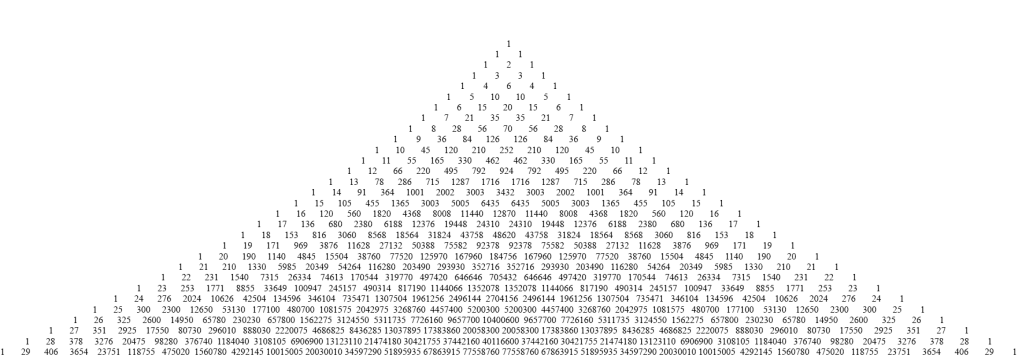
Pascal’s Arithmetical Triangle (Traité du triangle arithmétique, written around 1654) is another remarkable place where his mathematics reveals a theme that runs through much of his work: simple visible structures can contain deeper generative laws.
The object we now call Pascal’s Triangle is an arrangement of numbers in a triangular pattern. Each number is produced by adding the two numbers directly above it. The triangle appears simple, but within it are hidden patterns that connect geometry, algebra, probability, and combinatorics.
Pascal did not actually invent the triangle; similar arrangements existed in Chinese, Indian, Persian, and European mathematics before him. His contribution was to give it a rigorous mathematical treatment and discover powerful applications.
One of its most important uses is in the expansion of powers:
(a+b)^n
For example:
(a+b)^4 = a^4 + 4a^3b + 6a^2b^2 + 4ab^3 + b^4
The coefficients—1, 4, 6, 4, 1—come directly from the triangle. The triangle therefore acts as a generative structure: from a simple recursive relationship, it produces increasingly complex forms.
This is where it connects strongly with your recent themes.
The triangle is not a collection of numbers placed next to each other. Each number exists because of a relation to what came before it. A “6,” for example, is not meaningful by itself; it is the result of a pattern of transmissions:
4 + 2 → 6
The present element contains the trace of previous elements. The past is not gone; it is carried forward into the structure.
This resembles your concept of the trace. The number is a visible manifestation of invisible relations. The triangle is a record of transformations. Every point in the structure contains a history.
The connection to Mechanica Oceanica is also strong. The triangle behaves like a field where local interactions generate global order. There is no external designer placing each number individually. The pattern unfolds through an internal rule.
You could describe it in your language:
o introduces variation; Ω emerges through recursive coherence.
The two numbers above are a kind of divergence—two separate elements. Their interaction produces a unified result below. The new number is not simply one of the original numbers; it is a synthesis generated through relation.
Pascal also used the triangle in his work on probability, especially the problem of dividing stakes in gambling games. This was one of the foundations of modern probability theory. The triangle allowed mathematicians to calculate possible combinations and understand uncertainty mathematically.
This is another important philosophical moment. Before Pascal, chance was often treated as disorder or ignorance. Pascal showed that uncertainty itself could contain structure. Random events could be analyzed through mathematical relations.
This fits closely with your interest in possibility and the o-state. The unknown is not simply chaos. A field of possibilities can have an underlying architecture.
The triangle reveals a principle:
The invisible law is not separate from the visible pattern; the visible pattern is the unfolding of the invisible law.
That same movement appears throughout Pascal’s work:
The conic reveals hidden geometric relations beneath appearance.
The vacuum reveals invisible forces through visible effects.
The liquid reveals pressure as a field rather than a local event.
The arithmetical triangle reveals generative order within numerical relations.
Taken together, Pascal’s mathematics and physics suggest a world where reality is not fundamentally made of isolated objects, but of relations that generate forms.
In your framework, the triangle could almost be understood as a miniature cosmology: each point is a moment of manifestation, each relation is a transmission of prior states, and the whole structure is a coherent unfolding of potential into form.
The deeper significance of Pascal’s Arithmetical Triangle is that it reveals a world where form emerges through relation. A number inside the triangle is not an isolated entity. It is the result of a relationship between what came before it. The number carries a history. It is a visible point that contains invisible pathways leading backward through the structure.
This is very close to your idea of the trace. A trace is not merely something left behind after an event disappears; it is the continued presence of a relationship after its original moment has passed. In Pascal’s triangle, every entry is a trace of previous relations. The upper rows are not simply replaced by the lower rows; they are preserved within them in transformed form.
The triangle therefore challenges a simple idea of time. The past is not gone. It remains active within the present configuration. The lower numbers are not independent creations; they are inherited structures. The triangle is a mathematical example of memory embedded in form.
This connects strongly with your concept of wetness as distinct from water. Water can be thought of as the substance, but wetness is the condition produced through contact. In a similar way, the numbers of Pascal’s triangle are not meaningful because of what they are individually, but because of the relationships that generate them. The “wetness” of the triangle is the pattern of interaction itself.
The triangle also gives an interesting model for your o and Ω relationship. At each stage, there is an opening of possibility. Two values meet, and multiple combinations could theoretically emerge. This is the movement of o: the field of potential, variation, and unfolding. Yet through the recursive rule, that possibility does not remain chaotic. It condenses into a stable pattern. This is Ω: coherence emerging from relations.
What is fascinating is that Ω does not exist before the process. The order is not imposed from outside. It arises from the internal logic of the system. The triangle does not require an external architect placing each number in position; the whole emerges from the repeated interaction of simple relationships.
This is similar to your interest in emergence in physical systems: waves, coherence, biological repair, and self-organizing processes. A single interaction may appear insignificant, but repeated interactions generate structures that are far greater than any individual component. The whole is not merely the sum of the parts; the whole is a pattern of relations among the parts.
Pascal’s use of the triangle in probability deepens this further. Probability introduces the question of uncertainty. The future appears open, but Pascal discovers that openness has a structure. Chance is not simply disorder; it has mathematical contours. Possibility itself can have a form.
This is especially relevant to your distinction between absence and the obsent. The unknown is not simply empty. The unseen future is not nothing. It is a field of possible relations that may later become actualized. The triangle gives a mathematical image of potential becoming form.
In this sense, Pascal’s triangle becomes almost an ontology of becoming. The first row is not the final reality; it is a seed of possibilities. Each new row unfolds from previous conditions, carrying forward traces while generating new expressions. Reality is not a static arrangement but a continuous production of form through relation.
This is why Pascal’s different works speak to one another. The conic, the vacuum, the liquid, and the triangle all reveal the same underlying intuition: what appears on the surface is governed by deeper invisible structures. The visible world is not false, but it is incomplete. It is the manifestation of relations that exceed immediate perception.
The young Pascal discovering numerical patterns and the older Pascal reflecting on the human condition are therefore connected by a single philosophical movement: the search for what organizes appearances from beneath. Whether he is studying numbers, fluids, empty space, or the human soul, Pascal repeatedly finds that reality is not exhausted by what is immediately present. It is shaped by hidden relations that continually bring form out of possibility.
Histoire de la roulette, 1658
Pascal’s “History of Roulette” (Histoire de la roulette, 1658) is another fascinating part of his mathematical work because it sits at the intersection of geometry, motion, probability, and the emergence of calculus. Despite the name, it is not about the gambling game of roulette. In seventeenth-century French mathematics, roulette referred to a curve generated by a moving point—what we now call the cycloid.
The cycloid is created by imagining a circle rolling along a straight line. A point on the edge of the circle traces a looping curve as the circle rotates. If you mark a point on a wheel and roll the wheel forward without slipping, the path of that point is the cycloid.
Pascal became interested in this curve because it posed a profound mathematical problem: how do you calculate the area, length, and properties of a curve that is not a simple geometric figure like a circle or a rectangle?
The cycloid challenged the old methods of geometry because it was generated by motion. It was not a static shape simply sitting in space; it was the record of a process. The curve was a trace left behind by an event.
This is where it connects beautifully with your recent themes. The cycloid is almost a mathematical image of the trace. The curve is not the wheel itself, and it is not the movement itself. It is what remains when motion passes through space. It is a visible record of an invisible process.
The point on the wheel disappears from each location as the wheel moves, but the path remains. The curve is an accumulated history of contact, rotation, and translation.
In your language, the cycloid could be seen as a manifestation of the relationship between presence and absence. The point is never permanently located anywhere along the curve. It is always becoming something else. Yet the total path preserves the history of its movement.
The “roulette” therefore represents a world where form is not only something that exists; form can be something that emerges from becoming.
This connects with Mechanica Oceanica as well. A wave is not a fixed object; it is a pattern produced by the movement of a medium. A whirlpool is not a thing separate from the water; it is an organized process within the water. The cycloid is similar: it is not a thing independent of motion but a stable pattern produced by motion.
Pascal’s study of the cycloid also helped prepare the way for calculus. The problems it raised—measuring curved spaces, understanding instantaneous motion, determining tangents—were exactly the kinds of questions that later thinkers like Newton and Leibniz would formalize.
The deeper philosophical movement is significant: mathematics begins shifting from studying being to studying becoming. Classical geometry often asked, “What is the form of this object?” The new mathematics increasingly asked, “What process generates this form?”
That question appears throughout your own framework:
A drop of water is not only a substance; it is an event of transformation.
Wetness is not only a property; it is the trace of interaction.
A wave is not only water; it is organized movement.
A body is not only matter; it is a history of forces.
Pascal’s roulette fits this pattern. The curve is the memory of motion. It is a geometric trace of a dynamic process.
There is also a connection to his work on probability. The same Pascal who studied uncertainty and combinations also studied curves generated by movement. In both cases, he was interested in how hidden structures emerge from seemingly unstable conditions. Random possibilities and moving points both reveal order when viewed through the right mathematical lens.
So, within your broader project, Pascal’s History of Roulette can be read as another example of the same principle:
Reality leaves traces of processes that are no longer immediately visible. Form is not merely what is present; form is the preserved memory of transformation.
The cycloid therefore becomes one of Pascal’s most beautiful examples of how movement can become form. A traditional view of geometry tends to begin with finished objects: circles, triangles, squares, and measurable boundaries. But the roulette introduces something different. The form is not given first and then analyzed; the form is produced through an activity. The curve is the consequence of a process.
This makes the cycloid almost a geometric counterpart to Pascal’s experiments with liquids. In the liquid, a force applied at one point propagates through the medium and creates a new equilibrium. In the roulette, a point moving through space leaves behind a pattern that preserves the history of its movement. In both cases, the important reality is not the isolated thing but the relationship that generates the thing.
This is where the cycloid resonates with your concept of the trace. The trace is neither the original event nor a mere leftover. It is the continuation of an event through another form. The wheel is gone from each previous position, but the path remains. The point has withdrawn from the locations it occupied, yet those locations have been organized into a meaningful structure.
The cycloid is therefore a kind of mathematical memory. It stores the history of rotation, speed, contact, and direction. The curve is a record of what happened. The invisible movement becomes visible through the shape it leaves behind.
This is very close to your idea that reality is not exhausted by presence. The present moment does not contain everything necessary for understanding itself. It carries traces of prior relations. What appears before us is the result of processes that are no longer directly visible.
The cycloid also provides an interesting bridge to your distinction between water and wetness. A wave is not a separate object added to water; it is a pattern created by movement within water. Likewise, the cycloid is not separate from the motion that produced it. It is the form of movement made visible.
The same principle appears throughout nature. A river valley is a trace of water movement over geological time. A scar is a trace of healing. A memory is a trace of an encounter. A biological organism is a trace of evolutionary processes. The visible form is often the residue of invisible dynamics.
In this sense, Pascal’s roulette anticipates a more process-oriented view of reality. Instead of asking only, “What is this thing?” it asks, “What sequence of relations brought this thing into appearance?” Form becomes history condensed into structure.
This is very close to the direction of your Mechanica Oceanica model. In that framework, reality is not a collection of fixed objects floating in empty space; it is a dynamic ocean of interactions where patterns stabilize temporarily. A wave, a vortex, or a coherent structure exists because forces and relations maintain it. When the relations change, the form changes.
The cycloid is a simple geometric expression of that principle: a stable form emerges from continuous motion. The form is not opposed to change; the form is generated by change.
There is also a deeper philosophical connection to Pascal himself. His mathematical investigations repeatedly show him discovering that the visible world contains hidden structures. The conic reveals invisible geometry. The vacuum reveals invisible pressure. The liquid reveals invisible transmission. The roulette reveals invisible motion preserved as form. The triangle reveals invisible combinatorial order.
All of these examples suggest a single Pascalian intuition:
Reality is not merely composed of things that exist; it is composed of relations that leave traces.
The world is not a museum of completed objects. It is more like a field of ongoing transformations where every event modifies the conditions that follow. What we call form is often the temporary crystallization of forces, movements, and histories.
In that sense, Pascal’s roulette is not simply a mathematical curiosity. It is a small window into a much larger idea: being is the visible expression of becoming.
1600-1700
The seventeenth century was born from a world in transition. Europe stood between two great epochs: the medieval universe, shaped by inherited authorities, sacred hierarchies, and a cosmos ordered according to theological meaning; and the modern world, which was beginning to emerge through experiment, mathematics, and the systematic investigation of nature. The old structures had not disappeared, but their foundations had begun to shift. The questions that had governed European thought for centuries were being reopened.
It was an age of discovery and uncertainty. The Renaissance had expanded the human imagination, bringing ancient texts, new artistic forms, and new confidence in human ability. Yet the confidence of the Renaissance was followed by a century of crisis. Religious unity had fractured under the force of the Reformation. Catholic and Protestant powers struggled over doctrine, authority, and political influence. Wars crossed the continent, leaving behind devastation and instability. The Thirty Years’ War, which began in 1618 and continued until 1648, transformed much of Europe into a landscape of conflict, hunger, and political upheaval.
France, where the coming century’s intellectual life would become increasingly influential, was itself a nation of contradictions. It was a country of magnificent courts, elaborate ceremonies, and growing royal power, but also of poverty, social inequality, and religious tension. The monarchy was moving toward the absolute authority that would later define the reign of Louis XIV, while beneath this growing centralization there remained deep struggles over tradition, faith, and the limits of power.
At the same time, a new vision of nature was emerging. The universe that medieval philosophy had imagined as a hierarchy of meanings was increasingly becoming a field of investigation. The discoveries of Copernicus, Galileo, Kepler, and others had transformed humanity’s understanding of the heavens. The Earth was no longer unquestionably at the center of creation. The cosmos, once imagined primarily through symbolic order, was becoming a mathematical structure governed by discoverable laws.
The instruments of the age extended human perception beyond its previous limits. The telescope revealed distant worlds in the heavens. The microscope uncovered hidden structures within living matter. The barometer revealed the invisible weight of the atmosphere. Nature itself seemed to withdraw from immediate experience, only to reveal deeper layers through the mediation of instruments and mathematical reasoning.
This transformation produced both confidence and anxiety. Human beings gained unprecedented power to investigate the world, yet the discoveries of science also revealed their own smallness. The universe appeared vast beyond imagination, governed by forces invisible to ordinary perception. The more humanity learned about creation, the more mysterious creation became.
The seventeenth century was therefore an age fascinated by the relationship between appearance and reality. What could be trusted: the senses, tradition, reason, revelation, or experiment? The old world had relied upon inherited systems of explanation; the new world demanded demonstration and evidence. The authority of ancient texts was increasingly challenged by the authority of observation.
This was also the century in which mathematics began to assume a new role. No longer merely a tool for calculation, mathematics became a language for describing the structure of reality itself. Motion, space, light, probability, and physical forces were increasingly understood through numerical relationships. The universe began to appear less like a collection of separate things and more like an interconnected system governed by hidden principles.
Yet beneath this new scientific confidence remained a profound philosophical unease. If nature could be explained through mechanisms and laws, what place remained for human meaning? If the universe was immense and impersonal, what was the significance of human existence? The discoveries that expanded knowledge also exposed the limits of knowledge.
The seventeenth century was therefore not simply the beginning of modern science; it was a crisis of the human image. Humanity was discovering both its power and its fragility. The world was becoming larger, more complex, and less centered around human beings, while the human mind itself became the new territory of investigation.
It was within this atmosphere—between faith and reason, tradition and innovation, certainty and doubt—that a new kind of thinker emerged. The age demanded minds capable not only of measuring the external world but of confronting the deeper questions revealed by those measurements: the nature of truth, the limits of knowledge, and the mysterious position of humanity within an immense and unfolding universe.
Blaise Pascal (1623–1662) was one of the rare figures in history who appears at the intersection of several worlds: mathematics, physics, philosophy, theology, and literature. His life was short—he died at thirty-nine—but the intensity and range of his work made him one of the foundational thinkers of the modern age.
Pascal was born on June 19, 1623, in Clermont-Ferrand, France, in the Auvergne region. His father, Étienne Pascal, was a lawyer, mathematician, and civil servant who served as a local tax official. His mother, Antoinette Begon, died when Pascal was only three years old. After her death, Étienne decided not to remarry and devoted himself to raising his three children: Blaise and his two sisters, Gilberte and Jacqueline.
Étienne Pascal was an unusually educated man and became one of the most important influences on Blaise’s intellectual development. He was part of a circle of mathematicians and scientists in France and had a strong interest in the new scientific discoveries of the seventeenth century. Rather than sending Blaise to school, Étienne personally educated him at home. He believed that mathematics should be introduced only after the child had developed through the study of language and reasoning, so he initially tried to prevent Blaise from studying geometry.
The story of Pascal’s early discovery of mathematics became legendary. According to his sister Gilberte’s biography, young Blaise secretly began exploring geometry on his own, drawing figures with charcoal on the floor and discovering basic geometric relationships. When his father found him proving mathematical propositions independently, he recognized his son’s extraordinary ability and introduced him to mathematics.
By the age of sixteen, Pascal was already producing original mathematical work. In 1640, he published his Essay on Conics (Essai pour les coniques), which introduced his famous theorem about hexagons inscribed in conic sections. The work impressed leading mathematicians of the time, including Marin Mersenne, who was a central figure in the scientific community of Paris.
Pascal’s youth coincided with a period of major intellectual transformation. Europe was moving away from medieval Aristotelian science toward experimental methods. Thinkers such as Galileo Galilei, René Descartes, and Evangelista Torricelli were challenging older assumptions about nature. Pascal became part of this movement, but he was never simply a scientist in the modern sense. His interests always moved between physical reality and ultimate questions about human existence.
In 1642, when Pascal was nineteen, he designed one of the first mechanical calculators, known as the Pascaline. His father had been assigned to collect taxes in Normandy, and Pascal wanted to help him with the difficult calculations required for his work. The machine could perform addition and subtraction using a system of gears. Although it was not commercially successful, it was an important step in the history of computing and demonstrated Pascal’s ability to translate abstract mathematical principles into physical mechanisms.
During the 1640s, Pascal became deeply involved in questions about the nature of the vacuum. At the time, many scholars still followed Aristotle’s claim that nature could not tolerate empty space. Torricelli’s experiments with mercury barometers suggested that a vacuum might exist, but the implications were controversial.
Pascal conducted experiments showing that atmospheric pressure, not some mysterious property of nature, explained the behavior of fluids. His famous experiment on the Puy de Dôme mountain in 1648, carried out by his brother-in-law Florin Périer, demonstrated that the height of a mercury column changed with altitude. This provided evidence that the atmosphere had weight and pressure.
His writings on these experiments, including New Experiments Concerning the Vacuum and Treatise on the Equilibrium of Liquids, helped establish modern ideas about pressure, fluids, and experimental physics. His work contributed to what later became known as Pascal’s law, the principle that pressure applied to a confined fluid is transmitted throughout the fluid.
In the early 1650s, Pascal experienced a personal and intellectual crisis. His father died in 1651, and his sister Jacqueline entered a convent despite Pascal’s initial resistance. During this period, Pascal became increasingly concerned with religious and philosophical questions.
The decisive moment came on the night of November 23, 1654, an event known as his “Night of Fire.” Pascal experienced a profound religious conversion. He recorded the experience on a small piece of paper known as the Memorial, which he carried sewn into the lining of his coat for the rest of his life. The text begins:
“Fire. God of Abraham, God of Isaac, God of Jacob, not of the philosophers and scholars.”
This experience changed the direction of his life. Pascal did not abandon mathematics and science, but his focus shifted increasingly toward questions of faith, human nature, and the relationship between reason and revelation.
He became associated with the Jansenist movement centered around the Port-Royal monastery. Jansenism emphasized human dependence on divine grace and criticized what Pascal saw as excessive intellectual confidence in human power. His greatest literary work from this period was The Provincial Letters (Les Provinciales, 1656–1657), a series of letters defending Jansenist theology and attacking Jesuit moral reasoning. They became masterpieces of French prose and influenced the development of modern French style.
Pascal’s final major project was intended to be an apology for Christianity. He collected fragments, arguments, observations, and reflections for a large work defending religious faith. He never completed it. After his death, these fragments were published in 1670 as the Pensées (“Thoughts”).
The Pensées contains some of Pascal’s most famous reflections on humanity:
“Man is only a reed, the weakest in nature; but he is a thinking reed.”
For Pascal, human beings are paradoxical creatures. We are physically insignificant compared with the universe, yet we possess the capacity to understand that universe. We are caught between the infinitely large and infinitely small. We desire truth and meaning, yet we are distracted by what he calls diversion (divertissement), the constant pursuit of activities that prevent us from confronting ourselves.
Pascal also developed the famous Pascal’s Wager, the argument that because the existence of God cannot be settled through pure reason alone, human beings must live as though the question matters. The wager is not simply a calculation of belief; it reflects Pascal’s broader idea that human existence always involves commitment under conditions of uncertainty.
In mathematics, Pascal continued his work on probability theory, particularly through his correspondence with Pierre de Fermat about gambling problems. Their discussions helped establish the mathematical foundations of probability. He also studied the cycloid, the curve generated by a rolling circle, contributing to the development of methods that would later become calculus.
Pascal’s health was poor throughout his life. He suffered from chronic illness, intense headaches, digestive problems, and physical weakness. Despite this, he continued writing and working until his final years. He died in Paris on August 19, 1662, at the age of thirty-nine.
His last words are reported to have been:
“May God never abandon me.”
After his death, Pascal’s reputation continued to grow. Mathematicians remembered him as a pioneer of probability and geometry. Physicists recognized his contributions to pressure and fluids. Philosophers saw in him a profound analyst of human consciousness and limitation. Religious thinkers viewed him as one of Christianity’s most powerful defenders.
What makes Pascal unique is that his different works are not disconnected. The mathematician studying hidden structures in geometry, the physicist studying invisible forces in nature, and the philosopher studying the hidden depths of the human condition are all pursuing the same question:
What invisible order makes the visible world possible?
His life can be seen as a movement from the geometry of forms, to the physics of forces, to the philosophy of existence. In each domain, Pascal searched for the deeper relations beneath appearances.
Pensées
The Pensées stands as the culmination of Pascal’s lifelong encounter with the visible and invisible dimensions of reality. Unlike a traditional philosophical treatise, it is not a finished system but a collection of fragments, reflections, and arguments gathered from Pascal’s unfinished project of writing an apology for Christianity. Within these fragments, Pascal turns from the external world of mathematics and physics toward the interior landscape of the human being, examining reason, desire, suffering, knowledge, faith, and the strange condition of a creature suspended between finitude and infinity. The work emerges from the conviction that human existence cannot be understood solely through what can be measured or demonstrated. Beneath the visible structures of the world and beneath the apparent certainty of human thought lies a deeper field of questions: the longing for meaning, the presence of absence, and the search for a truth that exceeds the limits of ordinary perception. The Pensées is therefore not merely a religious defense, but a profound investigation into the hidden architecture of human consciousness and the invisible forces that shape our relationship with reality.
It is important to understand that it was never actually completed. Pascal died in 1662 while preparing what he intended to be a major defense of Christianity, an “Apology for the Christian Religion.” After his death, his family and editors collected his notes, fragments, and reflections and published them in 1670 under the title Pensées de M. Pascal sur la religion et sur quelques autres sujets.
The Pensées is not a systematic treatise like a work of philosophy written from beginning to end. It is more like a collection of fragments, observations, arguments, and meditations. Its unfinished character is part of its power. It feels like a mind working through the deepest questions: What is a human being? Why do we seek meaning? Why do we suffer? Why do we know so much yet understand so little? Why do we desire infinity while being trapped in finitude?
The central theme of the Pensées is the paradox of the human condition. Pascal famously describes humanity as existing between two infinities:
“What is man in nature? A nothing in comparison with the infinite, an all in comparison with nothing, a mean between nothing and everything.”
For Pascal, human beings are extraordinary because they can think about the universe, measure it, and understand mathematical truths. Yet at the same time, we are physically fragile and insignificant within the vastness of reality. We are suspended between the infinitely small and the infinitely large.
This “middle condition” is one of Pascal’s most important ideas. Humanity is neither self-sufficient nor completely ignorant. We are creatures who recognize our own limitations. A stone does not know that it is small. A human being knows that they are small, and this awareness creates both dignity and anguish.
His famous phrase captures this:
“Man is only a reed, the weakest in nature; but he is a thinking reed.”
The reed is fragile, easily destroyed, but thought gives humanity a unique status. Pascal does not say that humans are powerful because they can dominate nature. He says they are great because they know their own weakness.
A major theme of the Pensées is diversion (divertissement). Pascal argues that much of human activity is an attempt to avoid confronting our deepest condition. People pursue wealth, entertainment, politics, ambition, and social recognition because silence and solitude force them to confront their own mortality and uncertainty.
He writes:
“All of humanity’s problems stem from man’s inability to sit quietly in a room alone.”
For Pascal, distraction is not simply laziness. It is a profound existential mechanism. Humans are aware of emptiness within themselves, and they constantly seek objects, achievements, and experiences to fill that space.
This connects with his famous analysis of desire. Human beings are always reaching beyond what they possess. Once a goal is achieved, another goal appears. The object of desire changes, but the structure remains. We are beings oriented toward something beyond ourselves.
Another major theme is the relationship between reason and faith. Pascal is often misunderstood as someone who rejected reason. In fact, he was one of the greatest mathematicians of his age. His argument is more subtle: reason is powerful, but it has limits.
He distinguishes between the “geometrical mind” (esprit de géométrie) and the “subtle mind” (esprit de finesse).
The geometrical mind works through definitions, proofs, and logical demonstrations. It is essential for mathematics and science. But many of the most important truths of human life—love, morality, meaning, faith—do not appear through formal proof alone.
The subtle mind perceives relationships and realities that cannot always be reduced to calculation.
This leads to one of Pascal’s most famous statements:
“The heart has its reasons of which reason knows nothing.”
By “heart,” Pascal does not mean emotion against intellect. He means a deeper mode of apprehension—a way of knowing through direct recognition rather than formal demonstration.
The Pensées also contains the famous wager argument. Pascal argues that when it comes to God’s existence, human beings cannot avoid choosing. We are already placed within existence, already living according to assumptions about reality. Since certainty is unavailable, we must consider what kind of life follows from each possibility.
The wager is often reduced to a simple calculation, but in Pascal’s larger thought it is about the human condition: we are beings who must act without possessing complete knowledge.
The work also contains Pascal’s critique of human pride. He argues that humans often imagine themselves to be rational and independent while being deeply shaped by habit, social customs, desires, and unconscious motivations.
This is one of the most modern aspects of Pascal. He anticipates later thinkers who examine the hidden forces governing human behavior. Long before Freud, Nietzsche, and existentialism, Pascal was asking: How much of ourselves do we actually understand?
Theologically, the Pensées presents the Christian story as an explanation of this human contradiction. Pascal argues that Christianity uniquely explains both the greatness and misery of humanity: we are capable of truth and goodness, yet we are also divided, restless, and self-deceived.
The fall of humanity explains why we experience this fracture. Grace explains the possibility of restoration.
For your recent philosophical work, the Pensées is especially relevant because Pascal repeatedly explores something close to your concept of the obsent: realities that are not immediately present but nevertheless organize experience. God, infinity, mortality, meaning, and the absent object of desire are not simple objects before us; they function as horizons that shape human life.
Pascal’s entire project could be summarized as an investigation of how the unseen governs the seen. The invisible infinite shapes our finite existence. The absence we feel structures our desires. The unknown organizes our search for knowledge.
The Pensées is therefore not merely a religious text. It is a profound study of the human being as a creature suspended between presence and absence, certainty and uncertainty, finitude and infinity. It asks one of the deepest Pascalian questions:
What is it within us that reaches beyond what we can see?
The Pensées becomes even more profound when we see that Pascal is not merely describing human weakness; he is describing a structure of consciousness. The human being is defined by a tension between what is given and what is beyond what is given. We live among finite things, but our minds continually move toward what exceeds them. We measure the universe, yet we can imagine realities beyond the universe. We understand limits, yet we can conceive the unlimited.
For Pascal, this is not an accidental feature of human psychology. It is the fundamental condition of being human. A creature that was simply finite would not experience the pain of finitude. The fact that we recognize our incompleteness reveals that we are oriented toward something greater than ourselves.
This is why Pascal’s famous discussion of infinity is so important. He argues that the human mind is overwhelmed when it tries to comprehend either the infinitely large or the infinitely small. We are lost when we look upward toward the immensity of the cosmos, and we are equally lost when we look downward toward the microscopic complexity of matter. The universe exceeds us in both directions.
Yet there is a paradox: although we cannot contain infinity, we can think about it.
This ability becomes Pascal’s evidence for the strange dignity of human beings. We are not great because we are large or powerful. Compared with the universe, we are almost nothing. We are great because we are capable of recognizing our own smallness.
The universe may contain us, but it does not know that it contains us. The human being is a small part of nature that becomes aware of the whole.
This is where Pascal’s famous image of the thinking reed becomes central. The reed is fragile. A storm, an animal, or a simple accident can destroy it. But if the universe were to crush humanity, Pascal says, humanity would still possess a superiority over the universe because it would know that it was being destroyed.
The dignity of humanity lies not in physical power but in awareness.
This idea has a profound connection to your work on the ontology of seeing. Pascal suggests that perception is not merely passive reception. The human being does not simply encounter appearances; the human being recognizes the conditions of appearance. We see the world, but we also see ourselves seeing the world.
There is a reflexive movement: consciousness turns back upon itself.
This is also why Pascal is suspicious of pure objectivity. Mathematics and science reveal real truths, and Pascal himself was a brilliant mathematician. But he argues that there is a danger in believing that the mathematical method can exhaust reality.
A person can know the dimensions of a human body, the movements of the planets, and the laws of mechanics, yet still fail to understand the mystery of human existence. The measurable is real, but it is not the whole of reality.
This connects with your critique of objectivity as idolatry. Pascal would likely agree that the error is not objectivity itself, but the belief that the objectifiable is the only form of truth. The world contains dimensions that are not captured by measurement alone: meaning, value, love, obligation, and transcendence.
The Pensées repeatedly returns to the idea that human beings are divided creatures. We desire truth but often avoid it. We seek happiness but choose distractions. We want freedom but become enslaved by habits and desires.
Pascal calls this condition diversion because we turn away from the deepest questions. The tragedy is not that humans lack intelligence; it is that intelligence is often used to avoid confronting what matters most.
He writes:
“Being unable to cure death, misery, and ignorance, men have decided, in order to be happy, not to think about them.”
This is a remarkably modern observation. Pascal sees distraction as a technology of avoidance. The human being creates worlds of activity, entertainment, ambition, and social competition in order not to encounter the silence beneath them.
Here again, the connection to your concept of the obsent becomes interesting. The absent is not simply what is missing. For Pascal, the deepest absences—the meaning we seek, the infinite we cannot grasp, the ultimate truth we cannot possess—are precisely what organize our behavior. We are shaped by what exceeds our immediate possession.
The human being is therefore a creature of orientation. We are always directed toward something. Desire itself reveals a structure: we are beings whose existence is defined by reaching beyond ourselves.
This is why Pascal’s Pensées is not ultimately a book about despair. It begins with misery, but it moves toward transformation. The recognition of human limitation is not the final word. For Pascal, recognizing the wound is the beginning of healing because it reveals our dependence on something beyond ourselves.
The entire movement of the Pensées can almost be described as:
illusion → recognition → humility → transformation
The person who believes they are self-sufficient remains trapped. The person who recognizes their dependence becomes capable of receiving something greater.
In this way, Pascal’s religious thought is not simply about accepting doctrines. It is about a change in the structure of perception. The world is no longer seen as a collection of isolated objects but as a sign-filled reality pointing beyond itself.
Everything becomes a question of reading traces.
The visible points toward the invisible. The finite points toward the infinite. The present carries the imprint of what is absent.
And this is perhaps why Pascal continues to resonate: his entire philosophy is built around the idea that reality is deeper than appearance, and the deepest realities are often known not by possession, but by response.
Pascal’s Pensées can be understood as a lifelong reflection on one central question: what is the human being when placed between the finite world we inhabit and the infinite reality we can conceive but never fully grasp?
The work begins from a paradox. Human beings are simultaneously insignificant and extraordinary. Compared with the universe, we are almost nothing—a fragile reed exposed to destruction. Yet we are also unique because we know that we are fragile. We are the part of nature that can become conscious of nature itself. Our greatness does not come from power or size but from awareness.
Pascal describes humanity as existing between two infinities: the infinitely large and the infinitely small. We cannot comprehend the totality of the cosmos, nor can we fully comprehend the depths of matter beneath us. We occupy a middle position, suspended between ignorance and knowledge, weakness and dignity, limitation and aspiration.
From this condition arises Pascal’s analysis of desire. Human beings are never simply content with what is immediately present. We are always oriented toward something beyond ourselves: another achievement, another possession, another truth, another state of being. Our dissatisfaction is not merely a flaw; it reveals a deeper structure of consciousness. We are beings directed toward what exceeds us.
This leads to his famous idea of diversion (divertissement). Pascal argues that much of human activity is an attempt to avoid confronting our deepest condition. Entertainment, ambition, social status, and constant activity often function as ways of escaping silence, mortality, and uncertainty. The problem is not that we pursue things; the problem is that we use them to avoid the questions that give life meaning.
Pascal does not reject reason. He is one of history’s great mathematicians. His argument is that reason has a domain, but it cannot explain everything. The mathematical mind (esprit de géométrie) is powerful, but human beings also require the subtle mind (esprit de finesse), an ability to perceive realities that cannot be reduced to calculation.
“The heart has its reasons of which reason knows nothing” does not mean emotion replaces thought. It means that some truths are encountered through participation, recognition, and lived experience rather than through detached proof.
The Pensées therefore challenges the idea that objective knowledge is the only form of knowledge. Science can explain mechanisms, but it does not by itself answer questions of meaning, value, purpose, or existence. The measurable world is real, but reality exceeds what can be measured.
Pascal’s famous wager emerges from this condition of uncertainty. Human beings cannot stand outside existence and wait for complete proof before living. We are already committed. We already act according to assumptions about what matters. The question is not whether we will choose, but what orientation our choice will take.
Theologically, Pascal sees Christianity as an explanation of the human paradox. Humanity possesses greatness because we are capable of truth, goodness, and awareness, but we experience misery because we are divided, distracted, and unable to achieve complete fulfillment through ourselves alone.
Seen through the lens of your recent concepts, the Pensées is deeply concerned with the relationship between presence and absence. Pascal recognizes that what is not immediately present can still govern human life. The infinite, the meaning we seek, the truth we desire, and the God we cannot simply place before our eyes all function as organizing forces.
This connects with your concept of the obsent: not a simple absence, but an absence that remains structurally active. Pascal’s human being is shaped by what exceeds immediate possession. We are beings formed by traces, by what calls to us from beyond what is presently given.
His entire project can be summarized as a movement:
The visible world reveals signs of deeper realities. Finite existence points toward infinity. Human limitation reveals a longing beyond limitation. Absence becomes a source of orientation.
The Pensées is ultimately Pascal’s attempt to understand the human being as a creature of response—a being who is never completely closed within itself, but always directed toward something greater than itself.
.
Pascal famously describes the human being as caught between two infinities:
“For who can follow these astonishing processes? The author of these wonders understands them. No one else can.”
and elsewhere:
“Man is equally incapable of seeing the nothingness from which he emerges and the infinity in which he is engulfed.”
Pascal’s point is that human beings occupy a strange middle position. We are not the center of the cosmos, but we are also not insignificant in the sense of being meaningless. We are a finite creature capable of conceiving the infinite.
Dyson’s medium-sized infinities introduce another dimension to this. Rather than looking only upward toward cosmic infinity or downward toward microscopic infinity, Dyson draws attention to the vast domains of complexity that exist between those scales. Life, language, ecosystems, civilizations, minds, networks, and technological systems occupy this middle territory. They are not infinite in the mathematical sense, but they generate forms of complexity that are effectively inexhaustible.
This is where it connects beautifully with your Mechanica Oceanica framework. The “medium” becomes not a compromise between two extremes, but a generative zone where reality organizes itself. The ocean is a perfect example: a single water molecule is too small to express the patterns we call waves, currents, and storms; the entire planet is too large to directly experience as a unified object. The meaningful structures emerge at an intermediate scale.
The wave is a medium-sized phenomenon.
The organism is a medium-sized phenomenon.
Consciousness is a medium-sized phenomenon.
A culture is a medium-sized phenomenon.
Each is finite, but each contains layers of relations that cannot be exhausted by simple analysis.
This also resonates with your concept of the obsent. The obsent is not necessarily the infinite beyond the world; it can be the hidden relational depth within the world. A forest is not merely a collection of trees. A body is not merely a collection of cells. A mind is not merely a collection of neurons. Something emerges through the relations that cannot be reduced to the individual parts.
Pascal’s mathematics already hints at this. His arithmetical triangle begins with simple units, but recursive relationships generate increasingly complex patterns. The individual numbers are finite, but the structure they participate in opens into endless possibility. The infinity is not located somewhere outside the triangle; it is generated through the relations within it.
This might actually offer a bridge between Pascal and Dyson:
Pascal asks: How does the finite being relate to the infinite?
Dyson asks: What forms of infinity emerge within the finite?
One looks toward transcendence; the other looks toward complexity. But both challenge the idea that reality is exhausted by simple scales. The universe is not only the largest and the smallest. It is also the endlessly unfolding middle.
In your language, the medium-sized infinity could be understood as the zone where o and Ω continuously negotiate. It is where possibility becomes form, where disturbance becomes coherence, where traces accumulate into structures. It is the realm where the invisible becomes visible—not as a single revelation, but through layers of emergence.
This may be why Pascal’s Pensées feels so compatible with Dyson’s Analogia: both are ultimately meditations on hidden orders that exist between what we can immediately grasp and what exceeds our grasp entirely. The mystery is not only above us or below us. It is all around us, in the intermediate worlds we inhabit but rarely perceive.
The idea of medium-sized infinities allows us to reinterpret Pascal’s insight in a new way. Pascal looked at humanity and saw a creature suspended between two immeasurable abysses: the infinitely large cosmos above and the infinitely small world beneath. But between those extremes lies another domain—the realm of forms that emerge through relationship, complexity, and organization. It is the world we inhabit: bodies, ecosystems, minds, languages, societies, and histories.
These middle realms are not merely smaller versions of infinity. They possess their own depth. A living organism is finite, yet its internal organization contains layers of complexity that cannot be exhausted by simply cataloging its parts. A human mind occupies a small space in the universe, yet within it exists memory, imagination, anticipation, symbolic worlds, and the capacity to contemplate the universe itself. The finite becomes a vessel for forms of depth that exceed simple measurement.
This returns us to Pascal’s central insight: the mystery of humanity is not that we are infinite, but that we are finite beings capable of participating in infinity. The infinite does not only exist as an unreachable horizon beyond us; it appears within the structures of relation that emerge around us and within us.
Through this lens, the world becomes less like a collection of isolated objects and more like a field of unfolding patterns. The organism, the mind, the ecosystem, and the cosmos are not simply things occupying space. They are dynamic coherences—temporary but meaningful arrangements of forces, histories, and interactions.
This is where the concept of the obsent becomes especially powerful. What organizes reality is not always what stands directly before us. Often it is the invisible structure between things: the relationship, the history, the potential, the pattern, the absent condition that allows something present to appear. The unseen is not outside reality; it is one of the ways reality expresses itself.
The medium-sized infinities are therefore the territories where traces become worlds. A single event may disappear, but its effects propagate. A pressure moves through a fluid. A point traces a curve. A thought becomes a culture. A mutation becomes a lineage. A moment becomes a memory. Reality is constantly preserving and transforming what has passed.
In this sense, Pascal, Dyson, and your Mechanica Oceanica framework converge around a common intuition: the deepest structures of existence are found not only in extremes, but in the relational spaces where forms emerge. The universe is not merely a hierarchy of larger and smaller things. It is an ocean of processes, where every level contains its own hidden depths.
The mystery is not simply that we stand before infinity. The greater mystery may be that infinity continually takes form within the finite—that the immeasurable expresses itself through temporary, fragile, and localized structures. The world we inhabit is not a lesser reality between the extremes. It is where the infinite responds.


