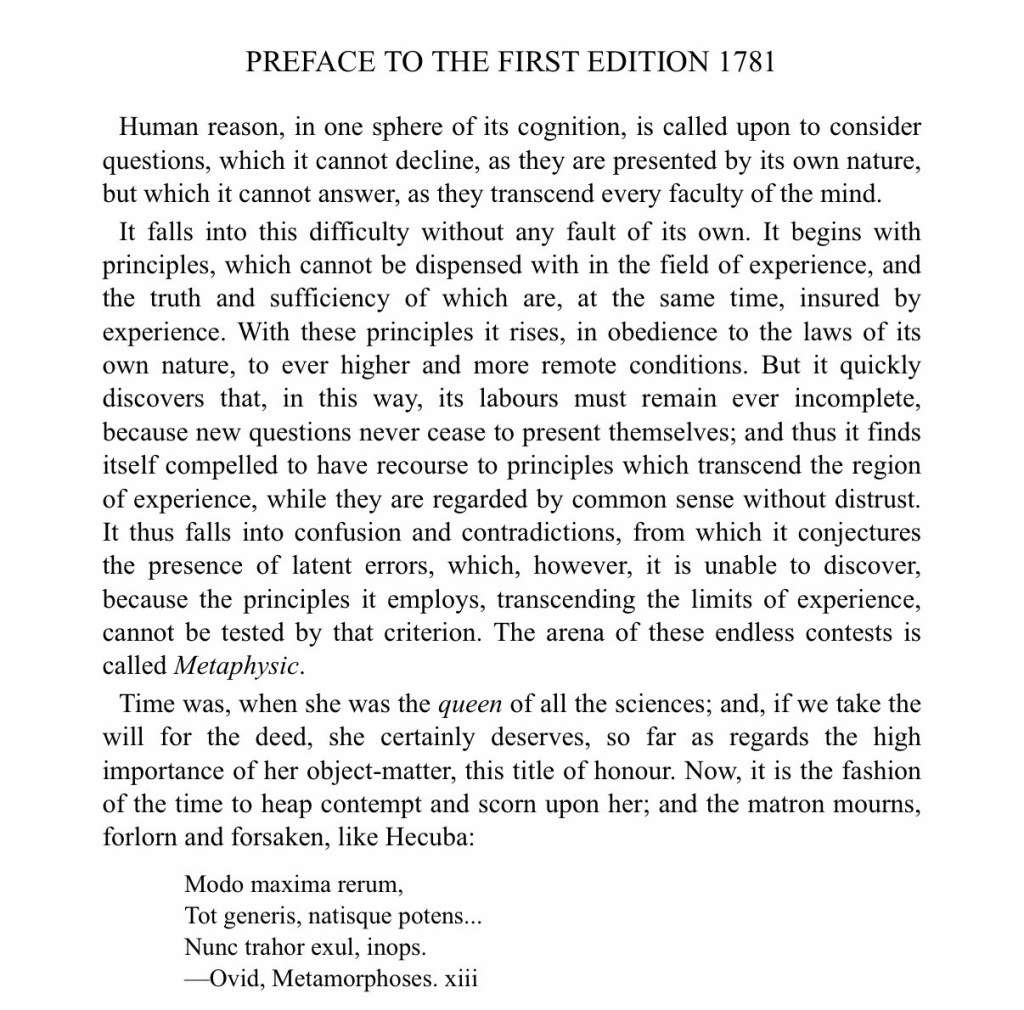
This is an extraordinary place to begin because Kant does something very deliberate in the first sentence: he does not begin by defining metaphysics, knowledge, reason, or even experience. He begins with a predicament. “Human reason, in one sphere of its cognition, is called upon to consider questions, which it cannot decline, as they are presented by its own nature, but which it cannot answer, as they transcend every faculty of the mind.” The German is: “Die menschliche Vernunft hat das besondere Schicksal in einer Gattung ihrer Erkenntnisse: daß sie durch Fragen belästigt wird, die sie nicht abweisen kann, denn sie sind ihr durch die Natur der Vernunft selbst aufgegeben; die sie aber auch nicht beantworten kann, denn sie übersteigen alles Vermögen der menschlichen Vernunft.” There is already a remarkable tension in the language. Kant says reason is “belästigt” by questions—literally something like “troubled,” “pestered,” or “burdened” by them—but these questions are simultaneously “aufgegeben,” given or assigned to it by the very nature of reason. Reason cannot simply tell itself, “These questions are meaningless; I will stop asking them.” The questions arise from reason itself. Yet reason cannot answer them because they “übersteigen” its capacities: they go beyond what its faculties can legitimately accomplish. This is the fundamental drama of the Critique of Pure Reason. Kant is not beginning by saying that human beings foolishly ask questions they shouldn’t ask. He is saying something much more disturbing: human reason is constituted in such a way that it necessarily generates questions that exceed its own cognitive powers. Metaphysics is therefore not simply a historical mistake that clever people should abandon. It is produced by reason itself. This is why Kant’s problem is much deeper than skepticism. Skepticism says, “Perhaps we cannot know these things.” Kant is saying, “We cannot know them in the way reason wants to know them, but reason cannot stop demanding them.” The philosophical problem is therefore not merely ignorance. It is the structural conflict between the demands of reason and the limits of cognition.
The next sentence makes this even more important: “It falls into this difficulty without any fault of its own.” Kant is protecting reason from a very old accusation—that metaphysical error comes simply from human stupidity, carelessness, or intellectual arrogance. The problem is not that reason occasionally misbehaves. The problem is that reason follows its own legitimate tendencies and thereby gets itself into trouble. Notice the sequence Kant gives us. Reason “begins with principles” that cannot be dispensed with “in the field of experience.” These principles are secure because experience confirms them. But then reason “rises” from these principles “to ever higher and more remote conditions.” This is the movement we need to understand. In ordinary cognition, we encounter something conditioned: an event, for example. We ask what caused it. We find a condition. Then we can ask what caused that condition. We find another condition. The human mind naturally continues the search. We don’t merely want to know that something happens; we want to know why. And if the answer is itself conditioned, reason asks for its condition. This is not irrational. In fact, it is perfectly rational within experience. The trouble begins when reason’s demand for conditions refuses to stop at the boundaries of possible experience. It starts looking for the “unconditioned”—something that would itself no longer require a condition. And here we can already see the seeds of the later ideas of the soul, the world as a whole, and God. Kant will eventually argue that reason is naturally driven toward precisely these ideas because reason seeks completeness. The understanding operates within experience by applying concepts to appearances; reason, in a more ambitious sense, seeks to organize conditioned knowledge under increasingly general principles until it reaches what would be absolutely unconditioned. The problem is that the unconditioned cannot simply be encountered as another object within experience. Thus the very success of reason in ordinary cognition becomes the mechanism by which it exceeds its legitimate domain.
This is where Kant’s distinction from Hume becomes important. Hume had already shown enormous skepticism toward concepts such as causality and necessary connection. But Kant does not want to conclude that because metaphysical concepts lead to difficulty, we should simply abandon reason’s demand for them. He wants to understand why the demand arises. This is one reason the opening sentence is so powerful: the metaphysical impulse is not an accidental disease. It is generated by the architecture of reason itself. There is a kind of philosophical inevitability here. We begin with experience; experience gives us legitimate principles; reason then asks for conditions; the demand for conditions generates a movement toward ever more comprehensive explanations; eventually the explanatory chain encounters questions that experience cannot settle. Then reason begins treating concepts that have legitimate use within experience as though they could be applied beyond experience. This is where the “confusion and contradictions” emerge. Kant’s later antinomies will dramatize this perfectly. Is the world finite or infinite in time and space? Does everything have a necessary cause, or is there freedom? Is there a necessary being, or is there none? Reason can apparently construct compelling arguments on both sides. That is what makes the situation so terrifying. The contradictions are not simply between reason and irrationality; they are conflicts between reason and reason.
The sentence “The arena of these endless contests is called Metaphysic” is therefore almost theatrical. The German says, “Der Kampfplatz dieser endlosen Streitigkeiten heißt nun Metaphysik.” Kampfplatz is literally a “battlefield” or “fighting ground.” Kant is imagining metaphysics as an arena in which rational systems endlessly fight one another. This is a historical diagnosis as much as a philosophical one. By 1781, Kant has inherited centuries of metaphysical conflict. Aristotle, the medieval scholastics, Descartes, Spinoza, Leibniz, Wolff, Locke, Hume, and others have offered radically different accounts of reality, substance, causality, God, mind, and world. And yet there seems to be no universally accepted method capable of settling the disputes. The problem is therefore methodological. Why does metaphysics repeatedly produce conflict without resolution? Kant’s answer will eventually be that metaphysics has not yet critically investigated the faculty by which metaphysical judgments are being made. It has asked what reality ultimately is before asking what human cognition is capable of knowing. This is where the “Critique” enters. Kritik in Kant’s sense is not simply criticism in the modern sense of finding fault. It is an examination of legitimacy, jurisdiction, and limits. Who has the right to claim what? Under what conditions? What kind of cognition is involved? What are its sources? Where does its legitimate use end? Kant is going to turn the tribunal of reason upon reason itself.
Then comes the extraordinary image of metaphysics as a fallen queen: “Time was, when she was the queen of all the sciences.” The German is “Es war eine Zeit, da sie die Königin aller Wissenschaften genannt wurde.” Kant then says that, judging by the importance of her subject matter, she deserves the title if we take “the will for the deed”—“wenn man den Willen für die Tat nimmt.” There is some irony here. Metaphysics has enormous ambitions. It wants to know the ultimate principles of reality, the soul, God, freedom, the world as a totality. In terms of what it wants to accomplish, it deserves to be called queen. But wanting to accomplish something is not the same as accomplishing it. This is already a subtle indictment of metaphysics. Kant does not mock its questions. He actually thinks its questions are among the most important questions human reason can ask. What he doubts is its ability to answer them through its traditional methods. That is why the image of Hecuba is so fitting. Kant quotes Ovid: once mighty, powerful through family and children, now dragged away in exile and poverty. Metaphysics has gone from queen to outcast. And Kant’s attitude is not simply contemptuous. There is almost pity in the image. He is saying: look at what has happened to this discipline. It once occupied the highest position, and now intellectual fashion treats it with “contempt and scorn.” But Kant does not want to bury metaphysics. He wants to rescue it by transforming its method.
This is where the historical background becomes essential. The “queen” Kant is mourning is not merely ancient metaphysics in the abstract. He is confronting the eighteenth-century crisis of metaphysics, particularly the rationalist tradition represented in Germany by Leibniz and Christian Wolff. Wolff had attempted to construct a comprehensive, systematic metaphysics through definitions, principles, demonstrations, and deductions. Kant himself had been educated within this tradition. The Wolffian system sought rational knowledge of ontology, cosmology, psychology, and theology. But Kant increasingly came to see that metaphysics could not simply proceed like mathematics by defining concepts and deriving conclusions from them. At the same time, Newtonian physics presented a spectacularly successful model of knowledge about nature. And Hume’s empiricism then challenged the rationalist confidence that concepts like causality could be justified merely through reason. Kant therefore finds himself between two apparently incompatible positions: rationalism seems to promise necessary knowledge but repeatedly generates metaphysical disputes; empiricism seems to restrain reason by grounding knowledge in experience but threatens to undermine necessity itself. The Critique will attempt to explain how both sides have grasped something essential and yet misunderstood the conditions under which their claims are legitimate.
There is also something important in the phrase “transcend every faculty of the mind.” We should not yet interpret “transcendent” in the later theological sense of simply referring to God or something beyond the material world. Kant’s concern is more precise. A faculty has a domain of legitimate operation. Sensibility gives us objects through intuition; understanding thinks those objects through concepts; reason seeks systematic unity and the unconditioned. The central question of the Critique will become: what can each faculty actually do? What happens when one faculty tries to perform the work of another? This is why Kant’s philosophy is so architectonic. He isn’t simply dividing the mind into psychological compartments. He is mapping jurisdictions of cognition. The great question is not merely “What exists?” but “By what faculty, under what conditions, and with what right could we claim to know that it exists?” This is the beginning of the transcendental turn. Instead of immediately directing consciousness outward toward objects, Kant asks what must be true of our mode of cognition for objects of experience to be possible for us at all.
And notice how perfectly this opening prepares the problem of the First Critique. Kant has not yet given us the solution. He has given us a diagnosis: reason naturally seeks the unconditioned; this demand takes it beyond experience; once beyond experience, its principles cannot be tested by experience; metaphysics consequently becomes a battlefield of competing arguments; and yet the questions themselves cannot be abandoned because they arise from reason’s own nature. The Critique therefore has a peculiar double purpose. It must restrain reason, but it must also preserve reason’s legitimate ambitions. It must tell reason, “You cannot know this,” without collapsing into, “You must never ask this.” That distinction will eventually explain why Kant can simultaneously be one of the great critics of metaphysics and one of the great defenders of metaphysical questioning. He is not trying to eliminate the questions of God, freedom, immortality, or the ultimate nature of reality. He is trying to determine what kind of answer, if any, reason can legitimately give them. And this is why the opening sentence should remain in our minds throughout the entire book: human reason is haunted by questions that it cannot simply dismiss because they arise from its own nature, while simultaneously being unable to answer them by extending ordinary cognition beyond its legitimate limits. The entire Critique is Kant’s attempt to understand that predicament without either surrendering reason to skepticism or allowing reason to become dogmatic.
Ovid matters here because Kant’s quotation is doing more than decorating the preface. He is borrowing a very specific scene from Ovid’s Metamorphoses, Book XIII, and using Hecuba’s fate as an image for the historical condition of metaphysics.
The passage Kant quotes comes from the speech of Hecuba after the fall of Troy. Hecuba had once been queen of Troy, wife of King Priam and mother of many children. After Troy is destroyed, that entire world of status, family, political power, and security collapses. Ovid has her contrast her former condition with her present one:
“Modo maxima rerum,
Tot generis natisque potens…
Nunc trahor exul, inops.”
Literally, something like: “Just now greatest of things, powerful through my lineage and children… now I am dragged away, an exile, helpless.”
The important word is “modo”: just now, moments ago. And then “nunc”: now. Hecuba’s identity has undergone an enormous historical reversal. She was not merely someone who possessed wealth and status; she occupied the highest possible position within her world. Now she is displaced, powerless, and bereft. Kant maps this image directly onto metaphysics. Metaphysics was once “the queen of all the sciences”; now it has become something intellectual fashion treats with contempt. The analogy is therefore not simply “metaphysics has fallen.” It is “metaphysics has suffered a catastrophe that has destroyed the conditions under which its former authority seemed secure.”
And Ovid is especially appropriate because the Metamorphoses is fundamentally concerned with transformation: things change their form, identities collapse and reappear, people become animals, plants, stones, stars; political worlds disappear; the apparently stable becomes unstable. Kant’s own project begins with a kind of philosophical metamorphosis. He does not simply want to restore metaphysics to its former throne. He wants to transform what metaphysics means. The old metaphysics wanted to know things beyond experience directly through pure reason. Kant is about to ask whether that project was ever legitimate in the first place. So Hecuba’s fallen kingdom becomes an image of a discipline whose old form has become untenable.
There is also a beautiful irony in Kant’s language: “if we take the will for the deed.” Hecuba’s former greatness corresponds to metaphysics’ aspirations. Metaphysics has wanted to be queen because its subject matter is supposedly the highest: God, soul, world, being, ultimate causes. But Kant’s qualification is devastating. If we count intention as accomplishment, then metaphysics deserves the crown. If we judge by what it has actually demonstrated, the situation is much less flattering. The queen has fallen because her claims have not been secured.
And this helps explain why Kant is not simply an enemy of metaphysics. If he were, the Hecuba image would be unnecessary. He would simply say: metaphysics is nonsense; abandon it. Instead, he mourns it. He thinks its questions are unavoidable and its subject matter extraordinarily important. What has failed is not the impulse toward metaphysics but the method by which metaphysics has traditionally attempted to satisfy that impulse. The fallen queen is therefore going to be subjected to something like rehabilitation—not by putting her back on the old throne, but by determining what kind of kingdom she can legitimately possess.
This becomes even more interesting when we remember that Hecuba’s tragedy is not merely that she loses power. She loses the world in which her identity made sense. She goes from queen to captive. Kant’s metaphysics is in a similar condition: the old framework in which metaphysics could claim to be the “queen of the sciences” has been undermined by the rise of mathematical natural science and by the internal conflicts of metaphysical systems. The question is whether metaphysics can survive the collapse of its old authority. Kant’s answer will eventually be yes—but only if it undergoes its own transformation.
So when Kant places Ovid at the very beginning of the First Critique, he is giving us a little literary key to the entire project: “Once the greatest; now dragged away, an exile, powerless.” Metaphysics has fallen. The Critique is going to ask whether that fall is terminal—or whether the discipline can be given a new form appropriate to the actual powers and limits of human reason.
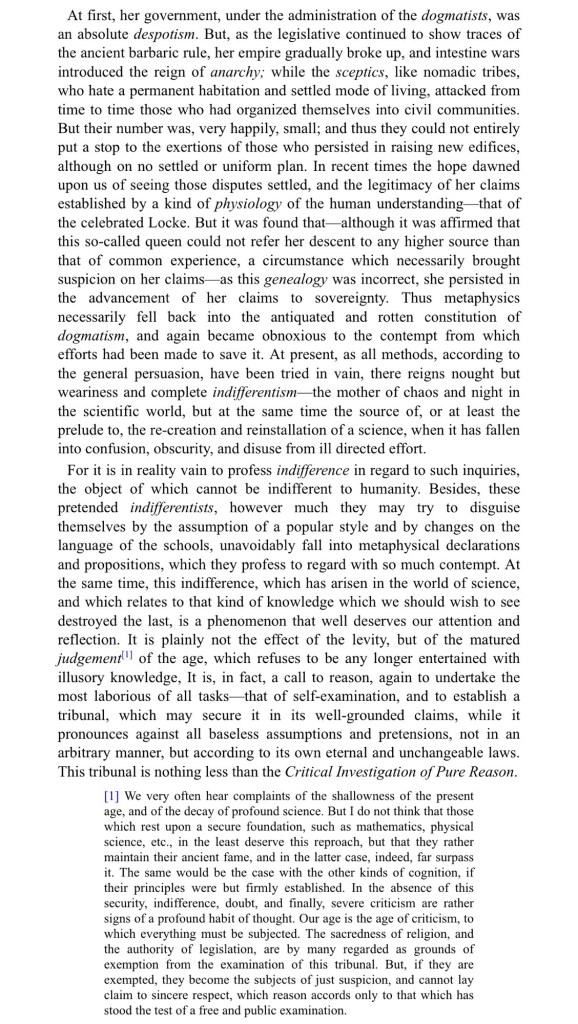
This is where Kant’s metaphor of metaphysics as a fallen queen becomes much more elaborate. He now turns the history of philosophy into the history of a political constitution. The German is striking: “Zuerst war ihre Herrschaft unter der Verwaltung der Dogmatiker ein Despotismus,” literally, “At first her rule, under the administration of the dogmatists, was a despotism.” Metaphysics is no longer merely a queen who has fallen; she is a kingdom whose political history mirrors the history of philosophy. The “dogmatists” are those rationalist metaphysicians who believed that reason could establish substantive truths about ultimate reality through principles whose validity they did not first critically examine. Leibniz and, especially in Kant’s immediate intellectual environment, Christian Wolff are important here. Wolff’s philosophy presented itself as an orderly, demonstrative science of metaphysics: definitions, axioms, propositions, proofs. From Kant’s perspective, however, this confidence contains the seed of the problem. Dogmatism is not simply “being stubborn” in the ordinary sense. It is the philosophical procedure of beginning to make metaphysical claims without first investigating the legitimate scope and powers of reason itself. The political metaphor is therefore exact: despotism means authority exercised without an adequate constitutional examination of its right to rule. Metaphysics claims sovereignty over questions concerning God, the soul, the world, necessity, freedom, and ultimate reality, but it has not yet established the jurisdiction under which those claims are legitimate. Kant is not saying that the dogmatists asked stupid questions. Quite the opposite: they asked the highest questions. Their error was that they assumed their method could answer them.
Then Kant says that “the legislative continued to show traces of the ancient barbaric rule,” and consequently the empire broke apart into “intestine wars.” This is Kant’s image for the internal disputes among metaphysical systems. “Intestine” here means internal, civil, within the body politic. Metaphysics becomes a civil war between competing rational systems. Leibnizians, Wolffians, Cartesian rationalists, empiricists, theological metaphysicians, and their various descendants can all produce arguments, but there is no universally recognized tribunal capable of deciding between them. This is precisely the “Kampfplatz,” the battlefield, he described in the previous paragraph. The remarkable thing is that Kant is not yet choosing one faction against another. He is asking why the war persists. If metaphysics were functioning like mathematics or successful natural science, disagreement would eventually be settled by demonstrations or evidence. But metaphysics repeatedly produces systems that claim necessity while disagreeing about the very foundations of reality. The fact of persistent disagreement therefore becomes philosophically significant. Kant is beginning to suspect that the problem is not simply that one metaphysical school has chosen the wrong propositions. The problem may lie in the conditions under which metaphysical propositions are being generated at all.
Then the skeptics arrive as “nomadic tribes.” This is a wonderfully revealing metaphor. The skeptic does not build a permanent philosophical state. He moves through the ruins of established systems, attacks their claims, exposes contradictions, and then moves on. Kant has Hume especially in mind, although the history of skepticism is obviously much older. Hume’s role is fascinating because Kant does not simply regard him as an enemy. Hume’s skeptical attack on causality and metaphysics helped Kant recognize the inadequacy of dogmatic rationalism. Yet skepticism, by itself, cannot provide the positive foundation Kant wants. If the dogmatist says, “Reason can know ultimate reality,” and the skeptic says, “No, reason cannot establish any of this,” Kant wants to ask a prior question: “What are the actual conditions and limits of reason?” That is why the skeptic’s nomadic character matters. Skepticism can destroy unjustified settlements, but it cannot itself establish a legitimate constitution. It can show that a particular claim fails, but it does not necessarily explain what kind of claim could succeed. Kant therefore needs to preserve the skeptical moment without allowing skepticism to become the final word.
The passage about Locke is particularly important because Kant is now telling us that someone had already attempted something resembling the project he himself is about to undertake. “In recent times the hope dawned upon us of seeing those disputes settled, and the legitimacy of her claims established by a kind of physiology of the human understanding—that of the celebrated Locke.” This is Kant’s description of Locke’s Essay Concerning Human Understanding. Locke had attempted to investigate the origin and limits of human knowledge by examining the human mind. The metaphor of “physiology” is significant because Locke turns philosophical attention away from purely abstract metaphysical objects and toward the cognitive apparatus through which we acquire ideas. In that respect Locke looks like a precursor to Kant’s critical project. But Kant thinks Locke made a fundamental mistake. Locke believed he could trace the origin of human knowledge back to experience. Kant says that this “genealogy was incorrect.” Why? Because experience cannot account for everything that makes experience itself intelligible. Locke’s empiricism tends to treat the mind as receiving materials from sensation and reflecting upon them, but Kant is going to argue that cognition requires structures that are not themselves derived from experience. Space and time, for example, cannot simply be learned from experience if they are conditions under which experience is possible. Likewise, the basic categories through which we think objects—causality, substance, unity, plurality, and so forth—cannot simply be copied out of experience. They are conditions for organizing experience in the first place.
This is one of the places where Leibniz and Locke become especially important to keep in view together. Leibniz had objected to the empiricist tendency to reduce cognition to sensory experience. His famous remark to Locke is that “there is nothing in the intellect that was not first in the senses, except the intellect itself”—“nihil est in intellectu quod non fuerit in sensu, nisi ipse intellectus.” Kant inherits the problem behind this dispute but transforms it. He will not simply return to Leibniz and say, “The rationalists were right; reason contains innate truths.” Instead, he asks what structures the subject must contribute in order for sensory material to become objective experience at all. This is the beginning of Kant’s distinctive position. He is neither simply rationalist nor simply empiricist. Sensibility supplies something that thought cannot generate by itself, while understanding supplies something that sensibility cannot provide by itself. Kant will eventually formulate this with the famous statement that “thoughts without content are empty, intuitions without concepts are blind.” That sentence is still far ahead of us, but the problem is already here in the preface: Locke correctly saw that we need to investigate the human faculty of cognition, but his empirical genealogy cannot explain the non-empirical structures that make experience possible.
Then Kant delivers a devastating diagnosis: because Locke’s genealogy fails, metaphysics “necessarily fell back into the antiquated and rotten constitution of dogmatism.” The image of a rotten constitution is important. Kant is not merely saying Locke made a mistake in one theory. The failure of Locke’s empiricism leaves metaphysics vulnerable to a return of the old dogmatism because no adequate alternative has been established. This is why Kant’s project cannot simply be called empiricism. He needs to establish a new constitution for reason. That constitution will not come from external authority, tradition, revelation, or empirical psychology. It will come from reason’s own examination of itself. This is the crucial meaning of “critique.”
Then we reach the present condition: “At present, as all methods, according to the general persuasion, have been tried in vain, there reigns nought but weariness and complete indifferentism.” The word “indifferentism” is important. Kant is diagnosing something that might initially look like intellectual progress. People have become tired of metaphysical disputes. Perhaps they have concluded that none of these questions can be answered and therefore it is better simply to stop caring. But Kant refuses this conclusion. He calls indifferentism “the mother of chaos and night in the scientific world,” yet immediately adds that it can also be “the source of, or at least the prelude to, the re-creation and reinstallation of a science.” This is a beautiful dialectical moment, even though we should not yet call it Hegelian. A crisis can be destructive, but it can also become the condition for reconstruction. The collapse of confidence in metaphysics might actually be beneficial if it forces philosophy to ask the question it has avoided: what are the legitimate conditions of knowledge itself? Kant is therefore interpreting intellectual exhaustion as a historical opportunity. The old metaphysics has failed; skepticism has destabilized it; empiricism has failed to provide an adequate foundation; people have become indifferent. This is precisely the moment when critique becomes necessary.
And Kant refuses the easy escape from metaphysics: “it is in reality vain to profess indifference in regard to such inquiries, the object of which cannot be indifferent to humanity.” This sentence is extremely important for understanding Kant’s conception of philosophy. The questions of God, freedom, immortality, the limits of knowledge, the nature of the world, and the possibility of moral obligation are not optional intellectual hobbies. Human beings inevitably care about them. Even someone who claims to reject metaphysics will eventually make assumptions about reality, knowledge, freedom, morality, or God. Kant says these alleged indifferentists “unavoidably fall into metaphysical declarations and propositions.” In other words, you cannot simply escape metaphysics by refusing to discuss metaphysics. The moment you make claims about what can or cannot be known, what reality is, whether freedom exists, whether causality is universal, or whether morality has objective authority, you are already making philosophical commitments. The question is therefore not whether we will have metaphysics. The question is whether our metaphysics will be conscious and critically justified or unconscious and dogmatic.
This is why the next sentence is so important: “this indifference… is plainly not the effect of the levity, but of the matured judgement of the age.” Kant is not sneering at his contemporaries for becoming skeptical. He thinks the exhaustion is intellectually legitimate. The age has discovered that inherited metaphysical systems cannot simply demand obedience. It refuses to be “entertained with illusory knowledge.” And this is where Kant makes one of his most profound claims: skepticism and criticism can be signs of intellectual maturity. He says in the footnote that “indifference, doubt, and finally, severe criticism are rather signs of a profound habit of thought.” This is a very different conception of intellectual progress from the idea that progress means accumulating more positive doctrines. Sometimes progress means losing the ability to believe what one can no longer justify. The crisis is therefore not merely a problem; it is evidence that reason has matured enough to recognize its own dissatisfaction with unsupported claims.
Then comes the sentence that essentially gives the entire book its mission: “It is, in fact, a call to reason, again to undertake the most laborious of all tasks—that of self-examination.” In German, “die Vernunft aufzufordern, das beschwerlichste aller ihrer Geschäfte, nämlich das der Selbsterkenntnis, wiederum zu übernehmen.” The phrase “Selbsterkenntnis,” self-knowledge, is crucial. Kant is not asking reason merely to acquire knowledge of another object. He is asking reason to know itself. This is where the Critique becomes genuinely revolutionary. Traditional metaphysics asks: What is being? What is the soul? Does God exist? Is the world finite? Kant asks a prior question: What is reason doing when it asks these questions? What are the conditions under which reason can legitimately answer them? What are the limits of the faculties involved? The philosophical gaze turns back upon the knower. This is why the title is “Critique of Pure Reason” rather than “A New Metaphysical System.” Kant is not initially giving us another system of ultimate reality. He is examining the instrument—or perhaps better, the jurisdiction—through which such claims would have to be made.
And then he gives us the magnificent image of the “tribunal”: reason must “establish a tribunal, which may secure it in its well-grounded claims, while it pronounces against all baseless assumptions and pretensions.” The German is “einen Gerichtshof einzusetzen, der sie bei ihren gerechten Ansprüchen sichere, dagegen alle grundlosen Anmaßungen… abfertigen könne.” The tribunal is one of the master-images of the Critique. Notice that reason is simultaneously judge and defendant. It establishes a court for itself, according to its own laws. This is why Kant’s project is neither authoritarian nor merely skeptical. The court cannot simply impose arbitrary restrictions on reason. Its judgments must be grounded in “eternal and unchangeable laws” belonging to reason itself. Kant is trying to create a form of intellectual self-legislation. Reason must determine what it is legitimately entitled to claim. That is why “critique” does not mean destruction. It is constitutional adjudication. Reason says: here is what I can legitimately know; here is what I cannot know theoretically; here is why; here are the conditions under which my claims are valid; here are the illusions produced when I exceed those conditions.
The footnote at the end extends this entire conception into Kant’s understanding of his historical moment. He rejects the common complaint that the age is intellectually shallow. Mathematics and physical science, he says, do not deserve this criticism. In fact, physical science has surpassed its ancient achievements. The problem is that other forms of cognition lack securely established principles. This is enormously significant. Kant is not anti-science, nor is the Critique an attack on the Enlightenment. He is actually trying to understand why mathematics and mathematical natural science have achieved the kind of certainty that metaphysics has failed to achieve. Newtonian physics is one of the great background conditions of the entire Critique. Kant wants to know how necessary, universal knowledge of nature is possible. If he can explain that, he may also be able to explain precisely why metaphysics has failed where science succeeds. The contrast is therefore methodological: science has secured its principles; metaphysics has not.
And then the footnote ends with perhaps one of Kant’s most politically significant sentences: “Our age is the age of criticism, to which everything must be subjected.” Notice the scope: everything. He explicitly includes religion and legislation. Neither sacredness nor political authority automatically exempts something from rational examination. “The sacredness of religion, and the authority of legislation,” he says, are by many regarded as grounds of exemption from the tribunal. But if they are exempted, they become objects of suspicion. Kant is therefore connecting epistemological critique to the broader Enlightenment project of public rational examination. Something deserves sincere respect not because it declares itself sacred or authoritative, but because it can withstand free and public examination. There is a political dimension here that we should not lose. Kant’s tribunal is not merely an abstract epistemological device. It expresses an ideal of rational autonomy: legitimate authority is authority that can give an account of itself before reason.
So the whole passage now becomes a remarkably coherent historical narrative. Metaphysics begins as a despotism under dogmatism; competing systems produce civil war; skepticism attacks the systems from outside; Locke attempts a genealogy of knowledge but cannot adequately explain the structures that make experience possible; metaphysics therefore falls back into dogmatism; exhaustion produces indifferentism; but indifferentism cannot last because the questions of metaphysics are built into human reason itself. The crisis therefore becomes an invitation to self-knowledge. Reason must establish a tribunal over itself. And that tribunal is the Critique. The genius of Kant’s opening is that he makes the crisis of metaphysics itself into the reason for doing philosophy differently. He is not asking us to choose between dogmatism and skepticism. He is asking whether reason can become mature enough to determine its own limits. And that is the question we should carry with us as we continue, because almost everything that follows in the First Critique is an attempt to answer this one opening demand: what are we actually entitled to claim when we use reason?
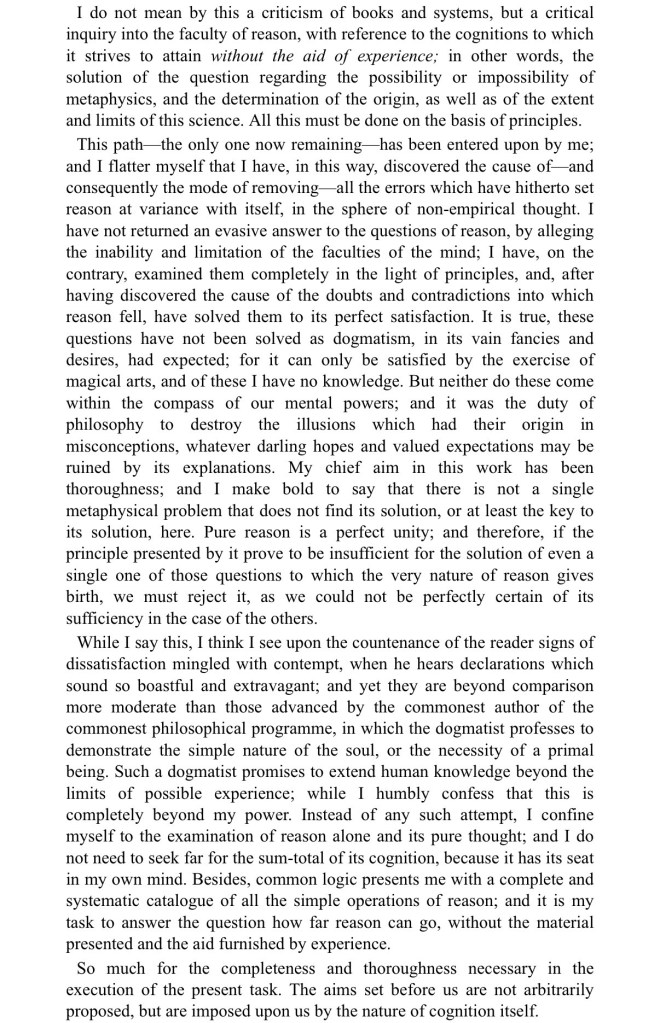
This passage is Kant tightening the meaning of the word “critique,” and it is important that he does this before he begins the actual machinery of the Critique. He wants to prevent us from making a very ordinary mistake about what he is doing. “I do not mean by this a criticism of books and systems,” he says. He is not proposing to write another history of philosophy in which he reviews Leibniz, Wolff, Descartes, Locke, Hume, and the rest and announces which systems he likes or dislikes. Nor is he merely offering another metaphysical system to compete with theirs. The German formulation is especially revealing: “Ich verstehe darunter aber nicht eine Kritik der Bücher und Systeme, sondern die des Vernunftvermögens überhaupt, in Ansehung aller Erkenntnisse, zu denen sie, von aller Erfahrung unabhängig, streben mag.” The object is the Vernunftvermögen, the “faculty or power of reason,” considered in relation to the kinds of cognition it attempts to reach independently of experience. So Kant is moving one level deeper than the traditional metaphysician. The metaphysician asks, “Is the soul simple?” Kant asks, “What kind of cognitive operation would allow us to make a legitimate judgment about the soul’s simplicity in the first place?” The metaphysician asks, “Does a necessary being exist?” Kant asks, “What are the conditions under which pure reason could legitimately establish the existence of such a being?” The difference is enormous. Kant is not initially investigating the objects of metaphysics; he is investigating the faculty that claims to know those objects. This is the beginning of what will become the transcendental standpoint. And notice that Kant is not simply asking whether metaphysics happens to be possible historically. He wants to determine its “origin,” its “extent,” and its “limits.” Where does this kind of cognition come from? How far can it legitimately reach? Where does it cease to have legitimate application? Those three questions will govern much of the entire book.
The phrase “without the aid of experience” is equally important. Kant is not asking whether human beings can know anything at all without experience. That would be absurd, because obviously much of our knowledge concerns things we encounter empirically. He is specifically concerned with cognition that reason seeks “independently of experience”—a priori cognition. This is the problem we encountered earlier in the historical background. Rationalist metaphysics believed that reason could discover truths about reality without depending upon sensory experience. Empiricism, especially in Hume, challenged the possibility of necessary knowledge that went beyond experience. Kant’s question is therefore not simply “rationalism or empiricism?” It is: what exactly does the mind contribute to cognition before experience gives us particular objects? And what kind of knowledge can arise from that contribution? This is why the Critique will eventually distinguish the a priori from the a posteriori, the analytic from the synthetic, sensibility from understanding, understanding from reason, and legitimate transcendental use from illegitimate transcendent use. Kant wants to discover the structure of cognition itself. But notice the phrase “all this must be done on the basis of principles.” This is crucial. Kant does not intend to give us a psychological description of how human beings happen to think. He is not doing empirical psychology. He is not going to conduct experiments on people’s minds. He wants to establish necessary principles governing cognition. This is one reason Kant’s “faculty” language should not be interpreted too casually as though he were simply describing brain modules. His question is normative and transcendental: what must be the case for certain kinds of cognition to be possible?
Then comes one of the boldest claims in the preface: “This path—the only one now remaining—has been entered upon by me; and I flatter myself that I have, in this way, discovered the cause of—and consequently the mode of removing—all the errors which have hitherto set reason at variance with itself, in the sphere of non-empirical thought.” The phrase “reason at variance with itself” is essential. Kant’s problem is not merely that different philosophers disagree with one another. He believes reason itself generates contradictions when it tries to think beyond possible experience. This anticipates the Antinomy of Pure Reason later in the book. Reason can prove a thesis and its opposite: that the world has a beginning in time and that it has no beginning; that freedom exists and that everything follows natural necessity; that there is a necessary being and that there is none. The problem therefore cannot be solved simply by picking the stronger argument. The conflict is structurally generated by reason’s own activity. Kant claims that he has discovered the “cause” of these contradictions, which means he believes he has discovered why reason inevitably gets itself into this condition. And because he has identified the cause, he believes he can also identify the way to remove the error. This is an extraordinary ambition. He is not merely saying, “Metaphysics has failed.” He is saying, “I can explain why metaphysics has failed.” That difference is the entire point of the Critique. A skeptic can point to contradictions; Kant wants to explain their source.
The next sentence is particularly revealing because Kant anticipates a very obvious objection: perhaps he is simply saying that human beings cannot know these things because our minds are limited. Kant explicitly rejects that strategy. “I have not returned an evasive answer to the questions of reason, by alleging the inability and limitation of the faculties of the mind.” This is important because Kant does not want his philosophy to collapse into a generic skepticism of human finitude. He does not want to say, “God is too big for our little brains,” or “The ultimate nature of reality is simply beyond us.” That would be intellectually unsatisfying because it would leave unexplained why reason generates these questions and why its arguments seem so compelling. Instead, Kant says he has “examined them completely in the light of principles.” In other words, he is not merely announcing a boundary; he is trying to demonstrate the boundary from the internal structure of cognition itself. This distinction will matter enormously later. When Kant says that we cannot know the thing in itself, for example, he is not simply confessing ignorance. He is trying to establish why the conditions under which objects can be known necessarily limit our knowledge to appearances. His limitation of knowledge is therefore itself supposed to be a piece of knowledge. This is one of the paradoxical beauties of the critical project: Kant wants to know the limits of knowledge, not merely to encounter them blindly.
His sarcastic attack on dogmatism then becomes understandable: “It is true, these questions have not been solved as dogmatism, in its vain fancies and desires, had expected; for it can only be satisfied by the exercise of magical arts, and of these I have no knowledge.” The sarcasm is wonderful. Kant is saying that dogmatism wants philosophy to perform miracles. It wants reason to produce knowledge of things that, according to Kant, lie outside the conditions under which human cognition can legitimately operate. If dogmatism demands demonstrations of the simple nature of the soul, the existence of a necessary being, or the ultimate constitution of reality independently of experience, Kant’s answer is essentially: philosophy cannot perform magic. But this is not anti-metaphysical nihilism. He immediately says that “it was the duty of philosophy to destroy the illusions which had their origin in misconceptions, whatever darling hopes and valued expectations may be ruined by its explanations.” That phrase “darling hopes” is emotionally significant. Kant knows that metaphysical claims are not merely abstract propositions. They carry enormous existential weight. People want certainty about God, immortality, freedom, the soul, the ultimate meaning of things. Kant is saying that philosophy’s duty is not to preserve those hopes at the cost of intellectual honesty. If a cherished belief depends upon a misconception, philosophy has to expose the misconception. This is part of Kant’s Enlightenment ethos: reason cannot be asked to protect comforting conclusions from examination.
Yet this is precisely where we need to be careful, because Kant is not simply destroying metaphysics. He is trying to distinguish illegitimate metaphysical knowledge from legitimate metaphysical questioning. His claim that there is “not a single metaphysical problem that does not find its solution, or at least the key to its solution, here” is astonishingly confident. But what does “solution” mean? It does not mean that Kant will tell us whether the soul is ultimately simple, whether the world has a beginning, or what God is like. In many cases, his “solution” will consist in showing why the question cannot be answered theoretically in the way dogmatism demands. That itself is a solution because it explains the source of the problem. This is one of Kant’s most important philosophical innovations: sometimes the correct resolution of a philosophical problem is not an answer to the original question but a demonstration that the question has been formulated beyond the conditions that could make an answer possible. The Antinomies are the clearest example. Kant does not choose between “the world is finite” and “the world is infinite.” He shows why reason generates both claims when it mistakes the world as a totality for an object that could be given within experience. The contradiction is dissolved by changing our understanding of what the world can legitimately mean as an object of cognition.
Then Kant makes the extraordinary claim that “Pure reason is a perfect unity.” This sentence deserves to stay in our heads for the whole book. Kant is assuming that reason is not an arbitrary collection of disconnected capacities. There must be systematic unity in its principles. If one of its fundamental principles fails to explain even one of the questions generated by the nature of reason, then we have reason to doubt the entire structure. The Critique is therefore supposed to be architectonic. Kant wants to map the whole system of pure reason. This is one reason he cares so much about completeness. He believes the faculties and their principles form an interconnected structure. If, for example, we discover that the categories of understanding cannot legitimately be applied beyond experience, that fact will affect our understanding of metaphysics, cosmology, theology, psychology, and the possibility of synthetic a priori knowledge. Nothing is isolated. The system has to hang together.
Now Kant anticipates the reader’s reaction: “I think I see upon the countenance of the reader signs of dissatisfaction mingled with contempt.” He knows he sounds arrogant. And then he makes a fascinating comparison. His claim that he will solve the problems of metaphysics sounds extravagant, but he says it is actually more modest than the ordinary metaphysician who claims to prove the simplicity of the soul or the existence of a necessary being. The dogmatist promises to extend human knowledge beyond possible experience. Kant refuses to make that promise. This is perhaps the central humility of the Critique. Kant’s ambition is enormous at the level of method but deliberately limited at the level of objects. He claims to be able to determine the limits of human cognition, but he does not claim to possess knowledge of everything beyond those limits. This is why the subtitle of the project could almost be understood as: “I will tell you exactly what human reason can and cannot legitimately know, and I will not pretend to know what lies beyond that.”
Then we get a fascinating sentence: “I confine myself to the examination of reason alone and its pure thought; and I do not need to seek far for the sum-total of its cognition, because it has its seat in my own mind.” Here we need to be careful not to read Kant as though he were saying, “I can introspect and discover every possible form of cognition inside my private psychology.” That would be a misunderstanding. Kant’s argument is not empirical introspection. He is asking what structures must be presupposed by the very possibility of cognition. The “seat” of pure reason is the human cognitive subject, but Kant’s investigation is transcendental rather than psychological. And this is where his relationship to Locke becomes particularly important. Locke had attempted to investigate the understanding by tracing the origins of ideas. Kant instead wants to investigate the conditions under which cognition is possible. He therefore moves from an empirical genealogy of mental contents toward a transcendental analysis of the structures that make objective experience possible. This is one of the points where Kant begins to depart decisively from the British empiricist tradition.
The reference to “common logic” then becomes extremely important. Kant says that common logic gives him “a complete and systematic catalogue of all the simple operations of reason,” and his task is to ask how far reason can go without the “material presented” by experience. Here Kant is preparing us for one of the most important structural distinctions in the whole Critique: logic tells us about the form of thought, while transcendental philosophy asks about the relation between those forms and objects of possible experience. Kant will eventually use the traditional logical forms of judgment as a clue for deriving the categories of the understanding. This is where Aristotle enters our story in a major way. Aristotle had developed a systematic account of categories and forms of predication, and his logical investigations became foundational for centuries of philosophical thought. Kant will take this inherited logical architecture and radically reinterpret it. He will argue that the basic forms of judgment can reveal the basic concepts through which the understanding structures objects of experience. This is one of the places where our backward genealogy will become especially rich: Aristotle → scholastic logic → Leibnizian/Wolffian rationalism → Kant’s table of judgments and categories. We will want to slow down considerably when we reach that point.
The final sentence of the passage gives us another crucial principle: “The aims set before us are not arbitrarily proposed, but are imposed upon us by the nature of cognition itself.” Kant is insisting that the Critique is not a philosophical game he invented. He is responding to a necessity built into cognition. Human beings naturally seek knowledge that goes beyond particular experiences toward principles, conditions, and ultimately the unconditioned. Therefore the investigation of reason’s limits is itself demanded by reason. This is why the book is both destructive and constructive. It destroys dogmatic illusions, but it does so because it wants to establish a secure domain for legitimate knowledge. And here we can already see the seed of something that will later become enormously important for Hegel and the post-Kantian tradition: reason must somehow become an object to itself. Reason cannot simply use its powers; it must examine the conditions and limits of those powers. The subject becomes capable of turning its own cognitive activity into the object of philosophical investigation. Kant’s “tribunal” is therefore the institutional metaphor for a deeper philosophical movement: reason examining itself.
The great historical picture is becoming clearer now. Aristotle gives Kant a logic and a vocabulary of categories, though Kant will transform them. Leibniz and Wolff give him the rationalist ambition to derive metaphysical truths through pure thought, but Kant comes to believe that this ambition exceeds the legitimate use of reason. Locke gives him the idea that philosophy must investigate the faculty of understanding, but Kant thinks Locke’s empirical genealogy cannot explain the a priori structures of cognition. Hume gives him the devastating challenge that concepts like causality cannot simply be assumed to have objective necessity, forcing Kant to ask what makes such necessity possible. Newton gives him a model of successful synthetic a priori natural science that metaphysics has conspicuously failed to match. And all of this converges in the peculiar task Kant announces here: not another system of metaphysical objects, but a critical investigation into the faculty that produces metaphysical questions. That is the threshold we are standing at now. The next step will be to understand exactly what Kant means by “pure,” “a priori,” “synthetic,” and “cognition,” because without those distinctions the title Critique of Pure Reason will remain almost impossible to understand.
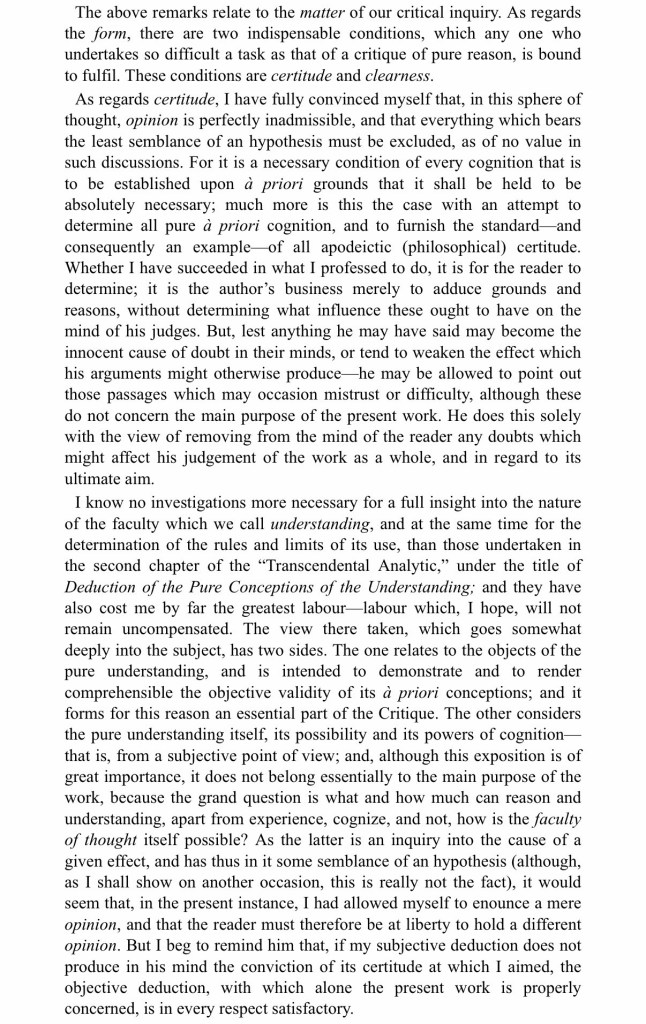
Kant is now doing something slightly different from what he was doing in the preceding pages. He has explained the matter of the Critique—namely, the investigation of pure reason and the possibility, origin, extent, and limits of metaphysics—and he now turns to the form that such an investigation must take. He says there are two “indispensable conditions”: certitude and clearness. The German is “Gewißheit und Deutlichkeit.” Those two words are worth retaining. Gewißheit is certainty or assuredness; Deutlichkeit is distinctness, clarity, intelligibility. Kant is saying that a critique of pure reason cannot be a speculative essay in which the philosopher offers interesting possibilities and asks the reader to consider them. If the book is going to establish the limits and legitimate powers of a priori cognition, then its own claims must meet an exceptionally high standard. This is because the object being investigated is precisely cognition that claims necessity. Kant therefore says that “opinion is perfectly inadmissible” and that anything resembling a hypothesis must be excluded. This is an important methodological declaration. He is not saying that philosophy can never employ provisional hypotheses in any sense. He is saying that a hypothesis cannot serve as the foundation for a determination of necessary a priori cognition. If I am trying to establish what must be true of cognition independently of experience, I cannot simply say, “Perhaps the mind works this way.” The very form of the investigation demands something stronger. Kant uses the word “apodeictic,” from the Greek ἀποδεικτικός, meaning demonstrative or necessarily certain. An apodeictic proposition is not merely true as a matter of fact; it is necessary. “A triangle has three sides” has a different modal character from “it is raining.” Kant’s ambition is to establish a standard for precisely this kind of necessity in philosophy. This is already telling us something about his intellectual relationship to mathematics. Kant looks at mathematics and asks: what makes mathematical cognition possible with this kind of necessity and universality? Can philosophy achieve comparable certainty, and if so, under what conditions?
There is also a subtle ethical dimension to Kant’s statement that “it is for the reader to determine” whether he has succeeded. Kant says the author’s business is to provide “grounds and reasons” and not to dictate what effect those reasons ought to have on the judges. The judicial metaphor from the previous passage continues. The reader is a judge; Kant is the advocate presenting evidence. He cannot simply declare himself victorious. But then he immediately adds an important qualification: he may point out passages that could create mistrust or difficulty, even if those passages do not concern the main purpose of the work. This is Kant anticipating objections. And this anticipatory quality will become characteristic of the entire Critique. Kant knows the argument is counterintuitive. He knows readers trained in traditional metaphysics or empiricism will find parts of it difficult. He therefore wants to distinguish a genuine structural problem in his argument from a passage that might merely seem suspicious because it is unfamiliar. This is part of why Kant’s prefaces are so useful to us. He is giving us a map of where he expects the reader to get lost.
Then we encounter what Kant himself identifies as the most difficult part of the entire First Critique: the “Deduction of the Pure Conceptions of the Understanding,” in the second chapter of the Transcendental Analytic. We should mark this very carefully because we are going to encounter it later and it will probably be one of the places where we slow down most dramatically. Kant says that he knows of no investigation more necessary for understanding the faculty we call “understanding” and for determining the rules and limits of its use. The German title is “Deduktion der reinen Verstandesbegriffe.” The word “Deduktion” here does not simply mean a logical deduction in the modern classroom sense, like deriving a conclusion from premises. Kant is borrowing a juridical meaning of “deduction,” something closer to a demonstration of a legitimate right or title. This makes perfect sense in the context of his tribunal metaphor. Kant has identified certain pure concepts of the understanding—the categories—and now he needs to establish their “objective validity.” In other words: by what right can these concepts claim application to objects? Why is it legitimate to think nature through concepts such as causality, substance, unity, plurality, necessity, and so forth? Where did we get the right to say that every event must have a cause? It is not enough for Kant to say that the human mind happens to use the concept of causality. He needs to establish that causality has objective validity for objects of possible experience. The Deduction is therefore going to be a kind of legal demonstration of the entitlement of the categories.
Kant then says the Deduction has “two sides.” This distinction is extremely important because it reveals a tension inside Kant’s own transcendental method. One side concerns “the objects of the pure understanding” and demonstrates the “objective validity” of its a priori concepts. The other concerns “the pure understanding itself, its possibility and its powers of cognition,” which is the subjective side. The first is about objects; the second is about the cognitive faculty. Kant’s priority is clear: the objective question is essential to the Critique, while the subjective question, although important, is not strictly essential to its main purpose. This distinction is going to matter enormously when we later discuss the different versions of the Deduction in the 1781 and 1787 editions. Kant substantially rewrites the Deduction for the second edition, and one of the major differences concerns precisely how he handles the subjective and objective aspects. So this little preface is actually preparing us for a major historical and textual issue. The 1781 Deduction will be more psychologically suggestive and architecturally difficult; the 1787 Deduction will present the argument in a more explicitly transcendental form. When we get there, we should read them carefully against one another rather than treating the second edition as merely a polished version of the first.
Now the phrase “objective validity” deserves to become one of our central terms. Kant is not simply asking whether the categories exist in the mind. Of course, if they are “pure concepts of the understanding,” they belong to the structure of cognition. But that is not enough. Suppose I have a concept of causality. I can demonstrate that I possess or employ the concept. But why should that concept tell me anything about objects? Why should nature conform to it? This is the problem of objective validity. Kant is therefore caught between two possibilities that each threaten his project. If the categories are merely subjective habits, then they cannot yield objective knowledge. But if they somehow apply to things as they are independently of our mode of cognition, then Kant needs to explain how we could possibly know that. His solution will be extraordinarily subtle: the categories have objective validity because they are conditions under which objects of possible experience can be objects for us at all. They do not give us knowledge of things as they might exist independently of experience. They govern the structure of possible experience. That is one of the great moves of transcendental philosophy, but we should not rush ahead too quickly. The Deduction is where Kant attempts to prove it.
Kant then becomes unusually candid about a possible weakness. He says that the subjective deduction might appear to be an inquiry into the “cause of a given effect,” and therefore might seem to have the form of a hypothesis. This is a fascinating self-criticism. If you ask, “Why does the human mind possess these particular cognitive powers?” you appear to be asking for a causal explanation of a fact. That starts looking like empirical psychology or speculative anthropology: perhaps the mind evolved this way, perhaps the brain is structured this way, perhaps experience produces these habits. But Kant’s transcendental project is not trying to discover the empirical cause of cognition. He wants to determine the conditions of its possibility. Those are very different questions. If I ask, “What caused human beings to develop the concept of causality?” that is an empirical historical or psychological question. If I ask, “What must be true of cognition for causal judgments to be possible as objective judgments about events?” that is a transcendental question. The former searches for an origin in time; the latter searches for a condition of possibility. Kant’s remark here is therefore a warning against reading transcendental philosophy as psychology.
This is one of the places where Kant’s departure from Locke becomes especially sharp. Locke asks about the origin of ideas in human experience. Kant asks about the conditions under which experience itself can yield objective cognition. Locke’s question is genealogical: where did this idea come from? Kant’s question is transcendental: what must be presupposed for this kind of cognition to be possible? The distinction is not merely terminological. It marks the transformation of the entire philosophical enterprise. Kant is not interested in discovering the historical or biological origin of our cognitive faculties. He wants to discover their necessary structure. This also helps explain why the word “transcendental” should not be confused with “transcendent.” Transcendent cognition tries to go beyond possible experience toward things that cannot be given within it. Transcendental inquiry investigates the conditions under which experience and cognition are possible. Kant’s entire project is therefore a kind of turning inward—not into private psychology, but toward the formal conditions that make objective cognition possible.
The final sentence is therefore Kant protecting the main argument from a possible failure of the subjective deduction. He says, essentially: even if the subjective account does not convince you, the objective deduction remains the essential argument. “If my subjective deduction does not produce in his mind the conviction of its certitude at which I aimed, the objective deduction… is in every respect satisfactory.” This is a remarkable admission because Kant knows the subjective side is philosophically interesting but potentially less demonstrable. He wants the reader to understand that the Critique does not stand or fall on a psychological explanation of how the understanding itself is possible. The essential issue is whether the pure concepts of the understanding can legitimately apply to objects of experience. This is another reason why “objective validity” is the phrase to remember.
There is, however, a deeper philosophical tension here that we should keep in view as we continue. Kant is attempting to investigate the conditions of cognition while refusing to explain those conditions causally. He wants to know how cognition is possible, but he does not want to answer by saying what caused the mind to have these powers. This distinction between transcendental conditions and causal explanations will become foundational for much of later philosophy. Husserl will radicalize it through phenomenology, asking about the conditions under which objects are constituted for consciousness. Heidegger will criticize Kant for not pushing the question of the conditions of possibility far enough into temporality and finitude. Hegel will object in a different way that Kant’s critical separation between the knowing subject and the object leaves a gap that philosophy must overcome. And Derrida will repeatedly examine what happens when a system tries to establish its own conditions of possibility and encounters conditions that are simultaneously necessary and resistant to complete conceptual mastery. But for now, Kant’s own question is simpler and more precise: if we possess pure concepts such as causality and substance, what gives us the right to apply them objectively to experience?
This passage therefore gives us a very useful preview of the architecture ahead. Kant has told us that the Critique must be certain because it investigates a priori cognition; it must be clear because the argument is extraordinarily difficult; and it must establish the legitimacy of the categories rather than merely describe that we happen to use them. The Deduction will be the courtroom where those categories are asked to produce their title of legitimacy. And the central question will not be “Where did the categories psychologically come from?” but “Why must these concepts apply to objects of possible experience if objective experience itself is to be possible?” That distinction is going to be one of the first great thresholds in our reading. When we eventually arrive at the Deduction, we should resist the urge to jump straight to its conclusion. We want to feel why Kant thinks he has to undertake a Deduction at all. Once that necessity is clear, the argument becomes much less mysterious.
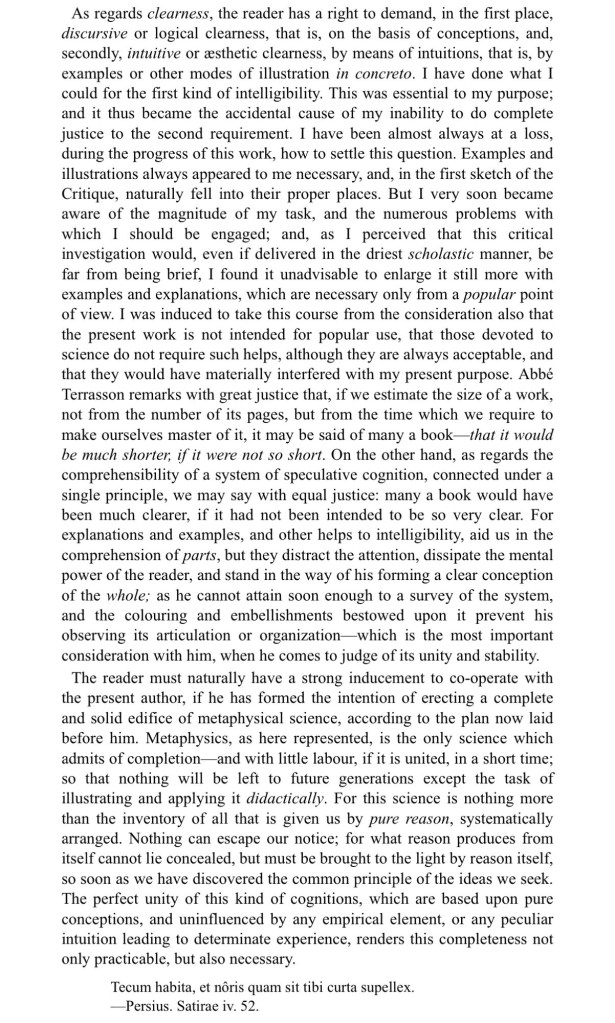
Kant is now completing his account of the conditions under which the Critique must be written, and the distinction he makes between two kinds of “clearness” is much more philosophically important than it initially appears. He says the reader has a right to demand, first, “discursive or logical clearness,” which operates through concepts, and second, “intuitive or aesthetic clearness,” which operates through intuitions, examples, and concrete illustrations. The German terms are “diskursive” and “intuitive,” and this is already bringing us toward one of the most fundamental distinctions in Kant: concepts and intuitions are not two different degrees of the same thing. They are different modes of cognition. A concept mediates; an intuition gives. When Kant says he has prioritized discursive clearness, he means that he has tried to make the logical relations among his concepts explicit and rigorous. But he recognizes that a reader also wants to see what those concepts look like when concretely instantiated. The problem is that Kant thinks too many examples can actually obscure the architecture of a philosophical system. This is a strange claim if we approach philosophy pedagogically, because examples usually make difficult ideas easier. Kant acknowledges that. But he is worried about something else: the reader might understand each individual part while failing to grasp how the parts fit together. He is therefore distinguishing local intelligibility from systemic intelligibility. An example may make one proposition clearer while making the structure of the whole system harder to see.
The word “intuition” here is especially important because it is not being used in the everyday sense of a hunch or gut feeling. Kant’s German is Anschauung. An Anschauung is a mode of immediate presentation: something is given to cognition rather than merely thought through a general concept. This distinction will become foundational when we reach the Transcendental Aesthetic. There Kant will argue that human sensibility has two pure forms of intuition, space and time. So when Kant says that “aesthetic clearness” comes through intuitions, he is already using a technical vocabulary that will become central to the First Critique. He is effectively saying: concepts alone are not enough for human cognition; we also need something to be given. A purely conceptual explanation can be logically impeccable while remaining difficult to grasp because the reader has no concrete presentation through which to orient the concepts. But Kant’s concern here is that the Critique is not simply a collection of concepts. It is a system of relations among faculties, principles, forms of cognition, and their legitimate domains. If he fills every stage with examples, he fears that the reader will begin to see isolated pieces rather than the structure.
This is why the remarkable sentence about books being “much shorter, if they were not so short” appears. Kant attributes the thought to Abbé Terrasson: if we measure the size of a book not by the number of pages but by the time required to master it, many books would be shorter if they were not so short. The paradox is that compression can produce difficulty. A very concise book may require enormous labor from the reader because so much has been packed into so little verbal space. Kant then turns the thought around: “many a book would have been much clearer, if it had not been intended to be so very clear.” This is one of the most revealing things he says about how he wants us to read him. Excessive explanation can fragment the reader’s attention. Examples illuminate parts, but they can prevent the reader from seeing the system. Kant therefore deliberately chooses a relatively “scholastic” presentation. He is writing for readers willing to reconstruct an architecture rather than merely consume explanations. This is perhaps one reason Kant can be so difficult: he is asking us to understand the organization of the argument as much as the individual claims.
The word “articulation” near the end of the paragraph is especially important. Kant says that examples and “colouring and embellishments” can prevent the reader from observing the “articulation or organization” of the system. The German is “Gliederung,” which can mean articulation, structure, division into members, or organization. This is a very Kantian way of thinking. A system is not merely a collection of propositions. It is a structured whole in which each part has a determinate function and relation to the others. If you want to judge whether the system possesses “unity and stability,” you need to see its architecture. This is why Kant’s table-like classifications and systematic divisions can sometimes feel almost obsessive. The organization itself is philosophical content. When Kant distinguishes sensibility from understanding, understanding from reason, intuition from concept, analytic from synthetic, a priori from a posteriori, transcendental from transcendent, he is not merely creating convenient labels. He believes that the architecture of cognition can be discovered through the systematic articulation of these distinctions. This is one of the points where his influence on later systematic philosophers, especially Hegel, becomes profound. Hegel will object to some of Kant’s divisions, but he will inherit the conviction that philosophy must be understood as an internally articulated system rather than a series of isolated insights.
Then Kant makes a breathtaking claim: metaphysics, properly constituted, “is the only science which admits of completion.” This sounds almost absurdly confident after everything we’ve just read about metaphysics being the battlefield of endless disputes. But this is actually the culmination of his argument. The old metaphysics was incomplete because it had not established its own principles. The new metaphysics, grounded in the Critique, can in principle be completed because pure reason has a finite and determinate structure. If we can discover all the fundamental principles and concepts that reason produces independently of experience, then we can inventory them. Kant calls metaphysics, in this new sense, “the inventory of all that is given us by pure reason, systematically arranged.” The word “inventory” is wonderfully prosaic. He is stripping metaphysics of its aura of mystical infinity. Pure reason does not generate an endless number of arbitrary principles. It has a determinate structure. If we can uncover the common principles governing its concepts, then we can systematically enumerate them. Nothing can escape because reason itself is the source. What reason produces from itself cannot remain hidden from reason forever, provided we discover the common principle organizing those productions.
This idea of completeness is directly connected to the earlier statement that “Pure reason is a perfect unity.” Kant believes that pure reason is finite in structure even though its ambitions are unlimited. That distinction is crucial. Reason can ask endlessly many questions, but the fundamental forms through which it asks them may be finite and systematically discoverable. This is why the Critique can aspire to completeness. Kant is not saying that human beings will know every fact about reality. He is saying that the system of pure a priori cognition can, in principle, be exhaustively mapped. This is a very different conception of infinity. Empirical knowledge can expand indefinitely because experience continues to provide new content. Pure reason, by contrast, supplies a determinate set of forms and principles. If we can identify them all, the foundational science of metaphysics can be complete.
And here the phrase “given us by pure reason” needs careful handling. Kant is not saying that pure reason magically generates a stockpile of substantive facts about things in themselves. That would put him right back into the dogmatism he has spent the preface criticizing. What pure reason gives us are principles and concepts that belong to cognition independently of particular empirical content. The categories will be the clearest example. The understanding has concepts such as unity, plurality, causality, substance, possibility, necessity, and so forth. These are not empirical concepts learned by observing particular objects. Yet neither do they tell us what reality is independently of experience. They structure the way objects can be thought within experience. This is the delicate middle ground Kant is constructing. Pure reason supplies form; experience supplies content. Pure cognition is therefore neither an empirical inventory of observed facts nor a dogmatic vision of things beyond experience.
The final Latin quotation from Persius is wonderfully appropriate: “Tecum habita, et nôris quam sit tibi curta supellex.” Literally, “Dwell with yourself, and you will know how scanty your furnishings are.” Persius is telling us to look within ourselves and discover how little we actually possess. Kant’s use of the quotation is almost paradoxical. He has just claimed that pure reason contains a complete inventory, and now he quotes a line telling us to examine ourselves and discover our meager possessions. But the point is precisely that the “furniture” of pure reason is finite. If we stop imagining that reason can endlessly manufacture metaphysical objects, we can discover what it actually possesses. The apparent poverty of pure reason is also its determinacy. It does not possess infinite metaphysical knowledge. It possesses a finite set of forms and principles that can, in principle, be systematically articulated. The Critique is going to conduct that inventory.
There is also a subtle connection here to the opening metaphor of metaphysics as a fallen queen. Kant has moved from political imagery to architectural imagery. First metaphysics was a kingdom; now it is a building. The old kingdom fell because its constitution was defective. Kant proposes a new constitution. Then the new metaphysical science becomes an “edifice” that must be complete and solid. This architectural language will recur throughout the Critique: foundations, structure, unity, system, principles, limits. Kant is thinking like an architect of reason. And that is why the reader’s task is not merely to understand individual rooms. We need to understand the building’s plan.
This also explains why Kant is warning us against demanding too many examples. If we treat the Critique as a textbook, we might constantly ask, “Can you give me an example?” Kant would answer that examples are useful, but they can also tempt us to remain at the level of individual cases. His project is to uncover the structure that makes all such cases intelligible. When he eventually says that “all events must have a cause,” the example of a billiard ball hitting another billiard ball can help. But the philosophical question is not about billiard balls. It is: what makes the judgment “every event has a cause” possible as a necessary judgment about objects of experience? The example illustrates the principle; it does not establish the principle. Kant is interested in the latter.
And this is a useful moment to connect what we’ve read so far. Kant began by describing metaphysics as a battlefield produced by reason’s natural demand for the unconditioned. He then said that reason must establish a tribunal for itself. He clarified that this tribunal is not criticism of books but a critique of the faculty of reason. He insisted that the investigation must be certain and clear. Now he tells us that the system must also be complete. These are not independent requirements. Certitude means that the principles cannot rest on hypotheses. Clearness means that the relations among those principles must be intelligible. Completeness means that the system cannot arbitrarily omit a principle generated by pure reason. Together, these requirements explain why Kant thinks he can construct something genuinely new: a science of metaphysics whose subject is not an unknowable collection of transcendent objects, but the determinate structure of pure cognition itself.
There is an interesting historical background here too. The dream of a complete systematic science is very much connected to the rationalist tradition Kant inherited from Leibniz and Wolff. Wolff especially wanted philosophy to proceed systematically, almost geometrically, from definitions and principles toward a complete body of knowledge. Kant does not abandon that systematic ambition. What he abandons is the dogmatic assumption that systematic rational thought can simply leap from concepts to knowledge of things beyond possible experience. In that sense, Kant is more radical and more conservative than he first appears. He rejects the old metaphysics while preserving its demand for systematicity. He rejects its dogmatism while retaining its aspiration toward necessity and completeness. He rejects the idea that pure reason can know transcendent objects while insisting that pure reason itself can be systematically understood.
And that gives us a particularly important lesson for our reading: Kant’s criticism of metaphysics is not the rejection of metaphysical rigor; it is an attempt to make metaphysics rigorous enough to survive criticism. He wants to transform metaphysics from a speculative kingdom into a science whose boundaries, principles, and structure are known. The strange promise of the Critique is therefore that philosophy can finally become “complete” precisely by discovering what it cannot know. The limitation is not the failure of the system. The limitation is part of the system. Once reason understands the boundary between legitimate cognition and illegitimate speculation, the old battlefield can finally become an ordered territory. And that is probably the deepest reason Kant keeps insisting on architecture, articulation, unity, and completeness: he believes the real philosophical achievement will not be one more answer to one more metaphysical question, but the discovery of the form within which all legitimate answers must occur.
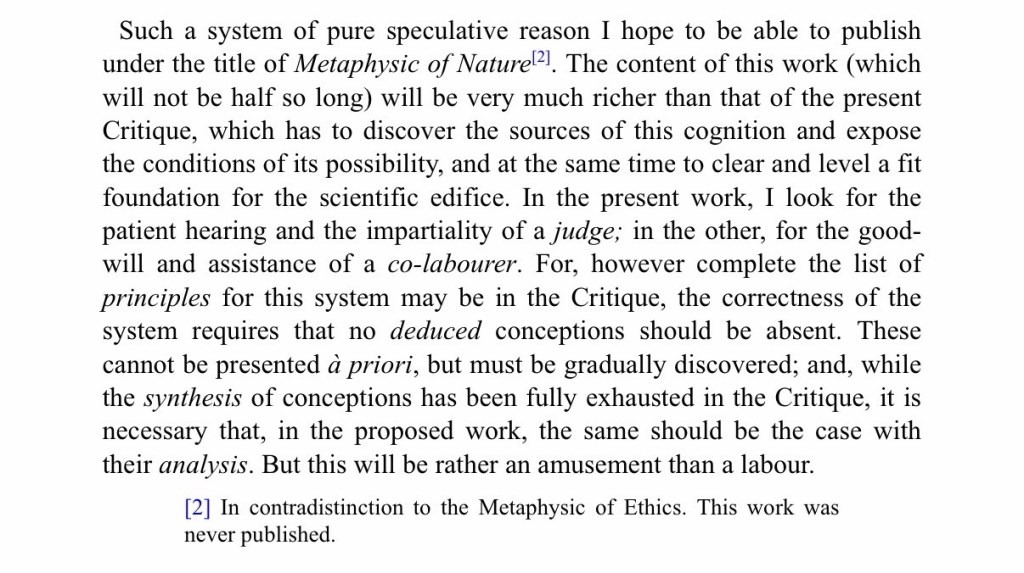
This is a very useful passage because Kant now tells us what he thinks the Critique is and, just as importantly, what he thinks it is not. He announces a future work that he calls the “Metaphysic of Nature,” German Metaphysik der Natur. The Critique is therefore not itself supposed to be the completed metaphysics of nature. It is the investigation that makes such a metaphysics possible. This gives us a distinction we should hold onto throughout our reading: the Critique is foundational, while the subsequent metaphysical system is constructive. Kant says the future work will be “very much richer” in content even though it will be less than half as long. Why? Because the Critique has a difficult preliminary task. It must discover “the sources” of pure cognition, expose “the conditions of its possibility,” and “clear and level a fit foundation” for the scientific edifice. Think of Kant as saying: before we construct the building, we have to determine what kind of ground we are standing on, what materials are legitimate, what the structural principles are, and where the boundaries of the building can be placed. The Critique is therefore not the building in its completed form. It is the investigation that determines the conditions under which the building can legitimately be constructed.
The German behind “sources” is Quellen, and behind “conditions of its possibility” is Bedingungen ihrer Möglichkeit. These expressions are going to become absolutely central to Kant. When Kant asks for the “conditions of possibility” of something, he is not asking what historically caused it or psychologically produced it. He is asking what must be presupposed for that thing to be possible at all. That distinction is worth becoming instinctive about. If we ask, “What caused me to learn the concept of causality?” we are doing psychology, history, education, perhaps neuroscience. If Kant asks, “What are the conditions under which an objective judgment of causality is possible?” he is asking a transcendental question. And the Critique is essentially one enormous attempt to answer questions of this type. What are the conditions of mathematical cognition? What are the conditions of experience? What are the conditions under which objects can be thought? What are the conditions under which reason can seek the unconditioned? And, eventually, what happens when reason attempts to use these structures beyond their legitimate domain?
There is a beautiful judicial shift here as well. Kant says that in the Critique he asks for “the patient hearing and impartiality of a judge,” whereas in the future metaphysics he asks for “the good-will and assistance of a co-labourer.” This perfectly continues the tribunal metaphor from earlier. The Critique is juridical: reason puts its own claims on trial. The reader is not supposed to simply join Kant enthusiastically; the reader is supposed to judge whether the arguments succeed. But once the critical foundation has been established, the mood changes. Now Kant wants collaborators. The future metaphysician is no longer primarily a judge of reason but a worker constructing the system upon the ground the Critique has cleared. There is almost a division of labor here: first the tribunal, then the construction site.
The next sentence is extremely revealing: “For, however complete the list of principles for this system may be in the Critique, the correctness of the system requires that no deduced conceptions should be absent.” Kant is distinguishing between principles and the concepts that can be derived or developed from those principles. The Critique aims to establish the fundamental inventory—the basic architecture of pure cognition. But a completed metaphysical science would have to work out all the consequences of that architecture. This is another reason Kant can say the future work will be richer even though the Critique is longer. The Critique spends enormous effort proving the foundations; the Metaphysics of Nature can then use those foundations to develop a much larger body of determinate doctrine.
The next distinction is particularly important: “These cannot be presented a priori, but must be gradually discovered.” This might initially sound contradictory. Kant has just spent hundreds of pages telling us about a priori cognition, and now he says these derived concepts cannot be presented a priori. What does he mean? He means that while the fundamental principles of the system can be established independently of experience, the full determination of the concepts that follow from them requires a different kind of intellectual work. The basic structure can be established a priori; the systematic elaboration of all the concepts that belong within that structure is another task. This distinction anticipates Kant’s later work in metaphysics, particularly his Metaphysical Foundations of Natural Science. There he attempts to show how the basic principles established critically can be used to formulate a metaphysical account of nature.
The most intriguing sentence is probably the last: “while the synthesis of conceptions has been fully exhausted in the Critique, it is necessary that, in the proposed work, the same should be the case with their analysis.” We should pause here because Kant is using “synthesis” and “analysis” in a technical philosophical sense, and this will eventually connect directly to his famous distinction between analytic and synthetic judgments. Synthesis is, broadly speaking, the combining or putting-together of representations into a unity. Analysis is the unpacking or clarification of what is contained within concepts. In the Critique, Kant believes he has carried the necessary synthesis far enough to establish the fundamental structure of pure cognition. The subsequent metaphysical work would then analyze and systematically develop the concepts that arise within that structure. So again we have the image of construction followed by examination of the constructed system. The Critique determines the basic architecture; the Metaphysics of Nature fills out the building.
The final remark—“this will be rather an amusement than a labour”—is characteristically Kantian in its confidence. Once the foundations have been established, he thinks the remaining work will be comparatively easy. This is almost painfully ironic historically, because Kant’s subsequent metaphysical project did not simply unfold as effortlessly as this preface suggests. More importantly, the footnote tells us that the work he mentions as the “Metaphysic of Nature” was never published under that title. Kant did, however, publish the Metaphysical Foundations of Natural Science in 1786, and later the Metaphysics of Morals in 1797. So we should distinguish Kant’s projected architecture from the works he actually completed. The First Critique is the foundation, but the complete metaphysical system Kant imagined was never realized exactly as promised here.
There is also something deeper happening in this passage. Kant is refusing the idea that the Critique itself is merely negative. It is tempting to read the title Critique of Pure Reason and imagine that Kant’s goal is simply to criticize reason, restrict it, and tell us what we cannot know. But Kant’s own description makes clear that critique is constructive. He wants to clear the ground so that something can actually be built. The limitation of reason is supposed to make positive knowledge possible. By determining which concepts legitimately apply to experience, Kant thinks we can secure the possibility of mathematics and natural science while simultaneously preventing metaphysics from illegitimately claiming knowledge of God, the soul, or the world as an absolute totality. The negative side of the Critique—the destruction of dogmatic metaphysics—is therefore in service of a positive project: establishing a secure domain of scientific and philosophical cognition.
And this is where the distinction between “pure speculative reason” and “pure practical reason,” which you encountered in the preface to the second Critique, will eventually become very important. In the First Critique, Kant is principally concerned with what pure reason can know. In the Second Critique, he will discover that freedom cannot be theoretically demonstrated in the same way as an object of knowledge, yet practical reason gives us a different kind of access to freedom through the moral law. That is why the later Kant can say that freedom becomes the “keystone” of the system of pure reason. But we should resist importing that later structure into the First Critique too early. For now, Kant is still constructing the critical foundation upon which the distinction between theoretical and practical reason will eventually become possible.
There is also a very important historical point concerning Aristotle and Leibniz here. Kant’s dream of a complete, systematically articulated science owes something to the rationalist tradition, particularly Leibniz and Wolff. Leibniz wanted knowledge to be organized through fundamental principles and logical relations, and Wolff turned this into an extraordinarily systematic philosophical architecture. Kant retains this systematic aspiration but subjects it to a radical critique. He essentially says: yes, philosophy must be systematic, but before we construct a system we must establish which cognitive resources actually possess objective validity. In that respect Kant does not destroy the rationalist project so much as place it under a tribunal. And Aristotle is lurking in the background as well, because Kant’s eventual inventory of the fundamental concepts of the understanding—the categories—will be presented through a systematic table. But whereas Aristotle’s categories concern the fundamental ways beings are predicated or said to be, Kant’s categories concern the fundamental concepts through which the understanding organizes objects of possible experience. That shift—from categories of being to categories of cognition—is one of the great transformations Kant makes.
So the trajectory of the preface is now becoming quite clear. Metaphysics historically began as queen, became dogmatic despotism, collapsed into skepticism and indifferentism, and now Kant proposes a critical tribunal. That tribunal examines pure reason itself. It discovers the sources, conditions, legitimate scope, and limits of a priori cognition. Once that foundation has been established, a genuine metaphysics can be constructed. The Critique is therefore not the final palace; it is the survey of the ground, the legal establishment of the building rights, and the architectural plan. The future metaphysics is the actual construction. Kant is asking us, in effect, to resist the temptation to demand immediate metaphysical answers from the Critique. First we have to learn what kind of cognition is possible. Only then can we responsibly ask what kind of metaphysical science can be built from it.
And that gives us a very good place to pause before Kant finally gets into the Preface’s remaining historical and editorial remarks. We now know what the Critique thinks it is doing: not producing a new collection of metaphysical doctrines, but establishing the conditions under which a legitimate system of metaphysics could exist at all. That distinction will govern almost every page that follows.


