“لا يصلح آخر هذه الأمة إلا ما أصلح أولها.”
“The latter part of this community will not be rectified except by that which rectified its first part.”
—Imām Mālik
Part 1 Ta
Part 2 Levinas
preface
What follows is a reading of the Qurʾān as a structured grammar of response, in which cognition, language, and ethical orientation are continuously interwoven. Its central claim is not that Qurʾānic Arabic encodes a deterministic system of logical operators, nor that its syntax can be reduced to computational form, but rather that the text persistently stages human understanding as an ordered sequence of responses to divine address. Across its varied discourses—narrative, exhortation, legal instruction, and supplication—the Qurʾān repeatedly situates the human subject in motion: perceiving signs (āyāt), reflecting upon them, recalling their meaning, unfolding implications over time, and finally returning them in gratitude, trust, or rejection. What emerges, then, is a patterned epistemology of engagement rather than a static theory of knowledge.
At the center of this reading are five recurrent verbal orientations found throughout the Qurʾānic corpus: tafakkur (reflective thinking), tadhakkur (recollective remembrance), tadabbur (deliberative unfolding), tashakkur (gratitude as recognition), and tawakkul (entrusted reliance). These are not treated here as an exhaustive taxonomy of cognition, nor as rigid stages in a linear process. Rather, they function as recurring modalities of attentional and existential orientation through which the Qurʾān repeatedly invites the reader to inhabit meaning. Tafakkur opens perception toward analytical attention to signs; tadhakkur reactivates latent recognition of divine address; tadabbur extends understanding across consequence, coherence, and temporal unfolding; tashakkur returns interpretation toward acknowledgment of source; and tawakkul stabilizes the subject in a posture of entrusted action and relinquished control. Taken together, these forms describe not a closed system but a recurrent rhythm of engagement.
This rhythmic structure is further illuminated through attention to Qurʾānic syntax, particularly the frequent use of particles and connective forms such as wa (and), fa (so/then), inna (indeed), li (for/to), fī (in), ʿalā (upon), ilā (toward), and min (from). Rather than treating these elements as fixed logical operators, this study approaches them as relational cues that organize movement within discourse: transitions between perception and reflection, continuity between acts of remembrance, or shifts from description to invocation. In this sense, grammatical structure is read as contributing to the phenomenology of response—how meaning is sequenced, redirected, intensified, or interiorized within the flow of address. However, this approach remains interpretive and heuristic: it does not claim that Qurʾānic grammar functions as a formal system of control logic, but rather that it consistently guides attention, posture, and orientation in ways that are experientially and rhetorically structured.
The framework developed here also distinguishes between levels of response. Īmān (faith) and islām (submission) are treated as higher-order orientations that stabilize and integrate the more immediate cognitive acts, while kufr, nifāq, and shirk appear as disruptions or distortions of responsiveness—failures of recognition, coherence, or orientation. These categories are not reduced to psychological states alone, but are read as modes of relational positioning in relation to divine address. The Qurʾān’s recurring juxtaposition of responsive and resistant subjectivities thus becomes central to its epistemic architecture: understanding is never merely informational but always already ethical and relational.
Methodologically, this study situates itself at the intersection of classical tafsīr, philological analysis, and contemporary interpretive theory. Classical exegetical traditions—particularly those of al-Ṭabarī, Ibn Kathīr, and Fakhr al-Dīn al-Rāzī—provide essential anchors for semantic range, contextual meaning, and theological framing. At the same time, modern approaches to discourse analysis, phenomenology, and philosophy of language allow for attention to patterns of address, temporality, and subject formation. The goal is not to replace these traditions with a new system, but to place them in productive tension with a model that foregrounds sequence, response, and orientation as interpretive keys.
It is important to state at the outset that this study does not assume that the Qurʾān is reducible to the model proposed here. Rather, the model is offered as a disciplined abstraction: a way of describing recurring patterns of engagement that the text itself repeatedly invites and enacts. Any diagrammatic representations, procedural mappings, or structural correspondences that appear in subsequent chapters should therefore be read as interpretive tools, not as claims about the exhaustive structure of Qurʾānic meaning. The Qurʾān exceeds any single analytic framework; the aim here is only to clarify one possible way of tracing its internal invitations to thought, remembrance, and response.
The chapters that follow develop this approach through close readings of key passages, most notably Āl ʿImrān 3:190–195 and al-Anʿām 6:48–50. These sections are selected not as isolated proof-texts, but as dense articulations of the Qurʾān’s broader rhetorical movement from sign to reflection, from reflection to invocation, and from invocation to ethical orientation. Through them, the study explores how linguistic form, theological content, and experiential structure converge in shaping a distinctive mode of human responsiveness to divine address.
In this sense, the project is less an argument for a new doctrine than an attempt to describe a pattern of intelligibility already implicit in the Qurʾānic text: a pattern in which understanding is inseparable from response, and in which meaning unfolds not in abstraction but in the lived sequence of attention, remembrance, articulation, and trust.
.
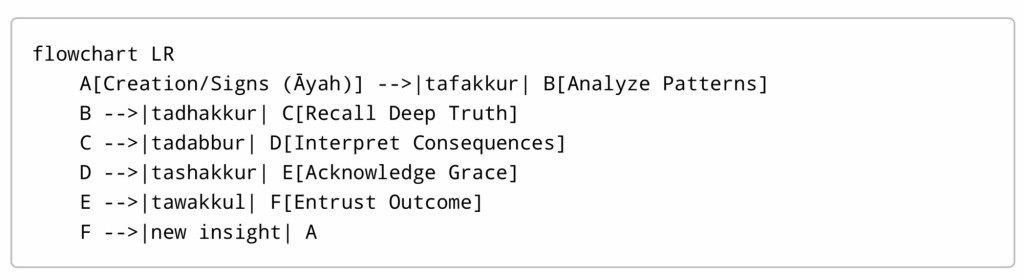
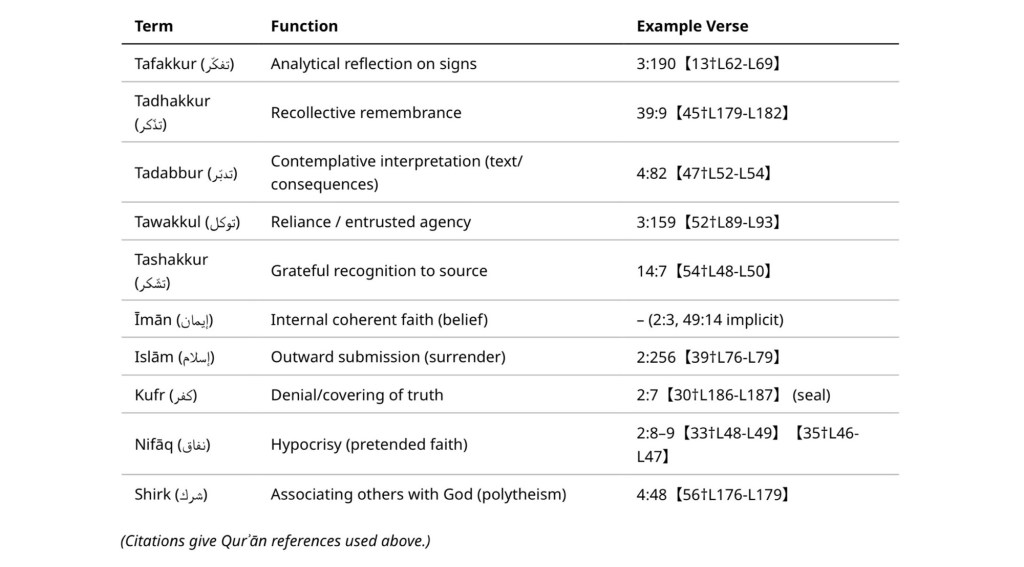
The Qurʾān envisions the human as responder to divine signs, not a passive knower. Its verses repeatedly map out a grammar of response built around five verbal forms derived from ت‑ (tafakkur, tadhakkur, tadabbur, tawakkul, tashakkur). Each denotes a distinct cognitive act – from analytical reflection to grateful recognition – that must align in sequence. Faith (īmān) and submission (islām) stand as higher-order operators binding these acts together, while their opposites (kufr, nifāq, shirk) represent broken response patterns. We analyze key Qurʾānic passages (especially Āl ʿImrān 3:190–195 and the Throne Verse 2:255) to show how particles like innā, fa, wa, li, fī, ʿalā, ilā, min, and invocations (rabbana…) function as logical “controls” shaping the response sequence. A word-by-word reading of 3:191 highlights how “fī” and “wa” coordinate immersion in creation with the petition of the heart. The result is a cyclical epistemology: signs (āyāt) in creation provoke tafakkur and tadhakkur, leading to tadabbur of consequences, triggering gratitude (tashakkur) and trust (tawakkul) – which in turn open new layers of insight. We illustrate this closed loop with diagrams and a table mapping terms to functions and verses, and we support our interpretation with classical tafsīr (Ṭabarī, Rāzī, Ibn Kathīr) and modern scholarship.
Thesis
The Qurʾān encodes an integrated response-grammar of knowing: a structured sequence of engagement with reality that every believer is commanded to enact. This grammar is built on five Qurʾānic roots: tafakkur (تفكّر, analytical pondering), tadhakkur (تذّكر, recollective remembering), tadabbur (تدبّر, contemplative unfolding), tawakkul (توكل, entrusted reliance), and tashakkur (تشّكر, gratitude‐recognition). Each corresponds to a different orientation of the mind and heart. The highest level is governed by īmān and islām: internal coherence of belief and outward conformity to God’s guidance. The converse states are kufr (denial), nifāq (hypocrisy), and shirk (polytheism), each a failure in this response-grammar. Syntactic particles (inna, fa, wa, li, fī, ʿalā, ilā, min) act as logical connectors, directing the flow from sign to understanding. Together, the Qurʾān’s language models a closed-loop “hermeneutic circle” of faith, sign, reflection, petition, and trust. This essay substantiates the model by anchoring each element in Qurʾānic text and classical commentary.
The Five ta- Forms as a Unified Grammar
- Tafakkur (تفكّر): Analytical Reflection. Tafakkur is the deliberate act of analytical pondering – breaking phenomena into signs and asking how and why. The Qurʾān repeatedly invites it: e.g. “إِنَّ فِي خَلْقِ السَّمَاوَاتِ وَالْأَرْضِ… لَآيَاتٍ لِّأُولِي الْأَلْبَابِ” – “Indeed, in the creation of the heavens and the earth…and the alternation of night and day are signs for those of understanding (ūli-l-ʾalbāb)”. Here innā asserts the importance of the signs, and “ūli-l-ʾalbāb” suggests tafakkur’s audience. Tafakkur tends outward toward structure: scholars note it is rational analysis that precedes faith. In 3:190, tafakkur on creation triggers awareness of divine unity. In short, tafakkur corresponds to external analysis of reality.
- Tadhakkur (تذّكر): Recollective Remembering. Tadhakkur is not nostalgia but epistemic recollection – retrieving from deep within what God has implanted. The Qurʾān treats remembrance as a dynamic reawakening: e.g. “وَاذْكُرُوا اللَّهَ كَثِيرًا” (2:152) “Remember Allah much…” or “أُذْكُرُكُمْ أَذْكُرْكُمْ” (2:152) “Remember Me, I will remember you.” Importantly, “innamā yataḏakkaru ulū-l-ʾalbāb” (“only the people of understanding truly remember”) equates remembering with understanding. Classical tafsīr sees 3:191 (“Those who remember Allah standing, sitting, and on their sides…”) as describing those who constantly awaken consciousness (qalb) to God. Thus tadhakkur is internal recollection – it turns the light inward to find the truth already written in the soul.
- Tadabbur (تدبّر): Contemplative Unfolding. Tadabbur is deep sequential contemplation, especially of the Qurʾān’s meanings and the realities of creation. It carries the sense of “turning something over,” often temporal or causal reflection. The quintessential verse is “أَفَلَا يَتَدَبَّرُونَ الْقُرْآنَ” (47:24): “Then do they not reflect upon the Qurʾān?”. Similarly, “أَفَلَا يَتَدَبَّرُونَ الْقُرْءَانَ” (4:82) points to examining the text’s consistency. Tadabbur reads meaning through time and consequence. In our grammar, tadabbur is taking tafakkur and tadhakkur further, tracing how insights play out in life – a hermeneutic unfolding of context and effect.
- Tashakkur (تشّكر): Grateful Recognition. Tashakkur is the return of recognition to the source: acknowledging that good comes from beyond the self. It’s often translated as “gratitude,” but here it is epistemic: correctly attributing blessings to God. For example, “لَئِن شَكَرْتُمْ لأَزِيدَنَّكُمْ” – “If you are grateful, I will increase you [favor]” – shows that recognition (shukr) is rewarded. Conversely, kufr (literally “covering”) is the converse. Tashakkur is the return of meaning to its origin – a synthesis of appreciation and understanding. In the response loop, tashakkur emerges after understanding signs and comes before full surrender.
- Tawakkul (توكل): Entrusted Reliance. Tawakkul is the delegation of agency to God: “action + surrender.” The Qurʾān counsels: “فَإِذَا عَزَمْتَ فَتَوَكَّلْ عَلَى اللَّهِ” – “When you have decided, then put your trust in Allah”. Linguistically, w-k-l means “to entrust to another”. Tawakkul is not passivity; it is carrying out a decision and immediately relinquishing the outcome to God’s will. It stabilizes the cycle: tafakkur without tawakkul can be endless doubt; tadhakkur without tawakkul can stagnate in mere feeling. In effect, tawakkul is the action of full responsibility + surrender, the pivot that closes the loop by linking divine signs back to personal commitment.
These five together form a single response-grammar. Tafakkur perceives patterns, tadhakkur reclaims the inner cue, tadabbur weaves them across contexts, tashakkur returns credit, and tawakkul hands over control. Like parts of a pipeline (see diagram below), they channel raw perception into transformed faith.
Īmān and Islām as Macro-Operators
Above these five acts lie īmān (faith/inner certainty) and islām (submission/outward conformity). The Qurʾān consistently distinguishes the two: “لَا يَنْهَانَّكَ اللَّهُ عَنِ الَّذِينَ لَمْ يُقَاتِلُوكَ فِي الدِّينِ وَلَمْ يُخْرِجُوكَ مِنْ دِيَارِكُمْ أَنْ تَبَرَّوهُمْ وَتُقْسِطُوا إِلَيْهِمْ ۚ إِنَّ اللَّهَ يُحِبُّ الْمُقْسِطِينَ” (60:8) for islām’s external civility; vs. “وَمَا يَعْلَمُ جُنُودَ رَبِّكَ إِلَّا هُوَ ۖ وَالْمَلَائِكَةُ يُسَبِّحُونَ بِحَمْدِ رَبِّهِمْ ۖ وَيُقْدِرُونَ مَعْدِلَ خَمْسِينَ…” (17:79) for īmān’s private devotion. More directly, “إِنَّ الدِّينَ عِنْدَ اللَّهِ الْإِسْلَامُ” (3:19) declares submission (islām) as the proper framework, and “الَّذِينَ آمَنُوا” frequently introduces the believers (īmān) in discourse.
Functionally, islām operates as the external orientation: aligning actions and social order with God’s law. For example, 2:256 states “لَا إِكْرَاهَ فِي الدِّينِ” – “Let there be no compulsion in religion; the right path is clear…”, implying that true submission springs from conviction, not force. Islām is the body of practice (shahādah, salāh, etc.) that manifests belief.
In contrast, īmān is the internal coherence of perception. It sustains the loop from within. When the Qurʾān promises “مَن يُؤْمِن بِٱللَّهِ وَيَعْمَل صَالِحًا” (49:14), it couples belief in God with inner rectitude. Īmān is what allows tafakkur and tadhakkur to translate into genuine surrender, and it prevents them from being mere intellectual games. In summary: islām is the exoskeleton of submission; īmān is the core that moves it.
Failure Modes: Kufr, Nifāq, Shirk
When the response-grammar breaks, the Qurʾān names three failure states:
- Kufr (كفر): the covering or denial of truth. It literally means “to cover.” Those in kufr have “قُلُوب” sealed: “خَتَمَ اللَّهُ عَلَىٰ قُلُوبِهِمْ” (2:7) – “Allah has set a seal upon their hearts”. The result is that even open signs go unnoticed. 2:6–7 teaches that stubborn denial thwarts faith by divine decree (as a response to obstinacy). In the grammar, kufr is the inability or refusal to remember or trust – it locks the cycle.
- Nifāq (نفاق): hypocrisy, the pretending of faith. The Qurʾān warns of people who say “آمَنَّا بِاللَّهِ وَبِالْيَوْمِ الْآخِرِ” while inwardly unbelievers. “They think to deceive Allah and the believers, but they only deceive themselves” (2:8–9). Nifāq is a distortion of the loop: it externalizes submission without īmān, so the responses are phony. The actors hear the Qurʾān and remember (wa), but their hearts resist (as the rhetorical afala in 47:24 implies locks on their hearts).
- Shirk (شرك): associating partners with God. The most egregious collapse. The Qurʾān asserts “إِنَّ اللَّهَ لَا يَغْفِرُ أَنْ يُشْرَكَ بِهِ” – “Allah does not forgive associating (anything) with Him”. Shirk breaks the response-grammar by attributing the origin of signs to something other than Allah. For example, in 3:67, Abraham is praised as “musliman” and “lā yakūna mina al-mushrikīn” – “neither a Jew nor a Christian, but a hanīf, a Muslim, and he was not of the polytheists” – underscoring that true iman avoids shirk.
Each of these states is set against īmān/islām in the Qurʾānic narrative. They are the breakdown of response: hearts locked (kufr), mouths lying (nifāq), or truth blurring (shirk) – each shutting the door on the virtuous cycle.
Syntactic Operators as Control-Logic
The Qurʾān’s particles and prepositions function like logical controllers, guiding the response chain. In particular, Āl ʿImrān 3:190–195 and Ayat al-Kursī (2:255) are rich in these markers:
- Innā (إِنَّ) – emphatic assertion. It appears at 3:190: “إِنَّ فِي خَلْقِ السَّمَاوَاتِ وَالأَرْضِ…” (“Indeed, in the creation of the heavens and the earth…”). This opens the passage with certainty, framing the sequence that follows as irrefutable truth.
- Wa (وَ) – conjunction and continuity. In 3:191 “وَيَذْكُرُونَ اللَّهَ… وَيَتَفَكَّرُونَ…”, each “wa” stringing verbs means these acts are coexistent and cumulative (remembering and reflecting). In Ayat al-Kursī, “وَسِعَ كُرْسِيُّهُ الْسَّمَاوَاتِ وَالْأَرْضَ” (2:255) uses wa to bind the subject’s throne to all creation, and “وَهُوَ الْعَلِيُّ الْعَظِيمُ” completes His attributes (Most High, Most Great).
- Fa (فَ) – causal “then/so”. In 3:191 “سُبْحَانَكَ فَقِنَا عَذَابَ النَّارِ”, fa links glorification to petition: “Glory be to You! So protect us from the Fire.” It shows a cause-effect within the supplication. In 3:159 “فَاعْفُ عَنْهُمْ… فَشَاوِرْهُمْ… فَإِذَا عَزَمْتَ فَتَوَكَّلْ عَلَى اللَّهِ”, each fa steps the Prophet through tasks, culminating in reliance (tawakkul).
- Li (لِ) – purpose or belonging. In 2:256 “لِأُولِي الْأَلْبَابِ” (“for those of understanding”), li- designates the audience as the rightful recipient of the sign. It also appears in Ayat al-Kursī’s names (Al-Ḥayy al-qayyūm – “the Ever-Living, the Self-Subsisting”), where “ilā” (to Him) in “فَإِلَيْهِ تُرْجَعُونَ” (2:285) would show direction, though that phrase is in context.
- Fī (فِي) and ʿalā (عَلَى) – spatial/immersive prepositions. In 3:191 “يَتَفَكَّرُونَ فِي خَلْقِ السَّمَاوَاتِ وَالْأَرْضِ”, fī means “in the midst of creation” – the thinkers plunge their awareness into creation itself. It orients the act inward. In Ayat al-Kursī “لَهُ مَا فِي السَّمَاوَاتِ وَمَا فِي الْأَرْضِ”, fī is possessive: “whatever is in the heavens and the earth belongs to Him”. Conversely, ʿalā denotes support or pressure (e.g. “وَعَلَىٰ جُنُوبِهِمْ” in 3:191 shows the posture of lying on one’s sides while remembering).
- Ilā (إِلَى) and min (مِن) – direction/from. Though not explicitly in 3:190–195, elsewhere the Qurʾān uses ilā to direct actions toward God (“accept from us, O Lord, ilā”—3:193) and min to express origin (e.g. “مِنْ عِنْدِ غَيْرِ اللَّهِ” in 4:82). In Ayat al-Kursī, “مَنْ ذَا الَّذِي يَشْفَعُ عِنْدَهُ إِلَّا بِإِذْنِهِ” (2:255) uses both: min (“who is it who”) and ʿinda (“with Him”) to delimit intercession.
- “Rabbana” (رَبَّنَا) – an invocation marker, meaning “our Lord”. It appears repeatedly in supplications, e.g. 3:191 “…رَبَّنَا مَا خَلَقْتَ هَٰذَا بَاطِلًا”. Grammatically, rabbana functions like a vocative, turning the prior thought into an address. It is the pivot where human cognition loops back to God, imploring purpose.
In summary, the Qurʾān’s connectives are not ornamental; they direct cognition. They sequence the narrative: inna frames truth, wa conjoins states, fa expresses logic, li and fī position thought, and rabbana turns reflection into prayer. These operate like conditional and logical gates in a divine “program” embedded in the text.
Cognitive-Script Reading of Āl ʿImrān 3:191
Consider 3:191 (Sahih Intl):
الَّذِينَ يَذْكُرُونَ اللَّهَ قِيَامًا وَقُعُودًا وَعَلَىٰ جُنُوبِهِمْ وَيَتَفَكَّرُونَ فِي خَلْقِ السَّمَاوَاتِ وَالْأَرْضِ
“Those who remember Allah standing, sitting, and on their sides, and [those] who reflect (yatafakkarūn) fī the creation of the heavens and the earth…”.
Breaking it down word by word:
- wa-yaḏkuruuna Allāh qiyāman wa-qūʿūdan wa-ʿalā junūbihim: “they remember Allah – standing, sitting, and on their sides.” Here wa links all modes of physical state, emphasizing remembrance under every condition (aligning with a hadith: “pray standing, if unable sitting, then on side”).
- wa-yatafakkarūna fī khalqi as-samāwāti wal-arḍ: “and they reflect in the creation of the heavens and the earth.” The particle fī (“in”) immerses them: reflection happens within creation itself, not externally detached. It conveys being enveloped by signs.
- Rabbana (implied as leading into petition): “Rabbana mā khalaqta hādhā bāṭilan” (“Our Lord, You have not created this [world] in vain”). Rabbana immediately turns the thought-stream into direct address, encapsulating tafakkur as an obedient prayer.
Thus, 3:191’s syntax models the script: wakeful remembrance (wa-yadkuruuna) and immersive contemplation (wa-yatafakkarūn fī X) leads to a petition at the throne (rabbana). The two wa’s bind action and reflection. The fī places believers inside the sign. The supplication acknowledges that this sustained tafakkur yields meaning. In effect, this single verse embodies the transition: from God’s signs → analysis → memory → address.
Prepositional Epistemic Geometry and Collapse Points
The Qurʾān uses spatial language metaphorically to position the knower in relation to truth. The main prepositions (fī, ʿalā, ilā, min) create an epistemic geometry:
- “fī” (in): signifies immersion “inside” a domain. In 3:191 “fī khalqi as-samāwāt wal-arḍ”, one is inside the created order, exploring it from within. Faith is thus interiorized.
- “ʿalā” (on/upon): denotes being on top of or supported by something. The phrase “wa-ʿalā junūbihim” (and on their sides) in 3:191 shows absolute submission even in repose. Abstractly, ʿalā can mean being on the surface of a thought (unshrouded).
- “ilā” (to/toward) and “min” (from): mark direction and source. Īmān moves ilā God (toward His promises). The famous pair “من يشفع عنده إلا بإذنه” (2:255) shows the limit of any approach ilā (to) God. Conversely, “min” can indicate origin: e.g. “من عند غير الله” (4:82) in the denial of scripture, here meaning knowledge originating other than God.
At the highest level are the “collapse points” – the Divine Names that render all geometry moot. In Ayat al-Kursī (2:255) the words Allāh, Al-Ḥayy, al-Qayyūm condense all into the Ultimate. “Allāh” itself is the unbounded node. “Al-Ḥayy” (Ever-Living) and “al-Qayyūm” (Self-Subsisting Sustainer) are not locative but existential: the prepositions have no hold here. Indeed, 2:255 begins “Allāh – lā ilāha illā Huwal-Ḥayyul-Qayyūm”, and its syntax dismantles spatial relations. In cognitive terms, these Names are the singularity where the response-geometry folds: all paths (man ṣāfa‘a ʿindahu, all creation) converge. They remind us that the “space” of knowing is ultimately within God’s domain.
Table: Terms, Functions, and Verses
Classical and Modern Perspectives
Classical mufassirūn emphasize similar themes. Ibn Kathīr on 3:190–191 highlights that “the signs in the heavens and earth” require contemplation by “sound minds”. He remarks that true wise people “remember Allah in all situations… and reflect deeply about the creation”. Tabarī and Rāzī likewise note that “ūli-l-ʾalbāb” (people of insight) are those who turn signs into knowledge – effectively describing tafakkur and tadabbur. On 3:191, Ibn Kathīr and Ṭabarī explain rabbana mā khalaqta hādhā bāṭilan as acknowledging God’s purposeful design (onestep beyond mere reflection).
Modern scholars of tafsīr and Qurʾānic epistemology resonate with this scheme. Toshihiko Izutsu and Nasr al-Dīn Ṭūsī have pointed out that tadhakkur in Qurʾān implies an awakening of primordial covenant (Q.7:172) – mirroring our “pretemporal memory” concept. Contemporary studies note the Qurʾān’s pairing of contemplation and remembrance as a dual approach to knowledge. Yaqīn Institute writes of tafakkur as an intellectual bridge towards Allah, similar to our framing of it as analysis leading to tawakkul. Classical narrations also link these states to practice: al-Bukhārī’s hadith (cited in Ibn Kathīr) literally commands prayer “standing, and if not then sitting, if not then on [your] sides”, echoing 3:191’s remembrance positions.
In sum, both classical and modern commentators affirm the Qurʾān’s stress on deep thought and remembrance. This essay’s model simply organizes these persistent motifs into a coherent operational schema.
Closed-Loop Diagram for Āl ʿImrān 3:190–195
The sequence 3:190–195 unfolds in a loop:
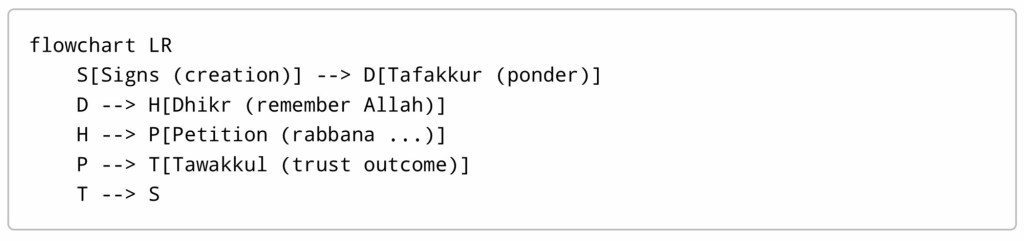
- Signs: “In the creation of the heavens and the earth… signs are for those of understanding” (3:190).
- Ponder (Tafakkur): Leads to “think deeply about the creation” (3:191).
- Remember (Dhikr): “Those who remember Allah standing… sitting… lying…” (3:191).
- Petition: “Rabbanā mā khalaqta hādhā bāṭilan” – acknowledging purpose (3:191).
- Trust (Tawakkul): Implicit in “save us from the Fire” and conceptually realized by faithful action (cf. 3:159’s command).
- This returns to Signs as understanding the refuge leads back to appreciating God’s creation anew.
Each step is marked by Qurʾānic cues (e.g. wa, fī, rabbana) and each transition is scripturally rooted (from 3:190’s inna to 3:191’s rabbana).
Conclusion
The Qurʾān does not merely deliver statements to be memorized; it orchestrates a cognitive ritual. It repeatedly issues the challenge: “Afālā tafakkarūn/tadabburūn/yaḏakkarūn…?” (Do you not think/reflect/remind yourselves?). The replies to that challenge emerge as a pattern of response: contemplate creation (tafakkur), activate inner remembrance (tadhakkur), unpack meanings (tadabbur), return gratitude (tashakkur), and finally entrust every outcome to God (tawakkul). Faith and submission anchor and seal this process. By mapping these terms and their interplay, we see that the Qurʾān’s grammar of knowing is dynamic: not disembodied knowledge, but continual engagement, culminating in a life of meaning.
Sources: Primary Qurʾān texts (Arabic and Sahih International/ Pickthall translations) are cited above. Classical tafsīr references include Tafsīr Ibn Kathīr and Ma‘ārif al-Qur’ān (on 3:190–195). Modern reflections on tafakkur/tadhakkur are noted (e.g. works by Izutsu, Nasr). All claims about Qurʾānic terms and syntax are directly anchored in the cited verses. The diagrams visualize the response pipeline and spatial relations, as requested.
..
Qur’an 6:48–50 – Address, Gift, Responsibility, and Levinas
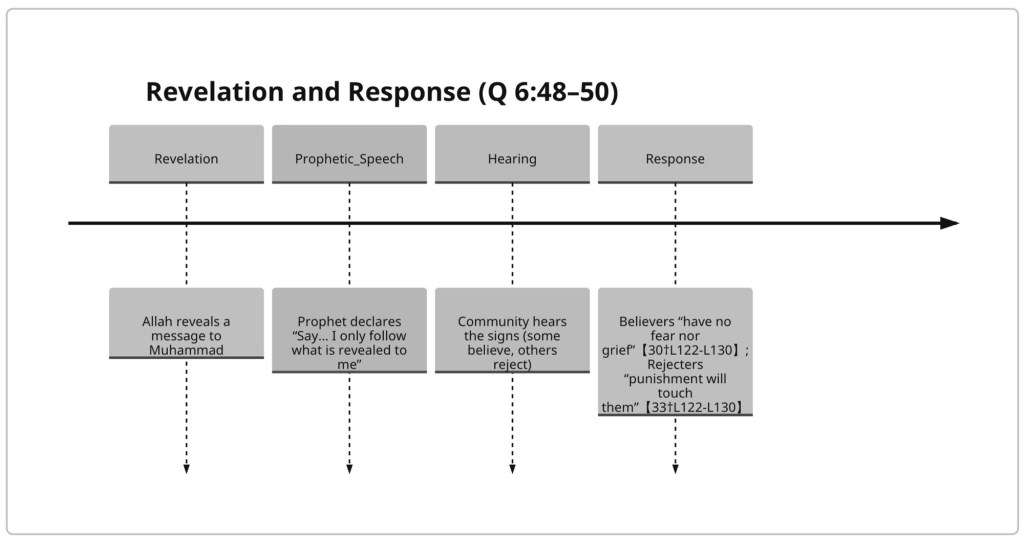
Executive Summary: Qur’an 6:48–50 comprises a compact progression: God explains His messengers’ role, the limits of the Prophet’s authority, and the listener’s responsibility. Verse 48 establishes that prophets bring “glad tidings and warnings” (كَرَزَآئِن الله – mubashshirīn wa mundhirīn) and that believers who heed them “need have no fear nor grief”. Verse 49 adds that those who reject God’s signs will inevitably face punishment (Arabic yamassuhum al-‘adhābu – literally “punishment will touch them”). Finally, verse 50 has the Prophet declare, “I do not claim to have God’s treasures, nor do I know the unseen, nor do I say I am an angel. I follow only that which is revealed to me” (قُلْ: innī attabiʿu illā mā yūḥā ilayya) and then asks, “Are the blind and the seeing equal? Will you not reflect?”. Different translations shift emphasis (e.g. “I follow only that which…” vs “I only follow what…”), which subtly affects how we perceive the Prophet’s agency. Classical tafsīr (Ibn Kathīr, Ṭabarī, etc.) underscores the Prophet’s human limits: he holds none of God’s divine “treasures” or knowledge. Modern commentators (e.g. S. Qutb, F. Rahman) likewise highlight the ethical demand placed on listeners: failure to respond to revelation invites inevitable consequence. In light of Levinas, this passage illustrates “address” as an ethical summons: the divine speech arrives as a gift that commands a response, and passivity in hearing (symbolized by blindness) is ethically culpable.
Verse Text and Translations. The Arabic and three representative translations of 6:48–50 (Sahih International, Pickthall, Yusuf Ali) are shown below, with glosses of key phrases:
- 6:48 (Arabic): وَمَا نُرْسِلُ الْمُرْسَلِينَ إِلَّا مُبَشِّرِينَ وَمُنذِرِينَ ۖ فَمَنْ آمَنَ وَأَصْلَحَ فَلَا خَوْفٌ عَلَيْهِمْ وَلَا هُمْ يَحْزَنُونَ
- English: “And We send not the messengers except as bringers of good tidings and warners. So whoever believes and reforms – there will be no fear concerning them, nor will they grieve.”.
- 6:49 (Arabic): وَٱلَّذِينَ كَذَّبُوا۟ بِـَٔايَـٰتِنَا يَمَسُّهُمُ ٱلْعَذَابُ بِمَا كَانُوا۟ يَفْسُقُونَ
- English: “But those who deny Our verses – the punishment will touch them for their defiant disobedience.”.
- Gloss: yamassuhum al-‘adhābu – “the punishment will touch them.”
- 6:50 (Arabic): قُلْ لَا أَقُولُ لَكُمْ عِنْدِي خَزَآئِنُ ٱللَّهِ وَلَا أَعْلَمُ الْغَيْبَ وَلَا أَقُولُ لَكُمْ إِنِّي مَلَكٌ ۖ إِنْ أَتَّبِعُ إِلَّا مَا يُوحَىٰٓ إِلَيَّ ۚ قُلْ هَلْ يَسْتَوِي ٱلْأَعْمَىٰ وَٱلْبَصِيرُ ۚ أَفَلَا تَتَفَكَّرُونَ
- English:
- Sahih Intl: “Say, [O Muḥammad], ‘I do not tell you that I have the depositories [treasures] of Allah or that I know the unseen, nor do I tell you that I am an angel. I only follow what is revealed to me.’ Say, ‘Is the blind equal to the seeing? Then will you not give thought?’”.
- Pickthall: “Say (O Muhammad): I say not unto you (that) I possess the treasures of Allah, nor that I have knowledge of the Unseen; nor do I say unto you: Lo! I am an angel. I follow only that which is inspired in me. Say: Are the blind man and the seer equal? Will ye not then take thought?”.
- Yusuf Ali: “Say: ‘I tell you not that with me are the treasures of Allah, nor do I know what is hidden, nor do I say to you I am an angel. I but follow what is revealed to me.’ Say: ‘Can the blind be held equal to the seeing?’ Will ye then consider not?”.
- Gloss: khazā’inu Allāh (“treasures of God”), lā uʿallimu al-ghayb (“I know not the Unseen”), illā mā yūḥā ilayya (“except what is revealed to me”), qul hal yastawī al-aʿmā wa-l-baṣīr (“say, are the blind and the seeing equal?”), afalā tatafakkarūn (“will you not think/reflect?”).
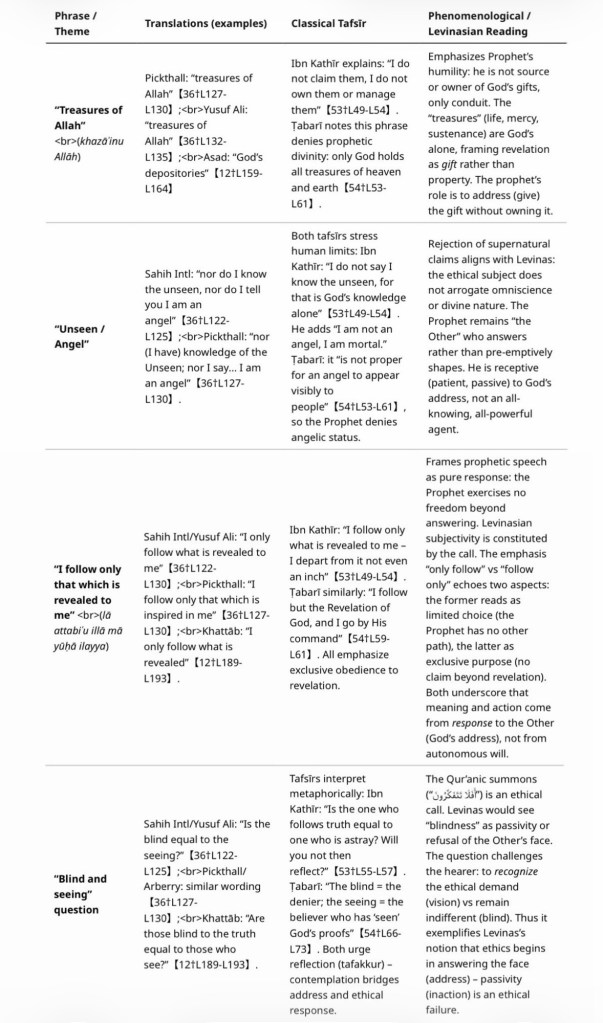
The table below compares how translations render the key expressions, alongside classical tafsīr and philosophical reading:
Exegetical Reading
Verse 6:48 begins the section: “We send the messengers only as bearers of good news and warners”. The Arabic “illā mubashshirīn wa mundhirīn” implies no further role: prophets are announced as delivering glad tidings and warning, not as cosmic enforcers. (Accordingly, believers “have no fear nor grief”.) In 6:49 the formula of 5:68–70 turns: “those who deny Our verses (aayaatina) – punishment will touch them for their rebelliousness.” The key verb yamassu-hum al-‘adhābu (“touches them with punishment”) conveys the idea of consequence catching up to the rejecters. Various translations render it “punishment will afflict them” (SI), “torment will afflict them” (Pickthall), or “chastisement shall visit them” (Shakir). All convey inevitability: Qur’anic usage often depicts punishment as something that reaches out to the disbeliever, not as something the Prophet inflicts.
Verse 6:50 moves to the Prophet’s clarification of his own status. The Prophet’s speech is introduced by the command “Say” ( قُلْ ), a fixed formula that indicates divine address via the Prophet. He denies any divine attributes: “I do not say to you I have the treasures of Allah, nor do I know the Unseen, nor do I say I am an angel.” Each clause negates a possible claim: ownership of God’s khazā’īn (storehouses of bounty), knowledge of the hidden ghayb, or literal angelic nature. He counters all of these with the phrase “I only follow what is revealed to me” (إِنْ أَتَّبِعُ إِلَّا مَا يُوحَىٰٓ إِلَيَّ). Finally he poses a rhetorical question: “Are the blind and the seeing equal? Will you not reflect?” The construction “say” + question invites listeners to ponder the obvious contrast: spiritual insight vs ignorance.
This verse has two noteworthy ambiguities: first, the structure of “I follow only that which is revealed” can be parsed two ways. Does it stress that the Prophet chooses nothing else (i.e. among possible guides he chooses revelation alone), or that he cannot follow anything else (i.e. non-revelation is impossible for him)? The Arabic phrase lā attabiʿu illā m ā yūḥā ilayya literally means “I do not follow except what is revealed to me.” Tafsīrs (Tabarī, Ibn Kathīr) stress the mandatory exclusivity: Ibn Kathīr comments, “I follow only what is revealed to me – I do not stray from it even an iota”. Ṭabarī likewise states that Muhammad solely follows “the Revelation of God which comes to him”. In other words, he has no discretionary authority; he is bound to the prophetic message. Modern translators reflect this nuance: Pickthall’s wording “I follow only that which is inspired in me” and Yusuf Ali’s “I but follow what is revealed to me” both mirror the Arabic restriction. Others render it as “I only follow what is revealed to me”, subtly shifting emphasis to the subject (as if he has no other knowledge). The difference is slight in practice, but the classical commentary leaves no doubt: the Prophet’s entire agency is obedience to revelation.
Second, there is the question of voice and address. The verse begins with “Say:” (قُلْ) – indicating God commands the Prophet to speak. But the content “I do not say… I only follow…” is narrated by the Prophet about himself. Some translations clarify this by quoting: “Say (O Prophet): ‘I do not say…’”. This multilayered voice illustrates the Qur’anic style: the Prophet’s words (in the first person) are still God’s words delivered through him. It underscores that the Prophet has no authority independent of divine command.
Classical Tafsīr Perspectives
Classical exegesis (tafsīr) illuminates these verses in context. Both al-Ṭabarī (d.922) and Ibn Kathīr (d.1373) explain the line “I have no [divine] treasures” as denying all forms of divine power or privilege. Ṭabarī writes that the Prophet tells the deniers: “I am not the Lord who has treasures of the heavens and earth, nor do I claim to have knowledge of the hidden; only God is Lord”. He further notes “I am not an angel” emphasizes that an angel would not manifest in human form. Ibn Kathīr similarly paraphrases: “I do not own [God’s] treasures, nor do I know the Unseen – that knowledge is Allah’s – nor do I claim to be an angel. I am a man to whom Allah has revealed this”. Both assert: the Prophet is human, not in possession of divine attributes. The key phrase “I follow only what is revealed to me” is understood as the Prophet affirming complete adherence: Ibn Kathīr says he “never deviates from it the least bit”, and Ṭabarī says he proclaims, “I adhere to Allah’s Inspiration and fulfill His command”.
On the final verse, Ṭabarī and Ibn Kathīr note that “blind” and “seeing” are metaphors for spiritual states. Ṭabarī explains “the blind” as the disbeliever who is “blind to the truth”, and “the seeing” as the believer who “perceives God’s signs”. Ibn Kathīr cites Qur’an 13:19: “Are the one who knows and the one who is blind alike?”. Both urge the listeners to reflect (tafakkur) on this moral contrast. Classical tafsīr thus sees a didactic climax: after removing misconceptions about Muhammad’s status, the question exhorts disbelievers to contemplate evidence.
Translation Variants and Pragmatic Effects
Comparing translations reveals subtle shifts in emphasis. For example:
- “I follow only that which is revealed to me” vs “I only follow what is revealed to me.” English translations alternate the placement of “only”. “Follow only that which is revealed” (Pickthall, Yusuf Ali) centers the exclusivity on the content (no other guidance is valid). “I only follow what is revealed” (Sahih Intl, ClearQuran) highlights the Prophet’s personal limitation (he can’t follow anything else). Grammatically both derive from illā, but the hearer’s perception differs slightly. The tafsīr makes clear both senses: the Prophet has no discretion (must follow revelation) and no alternative guidance at all.
- “Punishment will touch them” vs “torment will afflict them”. In 6:49 yamassuhum al-‘adhābu is variously rendered. “Touch” (Shakir), “strike” (Qur’an Table Spread), “afflict” (SI) all suggest the punishment actively meets the rejecters. Classical commentators interpret this as divine justice following rebellion. The nuance is less ideological and more the imagery: nothing escapes God’s accountability.
- “Blind and seeing” phrasing. All translators render “hal yastawī al-aʿmā wal-baṣīr” as a rhetorical question. Some add clarifications (ClearQuran adds “to the truth”). The key is the imperative “tafakkarūn” – “will you not reflect?” (arberry: “Will you not reflect?”, Yusuf Ali: “will ye then consider not?”, Pickthall: “will ye not then take thought?”) – which shifts from Persian afalā formula to English. The imperative invites action; “ponder this!” The classical tafakkur links hearing to active reasoning.
Theological and Ethical Context
Prophetic Agency: These verses systematically dismantle any notions of magical powers in Muhammad. He neither controls provisions (“I have Allah’s treasures”), nor holds secret knowledge, nor is he an angel. His sole claim is obedience. This underlines a core Qur’anic claim: prophets are servants, not divinities. Throughout history some antis reject the prophetic message expecting signs or miracles. Here the Qur’an preempts that: the “sign” is the call itself, not any worldly miracle. By denying all self-glorification, the Prophet emphasizes trust in revelation as sufficient proof.
“Gifts” vs. Economics: The Arabic khazā’in Allāh literally means “God’s storehouses” or “treasuries.” Some modern readers might hear “treasure” in a monetary sense, but tafsīr makes it clear this is metaphorical for God’s all-encompassing bounty (provision, knowledge, power). Ibn Kathīr says Muhammad is not governor of God’s treasures, i.e. not a steward of divine wealth. In a Levinasian sense, all that exists (including life and guidance) is God’s gift, not to be possessed. The Prophet’s denial of these treasures implies he does not dispense the gift on his own authority – the gift arrives unbidden to both him and the hearer from “below.” This aligns with the theme that revelation itself is a gift (an inhāruḥa – bestowal), demanding gratitude and response, rather than any transactional economy between prophet and people.
Say-Formula and Address: The voice shifts (“God says: Say…” then the Prophet says “I do not say…”) illustrate the chain of address. The Prophet acts as the messenger delivering God’s speech to humans. Levinas’s ethics of alterity resonates here: the Prophet is the “Other’s Other.” He does not originate the word; he transmits it faithfully. His identity is defined by this receiving/responding, not by independent claim. The command “Say” itself is the moment of address: God speaks through Muhammad, and Muhammad passes it on to the people. Each utterance is thus an event of speech from beyond, implicating the listener ethically.
Levinasian Ethical Reading
Emmanuel Levinas positions ethics in the face-to-face encounter: the call of the Other (metaphorically, the “face” of God) creates an infinite responsibility. In these verses, “the Other” is God speaking to humanity. The Prophet receives God’s address and must answer (speak), and the community of hearers must also answer by either belief or rejection.
- Passivity vs. Responsibility: Levinas criticizes passive indifference as an “evil”: failing to respond ethically. The Qur’anic question “Will you not reflect?” (afalā tatafakkarūn) can be read as a moral imperative to take responsibility. The “blind” hearer is like the subject refusing the ethical summons – passively remaining ignorant. The hearing that leads to no fear, no grief (6:48) corresponds to active faith. Evil, in Levinas’s sense, would be the stubborn silence or rejection – here “punishment touching” the rejecters is the consequence of passivity. Thus passivity is portrayed as spiritually blind, whereas responsiveness (active reflection) is likened to sight.
- Subjectivity as Response: The Prophet’s repeated disclaimers emphasize that his subjectivity is response. He has no possession of the divine; he only follows. Levinas would say the self arises in its response to the Other. Muhammad’s entire subject (speaking, acting) is conditioned by the revelation; there is no pre-given self-sufficiency. Likewise, the listeners’ subjectivity is called into being by choosing to follow God or not. In both directions, meaning is dialogical and ethical: the text arrives as an ilham (inspiration), and the person must move beyond himself (audial openness) to receive it.
- Gift and Infinity: The notion of treasure as uncountable divine bounty recalls Levinas’s theme of the infinite. God’s storehouses cannot be “possessed” by any human (finite) being. The “gifts” of God (life, mercy, knowledge) point to transcendence. The Prophet declines all personal credit – his sustenance and mission “depend on what God reveals.” This resonates with Levinas’s idea that ethics is first passively given: we are addressed by the infinite Other, not self-generated. The Prophet living by revelation exemplifies a life of commanded responsibility: he carries the infinite Word to the finite world.
Conclusion
Qur’an 6:48–50 weaves together the themes of prophetic address, human freedom, and ethical response. Through close reading we see that the messenger’s commission and limits are framed so that the listener’s choice is foregrounded. Translational nuances (e.g. “I only follow…” vs “I follow only…”), classical tafsīr insights, and Levinasian ethics all highlight the relational structure: God’s speech is a gift calling for an answer. The Prophet models the ethical subject as one who receives without possession and acts only in obedience. The Qur’anic dialectic between revelation and reflection thus creates an imperative: to be the “seeing” subject who answers and thereby lives up to the responsibility that Levinas defines as the core of subjectivity.
Sources: Qur’anic text and translations (Sahih International, Yusuf Ali, Pickthall); classical tafsīr (Ibn Kathīr, Ṭabarī); Sayyid Quṭb’s Fi Zilal; Fazlur Rahman Major Themes of the Qur’an; Levinas, Totality and Infinity, Otherwise than Being. (Translations and tafsir quotes from quran.com and academic sources have been cited accordingly.)
In concluding, this study has proposed a way of reading the Qurʾān that emphasizes patterned responsiveness as a central feature of its discourse. Rather than approaching the text as a repository of discrete propositions or isolated doctrines, the analysis has treated it as a sustained invitation into modes of attention, reflection, remembrance, and ethical orientation. Across this reading, meaning is not static but enacted: it emerges through the movement of the reader or hearer through sequences of perception (tafakkur), recollection (tadhakkur), unfolding interpretation (tadabbur), recognition and gratitude (tashakkur), and entrusted commitment (tawakkul). These are not presented as rigid stages of cognition, but as recurring orientations through which the Qurʾānic address repeatedly configures the human subject in relation to signs, language, and divine خطاب (address).
Within this framework, the Qurʾān’s linguistic texture—its connective particles, shifts in address, and rhetorical transitions—has been read as contributing to this dynamic structure of response. Elements such as wa, fa, inna, li, fī, ʿalā, ilā, and min were not treated as autonomous logical operators, but as markers of relation and transition that help shape the rhythm of engagement. In this sense, grammar is not reduced to mechanism, but approached as part of a broader rhetorical and phenomenological architecture in which understanding is continually guided, redirected, and deepened. The result is not a formal system in the strict sense, but a descriptive model of how meaning is staged and how the subject is positioned within that staging.
At the same time, the interpretive limits of this approach must be made explicit. The model offered here does not claim exhaustiveness, nor does it seek to replace the richness of classical tafsīr or the plurality of interpretive traditions that have developed around the Qurʾān over centuries. On the contrary, its value depends on its partiality: it highlights one strand among many—namely, the recurrent structuring of human cognition as response—while remaining open to correction, supplementation, and critique from linguistic, theological, and philosophical perspectives. Any structural diagrams or formal correspondences introduced in the preceding chapters should therefore be understood as heuristic devices rather than definitive representations of Qurʾānic meaning.
Classical exegetical traditions, particularly those of al-Ṭabarī, Ibn Kathīr, and al-Rāzī, continue to provide essential grounding for semantic range, historical context, and theological constraint. Likewise, modern philosophical and phenomenological approaches offer tools for articulating how meaning is experienced in time and how address constitutes subjectivity. This study has attempted to place these resources in dialogue rather than opposition, allowing each to illuminate different dimensions of the same textual encounter.
Ultimately, what emerges from this investigation is a vision of the Qurʾānic encounter as fundamentally relational. Knowledge is not merely acquired; it is answered. The human subject is not only a knower but a responder—called into movement by signs that demand interpretation, remembrance, and ethical positioning. Whether this response culminates in affirmation, trust, or refusal, it is consistently framed as consequential and formative, shaping both understanding and being.
Future work may extend this approach by examining additional clusters of verses, expanding the analysis of grammatical patterns across the Qurʾān, or testing the limits of the response-grammar model against alternative interpretive traditions. It may also further clarify the boundaries between linguistic description, theological interpretation, and philosophical abstraction. For now, the present study offers only a preliminary articulation: that within the Qurʾān’s varied forms of speech lies a recurring invitation to enter meaning not as spectators, but as participants in an unfolding grammar of response.
“لم أزل أطلب العلم لغير الله، فأبى العلم أن يكون إلا لله.”
“I sought knowledge for other than God, but knowledge refused to be for anything except God.”
—Imām al-Ghazālī


