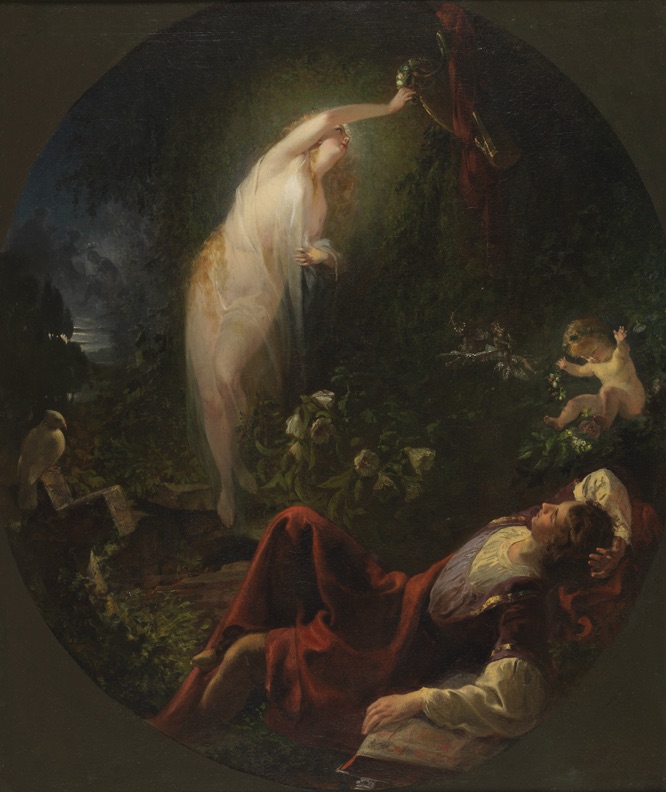
Shake off slumber, and beware.
introduction
“But when a long train of abuses and usurpations, pursuing invariably the same Object, evinces a design to reduce them under absolute Despotism, it is their right, it is their duty, to throw off such Government, and to provide new Guards for their future security.”
The pairing of right and duty is deliberate. Those are not synonyms.
A right means one is morally permitted to act. A duty means one is morally required to act. The Declaration therefore argues something much stronger than “the colonies may separate.” It argues that under conditions of sustained tyranny, failing to resist becomes a moral failure.
This is remarkably close to the kind of language Kant would later develop, although the philosophical foundations differ.
For Kant, morality is not grounded in consequences or political expediency but in rational obligation. The Categorical Imperative asks whether one’s maxim could be willed as a universal law and whether humanity is always treated as an end in itself rather than merely as a means.
Now imagine applying that framework to despotism.
A government that systematically destroys the autonomy of rational persons treats them merely as instruments of power. Such a government violates precisely what Kant takes to be the foundation of morality: respect for rational agency.
The Declaration reaches a similar practical conclusion through a different route. Jefferson writes in the language of natural rights inherited from Locke: human beings are endowed with certain unalienable rights by their Creator, governments exist to secure those rights, and when governments systematically destroy them, they lose their legitimacy.
Notice the logical progression:
- Human beings possess inherent dignity.
- Governments exist for the sake of that dignity.
- When governments consistently negate that purpose, they cease to fulfill the reason for which they exist.
- Therefore, resistance is not merely allowed but becomes obligatory.
That movement from permission to obligation is exactly what you are sensing.
There’s another subtle feature that often goes unnoticed.
The Declaration says “it is their right, it is their duty.” It does not say “it is their desire” or “their interest.” The standard being invoked is objective—or at least presented as objective. The revolution is justified not because the colonists happened to dislike British rule but because there exists a moral order against which governments themselves can be judged.
In other words, the Declaration presupposes that law is accountable to justice rather than justice being whatever law declares.
This is where it intersects interestingly with your own work on address and response.
The Declaration is itself an act of address. It opens by appealing to “the Opinions of Mankind.” It invokes “the Laws of Nature and of Nature’s God.” It concludes with an appeal to “the Supreme Judge of the world.”
These are not rhetorical flourishes alone. They establish an audience before whom the colonies justify their action. The document is performing responsibility. It is saying, in effect:
We do not merely assert our independence; we answer to a higher tribunal than Parliament.
That resonates strongly with your thesis that meaning is constituted by address. Political legitimacy here is not simply an exercise of power but a response to an antecedent claim—one grounded in natural law, reason, and ultimately divine judgment.
There’s an irony worth noting as well. Kant’s essay “What Is Enlightenment?” defines enlightenment as humanity’s emergence from self-incurred immaturity, the courage to use one’s own understanding without another’s direction (Sapere aude!). Although Kant was writing in a different context, the Declaration embodies a related aspiration: a people claiming the responsibility to govern themselves rather than remaining under what they regard as arbitrary authority.
So the phrase “it is their right, it is their duty” can be read as expressing a transition from passive subjects to morally accountable agents. Freedom is presented not simply as a privilege to be enjoyed but as a responsibility to be exercised.
That distinction has echoed through later political philosophy. It suggests that liberty is never merely a possession. It is an obligation. When institutions become instruments of domination rather than guardians of justice, the moral burden shifts to the people—not only to reclaim their rights, but to fulfill their duty to restore a political order that answers to justice.
The more one lingers over that sentence, the more radical it becomes. The Declaration does not say that revolution is justified whenever people are unhappy. In fact, it explicitly cautions against that. Just the line before says:
“Prudence, indeed, will dictate that Governments long established should not be changed for light and transient causes…”
That sentence is just as important as the one that follows. It introduces restraint. The authors recognize that governments are imperfect and that stability has moral value. Revolution is not the first duty; patience is. Only after “a long train of abuses and usurpations” does the duty change. This is almost an ethical threshold. The document is constructing a criterion for when obedience ceases to be virtuous and becomes complicity.
This creates an interesting inversion. We often imagine that the moral duty is to obey the law. The Declaration argues that there are circumstances in which the moral duty is to disobey the law because the law itself has become an instrument of injustice. In that sense, law is not ultimate. Justice is.
That distinction would later become central to figures like Henry David Thoreau, who argued that one should not permit one’s conscience to become an agent of injustice, and Martin Luther King Jr., who distinguished just laws from unjust laws in his “Letter from Birmingham Jail.” King explicitly draws on natural law, arguing that an unjust law is no law at all in the fullest moral sense. Whether one agrees with that conclusion or not, it belongs to a long tradition in political philosophy.
The Declaration is also deeply teleological. Governments are not treated as ends in themselves. Their legitimacy depends on the end for which they exist. Jefferson writes that governments are “instituted among Men” to secure unalienable rights. This is almost Aristotelian in structure. A thing is judged by its purpose. A knife that cannot cut is a bad knife. Likewise, a government that systematically fails to secure rights fails in the purpose that justifies its existence.
Kant would express something similar in different language. He would ask whether a political order respects persons as autonomous rational beings. The Declaration asks whether a political order secures their rights. These are not identical tests, but they converge on the idea that political authority is morally conditioned rather than absolute.
This work on address and response opens another avenue. Think about the Declaration not simply as a statement but as an answer. Every answer presupposes a prior call. The colonists portray the Crown’s actions as making a response necessary. They are saying, in effect, “The conduct of the government has addressed us in such a way that silence is no longer an adequate response.”
Notice how the structure unfolds:
- The Crown acts.
- Those actions make claims upon the colonists’ lives.
- The colonists first petition.
- Their petitions are ignored.
- The failure of response becomes itself a moral fact.
- Independence emerges as the response to an unanswered address.
This is remarkably close to the architecture that’s been developing, where the ethical question is not merely what is said? but how is an address received, answered, or refused? The Declaration repeatedly recounts unanswered petitions and ignored appeals. It presents revolution as arising not from impatience but from the collapse of reciprocal responsiveness.
There is also a fascinating grammatical feature. The phrase is not “they have a duty.” It is “it is their duty.” The duty is presented impersonally, almost as though it exists independently of anyone’s opinion. The obligation is not created by the colonists’ will; it is discovered. This is characteristic of natural-law reasoning. Moral obligations are understood as existing prior to political institutions and as binding upon rulers and citizens alike.
That is one reason the Declaration begins not with Britain but with humanity. Its opening paragraph speaks of “the separate and equal station to which the Laws of Nature and of Nature’s God entitle them.” Before there is America, there is a moral order. Before there is positive law, there is a claim about justice.
This is one of the Declaration’s deepest commitments: politics is answerable to something beyond politics. That “something” is described in terms of natural law, reason, and a Creator, but the essential point is that no government is the final judge of its own legitimacy.
From the perspective of a broader philosophical project, this raises a profound question: To whom is a government ultimately addressed? If our thesis is that meaning arises through address and response, then the Declaration suggests that governments themselves stand under an address they did not author. They are called to secure justice. Their legitimacy depends on how they answer that call. When they cease to answer it, the people become responsible for answering it themselves.
In that light, the famous phrase “it is their right, it is their duty” is not simply revolutionary rhetoric. It expresses a theory of moral responsibility in which authority is always derivative. The highest authority is not the state but the moral order to which both rulers and citizens are accountable. That is why the Declaration can claim that throwing off a despotic government is not merely politically prudent but, under the conditions it describes, ethically required.
The Declaration of Independence is remarkable for the fact that it is not written primarily in the language of power but in the language of justification. If political authority were simply a matter of force, there would be no need for a declaration at all. Independence could be asserted by military victory alone. Instead, the document devotes nearly its entire length to providing reasons. This reveals one of its deepest philosophical assumptions: force cannot, by itself, establish legitimacy. Political action must be capable of being justified before a broader standard of reason and justice.
This becomes apparent from the opening sentence: “When in the Course of human events, it becomes necessary…” The choice of the word necessary is significant. Jefferson does not write that independence becomes desirable or advantageous, but necessary. Necessity here is not physical but moral. The claim is that circumstances may develop in such a way that a people are no longer merely permitted to alter their government but are obligated to do so. History itself can present situations in which justice demands a particular response. This conception bears a striking resemblance to what Kant would later describe as practical necessity: an obligation arising not from external compulsion but from the demands of reason itself.
The Declaration proceeds from universal principle to particular action. It begins with the assertion that “all men are created equal” and concludes that “these United Colonies are, and of Right ought to be Free and Independent States.” This movement is philosophically important. The Revolution is not presented as an exception to universal moral law but as its application. The structure is clear: universal principles establish the standard by which historical circumstances are judged, and from that judgment follows political action. The legitimacy of the Revolution depends not upon the desires of the colonists but upon the prior truth of the principles from which their actions are derived.
The famous declaration that “all men are created equal” was understood in the eighteenth century primarily as a metaphysical rather than merely political claim. Equality does not imply sameness of ability, station, or vocation. Rather, it denies that any person possesses an intrinsic natural right to absolute rule over another. Kings may govern, judges may judge, and parents may exercise authority within their proper spheres, but no human being possesses unlimited political authority simply by virtue of birth. Hereditary monarchy therefore becomes subject to rational scrutiny. Political authority must be justified rather than presumed.
This emphasis on justification extends to the phrase “we hold these truths to be self-evident.” The Declaration does not present its principles as inventions or political innovations. Rather, it claims to recognize truths that already exist independently of those who proclaim them. The authority of the document therefore lies not in the Continental Congress itself but in the moral order to which the Congress appeals. The signers present themselves not as creators of justice but as witnesses to it. Their authority derives from fidelity to principles they regard as antecedent to every government.
The document’s rhetorical structure reflects this movement beyond itself. It appeals first to reason through “self-evident truths,” then to natural law through “the Laws of Nature and of Nature’s God,” then to history through its detailed list of grievances, and finally to divine judgment by invoking “the Supreme Judge of the world.” Each appeal places political authority under a higher tribunal. Government is not the final judge of its own legitimacy. Rather, it stands accountable to standards that transcend political power itself.
This progression culminates in the closing pledge: “with a firm reliance on the protection of Divine Providence, we mutually pledge to each other our Lives, our Fortunes and our sacred Honor.” This conclusion is not merely ceremonial. It demonstrates that genuine duty entails the willingness to bear its consequences. A moral principle becomes fully manifest when those who affirm it are prepared to sacrifice for it. Conviction without cost remains incomplete; the willingness to hazard one’s life, property, and reputation transforms abstract principle into lived commitment.
The Declaration can therefore be understood as more than a proclamation of political independence. It is an extended act of moral reasoning. It argues that political authority exists for the sake of justice rather than justice for the sake of political authority. Governments derive their legitimacy from the ends they serve, not merely from the power they possess. When a government systematically abandons those ends through “a long train of abuses and usurpations,” it not only forfeits its moral claim to obedience but gives rise to a corresponding obligation among the people. The transition from “it is their right” to “it is their duty” marks the decisive philosophical move of the Declaration. Liberty is no longer presented as a privilege to be enjoyed but as a responsibility to be undertaken whenever the conditions of justice require it.
In this way, the Declaration transforms revolution from an act of political expediency into an act of moral accountability. Its enduring significance lies not only in the historical establishment of a new nation but in its insistence that every exercise of political power remains answerable to principles that stand above power itself. Whether those principles are understood in terms of natural law, reason, or divine justice, the Declaration maintains that no government is exempt from the obligation to justify its authority before a higher moral order.
I’d extend it by showing that the Declaration did not invent this idea. It inherited and transformed a much older tradition in which obedience to authority is never absolute because all earthly authority is itself answerable to a higher law.
:::writing{variant=“document” id=“74281”}
Thou Shalt Revolt: From Sinai to Philadelphia
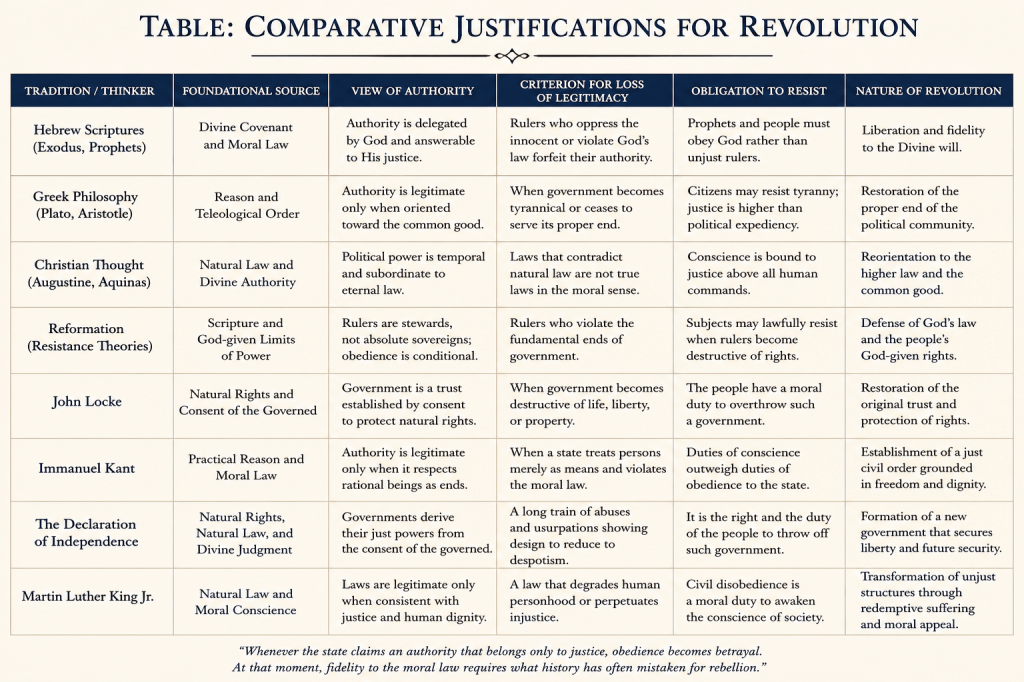
The proposition that tyranny may impose a duty of resistance did not originate in the eighteenth century. The Declaration of Independence stands at the end of a long moral tradition extending from the Hebrew Scriptures through classical philosophy, medieval natural law, the Reformation, the Enlightenment, and finally the American founding. Its originality lies not in discovering the principle, but in giving it political form.
The earliest expression of this principle appears not as a theory but as a narrative.
The Book of Exodus begins beneath the authority of Pharaoh, whose political power appears complete. He commands labor, controls law, and ultimately claims authority over life itself. Yet the narrative quietly introduces a limit to political sovereignty. The Hebrew midwives refuse Pharaoh’s command to kill the newborn sons of Israel. Their disobedience is not presented as criminal but as righteous. Before Moses confronts Egypt, ordinary women establish the moral architecture of the story: there exists a command higher than the king’s command.
The Exodus itself is therefore more than a story of liberation. It is the first great political theology of resistance. Pharaoh’s authority is exposed as contingent because no ruler possesses ultimate sovereignty. Israel leaves Egypt not merely because slavery is painful but because slavery contradicts a higher covenant. Freedom is grounded in obedience to God rather than rebellion against government. Political resistance emerges as fidelity rather than lawlessness.
This distinction echoes throughout the Hebrew prophets. Nathan stands before David. Elijah confronts Ahab. Amos denounces the corruption of the powerful. Isaiah condemns rulers who “decree iniquitous decrees.” In every case the prophet assumes that kings themselves stand under judgment. The prophet possesses no army and holds no political office. His authority derives entirely from the conviction that justice precedes power. The king may command the nation, but the prophet addresses the king.
The same structure enters Greek philosophy by another path. In Plato’s Apology, Socrates refuses to abandon philosophy even under threat of death because obedience to truth exceeds obedience to the city. His resistance is neither revolutionary nor violent, yet it reveals an identical hierarchy: the soul’s obligation to what is just transcends political expediency. The city may condemn him, but it cannot determine what justice is.
Aristotle develops this insight politically. Every political community exists for an end, and every form of government is judged according to whether it fulfills that end. Kingship degenerates into tyranny when the ruler governs for private advantage rather than the common good. Government therefore possesses an intrinsic standard by which it can be measured. Political authority is never self-justifying.
Christian thought deepens this tradition by distinguishing temporal authority from ultimate authority. The words attributed to Jesus—“Render unto Caesar the things that are Caesar’s, and unto God the things that are God’s”—do not abolish political obligation. They limit it. Caesar is given a sphere, but he is denied absoluteness. The state receives what belongs to the state; it cannot claim what belongs to God.
Saint Augustine radicalizes this distinction in The City of God. Earthly kingdoms are incapable of becoming the highest object of human devotion because every earthly polity remains marked by injustice and finitude. Political authority may preserve order, but it cannot become the source of ultimate justice. The state is relativized before a higher kingdom.
Thomas Aquinas provides perhaps the clearest philosophical articulation of this hierarchy through the doctrine of natural law. Human law derives its authority from its participation in the eternal law. A statute that fundamentally contradicts justice loses its moral character as law. It may retain coercive force, but it no longer binds the conscience in the same way. Positive law is therefore measured by a standard external to itself.
The Reformation intensifies this problem. Questions concerning the limits of obedience become unavoidable as religious and political authorities fracture across Europe. Resistance theories emerge, arguing that rulers who violate the fundamental ends of government may forfeit the obedience of their subjects. Political authority is increasingly understood as conditional rather than absolute.
John Locke gives this tradition its most influential modern expression. Human beings possess natural rights prior to government. Governments are established by consent to protect those rights. When political power becomes destructive of that trust, it dissolves the very basis upon which it rests. Revolution is therefore not the destruction of political order but the restoration of its original purpose. Jefferson’s language follows Locke so closely that the intellectual lineage is unmistakable.
Immanuel Kant approaches the question differently. Although Kant remained deeply cautious about revolution itself, his moral philosophy transformed the understanding of duty. Human beings are not merely subjects of political authority but autonomous rational agents bound by the moral law. Every person possesses an intrinsic dignity that forbids treating humanity merely as a means. Political institutions derive their legitimacy from their conformity to this moral principle rather than the reverse. The state is accountable to reason because reason is prior to the state.
The Declaration gathers these diverse streams into a single argument. The Exodus contributes the conviction that rulers are not absolute. The prophets contribute the judgment of power in the name of justice. Greek philosophy contributes teleology and the common good. Christianity contributes the limitation of earthly sovereignty. Aquinas contributes natural law. Locke contributes natural rights and consent. The Enlightenment contributes confidence in universal reason. These traditions converge in one extraordinary sentence:
“It is their right, it is their duty, to throw off such Government.”
The sentence marks a profound transformation in political ethics. Revolution is no longer understood as the triumph of force over force. It becomes an act of obedience to a higher moral order. The object of fidelity shifts from the government to the principles that justify government.
This tradition does not celebrate perpetual rebellion. It consistently warns against it. Scripture repeatedly calls for patience. Aristotle prizes stability. Aquinas values order. Locke insists upon a long pattern of abuses. The Declaration itself warns against changing governments “for light and transient causes.” Resistance becomes obligatory only when political authority persistently destroys the very goods for which it exists.
The imperative is therefore conditional but no less demanding. It is not “revolt whenever authority disappoints.” It is “revolt when authority has become fundamentally incompatible with justice.”
This tradition reaches one of its most powerful modern expressions in Martin Luther King Jr.‘s “Letter from Birmingham Jail.” There King distinguishes between just and unjust laws, echoing Aquinas’s claim that an unjust law is a corruption of law rather than its fulfillment. Civil disobedience is presented not as contempt for law but as profound respect for law rightly understood. The individual who breaks an unjust law openly and accepts the legal penalty does so in order to awaken the conscience of the community to the distinction between legality and justice.
Across more than three millennia, the central principle remains remarkably stable. No ruler is ultimate. No government is absolute. No political institution is exempt from judgment. Every exercise of authority remains accountable to a law that precedes power and survives it.
Only within this horizon can the paradoxical imperative be understood.
It is not a command to disorder.
It is not a command to violence.
It is not a command to perpetual revolution.
It is the command to refuse the idolatry of political power.
Whenever the state claims an authority that belongs only to justice, obedience becomes betrayal. At that moment, fidelity to the moral law requires what history has often mistaken for rebellion.
Only then can the ancient imperative be spoken in political form. Children know how much more half is than whole, and how much is in mallow and asphodel.
further reading

 ov1d.com