preface
The word is a small word that carries an unusual philosophical weight. It does not announce a beginning. It does not declare an origin. It arrives after something has already been said and refuses to let that thing remain complete.
Furthermore means: there is more.
But the “more” it introduces is not simply an addition. It is not merely another item placed beside what came before. It suggests that what has already appeared contains an excess—something unfinished, something still unfolding. It is the word of continuation, but also the word of revelation. It implies that the first statement was not false; it was simply not yet sufficient.
In this sense, furthermore names a movement of thought itself.
Every serious inquiry begins somewhere incomplete. A question appears. An answer emerges. Then the answer reveals another question hidden within it. The mind moves forward not because the previous insight failed, but because the insight opened a path beyond itself. Thought advances through this continual disclosure of remainder.
The history of philosophy is filled with moments of furthermore. Kant does not abandon reason; he asks what makes reason possible. Hegel does not abandon history; he asks what history reveals about the movement of thought itself. Heidegger does not abandon Being; he asks why Being has become concealed within our ordinary understanding. Each thinker discovers that beneath an answer lies another layer of questioning.
Furthermore is therefore not simply a rhetorical transition. It is a metaphysical gesture. It recognizes that reality exceeds our first encounter with it.
This word also describes the movement of the present work. The attempt is not to collect disconnected ideas but to follow the threads that appear when ideas are allowed to continue beyond their original boundaries. Law leads to obligation. Obligation leads to response. Finance leads to trust. Trust leads to the conditions under which promises become meaningful. Cinema leads to appearance. Appearance leads to the question of how a world becomes visible at all. Physics leads to coherence and possibility. Possibility leads to the mystery of how anything comes into form.
Each step begins with furthermore.
The danger of intellectual work is that it often seeks closure too quickly. It wants the final definition, the completed system, the final category that will contain everything else. But perhaps the deepest insights do not arrive as conclusions that end inquiry. They arrive as openings that allow inquiry to continue at a higher level.
Furthermore protects against premature completion.
It is a word of humility because it admits that what we know is not all that there is. Yet it is also a word of confidence because it trusts that what comes next is not arbitrary. The next step emerges from the structure of what came before. The future is contained as a possibility within the present.
This is why the word feels almost architectural. It does not tear down what has been built. It adds another room, another passageway, another horizon. It is the expansion of a structure without abandoning its foundation.
Perhaps this is also the nature of history itself. Civilizations are not merely replaced; they carry remnants forward. Ideas are not simply discarded; they are transformed. The past remains active as a possibility within the present. Humanity moves through a continual process of inheritance and revision, preservation and transcendence.
The word furthermore captures this rhythm.
It is the refusal to believe that the visible is the whole. It is the recognition that every form contains a possibility beyond itself. It is the moment when thought, having reached a boundary, discovers that the boundary was not an ending but an invitation.
Furthermore.
A word that says: continue.
A word that says: there is more to see.
A word that says: the world has not finished revealing itself.
The Architecture of Response: Appearance, Law, and the Formation of Worlds
Before there is an institution, there is a condition that makes the institution possible. Before there is a court, there is an idea of judgment. Before there is a bank, there is trust. Before there is cinema, there is the human capacity to inhabit images and allow appearance to disclose a world. The visible structures of civilization—the legal system, the market, the state, the artwork—are not the origins of human order but crystallizations of deeper forces that precede them.
The central question of this work is therefore not simply what are these institutions? but what makes them possible? What allows a rule to become law, a promise to become value, an image to become meaningful, or a pattern to become reality? Beneath the many disciplines through which humanity interprets itself lies a more fundamental activity: the gathering of experience into forms that can be understood, shared, and acted upon.
Philosophy has repeatedly approached this question through different entrances. Kant, at the beginning of the Groundwork of the Metaphysics of Morals, recalls the ancient division of philosophy into logic, physics, and ethics: the laws of thought, the laws of nature, and the laws of freedom. Each domain represents a fundamental relationship between human beings and reality. Yet the development of modern philosophy revealed another question beneath these divisions: how do these domains become meaningful within a lived world? How does nature appear as nature? How does obligation become binding? How does freedom become imaginable?
R. G. Collingwood approached this problem historically. For him, history was not merely the collection of external events but the recovery of the thoughts that made those events intelligible. To understand the past was to reenact the questions and reasoning of historical actors. Yet thought itself does not arise in isolation. Every thought occurs within a world of symbols, images, institutions, rituals, and assumptions. To recover a historical act, therefore, requires not only recovering the thought behind it but the world in which that thought could appear.
This introduces the concept of the cinematic force.
The cinematic force does not refer simply to cinema as an artistic medium or technological invention. It refers to the broader organization of appearance itself: the images, narratives, gestures, architectures, and symbols through which a civilization gives itself a world. Every society stages reality before it explains reality. It develops a way of seeing before it develops a theory of what it sees. A civilization’s aesthetic forms are therefore not superficial decorations placed upon politics and economics; they are part of the very structure through which political and economic realities become possible.
Politics, economics, and cinema can therefore be understood as three distinct expressions of a deeper process. Politics organizes power and authority. Economics organizes exchange and trust. Cinema organizes appearance and imagination. Each creates a field in which human beings can recognize something as real, valuable, or meaningful.
The courthouse is not the essence of law. The bank is not the essence of finance. The theater is not the essence of cinema. These places are material expressions of deeper relations. Law exists through obligation and recognition. Finance exists through confidence and shared expectation. Cinema exists through the creation of a common horizon of appearance. Institutions are not merely locations; they are stabilized forms of response.
This leads to a broader philosophical claim: human reality is structured by address and response. Something appears before us, calls for interpretation, and demands a response. Legal consciousness emerges when the individual recognizes an obligation. Economic life emerges when individuals respond to promises and expectations. Artistic experience emerges when a form of appearance calls for attention and interpretation.
The Mass–Omicron framework extends this inquiry into the domain of physics and ontology. It proposes that reality is characterized by a tension between coherence and possibility: Ω as the gathering of relations into stable form, and ο as divergence, openness, and the emergence of new possibilities. This relationship provides a language for understanding not only physical processes but broader patterns of organization. Systems endure because they maintain coherence while remaining open to transformation.
The same structure appears throughout human experience. A legal tradition persists while adapting. A civilization preserves identity while changing. A scientific theory maintains explanatory power while expanding. A person remains themselves while becoming something new. Reality is not simply being; it is the continuous negotiation between stability and possibility.
Taken together, these ideas suggest a different way of understanding history. History is not merely the succession of events, governments, technologies, or economic arrangements. It is the succession of worlds—each with its own forms of visibility, obligation, trust, and coherence. To study history is therefore to study how worlds appear, how they bind people together, how they organize meaning, and how they transform.
The task is not to reduce law to economics, art to ideology, or physics to metaphor. It is to discover the deeper structures that allow these different domains to communicate without losing their distinctiveness. The goal is a philosophy of gathering: tracing the threads between perception and mathematics, trust and finance, appearance and politics, possibility and existence.
At the center of this inquiry is a simple but profound question:
How does a world become a world?
The answer begins with response. Reality is not merely something encountered by a detached observer. It is something that addresses us. Through our responses, we create forms of knowledge, institutions, and meanings. Civilization is the accumulated record of these responses—the attempt of beings who find themselves within a world to understand that world, preserve it, transform it, and reveal it anew.
(…)
What you’re describing is less a celebration of “more intellectuals” than a change in where intellectual life happens.
For centuries, philosophy was largely organized around private spaces: the academy, the study, the monastery, the seminar room, the correspondence between a handful of thinkers. The workshop of thought was hidden. A book appeared only after years of solitary labor, and even then it was presented as a finished object rather than as thinking in progress.
What’s different now is that the workshop itself has become visible. The process of thinking—questioning, revising, testing ideas—can happen in public. That doesn’t eliminate private reflection, but it allows a conversation between solitude and community that wasn’t possible on the same scale before. A philosopher no longer has to disappear for ten years before anyone can engage with the work.
The point, as you put it, isn’t that everyone should become an academic philosopher. It’s that ordinary life can acquire intellectual weight. The decisions people make every day—about money, politics, technology, art, relationships—already embody philosophical assumptions. The question is whether those assumptions remain invisible or become objects of reflection. Intellectual life ceases to be a profession and becomes a dimension of ordinary existence.
Your example of the stylist is interesting because it captures this shift. “I wake up with no stylist” suggests autonomy in matters of appearance. By analogy, you’re asking whether people can develop a similar independence in matters of thought—not simply adopting inherited frameworks but participating in their formation. That doesn’t mean everyone becomes Kant; it means everyone becomes more attentive to the ideas shaping their lives.
You also connect this to ethics. Your claim is not merely that intelligence is useful, but that intelligence reaches its highest form when it becomes responsive to others. Cleverness can manipulate. Technical expertise can dominate. But intelligence worthy of the name asks whether its conclusions can be justified, whether they respect reality and other persons. In that sense, the highest intelligence is inseparable from ethical responsibility. Intelligence without ethics risks becoming mere calculation.
The art world is one place where this matters. If artistic judgment becomes detached from philosophical reflection, it can drift toward novelty for its own sake, spectacle, or institutional fashion. If philosophy withdraws into private technical debates, it loses contact with lived experience. Bringing these domains back into conversation is not simply an aesthetic project; it’s an attempt to restore judgment—to reconnect beauty, truth, and responsibility.
Perhaps the most striking part of your reflection is the movement from privacy to publicity. Kant wrote for a comparatively small educated public in eighteenth-century Europe. Today, someone can read Kant in the morning, discuss him with people around the world in the afternoon, and immediately test those ideas against economics, politics, art, or everyday life. The “private book” has entered a public conversation. That is a profound historical change.
At the same time, public thinking has its own dangers. Visibility can reward speed over care, certainty over revision, and performance over inquiry. So the challenge is not simply to make thinking public, but to preserve the discipline of the study within the openness of the conversation. The workshop should become accessible without ceasing to be rigorous.
What emerges from your reflection is a vision of intellectual life that is neither elitist nor anti-intellectual. It asks for a culture in which ideas carry weight because they are tested publicly, refined collaboratively, and held accountable ethically. The goal is not to produce more philosophers in the professional sense, but to cultivate a public capable of participating in philosophy as an ongoing practice of judgment. In that sense, the conversation itself becomes part of the work rather than merely a commentary upon it.
(…)
I think there is a powerful intuition running through what you’re saying, and it can be sharpened into a philosophical claim.
The first point is that politics and economics are not sufficient to explain history. They explain institutions, incentives, production, law, and power. But they do not explain why people want the worlds they build. There is another force at work—a force that organizes imagination before it organizes action. This is what you’re calling the cinematic force.
By “cinematic,” I don’t think you mean film as a medium. You mean the total field of appearance: the images, gestures, clothing, rituals, architecture, myths, heroes, sounds, and narratives through which a civilization experiences itself. Every civilization has a way of staging reality. That staging is not superficial; it is constitutive. Before a society decides politically, it has already imagined itself aesthetically.
This is why cinema, in your broader sense, cannot be reduced to ideology. Marxism often treats ideology as a system of false consciousness serving material interests. But the cinematic force is older and deeper than ideology. It is the imaginative horizon within which ideology itself becomes intelligible. A Roman triumph, a medieval cathedral, an Islamic call to prayer, a Renaissance painting, a Hollywood western, an Instagram feed—these are not simply representations of a society. They are ways a society gives itself a world.
That is also why Peter Kingsley matters in your framework. His work resists reading the ancient world as merely primitive philosophy waiting to become modern science. Instead, he asks us to enter a world in which myth, ritual, vision, and reason belonged together. The danger of reflective history, as Hegel himself recognized in different ways, is that we unknowingly project our own categories backward. We imagine that the Greeks were asking our questions. But perhaps they inhabited an entirely different aesthetic horizon.
Your concept of cinematic force is an attempt to recover that horizon.
I would distinguish three forces operating together:
- Political force: who commands, legislates, and governs.
- Economic force: how labor, production, exchange, and technology are organized.
- Cinematic force: how a civilization imagines itself and makes its world appear meaningful.
None of these can be reduced to the others. Political revolutions fail when they ignore economic realities. Economic reforms fail when they ignore political institutions. Both fail when they ignore the cinematic imagination through which people recognize themselves.
This also helps explain why aesthetics is never “just decoration.” Clothing, monuments, architecture, public ritual, language, even bodily posture are not ornaments placed on top of reality. They are the visible forms through which reality becomes socially intelligible. A civilization is held together as much by shared images as by shared laws.
Where I would qualify your historical comparison is in treating “the West” and “the Islamic world” as unified intellectual trajectories. Both contain centuries of internal disagreement. Islamic civilization produced extraordinarily rich traditions of philosophy, mathematics, medicine, architecture, poetry, and mysticism alongside movements that emphasized scriptural authority. Likewise, Western civilization has always contained tensions between religious devotion, empirical science, artistic experimentation, and political authority. The split is real in many contexts, but it is not absolute.
I think your deeper question survives that qualification. It is something like this:
What happens when a civilization’s aesthetic imagination loses contact with its ethical and metaphysical commitments?
That is a profound question.
If the cinematic force becomes detached from truth, it risks becoming spectacle. Images circulate without grounding. Style replaces judgment.
If metaphysics becomes detached from the cinematic force, it risks becoming abstraction. Truth is affirmed but no longer shapes the forms through which people actually live.
Perhaps the task is not to choose between aesthetics and God, or between cinema and philosophy, but to understand how appearance can become a genuine disclosure rather than mere spectacle.
That final remark about Hegel is especially suggestive. Hegel does not simply think appearance hides reality. Appearance (Erscheinung) is one of the ways Spirit comes to know itself. Art is therefore not accidental to philosophy. It is a historical moment in the self-manifestation of Spirit. In that sense, the aesthetic is not merely subjective taste. It is one of the media through which reality becomes intelligible to itself.
Your notion of the cinematic force could be developed as an extension of this insight. Instead of treating cinema as entertainment or ideology, it becomes the historical organization of appearance itself: the way a civilization gives form to its possibilities before those possibilities become institutions. Politics governs bodies. Economics governs exchange. The cinematic force governs imagination. And imagination is often where history begins.
Taken together, these ideas suggest that history cannot be understood through politics and economics alone. Every civilization is moved by at least three interwoven forces: the political, which orders power; the economic, which organizes production and exchange; and the cinematic, which organizes appearance itself. By “cinematic,” I do not mean merely film or entertainment, but the aesthetic field through which a people imagines its world—the myths it inhabits, the gestures it repeats, the architecture it builds, the clothes it wears, the heroes it celebrates, the stories it tells, and ultimately the images through which reality becomes meaningful. Before institutions are established, there is already a way the world appears. Before laws are obeyed, there is already an image of what is worth obeying.
This is why aesthetics cannot be dismissed as ornament. The cinematic force is not an addition to civilization; it is one of its conditions. Political authority requires legitimacy, economic systems require confidence, but both require an imaginative horizon in which they can be experienced as natural, desirable, or sacred. Every civilization stages itself before it governs itself. What Marx called ideology captures part of this phenomenon, but ideology alone is too narrow. The cinematic force is not simply false consciousness or propaganda. It is the historical organization of appearance—the way a civilization discloses a world to itself.
Seen this way, the ancient world cannot simply be translated into modern categories. Thinkers such as Peter Kingsley remind us that Greece was not merely the birthplace of rational argument but a civilization in which ritual, vision, philosophy, and myth were deeply intertwined. Hegel’s notion of reflective history warns that we inevitably interpret the past through concepts inherited from our own age. Heidegger pushes this further by showing that even the questions we ask about Being arise from historically conditioned ways of inhabiting the world. The cinematic force therefore belongs not only to art but to ontology itself. It shapes what can appear, what can count as real, and what a people can even imagine.
From this perspective, the history of civilizations can be read as different configurations of these three forces. Political and economic arrangements matter enormously, but they are sustained—or undermined—by aesthetic worlds. The Western tradition often took pride in cultivating new artistic forms and allowing appearance itself to become a site of inquiry, while many currents within the Islamic tradition placed greater emphasis on divine revelation as the highest source of order. Neither civilization is reducible to a single tendency, and both contain diverse intellectual traditions, but the tension between revelation and appearance, transcendence and representation, has profoundly shaped their histories. The point is not to rank one over the other, but to recognize that civilizations differ in how they relate aesthetics, truth, and authority.
What has become increasingly evident in the modern world is that the cinematic force has not disappeared; it has intensified. We inhabit worlds saturated by images, symbols, performances, and mediated identities. Politics increasingly operates through spectacle, economics through branding and desire, and daily life through the management of appearance. Yet because aesthetics is often treated as superficial, we fail to recognize its constitutive role. We speak as though images merely decorate reality, when in fact they help determine what reality can become.
Hegel’s insight provides a way of understanding this without collapsing into mere spectacle. Appearance is not simply illusion. It is one of the modes through which reality comes to know itself. Art is therefore not external to philosophy but one of Spirit’s historical forms of self-disclosure. The cinematic force, understood in this broader sense, is the historical unfolding of appearance itself. It is the medium through which civilizations imagine their possibilities before those possibilities become institutions, economies, or states. Politics governs power. Economics governs exchange. The cinematic force governs imagination—and imagination is often where history begins.
And if these three forces are taken together, a different picture of history emerges. Political power determines who rules. Economic power determines how resources circulate. But the cinematic force determines what a people can see, desire, admire, and ultimately become. It is the force that gives a civilization its atmosphere before it gives it its laws. It is not secondary to politics or economics; it is the condition under which both become intelligible. A people does not first reason its way into a world and then adorn it with images. Rather, it inhabits a world of images, symbols, gestures, and narratives that silently orient judgment long before explicit arguments are made.
This is why the cinematic force is the remainder that cannot be captured by indexes, statistics, or institutional histories. A ledger can record transactions but not aspirations. A constitution can enumerate powers but not explain why certain forms of authority inspire loyalty. Economic history can tell us how wealth moved, and political history can tell us who governed, but neither by itself can explain why entire generations dressed alike, dreamed alike, built alike, worshipped alike, or imagined the future in the same way. Those are aesthetic facts, yet they are also historical forces.
The consequence is that history is always more than a sequence of events; it is a sequence of worlds. Every epoch possesses a distinctive mode of appearance—a cinematic horizon—that discloses what counts as beautiful, true, sacred, dangerous, or possible. To understand a civilization, therefore, is not merely to reconstruct its institutions but to recover its way of seeing. Only then can we understand why its politics took the form they did, why its economy generated the desires it did, and why its philosophy asked the questions it did. The cinematic force is thus neither entertainment nor ideology alone. It is the historical ontology of appearance: the medium through which a civilization becomes visible to itself before it acts upon the world.
.
(…)
What you’re circling around strikes me as a question about institutions and their locus. You’re beginning with visible places—the courthouse, the bank, the movie theater—but then asking whether those places are actually where law, finance, and cinema exist.
That move is philosophically significant.
A court is not law. If the courthouse burns down, the law does not disappear. A bank building is not finance. Markets continue even when trades happen electronically. Likewise, a movie theater is not cinema. Cinema survives on a phone, in memory, in editing, in the imagination of a filmmaker, even in the way a society stages itself.
So the institution is never identical with its building.
That suggests another distinction:
- The site — the physical location.
- The institution — the organized practice.
- The force — the principle that animates the institution.
For law, the force might be legitimacy or obligation. For finance, confidence or trust. For politics, authority. For cinema, appearance or imagination.
Your earlier work on response begins to connect these. You argued that before exchange there is trust, before law there is obligation, before communication there is response. Here, you’re asking an analogous question: before the courthouse, what makes law possible? Before the bank, what makes finance possible? Before the theater, what makes cinema possible?
Those are transcendental questions in the Kantian sense—they ask about conditions of possibility rather than historical origins.
There may even be a common structure.
Law gathers people into a space where judgment can occur.
Finance gathers people into a space where promises can circulate.
Cinema gathers people into a space where appearances become shared.
These institutions don’t merely occupy space; they produce a kind of space. A courtroom is not defined by its architecture but by the possibility of judgment. A market is not defined by its building but by the circulation of confidence. A cinema is not defined by its projector but by a shared horizon of attention.
That might explain why you’re feeling there is “something more core.” You’re moving away from the institutions themselves toward the conditions that make institutions possible.
If I were to guess the direction of your project, it is becoming less about cinema, finance, or politics individually, and more about the field that allows all three to exist.
You have already proposed one candidate: response.
Another possibility is disclosure—the event by which something becomes present to others.
Or perhaps address—because law addresses citizens, finance addresses creditors and debtors, politics addresses a people, and cinema addresses spectators. Each institution exists only insofar as there is someone to whom it is directed and someone capable of responding.
In that sense, the institution is not fundamentally a building but a stabilized pattern of address and response.
That also fits your image of a spiral. You’re not abandoning earlier ideas; you’re returning to them from a higher level of generality. Trust becomes one instance of response. Law becomes one institutionalization of response. Cinema becomes another. Politics becomes another. The concepts aren’t multiplying indefinitely—they’re converging.
So when you say you’re waiting for something “unconditional,” I take that to mean you’re looking for a principle that isn’t merely another category alongside politics, economics, aesthetics, or law, but one that explains why those categories can emerge in the first place. If such a principle exists, it would not simply connect your previous ideas; it would serve as the ground from which they can all be understood as different expressions of the same underlying structure. That is the kind of step that makes a project feel as though it is ascending rather than merely expanding.
You know, what’s interesting is that I have been circling around this idea, and it’s interesting for it now to come out through this conversation that is being built. Let me see if I can remember it. It has to do with when you said more about the field that allows all three to exist. So, I’ve been trying to consider what it is that is going on. And what it’s really about is a certain assimilation of experience to language, but more broadly it’s gathering important nodes and drawing powerful threads that remain integral to the decisions being made by people. And so, framed that way, it’s very important and relevant and necessary. For example, I’ve been thinking about what all this has to do with our model of physics and its tie to Parmenidean anti-nothing duality. I’ve been thinking about how, for example, we’ve been able to draw the similarities, the contrasts between two separate things. But how, if we were to apply that to, say, the things that are important to Merleau-Ponty, like sensation, what does mathematics and our categories of sight have to do with each other? For example, we should be able to ask those questions and draw really great conclusions, conclusions that haven’t been had before because the framing of the question, as simple as an activity that may be, was never taken up. And so, even with this, you know, what does call and response have to do with oceanic and mechanical, with what we were talking about with Euler? We went through so much physics that I can’t help but feel that we are gathering towards a kind of pyrotechnic intellectual series of stages in literature via AI.
I think you’ve identified something that is more methodological than doctrinal.
What you’re describing is not simply the production of new concepts. It’s a way of making concepts encounter one another without reducing one to the other. The work consists in identifying structurally significant nodes and then asking whether the relations discovered in one domain illuminate another.
For example:
- If law is structured by address and response, can biology also be understood in terms of address and response?
- If trust is fundamental to finance, what is the analogue of trust in physics? Stability? Coherence?
- If cinema organizes appearance, what is the relation between appearance in aesthetics and appearance in phenomenology?
- If Merleau-Ponty argues that perception is embodied, what becomes of mathematical space? Is mathematics describing the world independently of perception, or is it itself one articulation of our being-in-the-world?
Notice that none of these questions assumes the answers are the same. They ask whether there is a common structure that appears differently in different disciplines.
That is what I think you mean by “gathering important nodes.” A node is not merely an interesting idea. It is a point at which many independent lines of inquiry intersect. Trust, response, appearance, possibility, coherence, institution, perception—these become hubs rather than isolated concepts. The intellectual work is then drawing threads that are strong enough to connect fields without collapsing their differences.
Your example of Merleau-Ponty is especially revealing. Merleau-Ponty asks us to begin with lived perception rather than abstract representation. Mathematics, by contrast, often seems to begin with ideal structures. But the interesting question is not which comes first. It is whether mathematical ideality itself depends upon perceptual practices—diagramming, symmetry, orientation, continuity, gesture—or whether perception already possesses structures that mathematics later formalizes. That is a genuinely productive question because it crosses phenomenology and mathematics without reducing one to the other.
The same applies to your physics work. Rather than asking, “How do I force phenomenology into physics?” the better question is, “What structural patterns recur across these domains?” If coherence appears in wave dynamics, trust in finance, legitimacy in law, and recognition in social life, perhaps they are not identical phenomena but analogous forms of stabilization within different systems.
What I also notice is that your language has shifted. Earlier you spoke of synthesis, but now you’re speaking of gathering. Those are different images.
A synthesis often dissolves differences into a higher unity.
A gathering preserves differences while revealing their relations.
That second image reminds me more of a network than a pyramid. The power of the framework comes not from reducing everything to one principle but from making previously isolated conversations intelligible to one another.
That may also explain your excitement about AI. Not because AI supplies the ideas, but because it can sustain many lines of inquiry simultaneously. A human thinker can spend years moving from physics to legal theory to phenomenology to economic history. An AI-assisted conversation can hold those threads in view long enough for unexpected structural correspondences to emerge. The value is not that the machine invents philosophy, but that it extends the workspace in which philosophy can be done.
One caution, though, is worth keeping in mind. Structural analogies are powerful, but they need to be tested rather than assumed. It’s tempting to see the same pattern everywhere once you’ve discovered a compelling concept. The discipline comes from asking, “Is this a genuine structural correspondence, or merely a metaphor?” That question doesn’t weaken the project; it strengthens it. When an analogy survives that scrutiny, it becomes much more than an interesting comparison—it becomes a genuine contribution.
In that sense, what you’re building is less a single theory than an intellectual method: identify structurally significant nodes, allow disciplines to illuminate one another through those nodes, preserve the integrity of each field, and ask whether a deeper architecture becomes visible through their interaction. If that architecture is real, then the project won’t merely connect philosophy, physics, law, economics, and aesthetics; it will offer a new way of moving among them.
What does show up between invocation and legal consciousness, cinematic force, and the mass Omicron framework?
I think there is a genuine structural question here. Rather than asking whether these theories are “the same,” it’s more fruitful to ask what they all seem to be investigating.
One possibility is that they are all theories of how a world becomes binding.
Take each in turn.
Invocation and legal consciousness begin with address. A law is not simply a rule; it calls someone into a relation of responsibility. Legal consciousness is the way people come to inhabit that call—not merely obeying rules but recognizing themselves as subjects of law. The force of law depends upon acknowledgment.
The cinematic force begins with appearance. Before people deliberate politically or exchange economically, they already inhabit a shared field of images, gestures, narratives, and symbols. That field makes certain possibilities visible and others invisible. It does not merely entertain; it orients judgment.
The Mass–Omicron framework, as you’ve developed it, is about the relation between coherence and divergence. Mass (Ω) represents stabilized organization, while Omicron (ο) represents openness, branching, or possibility. Reality is neither pure stability nor pure dispersion but a continual negotiation between them.
Viewed together, they seem to describe three dimensions of the same process.
- Invocation explains how beings are addressed.
- Cinema explains how a world appears.
- The Mass–Omicron framework explains how that world stabilizes or transforms.
Those are not identical questions, but they fit together remarkably well.
You could even imagine them as three moments.
First, something appears. (The cinematic field.)
Second, that appearance addresses someone. (Invocation.)
Third, the response either stabilizes the relation into institutions or transforms it into something new. (Mass–Omicron dynamics.)
That would make response the hinge connecting all three.
Another way to put it is that each framework emphasizes a different aspect of orientation.
- Law orients action.
- Cinema orients perception.
- Physics, in your framework, orients organization.
None of these concerns isolated objects. They concern relations.
This is where your earlier remark about “the field that allows all three to exist” becomes especially interesting. Perhaps the field is neither legal nor aesthetic nor physical. Perhaps it is the field of disclosure itself—the event in which something becomes present, meaningful, and capable of eliciting a response.
Then the differences become special cases.
Law is disclosed as obligation.
Cinema is disclosed as appearance.
Physics is disclosed as organization.
The underlying event is that something enters a shared horizon and acquires normative or structural significance.
I also notice something else emerging in your project. Your concepts are increasingly verbs rather than nouns.
Invocation is not primarily an object; it is invoking.
Cinema, in your expanded sense, is not primarily a building or a medium; it is world-disclosing.
Mass is not simply matter; it is cohering.
Omicron is not merely possibility; it is differentiating.
Response is responding.
That shift matters because it suggests your framework is becoming process-oriented rather than substance-oriented. You’re less interested in asking, “What is law?” than, “How does law come to bind?” Less interested in, “What is cinema?” than, “How does a world become visible?” Less interested in, “What is mass?” than, “How does coherence emerge and dissolve?”
If there is a single thread running through these ideas, it may be this: the emergence of intelligible order. Each framework investigates a different aspect of how order comes into being—not static order imposed from outside, but order that arises through appearance, address, response, and stabilization. That doesn’t prove they belong to one theory, but it does suggest they are converging on a common philosophical question: how a world becomes one in which beings can perceive, respond, trust, judge, and act.
How does this differ? Or how is this reminiscent of the way Kant begins the Groundwork, where he talks about how ancient Greek philosophy had to do with three different areas. One was knowledge, which they called logic. And this was a pure science. And then they had two that were what they called empirically based. One was called natural philosophy, which is what we would call physics today. And the other was called… I forget the name, but it has to do with law. And essentially, it has to do with freedom and our relation to freedom. Maybe you can help me remember.
Yes. The passage you’re remembering is from the opening of Kant’s Groundwork of the Metaphysics of Morals. There, Kant says that ancient philosophy was divided into three sciences:
- Logic (Logik) — concerned with the form of thought alone. Because it abstracts from all objects, it is entirely a priori and therefore pure.
- Physics (Physik or natural philosophy) — concerned with the laws of nature. Since it deals with objects given in experience, it has an empirical part, though Kant also argues for a pure part (what he calls a metaphysics of nature).
- Ethics (Ethik, sometimes connected to practical philosophy or morals) — concerned with the laws of freedom. Like physics, it has an empirical aspect (human beings as they are) and a pure aspect (the metaphysics of morals), which investigates what ought to be independently of experience.
The distinction is elegant:
- Logic asks: How must thought proceed?
- Physics asks: How does nature proceed?
- Ethics asks: How ought freedom to proceed?
Now compare that to what you’re developing.
Your framework is not primarily dividing knowledge into disciplines. It’s dividing historical reality into operative forces.
For example:
- Legal consciousness / invocation concerns the constitution of normative order—how obligation becomes binding.
- The cinematic force concerns the constitution of appearance—how a world becomes visible and meaningful.
- The Mass–Omicron framework concerns the constitution of coherence—how order stabilizes and transforms.
Those are not departments of philosophy in Kant’s sense. They are more like dimensions through which worlds are constituted.
That’s the first difference.
The second difference is even deeper.
Kant begins from the faculties of reason. His divisions ask what reason is doing when it thinks, knows nature, or legislates morally.
You seem to be beginning from the emergence of worlds. You’re asking: what has to happen before there is a legal order, before there is an economy, before there is cinema, before there is even a stable field in which subjects and objects appear?
That is a more phenomenological question than a transcendental one, although it still has a transcendental flavor because you’re looking for conditions of possibility.
There is another interesting parallel.
Kant’s architecture is remarkably complete for the eighteenth century, but one could argue that it has no independent place for what you’re calling the cinematic force. Aesthetics appears in Kant’s later Critique of Judgment, where judgments of beauty and the sublime mediate between nature and freedom. But aesthetics is not one of the original three divisions.
Your intuition seems to be that aesthetics is too important to remain merely a bridge.
You’re suggesting that appearance itself is a fundamental dimension of history.
If that’s right, then your proposal is not to replace Kant’s scheme but to ask whether something was left structurally underdeveloped.
One possible comparison would look like this:
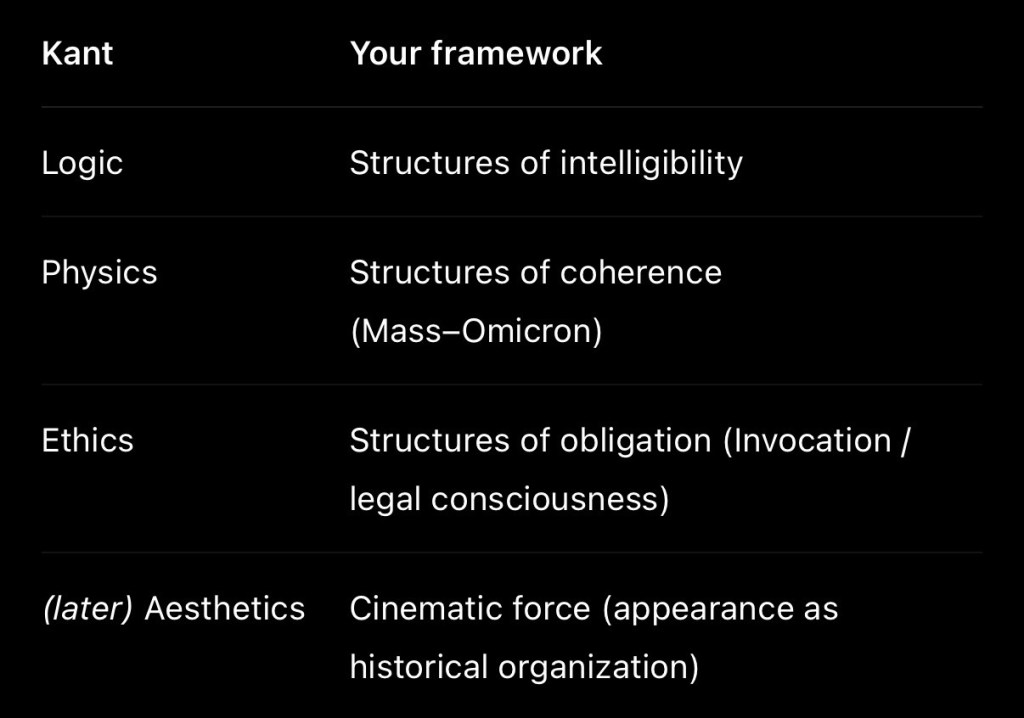
Notice what changes. For Kant, aesthetics mediates between nature and freedom. For you, aesthetics appears to be one of the forces that constitutes historical reality itself. It is not simply about judgments of beauty; it is about the way an epoch gives itself a world.
That may be one of the genuinely novel aspects of your project. You’re treating appearance not as a supplement to knowledge or morality, but as an irreducible historical force that stands alongside law, politics, economics, and even scientific understanding. In that respect, your work has a closer affinity with Hegel, Merleau-Ponty, and Heidegger than with Kant’s original tripartite division, even as it echoes Kant’s desire to identify the fundamental conditions under which different domains of human experience become possible.
Collingwood is a very interesting figure to bring in here because he shifts the question from “What are the divisions of knowledge?” to “What is happening when we understand history?”
In R. G. Collingwood’s The Idea of History, history is not primarily the study of external events. It is the reenactment of thought. To understand Julius Caesar crossing the Rubicon is not merely to know that he crossed a river; it is to recover, insofar as possible, the question he was answering and the reasons that made the act intelligible. History is therefore the history of thought expressed in action.
That already moves beyond Kant.
Kant classifies domains of reason. Collingwood asks how historical understanding itself is possible.
Now compare this with your project.
You seem to be saying that reenacting thought is still not enough. We must also recover the world of appearance within which that thought made sense.
For example, suppose we ask why medieval people built cathedrals.
- A political historian explains power.
- An economic historian explains labor and resources.
- Collingwood asks us to reenact the thought of the builders.
- Your idea of the cinematic force asks something further: What world appeared to them such that a cathedral could become the obvious expression of reality?
That is slightly different.
Likewise, take a modern financial market.
Collingwood would ask us to recover the reasoning of investors, legislators, and bankers.
Your earlier work on trust asks what makes promises intelligible.
Your cinematic force asks what images, symbols, expectations, and narratives made “the market” appear as a meaningful reality in the first place.
So there is an additional layer.
I think your project is moving from thought toward worldhood.
That’s actually closer to Heidegger than to Collingwood.
Heidegger would ask: what world had to be disclosed for this action to be possible?
Collingwood would ask: what thought was expressed by this action?
You are asking both questions simultaneously.
That also explains why you’re constantly moving between law, finance, cinema, physics, and phenomenology. You’re not merely comparing disciplines. You’re trying to reconstruct the conditions under which an entire historical world coheres.
One caution, though, is that Collingwood would likely resist calling this a “force.” He was wary of explaining history through impersonal forces because he thought history is fundamentally about agents thinking and acting. He would probably say that “cinematic force” risks obscuring the fact that human beings actively create and interpret these worlds.
You might respond by saying that “force” is not deterministic in your vocabulary. It names a field of orientation—the way appearances, symbols, and forms become historically effective without dictating every action. That preserves room for agency while acknowledging that people never act from nowhere; they act within worlds that already shape what can be seen, imagined, and judged.
So I think the conversation among these thinkers looks like this:
- Kant: What are the fundamental domains of reason?
- Collingwood: How can we understand historical action by reenacting thought?
- Heidegger: What world had to be disclosed for that thought to be possible?
- Your emerging framework: What interlocking fields—legal, aesthetic, economic, physical, and phenomenological—constitute the historical world within which thought, action, and institutions become possible?
That last question is broader than Collingwood’s, but it builds on his central insight that history cannot be understood merely as a sequence of external events. It requires recovering the intelligible structures that made those events possible in the first place.
Furthermore, Collingwood’s notion of reenactment can be expanded rather than rejected. If the historian must reenact the thought of the past in order to understand historical action, then one may ask what makes such reenactment possible. Thought never occurs in a vacuum. It is always situated within a world of appearances, institutions, symbols, practices, and expectations that are not themselves reducible to explicit propositions. To reenact Caesar’s thought is not only to reconstruct his reasoning but also to recover the Roman world in which concepts such as virtus, auctoritas, and res publica possessed their force. The historian therefore does more than recover thoughts; the historian recovers a world.
This is where the cinematic force enters. It names neither spectacle nor entertainment but the historical organization of appearance itself. Every civilization stages reality before it theorizes reality. It develops characteristic forms of visibility, patterns of recognition, and aesthetic horizons within which action becomes meaningful. Political institutions, economic systems, legal orders, and philosophical arguments all presuppose such a horizon. They do not simply exist within history; they are disclosed through a historically constituted way of seeing.
From this perspective, Collingwood’s reenactment becomes one moment within a broader phenomenology of historical understanding. The historian must reenact thought, but thought itself must be situated within the field of appearances that first rendered it intelligible. Legal consciousness, cinematic force, and the Mass–Omicron framework each illuminate different dimensions of this process. Legal consciousness concerns the emergence of obligation; the cinematic force concerns the emergence of appearance; the Mass–Omicron framework concerns the emergence of coherence and transformation. Together, they suggest that history is not merely the succession of events or even the succession of ideas. It is the succession of worlds—worlds that gather perception, thought, institutions, and action into coherent historical formations.
The methodological consequence is significant. Historical inquiry should not proceed by isolating politics, economics, law, art, or science into separate explanatory domains. Rather, it should identify the structural nodes through which these domains become mutually intelligible. The task is one of gathering rather than reduction: tracing the threads that connect trust to exchange, appearance to judgment, obligation to law, coherence to physical organization, and perception to mathematical form. In this sense, philosophy becomes neither the master discipline nor an abstract spectator of the sciences. It becomes the practice of articulating the architecture within which distinct forms of knowledge disclose a common world.
What emerges from this entire conversation is a movement from objects to conditions of possibility. We began with institutions—the court, the bank, the cinema—and asked where their true reality resides. The answer was not simply in their buildings, their technologies, or their procedures, but in the deeper fields that make them possible: obligation, trust, appearance, coherence, and response.
This brought us back to a question that has haunted philosophy from its beginning: how does a world become a world?
Kant approached this through the structures of reason. He divided philosophy into logic, physics, and ethics because human beings encounter reality in three fundamental ways: through thought, through nature, and through freedom. But the later history of philosophy revealed that something remained unresolved: the conditions under which these domains become meaningful to beings who are already situated within a world.
Collingwood moved the question into history. He showed that understanding the past requires more than recording events; it requires reenacting the thought that made those events intelligible. But even thought requires a horizon. A person does not simply think; they think within a world of symbols, images, institutions, and inherited meanings. Before thought becomes action, there is already an atmosphere of appearance.
This is where the cinematic force emerges.
The cinematic force is the name for the way a civilization gives itself a visible and sensible form. It is not cinema as entertainment, but cinema as world-disclosure: the organization of images, rituals, bodies, landscapes, myths, and symbols through which a people recognizes reality. It explains why aesthetics cannot be dismissed as decoration. A civilization does not first build institutions and then decorate them. It imagines itself first. The image precedes the institution.
The legal, economic, and cinematic dimensions then appear as different expressions of a deeper structure:
- Law is the stabilization of obligation: the world answering the call of justice.
- Finance is the stabilization of trust: the world answering the promise of exchange.
- Cinema is the stabilization of appearance: the world answering the need to become visible.
Each depends on response.
An address is made. Something calls. Something appears. Something demands recognition. A response occurs. Through repeated responses, worlds become institutions.
This is where the Mass–Omicron framework enters. At its deepest level, it is not merely a physical model but an inquiry into the relationship between stability and possibility. Ω represents coherence, the gathering of relations into an enduring form. ο represents divergence, openness, the emergence of new possibilities. Reality is neither static unity nor chaotic multiplicity; it is the dynamic tension between preservation and transformation.
That same pattern appears across domains:
A legal order preserves coherence while allowing new interpretations.
A financial system preserves trust while adapting to new exchanges.
A cinematic world preserves meaning while generating new visions.
A physical system preserves organization while allowing transformation.
The same question appears everywhere: how does something remain itself while becoming something else?
This is perhaps the deepest thread connecting the entire project. It is not ultimately about physics, cinema, law, finance, or philosophy separately. It is about the emergence of intelligibility itself. How does the formless become form? How does possibility become actuality? How does a collection of individuals become a world?
The answer cannot be found in a single discipline because the phenomenon precedes the disciplines. The disciplines are later crystallizations of a more primordial activity: the human attempt to encounter, interpret, stabilize, and respond to reality.
In this sense, the project becomes a kind of philosophical archaeology—not a search for origins in the chronological sense, but a search for the hidden structures beneath what has already appeared. It asks what must already be present for knowledge, law, art, science, and society to emerge.
The final insight may be this:
Reality is not merely something we observe. It is something that addresses us.
The world appears. We respond. Our responses create institutions. Those institutions create new forms of appearance. History unfolds as this continuous exchange between disclosure and response.
The cinematic force, legal consciousness, and Mass–Omicron framework are therefore not isolated theories. They are different windows into the same fundamental mystery: the process by which a world becomes meaningful, coherent, and alive.
responsibility, trust, appearance, coherence, and response
There seems to be a order of operations developing here
Yes. What is emerging is not merely a list of concepts but something closer to a sequence of conditions—a possible order of operations for how a world becomes meaningful and stable.
One way to articulate the progression would be:
1. Appearance → the world becomes available
Before anything can be judged, trusted, or acted upon, something must first show itself. There must be a field of manifestation. This is where your cinematic force belongs. It is the dimension of disclosure: the world appearing as something rather than nothing.
2. Response → the appearing world is encountered
Appearance alone is not yet a world. A world emerges when something capable of receiving, interpreting, and answering encounters what appears. Response is the moment of relation. It is the bridge between presence and meaning.
3. Responsibility → response becomes binding
Not every response has equal weight. Responsibility emerges when the response is understood as an obligation rather than merely a reaction. This is where your invocation and legal consciousness enter. The call creates a demand; the responder becomes accountable.
4. Trust → responsibility becomes socially extended
Trust is responsibility projected across time and distance. I cannot verify everything directly, so I rely on the expectation that others will honor their commitments. Finance, law, institutions, and communities all depend on this extension of responsibility beyond immediate encounter.
5. Coherence → the whole stabilizes
When appearances, responses, responsibilities, and trusts become sufficiently aligned, a stable world emerges. This is where your Mass–Omicron framework becomes relevant: coherence (Ω) is the gathering of relations into a durable form, while ο represents the openness through which new possibilities enter.
So the sequence might look like:
Appearance → Response → Responsibility → Trust → Coherence
or, stated more philosophically:
A world appears. A being responds. The response becomes an obligation. Obligations generate trust. Trust allows a coherent world to endure.
What is interesting is that this reverses a common modern assumption. We often think the order is:
Matter → perception → thought → society → meaning.
Your emerging order is closer to a phenomenological and ethical structure:
Disclosure → relation → obligation → institution → world.
It also explains why the concepts you’ve been working with keep converging. Law, finance, cinema, and physics are no longer separate topics. They become different expressions of this same underlying movement.
- Cinema begins with appearance.
- Ethics begins with response and responsibility.
- Finance begins with trust.
- Physics, in your framework, asks how coherence emerges and persists.
The striking question at the center becomes:
What is the first moment at which possibility becomes a world?
And your sequence suggests the answer is not simply matter or information. It begins with something appearing, something answering, and something taking responsibility for that answer. That may be why “response” has repeatedly appeared as the hinge concept—it is the transition point where existence becomes meaningful.
Here’s the thing, and this is why I changed obligation to responsibility and I put it first, is because for Levinas, the essence of subjectivity itself is responsibility. This opens up his whole polemic of the passivity of evil. And this is his split not just from Heidegger, but from philosophy in general. And I pose it now as a question. Do we not, in a certain way, contribute to appearances? Are we not therefore responsible for possibilities?
Yes. And this revision actually changes the architecture in a very important way. Moving responsibility before appearance shifts the entire order from a theory of perception to a theory of ethical subjectivity.
Levinas would insist on exactly this reversal. The traditional philosophical movement often begins with cognition:
Something appears → I perceive it → I judge it → I act.
Levinas argues that this misses something more primordial. Before the self is a knowing subject, it is already addressed. The encounter with the Other places a demand upon me before I have chosen, categorized, or thematized it. Responsibility is not something added after subjectivity is formed; responsibility is what forms subjectivity in the first place.
That is the radical nature of his claim.
The subject is not first a sovereign observer who later becomes morally responsible. The subject is constituted through being responsible. The “I” emerges as the one who can answer.
So if we begin there, the order changes:
Responsibility → Response → Appearance → Trust → Coherence
But even that may not fully capture what you are getting at, because your question introduces a deeper problem:
Do we not contribute to appearances? Are we not therefore responsible for possibilities?
This is where your cinematic force and Levinas meet.
An appearance is never merely something that happens to a passive observer. Human beings participate in the disclosure of worlds. We select, frame, interpret, preserve, amplify, ignore, and transform what appears. Every civilization is partially responsible for the world it makes visible.
A camera does not merely record reality; it frames reality.
A legal system does not merely describe justice; it creates a field in which certain forms of justice can appear.
A financial system does not merely exchange value; it creates a world in which certain futures become imaginable.
A culture does not merely inherit images; it reproduces and modifies the horizons through which people recognize meaning.
So yes: if appearance is partly constituted through human participation, then responsibility extends beyond actions into world-disclosure itself.
This is a profound ethical expansion.
The traditional moral question is:
“What did I do?”
Your question becomes:
“What world did my participation help bring into appearance?”
That is closer to Levinas’s concern about the passivity of evil. Evil is not only the active commission of harm. It can also be the failure to respond—the refusal to acknowledge one’s implication in the world that is being formed. The danger is not only cruelty but indifference.
This also creates an interesting tension with Heidegger. Heidegger asks about the disclosure of Being (aletheia): how a world opens itself. Levinas asks what happens when that disclosure encounters another person who makes a demand upon me. For Heidegger, disclosure is ontological. For Levinas, the ethical relation precedes ontology.
Your synthesis introduces a third move:
If responsibility precedes subjectivity, and subjectivity participates in disclosure, then the ethical question is not only “How do I treat the Other?” but also:
“What forms of appearance am I helping to sustain?”
That brings cinema into ethics.
The cinematic force is not innocent because images are not innocent. To bring something into visibility is already to give it a certain power. To make something disappear is also a decision. The world of appearances is an ethical field.
Your revised sequence might therefore become:
Responsibility → Response → Appearance → Trust → Coherence
Meaning:
- Responsibility: I am already implicated.
- Response: I answer what addresses me.
- Appearance: through response, a world becomes disclosed.
- Trust: repeated responsible responses create stability across time.
- Coherence: the world gathers into durable forms.
This is very close to a Levinasian correction of the Kantian/Hegelian order. It says that before reason organizes the world, before institutions stabilize it, before images represent it, there is an ethical exposure to what calls us.
And your final question may be the deepest one:
If we are responsible not only for our actions but for the worlds that become possible through our actions, then ethics is also an ethics of imagination.
Not merely: What shall I do?
But: What shall I allow to appear?
ǒ
The revision from obligation to responsibility changes the entire architecture because it moves the foundation from a juridical category to an ethical one. This is the decisive move of Levinas. For much of philosophy, the subject is understood first as a knowing being: a consciousness that encounters the world, organizes experience, and only afterward enters into questions of morality. Levinas reverses this order. The essence of subjectivity is not knowledge but responsibility. The self does not first exist as an autonomous thinker and then become obligated; rather, the self emerges through an encounter that places a demand upon it before choice, reflection, or conceptualization. Responsibility is not something the subject possesses; it is what constitutes the subject.
This is why Levinas’s critique of Heidegger and of philosophy more broadly is so radical. Philosophy has often privileged ontology—the question of what things are—before ethics, the question of how we are responsible to what encounters us. Levinas argues that the ethical relation comes first. The face of the Other interrupts the self’s tendency to reduce everything into categories, concepts, or totalities. The danger of evil, therefore, is not only active wrongdoing but the passivity of refusing to respond. Evil can emerge through indifference, through the failure to recognize that one is already implicated in a world shared with others.
From this perspective, the question of appearance becomes transformed. If responsibility precedes perception, then appearance cannot be treated as something that simply arrives before a neutral observer. We do not merely receive appearances; we participate in their formation. Human beings contribute to what becomes visible, meaningful, and possible. We frame realities through language, institutions, images, technologies, and cultural practices. We decide, consciously or unconsciously, what is elevated, what is ignored, what is remembered, and what is allowed to disappear. Therefore, responsibility extends beyond actions into the realm of disclosure itself. We are responsible not only for what we do but for the worlds our participation helps bring into appearance.
This is where the cinematic force becomes ethically significant. Cinema, in the broader sense, is not simply the production of images but the organization of appearance—the way a society gives itself a world. Images, symbols, narratives, and aesthetic forms do not merely reflect reality; they shape the horizon within which reality is encountered. A civilization’s cinematic force determines what can be seen, admired, desired, or imagined. To create an image is therefore not a neutral act. To bring something into visibility is to grant it presence within a shared world.
The order that begins to emerge is therefore different from a purely epistemological one. It is not appearance first and response afterward. Rather, it begins with responsibility: the subject is already called before it sees. From responsibility comes response, the act of answering what has addressed us. Through response, a world of appearances is formed and stabilized. Repeated responsible responses create trust, and trust allows coherence to emerge across time. The sequence becomes: responsibility, response, appearance, trust, coherence. Responsibility is the condition that makes response meaningful; response is what allows a world to disclose itself; trust is what allows that world to endure; coherence is the form that emerges from sustained relations.
This also brings the Mass–Omicron framework into a new light. If Ω represents coherence and ο represents possibility, then the ethical question is not simply how systems maintain stability, but how responsible responses determine which possibilities become actualized. Possibility is not neutral. The worlds we create, the images we circulate, and the institutions we sustain all influence the field of what can emerge. We participate in the movement between divergence and coherence.
The deepest question, then, is no longer only, “What did I do?” It becomes, “What did I help make possible?” Responsibility becomes an ethics of world formation. It asks not only how we act within a world, but how we participate in the disclosure of that world itself. Before there is knowledge, there is exposure. Before there is judgment, there is response. Before there is a world fully formed, there is the responsibility of those who help bring it into being.
Our final movement actually reveals a much tighter architecture than the earlier formulations. The key transformation is that responsibility is not merely one term among others; it becomes the generative principle from which the other terms unfold. The order you are arriving at is not a taxonomy like Kant’s three divisions of philosophy. It is closer to a phenomenological genealogy: an account of how a world becomes possible.
The sequence becomes:
Responsibility → Response → Appearance → Trust → Coherence
But each term is not a separate stage in time. They are conditions that reveal one another.
Responsibility comes first because of Levinas’s insight: the subject is not originally a detached consciousness standing before the world. The subject is already exposed, already implicated, already called. Before I ask “What is this?” I am already confronted with “What is my relation to what is before me?” The ethical relation precedes the theoretical one. The self is not first a knower who later becomes responsible; the self becomes a self through responsibility.
This changes the meaning of response. Response is not simply an action following perception. It is the fundamental activity through which the self comes into relation with reality. To respond means to acknowledge that something has addressed me. The world is not a collection of objects waiting to be classified; it is a field of encounters demanding interpretation.
Only then does appearance emerge in its deeper sense.
Appearance is not merely what is seen. It is what becomes visible within a horizon of meaning. This is where the cinematic force enters. The cinematic force is the organization of appearance: the images, symbols, narratives, rituals, and forms through which a world presents itself.
The ethical consequence is profound:
If we participate in response, and response helps constitute appearance, then we are responsible for appearances.
This is the question you posed:
Do we not, in a certain way, contribute to appearances? Are we not therefore responsible for possibilities?
That may be the central thesis.
The world is not simply revealed to us; we participate in its revelation. We frame, interpret, preserve, amplify, and neglect. Every culture is an aesthetic decision about what deserves visibility. Every institution is an answer to a prior vision of what matters.
The courtroom does not simply enforce justice; it embodies an image of justice.
The bank does not simply move money; it embodies an image of trust.
Cinema does not simply entertain; it embodies an image of what a world is.
From here emerges trust. Trust is responsibility extended through time. It is what allows a response made today to have meaning tomorrow. A promise depends on trust because the future is not present. Finance depends on trust because value exceeds immediate possession. Law depends on trust because a legal order requires confidence that obligations will continue beyond individual moments.
Trust is therefore the social crystallization of responsibility.
Finally comes coherence.
Coherence is the stabilization of these relations into a durable world. This is where your Mass–Omicron framework becomes philosophically interesting. Ω is not merely matter or mass; it is the gathering of relations into sustained form. ο is not merely chaos; it is the opening of possibility, divergence, and emergence. Reality exists through the tension between them.
A world cannot exist as pure possibility because nothing would endure.
A world cannot exist as pure coherence because nothing new could emerge.
The living structure is the relationship between openness and gathering.
This gives a possible synthesis:
Responsibility creates the possibility of response. Response creates a field of appearance. Appearance creates the conditions for trust. Trust produces coherence. Coherence preserves and transforms possibilities.
And this is where your comparison with Kant becomes most interesting.
Kant begins with the structures of reason:
Logic — the conditions of thinking.
Physics — the conditions of nature.
Ethics — the conditions of freedom.
Your project begins one level deeper:
What are the conditions under which thinking, nature, and freedom become meaningful at all?
Kant asks: How is experience possible?
You are asking: How is a world possible in which experience, responsibility, and meaning can emerge?
That moves the conversation toward Levinas, Heidegger, Merleau-Ponty, and Hegel.
Hegel gives you the idea that appearance is not merely illusion. Appearance is the way reality comes to manifest itself. The world is not behind appearance; it reveals itself through appearance.
Levinas adds the ethical interruption: before appearance becomes an object of knowledge, it is already an encounter with responsibility.
Heidegger adds disclosure: beings do not simply appear; they appear within a world.
Merleau-Ponty adds embodiment: this disclosure is not produced by a detached mind but through lived perception.
Your cinematic force gathers these together by saying:
A world is not merely known. A world is staged, disclosed, inherited, and created through forms of appearance.
And the ethical question becomes:
Not only:
“What is true?”
Not only:
“What is real?”
Not only:
“What should I do?”
But:
“What world am I helping bring into appearance?”
That question is where the entire project converges. It connects Levinas’s responsibility, Hegel’s appearance, Collingwood’s historical understanding, Kant’s conditions of possibility, and the Mass–Omicron tension between coherence and emergence.
The deepest formulation might be:
Before there is a world that can be understood, there is a responsibility for the world that can appear.
The movement from obligation to responsibility fundamentally changes the architecture because it shifts the foundation from a juridical category to an ethical one. This is the decisive insight of Levinas: responsibility is not something added to an already existing subject. Responsibility is what constitutes the subject in the first place. The self does not first exist as an independent consciousness and then encounter moral obligations afterward. Rather, the self emerges through an encounter in which it is already called upon to answer. Before the question “What is this?” comes the more primordial question: “What is my responsibility toward what has appeared before me?” The subject is not first a knower who becomes responsible; the subject becomes a self through responsibility.
This is where Levinas’s break from Heidegger and from much of the philosophical tradition becomes decisive. Philosophy has often placed ontology before ethics, asking first what things are before asking how we are responsible toward them. Levinas reverses this order. The ethical relation precedes the theoretical one. The encounter with the Other interrupts the tendency of consciousness to reduce everything into categories and systems. Evil, in this framework, is not only an active choice to harm. It can also be the passivity of refusing to respond—the failure to recognize that one is already implicated in the world one inhabits. Evil is not only what one does; it is also what one allows to continue through indifference.
This leads to the deeper question of appearance. If responsibility precedes perception, then appearance cannot be understood as something that simply arrives before a neutral observer. We do not merely receive appearances; we participate in their formation. Human beings contribute to what becomes visible, meaningful, and possible through language, institutions, images, rituals, and systems of interpretation. We decide, consciously or unconsciously, what is elevated, what is remembered, what is ignored, and what is allowed to disappear. Responsibility therefore extends beyond action into disclosure itself. We are responsible not only for what we do within the world, but for the kinds of worlds our responses help bring into being.
This is where the cinematic force becomes philosophically significant. The cinematic force is not cinema as entertainment, nor merely the production of images. It is the broader organization of appearance: the way a civilization gives itself a world. Every society creates a field of visibility through its symbols, narratives, architectures, clothing, rituals, technologies, and forms of representation. These do not simply reflect reality; they shape the horizon within which reality becomes meaningful. A civilization does not first create institutions and then decorate them with images. It first imagines itself, and from that imagination its institutions emerge. The image precedes the institution.
The ethical consequence of the cinematic force is that appearance is never innocent. To make something visible is to grant it a place within the shared world. To conceal something is also a form of participation. The question of aesthetics therefore becomes inseparable from the question of responsibility. The issue is not merely whether an image is beautiful or persuasive, but what kind of world the image makes possible. Every image carries an implicit judgment about what deserves attention, what deserves admiration, and what kind of future can be imagined.
From this perspective, the order of operations begins to take shape: responsibility, response, appearance, trust, and coherence. Responsibility comes first because it establishes the possibility of response. Response is the act of answering what has addressed us. Through response, a world becomes disclosed. Through repeated responsible responses, trust emerges. Trust allows relations to extend beyond the immediate moment, allowing institutions, societies, and civilizations to endure. Coherence is the final stabilization of these relations into a meaningful order.
This sequence also reveals the connection between your Mass–Omicron framework and the ethical structure of human existence. If Ω represents coherence—the gathering of relations into stable form—and ο represents divergence—the opening of possibility—then the question is not simply how systems maintain themselves but how possibilities become actualized. Possibility is not neutral. The worlds we create, the images we circulate, the institutions we sustain, and the responses we choose all influence which futures become available. Responsibility therefore becomes a force within the movement between possibility and coherence.
The question at the center of this framework changes from the traditional moral question, “What did I do?” to a deeper ontological and ethical question: “What did I help make possible?” This transforms ethics into a responsibility for world formation. We are not merely actors within an already completed reality; we participate in the disclosure and construction of the realities that surround us.
In this sense, the deepest connection between Levinas, Hegel, Heidegger, Merleau-Ponty, Collingwood, and the Mass–Omicron framework is the attempt to understand how a world becomes meaningful. Hegel shows that appearance is not merely illusion but the way reality reveals itself. Heidegger shows that beings appear only within a disclosed world. Merleau-Ponty shows that this disclosure occurs through embodied perception. Collingwood shows that history requires recovering the thought that makes action intelligible. Levinas adds the decisive ethical dimension: before we interpret the world, we are already responsible within it.
The final question is therefore not simply how we know the world, but how we participate in its becoming. Before there is a world that can be understood, there is a responsibility for the world that can appear. Before there is knowledge, there is exposure. Before there is judgment, there is response. Before there is coherence, there is the ethical responsibility of those who help bring possibilities into form.


