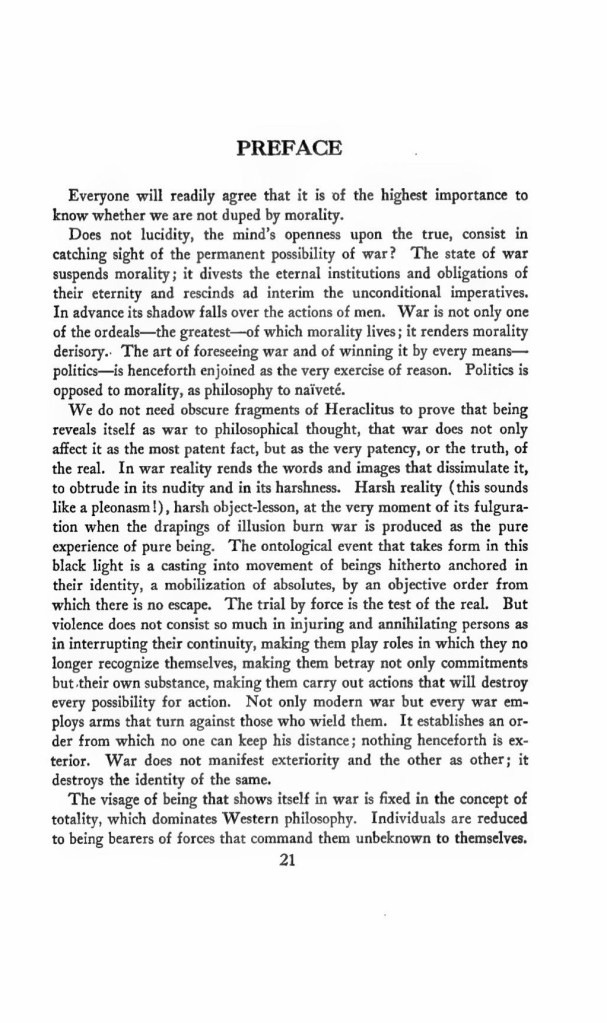
That exclamation point always stood out to me. Nothing else takes that tone. I don’t remember many if any more exclamation points.
“In war reality rends the words and images that dissimulate it, to obtrude in its nudity and in its harshness. Harsh reality (this sounds like a pleonasm!), harsh object-lesson, at the very moment of its figuration when the drapings of illusion burn war is produced as the pure experience of pure being.”
You are noticing something genuinely important in Levinas’s rhetoric. That exclamation point is unusual because it is not functioning as ordinary emphasis or emotion. It is almost a philosophical interruption.
The phrase you quoted:
“Harsh reality (this sounds like a pleonasm !), harsh object-lesson…”
In French the phrase is:
“La dure réalité (cela sonne comme un pléonasme !)”
Levinas pauses to call attention to the phrase itself. He is not simply saying “reality is harsh.” He is saying that the phrase “harsh reality” already seems redundant because reality, as revealed by war, appears to be nothing other than harshness itself.
That is the paradox:
- A pleonasm is an excess of words: adding something that is already contained in the thing named.
- “Harsh reality” seems like a pleonasm because, in the experience of war, reality has stripped away illusion and revealed itself as harsh.
But Levinas is doing something more subtle. The parenthetical exclamation marks the moment where language catches itself. The phrase appears redundant, but that redundancy reveals a philosophical problem:
Is harshness merely an accidental quality of reality?
Or does war disclose a deeper conception of reality as force, necessity, and violence?
The next phrase is crucial:
“war is produced as the pure experience of pure being.”
Here Levinas is diagnosing the danger of ontology when Being is understood as sheer presence, force, and inevitability. War is the moment where beings are reduced to their anonymous participation in a totality.
So the “pleonasm” is not just a stylistic joke. It points toward the entire architecture of Totality and Infinity:
Harsh reality seems to say:
reality = harshness
But Levinas’s whole project asks whether this equation is false.
Is reality exhausted by the experience of violence?
Is Being exhausted by the anonymous “there is” (il y a)?
Or is there an excess—an “otherwise than being”—that interrupts totality?
The exclamation point marks the instant where Levinas sees the danger: the phrase that seems merely redundant may actually expose the metaphysical assumption he is about to challenge.
It is also interesting that he chooses the word pléonasme rather than simply “redundancy.” A pleonasm is an overflow. It contains “more” than necessary. That makes it almost the inverse of what war does: war tries to reduce everything to bare force. The little excess of language hints that reality may itself contain an excess that cannot be reduced.
“The ontological event that takes form in this black light is a casting into movement of beings hitherto anchored in their identity, a mobilization of absolutes, by an objective order from which there is no escape. The trial by force is the test of the real. But violence does not consist so much in injuring and annihilating persons as in interrupting their continuity, making them play roles in which they no longer recognize themselves, making them betray not only commitments but their own substance, making them carry out actions that will destroy every possibility for action.”
This passage is one of the places where Levinas is most explicitly showing what he means by the violence of totality. It also deepens the significance of the earlier “harsh reality (this sounds like a pleonasm!)” remark.
The key phrase is:
“The ontological event that takes form in this black light…”
The “black light” of war is a reversal of revelation. Light normally discloses; it allows things to appear. But war produces a kind of illumination that reveals only the domination of forces. It reveals being as a field of mobilization, conflict, and necessity.
Levinas writes:
“a casting into movement of beings hitherto anchored in their identity”
This is a profound phrase. A being normally appears to itself as having continuity: a person has a name, a history, commitments, a sense of “I.” War disrupts that anchoring. It takes beings who experience themselves as subjects and turns them into functions within an objective order.
The phrase:
“mobilization of absolutes”
is especially important. An “absolute” is something that should stand on its own, something irreducible. But war mobilizes absolutes—it takes persons, nations, ideals, and identities and places them into a system where they become means. The absolute becomes a role.
Then:
“The trial by force is the test of the real.”
Here Levinas is describing a worldview in which force becomes the criterion of truth. What survives, what wins, what dominates—that is treated as what is real. This is the logic of totality: reality is measured by what can be incorporated into an objective order.
But then comes the deeper definition of violence:
“Violence does not consist so much in injuring and annihilating persons as in interrupting their continuity…”
This is perhaps the most important sentence in the passage.
Levinas says violence is not only physical destruction. Its deeper form is the interruption of a person’s relation to themselves:
- making someone act a role they do not recognize,
- forcing betrayal of commitments,
- separating a person from their own “substance,”
- destroying the possibility of future action.
The final phrase:
“actions that will destroy every possibility for action”
is almost a definition of totalizing violence. Violence closes the future. It does not merely harm a person in the present; it attempts to determine what they can become.
This connects back to pleonasm in a striking way. A pleonasm is an excess that seems unnecessary because the thing already contains what the word adds: “harsh reality.” But Levinas’s entire argument is that the human person is never exhausted by what is already present. There is always a “more”—a future, a responsibility, a transcendence.
War attempts to eliminate that “more.” It turns the person into what they are in the present moment: a soldier, a victim, an enemy, a statistic.
Infinity, for Levinas, is precisely the refusal of that reduction. The Other always exceeds the role imposed upon them. There is always a surplus beyond the totality that claims to define them.
Not only modern war but every war employs arms that turn against those who wield them. It establishes an order from which no one can keep his distance; nothing henceforth is exterior. War does not manifest exteriority and the other as other; it destroys the identity of the same.
This passage is one of the clearest statements of Levinas’s central distinction between war and the ethical relation. It also completes the movement begun with “harsh reality (this sounds like a pleonasm!).”
The crucial sentence is:
“War does not manifest exteriority and the other as other; it destroys the identity of the same.”
At first glance, war seems like the ultimate encounter with otherness: there is an enemy, an outside, an opposing force. But Levinas argues that this is a false exteriority. War does not truly reveal the Other; it absorbs everything into a single system of forces.
The phrase:
“It establishes an order from which no one can keep his distance; nothing henceforth is exterior.”
is essential. War creates a totality. Everyone becomes positioned within the same field of necessity:
- aggressor and victim,
- victor and defeated,
- citizen and soldier.
Even opposition becomes internal to the same order. The enemy is not encountered as an irreducible Other; the enemy is defined as something to be overcome, classified, or destroyed.
That is why Levinas says:
“arms that turn against those who wield them.”
The weapon is not simply an external tool. In war, human beings become subject to the very structures they create. The means dominate the makers. This recalls the Hegelian idea of alienation, but Levinas pushes it toward a critique of ontology: human beings become trapped in a system of forces where transcendence disappears.
The phrase “destroys the identity of the same” is particularly interesting. Earlier he described beings as “anchored in their identity.” War seems to destroy that identity—but not by liberating the person into genuine otherness. Instead, it dissolves individuality into anonymous participation.
The Same (le Même) in Levinas is the self’s tendency to absorb everything into its own understanding. War does not break this structure; it radicalizes it. Everything becomes part of the same total field.
This is why the alternative Levinas proposes is not peace understood as merely the absence of war. Peace requires a different kind of relation:
- War: the Other is reduced to a manifestation within my world.
- Ethics: the Other exceeds my world.
The connection to your earlier attention to pleonasm is striking. “Harsh reality” seems redundant because war presents reality as nothing but harshness. But Levinas’s entire project is to show that this apparent closure is false. Reality contains an excess that war tries to suppress.
The “more” (pleon) is precisely what totality cannot contain: the Other who remains other.
…
Levinas’s opening of Totality and Infinity places the question of morality itself on trial. “Everyone will readily agree that it is of the highest importance to know whether we are not duped by morality.” The question is not merely whether human beings behave morally, but whether morality itself survives contact with the reality of history. War appears as the great test because it suspends the very structures that morality depends upon: obligations, institutions, promises, and ideals. In war, what seemed eternal becomes temporary; what seemed unconditional becomes conditional. The shadow of war falls in advance over human action because it reveals a world where everything can be subordinated to necessity, strategy, and survival.
This is why Levinas writes that politics—the art of foreseeing and winning war by every means—presents itself as the very exercise of reason. Politics claims to see reality clearly because it refuses the “naivete” of morality. The world, from this perspective, is not governed first by responsibility but by force. The philosophical danger Levinas identifies is that this logic does not remain merely political; it becomes ontological. War is no longer just something that happens between beings; it becomes a way of understanding being itself. When he writes that “being reveals itself as war to philosophical thought,” he is describing a vision of reality in which conflict, opposition, and domination become the deepest truths of existence.
The phrase “harsh reality” becomes decisive at this point. Levinas’s parenthetical remark—“this sounds like a pleonasm!”—is not a casual linguistic observation but a philosophical interruption. A pleonasm adds something unnecessary because the meaning is already contained in the word itself. “Harsh reality” seems redundant because war appears to reveal reality precisely as harshness. If war tears away the illusions and coverings that conceal the real, then harshness appears to be the very essence of reality itself. The adjective “harsh” merely repeats what “reality” has supposedly already disclosed.
Yet the exclamation point marks Levinas’s hesitation before accepting that conclusion. The apparent pleonasm contains a danger: the assumption that what is revealed in violence is the whole truth of being. War exposes something real, but Levinas asks whether it exposes the whole of reality. The violence of totality lies in turning one mode of disclosure—the experience of force—into the final measure of what exists. The remainder, the excess, the “more” that cannot be absorbed into this order is precisely what Levinas will call infinity.
In this sense, the opening of Totality and Infinity turns on a tension between closure and excess. War reveals a world where nothing is exterior, where every person and every value can be incorporated into a system of forces. But Levinas’s philosophy begins from the possibility that reality exceeds this totalization. The Other is not another object within the world revealed by war; the Other is what interrupts the claim that war has revealed everything. The “pleonasm” of harsh reality therefore becomes the first sign of the central question of the book: whether being is exhausted by what appears, or whether there is always a surplus beyond what violence can disclose.
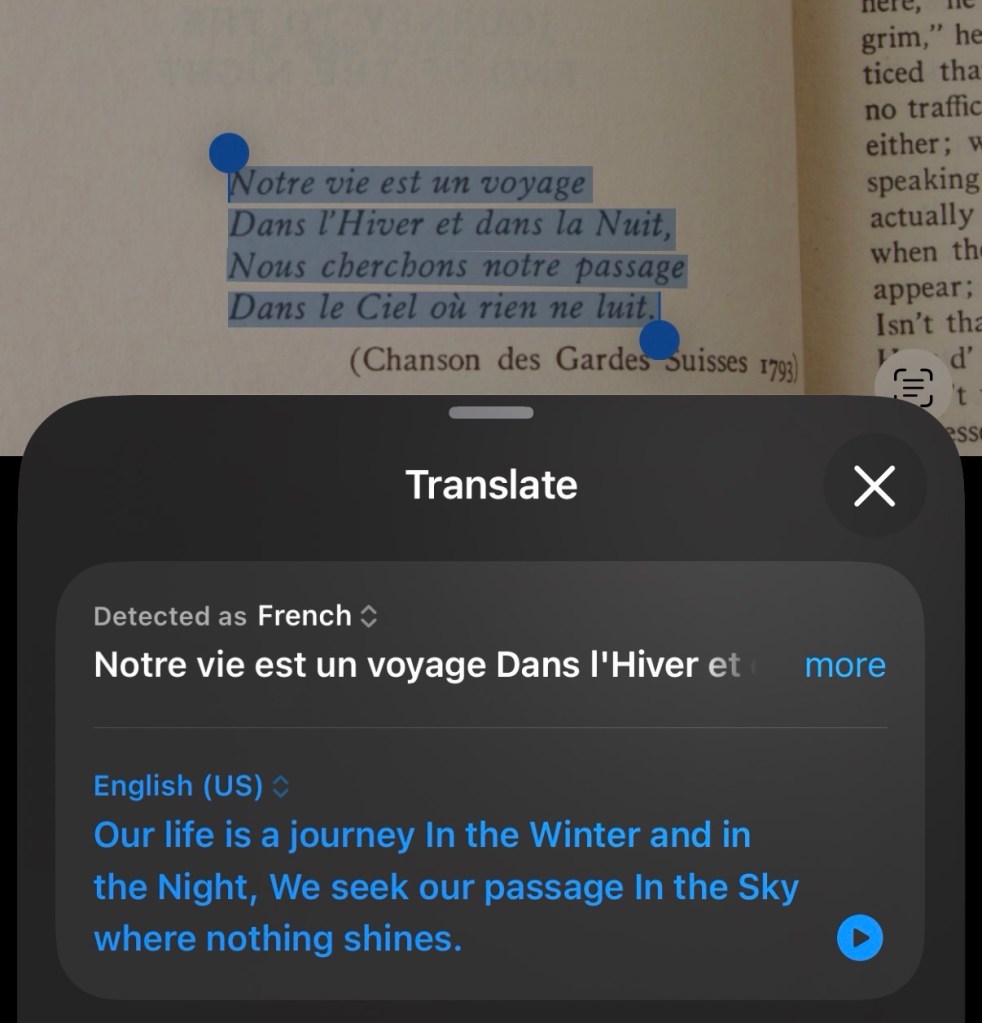
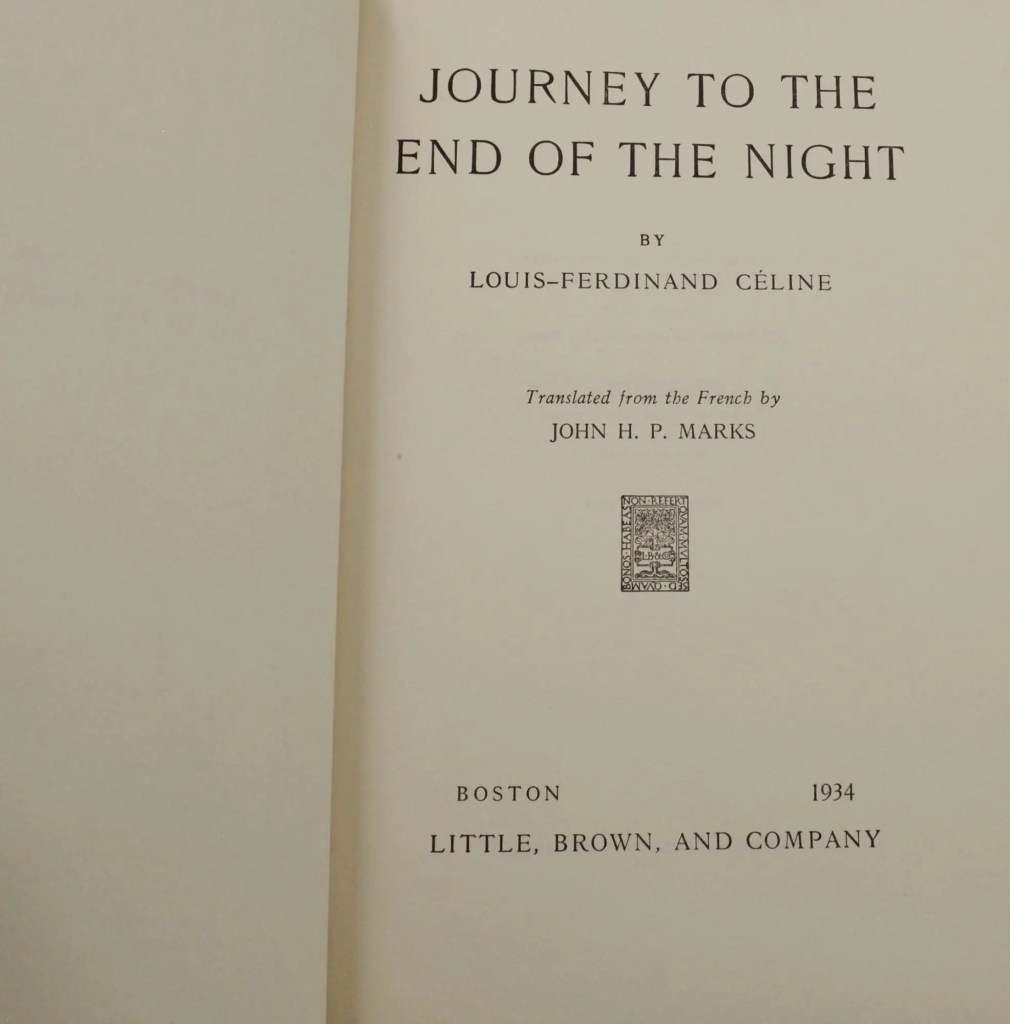
When you're in, you're in. They put us on horseback, and after we'd been on horseback for two months, they put us back on our feet. Maybe because of the expense. Anyway, one morning the colonel was looking for his horse, his orderly had made off with it, nobody knew where to, probably some quiet spot that bullets couldn't get to as easily as the middle of the road. Because that was exactly where the colonel and I had finally stationed ourselves, with me holding his orderly book while he wrote out his orders.
Down the road, way in the distance, as far as we could see, there were two black dots, plunk in the middle
like us, but they were two Germans and they'd been busy shooting for the last fifteen or twenty minutes.
Maybe our colonel knew why they were shooting, maybe the Germans knew, but I, so help me, hadn't the
vaguest idea. As far back as I could search my memory, I hadn't done a thing to the Germans, I'd always
treated them friendly and polite. I knew the Germans pretty well, I'd even gone to school in their country
when I was little, near Hanover. I'd spoken their language. A bunch of loudmouthed little halfwits, that's
what they were, with pale, furtive eyes like wolves; we'd go out to the woods together after school to feel
the girls up, or we'd fire popguns or pistols you could buy for four marks. And we drank sugary beer
together. But from that to shooting at us right in the middle of the road, without so much as a word of
introduction, was a long way, a very long way. If you asked me, they were going too far.
This war, in fact, made no sense at all. It couldn't go on.
Had something weird got into these people? Something I didn't feel at all? I suppose I hadn't noticed it . . .
Anyway, my feelings toward them hadn't changed. In spite of everything. I'd have liked to understand their brutality, but what I wanted still more, enormously, with all my heart, was to get out of there, because suddenly the whole business looked to me like a great big mistake.
"In a mess like this," I said to myself, "there's nothing to be done, all you can do is clear out . . .”
Over our heads, two millimeters, maybe one millimeter from our temples, those long tempting lines of
steel, that bullets make when they're out to kill you, were whistling through the hot summer air.
I'd never felt so useless as I did amid all those bullets in the sunlight. A vast and universal mockery.
This opening from Louis-Ferdinand Céline’s Journey to the End of the Night is remarkably illuminating when read alongside Levinas. The two texts begin from the same historical horizon—war—but they draw radically different philosophical conclusions.
Céline begins not with strategy, heroism, or national purpose, but with bewilderment. The narrator cannot understand why the Germans are shooting at him. He insists that he has done nothing to them, that he knew Germans as children, went to school among them, spoke their language, drank beer with them, chased girls with them. The enemy is not initially an abstract political category but a remembered human being. The absurdity of war lies precisely in the collapse of this familiarity into anonymous violence. “Without so much as a word of introduction” they are trying to kill one another. The phrase is almost comic, but beneath the humor lies a profound metaphysical shock: the ordinary conditions of human relation have disappeared.
This bewilderment resonates with Levinas’s claim that war “suspends morality.” War does not merely permit killing; it abolishes the ordinary structures through which persons recognize one another. The narrator’s repeated insistence that “this war… made no sense at all” is not simply a political judgment. It expresses the collapse of intelligibility itself. The ethical world in which one asks, “Why are you doing this?” has given way to a world in which force no longer requires explanation.
Yet Céline’s phenomenology differs sharply from Levinas’s. Levinas writes that war reveals an ontological order from which no one can escape, an order in which beings are mobilized into a totality that destroys their identity. Céline experiences the same reality from within. He does not theorize war; he feels himself reduced by it. His overwhelming sensation is uselessness. The bullets passing “one millimeter from our temples” do not reveal courage or destiny but “a vast and universal mockery.” War strips the world of meaning until existence itself appears ridiculous.
This is precisely the temptation Levinas identifies at the opening of Totality and Infinity. If war reveals reality “in its nudity and in its harshness,” then one may conclude that reality simply is absurd violence. Céline often seems to embrace this conclusion. His narrator encounters no transcendence beyond force, only the bitter recognition that human beings are swept into events that neither they nor their enemies truly understand. Levinas, by contrast, begins with this same disclosure only to refuse it. The experience of war may appear to reveal the truth of being, but Levinas’s entire work argues that this revelation is incomplete. The ethical relation to the Other discloses a dimension of reality that cannot be reduced to violence, politics, or totality.
Placed together, the two texts frame one of the decisive philosophical questions of the twentieth century. Does war reveal what reality truly is, or does it merely reveal one catastrophic way in which reality can appear? Céline records the experience of a world abandoned to force, where meaning dissolves into irony and survival. Levinas accepts the force of that experience but refuses to grant it the final word. The opening of Totality and Infinity is therefore not a denial of Céline’s world but an attempt to discover whether, even after war has stripped reality bare, there remains an ethical excess that violence cannot destroy.
Yes! Whats this silliness
I think I know what you’re reacting to. My previous response rushed into a neat comparison instead of staying with the text itself. The power of Céline’s opening is that it is far stranger than “war is absurd.”
What Céline does phenomenologically is almost the inverse of Levinas’s opening.
Levinas begins by asking whether war reveals the truth of reality. He writes at the level of ontology: being reveals itself as war. Céline begins with a man who simply cannot enter that ontology. He keeps returning to a prior fact:
I hadn’t done a thing to the Germans… I’d always treated them friendly and polite.
This is not a moral argument. It is a refusal of the political and ontological categories that have suddenly engulfed him. He cannot understand how two boys who drank beer together become enemies because someone somewhere has declared a war.
Then comes the extraordinary sentence:
”…without so much as a word of introduction…”
That is the sentence. It is almost Levinas before Levinas.
The “word of introduction” is not literally an introduction. It is the demand that violence justify itself through discourse. Before you shoot me, at least speak to me. Address me. Tell me who you are and why. Instead, there is only anonymous force.
Levinas’s entire philosophy begins with address. Ethics is not first a rule but an encounter. Céline’s narrator is scandalized because war abolishes the possibility of encounter. The first thing lost is not peace but speech.
Likewise, when Céline says:
This war, in fact, made no sense at all.
He does not mean history has no causes. Wars obviously have causes. He means the experience itself cannot be inhabited by consciousness. It cannot become my reason for acting. He cannot make it his own.
That is very close to Levinas’s later definition of violence:
Violence consists in making men play roles in which they no longer recognize themselves.
Céline is already there. He is being made to play “French soldier.” The Germans are being made to play “German soldiers.” Neither role arises from the concrete relation he remembers.
The last sentence is devastating:
I’d never felt so useless… A vast and universal mockery.
Notice he does not conclude, “Reality is harsh.” He concludes that his agency has evaporated. The mockery is directed at the illusion that he was ever acting as a free subject.
That’s why I would actually put Céline much closer to Levinas than I initially suggested. Levinas philosophizes the condition Céline narrates. Both begin with the destruction of ordinary interpersonal life by an anonymous order that no individual has authored.
The difference comes later. Céline largely remains inside that catastrophe. Levinas asks whether that catastrophe deserves to be called the truth of Being.
I actually think the phrase “without so much as a word of introduction” deserves as much attention as Levinas’s “Harsh reality (this sounds like a pleonasm!).” They are both tiny rhetorical moments that disclose an entire philosophy. One notices that reality has become “harsh” as though that were redundant; the other notices that killing has begun without anyone first speaking. Both are asking what has happened to the world when force replaces address.


