.
Across political philosophy, economics, and systems theory, there persists a shared assumption that order depends on some prior layer of meaning: laws require legitimacy, coordination requires shared models, and stability requires representational coherence between agents and the world they act upon. Even in its most technical forms—equilibrium theory, institutional analysis, or information-based models of coordination—this assumption survives in altered guise. Systems are understood as functioning because they “track” reality in some sufficiently faithful way, whether through prices, policies, or predictions.
This essay develops a counter-thesis that progressively dismantles that assumption. It begins from a simple but destabilizing observation: complex systems do not, in practice, require persistent shared interpretation in order to maintain macroscopic order. From this starting point, it reconstructs a layered framework in which regimes are treated as transient stabilizations of structure, coherence as an intermittent event rather than a continuous property, and meaning itself as a local compression phenomenon arising within underlying constraint dynamics. As each layer is revised, what initially appears as a theory of interpretation gradually becomes a theory of transformation without interpretation.
Within this shift, even mathematics must be re-situated. Rather than functioning as a privileged language of ultimate truth or hidden ontology, mathematics is treated here as the most durable available method for describing invariance under transformation. It is not invoked as evidence that reality is fundamentally quantitative, but as a tool for tracking what persists when structures drift. Wherever constraint, flow, and adaptation are present, mathematics enters not as interpretation but as a compressed notation for consistency: a way of expressing what remains stable across change without requiring shared meaning among observers.
The result is a shift in what it means for a system to be intelligible at all. Rather than presupposing that civilization, economy, or governance depends on stable models of itself, the framework developed here treats such models as temporary artifacts—useful when they emerge, but not foundational to the persistence of the system. What remains in the end is not a theory of meaning imposed upon structure, but a theory of how structure continues to reorganize itself in the absence of any requirement to be meaningfully represented.
ECON
This essay presents an integrated framework for understanding social and technological systems as evolving constraint-distortion dynamics. We define an underlying constraint field A(t) (the real-world resources, laws, physics) and a distortion field 𝔻(t) (agents’ beliefs, models, and biases). These fields interact through a time-dependent coupling matrix L(t) whose eigenmodes vₖ(t), λₖ(t) correspond to emergent regimes of coherence. In stable regimes, fixed eigenmodes allow effective governance and planning. But as L(t) itself begins to change on timescales comparable to or faster than policy and control (τ_control ≳ τ_structure), no fixed basis remains. We move into a regime-field of transient, drifting modes, where traditional control fails and only local, redundant adaptation can persist. This leads to a coherence ecology in which intelligibility (alignment of internal models M, actions X, and reality A) only occurs intermittently. When drift fully outpaces adaptation (δL·τ_adapt ≳ 1), even local coherence ceases (post-coherence). Systems can still self-organize through distributed constraint interactions, but meaning and stable control vanish (post-intelligibility). At this extreme, the only viable design is on the constraint field itself, creating a “post-semantic” environment engineered for compatibility. Finally, we reach a self-modifying constraint autopoiesis, a living ecology of constraints that continuously reshapes itself in response to instability, with no fixed semantics at all.
Thesis: Modern social-technical systems are transitioning from a world of fixed regimes (stable eigenstructures) into a regime-field of perpetual drift, where governance must shift from top-down control to engineering conditions for ephemeral coherence; intelligence becomes a transient phenomenon in a fundamentally constraint-driven, non-semantic dynamic.
The essay defines each layer of this arc formally, states key conditions (e.g. τ_control vs. τ_structure, δL·τ ≥ 1), and illustrates consequences with examples (economic policy vs. markets, AI regulation, ecosystems). We compare regimes in a summary table and use diagrams (phase timeline and a model–action–constraint cycle) to clarify structure. Throughout, we tie the novel framework to established ideas of complex systems, control theory, and resilience (e.g. requisite variety, edge of chaos, stigmergic coordination, adaptive cycles). We conclude that order does not require understanding – stability can emerge purely through shared constraints – and that the future of governance and AI lies in facilitating repeated “windows of sense” rather than fixed truths.
1. The Constraint–Distortion Framework
We model a society or system as a set of agents embedded in a constraint field A(t) (material, legal, informational limits) which defines what actions can affect what states. Each agent has an internal distortion field 𝔻ᵢ(t) (its beliefs, ideologies, cognitive biases) that translates reality into subjective terms. Together, all agents’ distortions interact via a coupling matrix L(t) (e.g. influence or communication links).
- Constraint field A(t): the objective environment (resources, physics, laws) that imposes boundary conditions on system dynamics.
- Distortion field D_i(t): agent i’s subjective representation (culture, interests, misinformation) – the “lens” through which it perceives and acts on A.
- Coupling matrix L(t): an N×N weighted network defining how distortions propagate between agents (e.g. social influence, trade ties). L(t) is generally time-varying as institutions and connections evolve.
We compute the eigen-decomposition of L(t): its eigenvectors vₖ(t) and eigenvalues λₖ(t) define collective modes of distortion. In a stable regime, L is nearly constant for long periods, and the dominant eigenmodes (ordered by λₖ) form the hierarchy of control. A single global mode (largest λ) may dominate, representing the prevailing ideology or state; secondary modes are minor alternative viewpoints.
As a formal definition, we say a regime is an extended period when L is quasi-static and its eigenmodes vₖ, λₖ persist. Under a regime, governance can steer the principal eigenvalues λₖ via policy knobs, thus shaping the system. For example, a stable monetary policy (L fixed) allows a central bank to target inflation by adjusting an eigenmode of economic output.
2. Stable Regimes and Control
In a stable regime the system behaves like a linearized networked oscillator: agents’ distortion deviations θᵢ evolve by
$$\dot θ = -D\;\theta + L\,θ,$$
where D is damping (policy, adjustment speed) and L is static. Here standard spectral methods apply: each eigenmode decays or grows exponentially with rate ~λₖ−d. Control theory ensures that if the control timescale τ_u (policy reaction time) is much shorter than the structure-change timescale τ_l (drift in L), the controller can treat L as fixed and adjust eigenvalues. Equivalently, viability requires
Governance inequality: τ_u < τ_l.
When this holds, one can reliably shape outcomes via policy. This echoes Ashby’s law: a regulator needs sufficient internal variety to counter external disturbances – if the environment (L) moves slowly, fixed rules suffice. In regime regimes, planners assume an essentially stationary “model of the world” and seek optimal solutions. The system’s coarse-grained dynamics dominate: we can work in a basis of a few dominant modes rather than track every agent.
3. Timescale and the Loss of Governance
Modernity challenges τ_u < τ_l. Rapid technological change, global markets, and social media mean L(t) now shifts on comparable or shorter timescales than policy cycles. Formally, when
Drift-control threshold: δL·τ_u ≥ 1,
the structure changes before policies apply. For instance, AI models can update weekly while legislation lags years. Similarly, financial markets swing fast, making monetary policy perennially behind. In this regime-field, the classical assumption of a fixed policy basis is violated.
In control terms, the standard eigenvalue approach fails when L is time-varying. As Belýkh et al. show, “the eigenvalue method cannot be applied to networks with a time-varying coupling structure”. The modes vₖ themselves fluctuate so quickly that interventions never hit the intended target. Consequently, old policies become ineffective or even counterproductive.
Theorem (Governance collapse): If structural drift timescale τ_l approaches or undercuts control timescale τ_u, no actor can stably govern system eigenmodes; control reduces to transient, local adjustments.
In practice, this means top-down governance fragments. Once τ_u ≳ τ_l, central planning fails and we enter an era of coherence ecology (next section). At that point, only two broad tactics remain viable: continuously tracking the drift (to rebase models on-the-fly) or working on the constraint field itself (hard limits). For example, regulators may switch to high-frequency monitoring and adaptive rules (continuous observability), or impose brute “hard caps” on carbon emissions, energy, debt, etc., which do not rely on detailed models.
4. Regime-Field: Transient Modes and Patchwork Control
When L(t) is not fixed, the system no longer has a permanent eigenbasis. Instead, a time-dependent spectral manifold emerges: modes appear, interact, and vanish. Control enters a new paradigm of “follow the mode” rather than “set the mode”. Governance in a regime-field has three partial strategies:
- Drift tracking (not direct control): Rapid sensing and re-identification of transient modes. Governments and firms invest in real-time data analytics to detect emerging instabilities or bubbles. But this is no guarantee of control – by the time information is assimilated, the system may have reconfigured. (This echoes the WEF’s call for “continuous monitoring” in AI governance.)
- Local stabilization: Instead of global eigenvalue adjustment, policy becomes crisis management: firefighting localized breakdowns. Examples include emergency liquidity lending in a bank panic, pandemic hotspots quarantines, or targeted cyber incident response. These are patches to immediate instabilities rather than structural reforms.
- Constraint anchoring: With internal structure elusive, the only truly reliable lever is the external constraint field A(t). This is “hard control”: for societies it means hard limits (resource caps, legal boundaries, infrastructure). In markets, it is central bank reserves; in ecology, it is protected areas. Constraint anchoring is survivalist: it doesn’t shape nuance, but it can hold catastrophic drift at bay.
In a regime-field, intelligence shifts from optimization to adaptation. The system’s behavior is now like a turbulent flow: occasional eddies and vortices (eigenmodes) form and dissipate. Agents must continuously adapt to a moving frame of reference. As our analysis suggests, only the rigid parts of institutions (constraints) remain stable enough to steer.
5. Coherence Ecology: Model–Action–Constraint Triad
We next introduce the triad of Model (M), Action (X), and Constraint (A). Every agent has an internal model M(t) that tries to represent L(t) and A(t), and chooses actions X(t) accordingly, which then feed back into the system. We represent this as a closed loop: M → X → A → M (see diagram below):
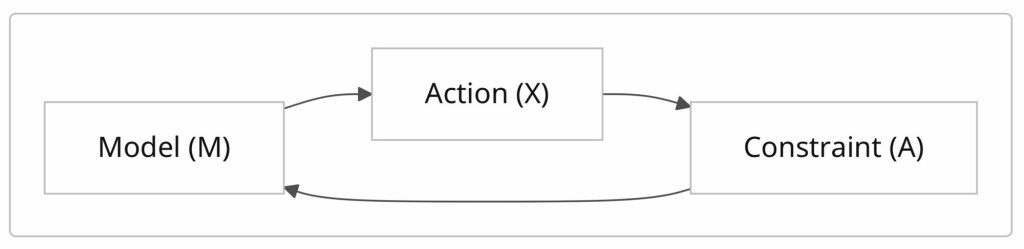
In a stable regime, M can be coherent (close to reality), so that the action X effectively adjusts the constraint state as intended, reinforcing M. In a coherence event, M, X, and A transiently align: the model is “right enough” that actions produce predictable, desirable outcomes under existing constraints. We define coherence ξ (Xi) as the probability or measure of such alignment over a time window Δt. When ξ is high, agents effectively coordinate; when ξ→0, plans misfire and actions decouple from results.
Intelligence, in this ecology, is the capacity to keep ξ(t) appreciable despite drift in L. It demands plastic models, robust actions, and grounding in A (the only stable reality). Formalizing this:
- Model plasticity: updating M rapidly as L(t) shifts.
- Action continuity: sustaining X (supply chains, policy measures) amid shifting definitions.
- Constraint anchoring: relying on A features (energy, material) that do not “drift away”.
When L drift is moderate (coherence ecology), multiple conflicting models coexist, and ξ emerges locally or intermittently. For example, during a financial crisis, banks might temporarily converge on similar risk assessments (local coherence) before diverging again. The system harbors overlapping “micro-regimes” where limited intelligence holds, but no single narrative dominates globally.
This stage exhibits edge-of-chaos dynamics: systems balance on the brink between order and disorder. Stuart Kauffman observed that adaptive systems often evolve to this “edge”, where creativity and responsiveness peak. Here, some stability exists (so the system doesn’t immediately collapse), but flexibility remains. In terms of our model, L(t) is neither fixed nor random – it spends time near critical states, allowing transient coherence.
However, because L(t) keeps moving, ξ never settles permanently high. Intelligence events are ephemeral: valid models M form briefly and then are invalidated. Any centralized plan will likely “miss the target” when the coordination mode shifts. As Simon (1962) noted, only nearly-hierarchical systems are tractable; a fully non-hierarchical coupling would “escape our understanding and observation”. In the coherence ecology, the coupling is increasingly flat and nested unpredictably, pushing Simon’s warning toward reality: to maintain comprehension, some structure must be assumed or periodically rediscovered.
6. Collapse Conditions: Post-Coherence Regimes
When drift intensifies further, we enter post-coherence: coherence is impossible even locally. Formally, ξ(t)→0 for all agents in all intervals. No M reliably matches any part of L, and no action aligns stably with outcomes. This occurs when
Collapse condition: τ_drift ≤ τ_adapt, or δL·τ_adapt ≥ 1.
Think of it as a “non-stationary crisis”: by the time an agent updates M or sees results of an action, L has moved on. Neither prediction nor feedback helps. Even decentralized coordination (stigmergy, market pricing) breaks down if every variable re-binds faster than signals propagate.
At this point, intelligence in the usual sense vanishes. There are no persistent attractors in the M–X–A space: one can define no stable model to even be “wrong” – all models cease to converge. Action becomes habit or routine without informative feedback. The system still evolves (constraints and resources still interact), but its dynamics become de-coupled from any narrative. This is not chaos (which has structure in aggregate) but a form of nihilistic drift: the system is its own attractor (a drifting attractor field).
Examples are hard to find in full extreme, but one can imagine an ecosystem on the verge of collapse: species cannot adapt to rapid climate swings, so neither predator-prey nor resource cycles stabilize. Or think of a technological ecosystem where all protocols change before standards emerge: no stable interoperability, just continuous rewiring.
7. Post-Intelligibility: Emergent Constraint Coordination
Even without coherence, the world doesn’t freeze; it can still organize through constraints alone. In post-intelligibility, internal meanings or models cease to matter. Instead, agents become mere nodes in a self-organizing constraint network. Coordination arises not via shared plans but via shared limitations.
For instance, traffic flow can settle into a stable pattern without drivers agreeing on a route; ants build trails by stigmergy rather than design; traffic lights can synchronize without a central controller. These systems use the environment as “memory” and constraints as guides. Stigmergy (from social insects) shows how “agents leave traces or signals in the environment, which guide the swarm toward desired emergent behaviors.” In such systems, order emerges as an epiphenomenon of constraint interactions, not as the result of understanding.
Concretely, even when no one understands the whole, patterns can form: supply chains may find bottlenecks, genomes may adapt evolutionarily, or machine protocols may auto-correct errors through redundancy. However, these patterns are non-semantic – one cannot easily label them with a global model or explain them in classical terms. Intelligence becomes distributed and embodied.
In this regime, stability comes from collective constraint compliance. If every agent simply responds to immediate stress (like a spring–damper responding to displacement), the ensemble can settle into a rough equilibrium. But no one “knows” that equilibrium; it’s a product of physics or economics. As Simon observed, without hierarchy, analyzing the system requires full detail of every part – which is impossible. Instead, order just “lives” in the background.
8. Post-Semantic Design: Engineering the Constraint Field
Given this limit, the only locus of agency is the design of A(t) itself. We call this post-semantic design. Here “policy” no longer means directing behavior; it means shaping the possible space of behaviors. Instead of telling agents what to do, a post-semantic designer crafts friction, affordances, and coupling.
Key levers are:
- Gradient architecture: Sculpt how costly different transitions are. E.g., build high-speed rail (low cost of travel) or impose tariffs (high cost of some trade). Agents will “choose” paths of least resistance automatically.
- Coupling topology: Determine which interactions propagate. For example, decentralize infrastructure so local failures stay local. In social media, alter algorithms so extreme content doesn’t cascade system-wide.
- Friction distribution: Make some dynamics slow (high friction) and others easy (low friction). Plant more rugged forest to slow deforestation waves; invest in frictionless data-sharing in safety-related systems.
The design paradox is that the system must not be over-fitted to any particular L. Any rigid architecture invites collapse when drift continues. Instead, the “optimal” regime is critical: constantly rebalancing between rigidity and flux. This echoes Ashby and Goodman’s insight: “only variety can absorb variety”, so a plurality of pathways is needed.
In effect, governance becomes invisible: no agent needs to understand why a policy works, only that it biases the system toward compatibility. This is akin to ant colonies building nests without an ant “architect”. The designer acts only on constraint geometry, while patterns emerge automatically.
9. Self-Modifying Constraint Autopoiesis
The final stage is a self-sustaining dynamic: the constraint field not only is designed but continually self-modifies in response to instability. There is no external planner – the system autopoietically reshapes itself. Feedback loops of instability and repair create a living structure.
For example, consider an economy where markets automatically shift resource allocations and regulatory parameters adjust themselves algorithmically based on local stress signals. Every breakdown triggers a local adaptation that tweaks the rules; the aggregate is a continuous experiment with no fixed end-state.
Crucially, this feedback happens without any global semantic layer. Agents need not ever form a coherent global model. They only react to local failure modes, and whatever emerges is a byproduct. The system evolves toward configurations that mitigate the immediate instabilities, preserving its future ability to change. In cybernetic terms, the “goal” is simply continued flexibility.
This constraint autopoiesis can survive even post-human: imagine a planetary system of machines and ecosystems that reorganize themselves whenever thresholds are crossed. There is no vision of an end state, only endless transformation.
10. Formal Definitions and Theorems
- Eigenmodes: Given L(t), its instantaneous eigenpairs {vₖ(t), λₖ(t)} satisfy L vₖ = λₖ vₖ. In a regime, vₖ are approximately constant in time.
- Coherence (Ξ): A scalar measure (0≤Ξ≤1) of alignment among model M(t), action X(t), and constraint A(t) over Δt. We say a coherence event occurs if M correctly predicts X’s effect on A during Δt, so Ξ is high.
- Timescales: Let τ_u = characteristic time for M–X–A adaptation (learning, policy cycles, reaction), and τ_l = characteristic time of structure drift (change in L or A).
Theorem (Governance Limit): If τ_u < τ_l, spectral governance is feasible (policy can steer λₖ). If τ_u ≥ τ_l, no fixed eigenbasis exists for control; control is limited to constraint anchoring and local adaptation.
Corollary (Collapse Condition): Define δL = rate of change of L. If δL·τ_u ≥ 1, then ξ→0 globally: agents cannot maintain coherence.
These formal conditions echo Ashby’s Law: the “requisite variety” for regulation requires control actions to match the variety of perturbations. Here the “perturbation” is structural drift itself.
11. Examples
- Policy vs Markets: Financial markets drift minute-by-minute, whereas monetary/fiscal policy adjusts monthly/annually. Post-2008 studies note that by the time regulators react, markets have moved to a new regime. This exemplifies τ_u ≫ τ_l, forcing central banks into local crisis aversion (lender of last resort) rather than steering macro variables.
- Climate Governance: Physical climate change (CO₂ rise, ice melt) proceeds on decadal timescales, while international agreements crawl at political pace. The misalignment means we rely on hard constraints (e.g. technology fixes, geoengineering) and resilience building, since stable global policy regimes have not formed.
- AI and Technology: Generative AI models evolve weekly; regulation (e.g. EU AI Act) lags years. This has driven calls for “continuous oversight” as opposed to static audits. Indeed, the WEF argues governance must become adaptive: “a governance model designed for periodic compliance cannot keep pace with… learning AI systems”.
- Ecology: Traditional “equilibrium” fisheries policy fails when ecosystems flip abruptly. Resilience science (Holling, Walker et al.) shows that sudden regime shifts occur when slow variables (e.g. biodiversity) cross thresholds. Management thus shifts to enhancing systemic adaptability (diversity, precaution) rather than optimizing yield in a stationary regime.
- Organizational Design: Large projects often collapse under their own complexity. Enterprise Architecture experts note that “reinforcing a complex system’s ability to change wins over optimizing the status quo”. Rigid architectures (“best blueprint ever”) quickly fracture through “creative interpretation,” as Bente et al. illustrate.
These examples show the universality of the principles: when environmental or systemic change accelerates, any fixed scheme fails, and adaptation via structural constraints dominates.
12. Table: Regime Regimes vs. Timescales vs. Survivability
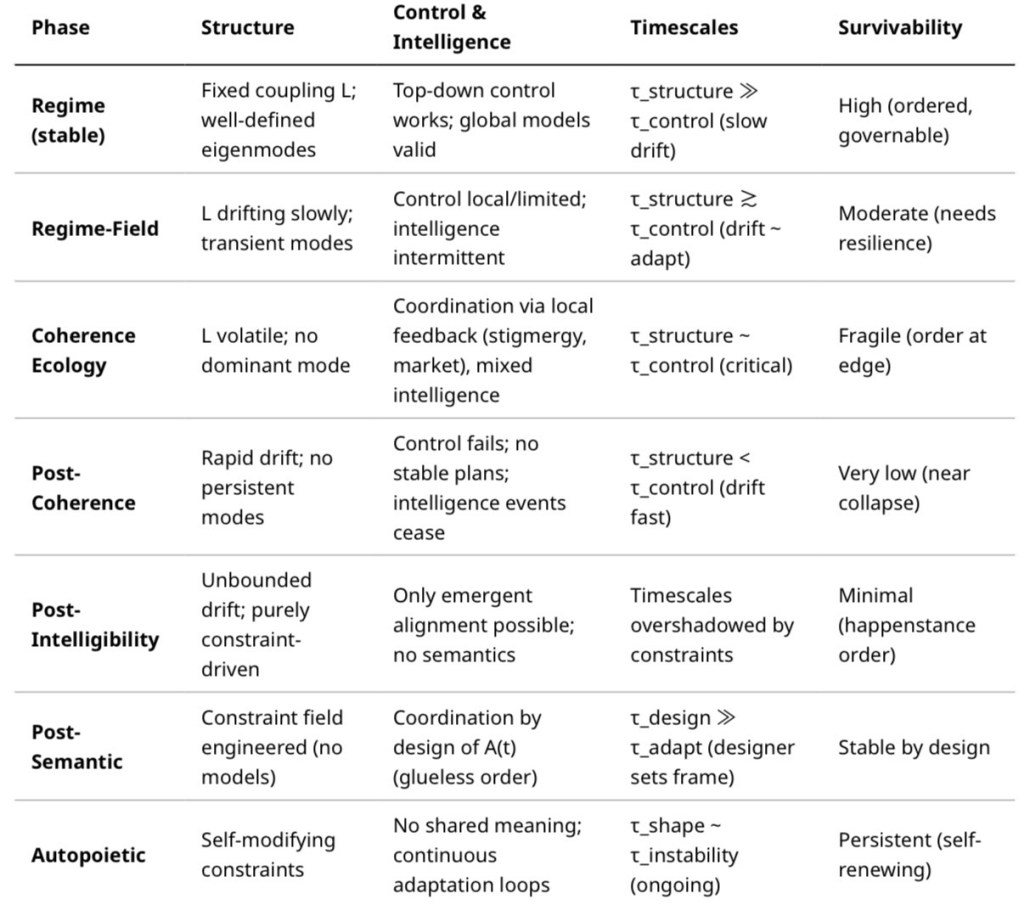
Table: Comparison of system regimes. Survivability refers to the system’s ability to maintain functionality (identity, continuity) under perturbations, given the nature of control and interpretation in each phase.
13. Implications for Governance, AI, and Design
This framework has broad implications:
- Governance: Traditional command-and-control fails if the “model of reality” is always outdated. Policy must shift to adaptive regimes: continuous monitoring, rapid feedback loops, and constraint-based rules (e.g. resource caps, modular institutions). Multi-level governance (federalism, polycentricity) inherently injects redundancy, increasing Ashby’s variety.
- Artificial Intelligence: AI systems exemplify structural drift: models learn and self-improve, invalidating fixed oversight. The call for “agile AI governance” is precisely this insight. It means moving from static audit to real-time assurance (continuous evaluation APIs, risk dashboards) and designing AI ecosystems (data access, architectures) that buffer against drift. Crucially, we cannot rely solely on interpretability or alignment with a fixed goal: adaptability is key.
- System Design: Engineers should favor modular, near-decomposable architectures. Designs should maximize internal variety and feedback, acknowledging uncertainty. For instance, in software and infrastructure, microservices and loosely coupled modules embody “modularity in space and time,” preserving functionality as parts evolve independently.
- Failure Modes: If designers ignore drift, the system risks regime collapse. Overcentralization (locking a rigid L) or over-synchronization (force sharing one model) are fatal: either rigidity leads to breakage under stress or a single regime amplifies systemic shocks. Conversely, excessive fragmentation (complete incoherence) leaves no common ground. The “edge of chaos” insight suggests the sweet spot is partial coupling and controlled diversity.
14. Concluding Synthesis
Civilization is not a fixed machine but a living flow through a shifting landscape of constraints and interpretations. In regimes of stability, we naively treated order and meaning as permanent. But in our modern regime-field, order must be continually re-formed. Control is no longer about imposing a plan; it’s about sculpting the conditions under which local order naturally arises. Intelligence is no longer housed in institutions, but flickers in the spaces between them.
Provocatively, this means real understanding is not the foundation of governance, but a fleeting byproduct. Every plan we write, every truth we preach, is subject to the evolving syntax of reality. The true governance challenge is not to enforce a global narrative, but to make sure the conversation can happen at all under shifting circumstances.
In the end, the world need not ever “make sense” to keep on happening. Order can come from the constraints, not the semantics. All that matters is that the system keeps making room for meaning to reappear, even if only for a moment.
This echoes Ashby and Simon long ago: only by preserving structural flexibility and variety can a complex system remain viable. Our analysis suggests that the final art of governance and design is to navigate at the edge, constantly open to the next brief alignment. The golden rule becomes: Do not create a fixed map; create the space in which new maps can be drawn, even as the territory continually changes.
References
- Ashby, W. R., An Introduction to Cybernetics (1956). Law of requisite variety: “only variety can absorb variety”.
- Walker, B. et al., “Resilience, adaptability and transformability in social-ecological systems,” Ecol. & Society 9(2) (2004): “Resilience (the capacity of a system to absorb disturbance and reorganize…still retain the same function)”.
- Bente, S., Langade, S. et al., Foundations of Collaborative EA (2012): “A system is viable to the extent it can preserve its identity under change; to do so, it must form variations… A rigid corset is likely to break down”.
- Belýkh, V.N. et al., “Connection graph stability method for synchronization in networks,” Physica D (2004): “the eigenvalue method cannot be applied to networks with a time-varying coupling structure”.
- Bilder, R. et al., on “edge of chaos”: “Some physical, biological, economic and social systems operate…where complexity is maximal”.
- Aina, K.O. & Ha, S., Deep RL for Multi-Agent Coordination (2025): “Stigmergy…as a coherent and effective method of decentralized communication via local stimuli… agents leave traces in the environment to guide the swarm”.
- World Economic Forum (2026), “Agile AI governance”: “Existing governance timelines cannot capture [AI] shifts… governance must evolve from static to dynamic… from compliance to continuous assurance”.
- Simon, H.A., “The Architecture of Complexity” (1962): “Without a hierarchical structure… non-hierarchic systems escape our understanding…analysis of their behavior would involve…detailed knowledge of their elementary parts”.
(Additional references on complex systems, panarchy, and coordination can further contextualize these arguments.)
In the end, the framework developed here does not conclude in a doctrine of meaning, nor in a theory of stable order, but in a more restrained claim about what persists when neither meaning nor stability can be taken for granted. Across regimes, regime-fields, coherence ecologies, and post-intelligibility systems, what remains continuous is not interpretation but transformation under constraint. Systems endure not because they correctly represent themselves, but because they continue to reconfigure under pressures they do not need to fully understand.
From this perspective, intelligence, coherence, and meaning are no longer foundations but local phenomena—brief compressions within a broader space of ongoing structural drift. They appear when conditions temporarily allow parts of a system to align, model, and act in ways that are mutually legible, and they dissolve when those conditions pass. Nothing in this account requires that such moments be permanent for the system to remain viable.
Mathematics, in this context, does not resolve the instability of interpretation; it simply offers the most compact way of describing what remains invariant while interpretation fails. It names patterns of persistence without requiring that those patterns be understood in semantic terms by the systems that exhibit them.
The final implication is therefore deliberately modest. A civilization, an economy, or any complex multi-agent structure does not ultimately depend on shared understanding of itself. It depends on whether its underlying constraints can continue to reorganize in ways that preserve the possibility of future reorganization. Everything else—meaning, coherence, intelligence—belongs to the transient interior of that process: real when it occurs, consequential when it holds, but never required for the system’s continuation.


