PREFACE
Edward Said’s Orientalism remains one of the most influential works of the twentieth century because it fundamentally altered the way scholars understand the relationship between knowledge and power. Its central claim is not merely that the “Orient” was misrepresented by Europe, but that the Orient itself was constituted through a network of scholarship, literature, political discourse, and cultural representation. The significance of this insight extends far beyond the history of colonialism. It demonstrates that meaning is never simply discovered as an objective property of the world. Rather, what appears as reality is always mediated by structures that determine what may be seen, said, and recognized as intelligible.
This volume belongs to the philosophical tradition that made such an analysis possible. The movement from Ferdinand de Saussure’s structural linguistics, through Claude Lévi-Strauss’s structural anthropology and Edmund Husserl’s phenomenology, to Jacques Derrida’s deconstruction transformed the modern understanding of meaning. Structuralism displaced the assumption that things possess significance independently of their relations, revealing instead that meaning emerges from systems of difference. Post-structuralism then demonstrated that these systems themselves are never complete or self-grounding, but remain open to revision, instability, and historical transformation. The chapters that follow trace this intellectual development as an initiation into the structural imagination: an introduction to the philosophical discovery that relations precede isolated substances and that intelligibility arises through organization rather than intrinsic essence.
The discussion of Orientalism therefore serves not as a political conclusion but as a philosophical illustration. Said’s analysis may be understood as an application of structuralist and post-structuralist insights to the history of culture and empire. His concern is not simply that certain descriptions of the East were inaccurate, but that entire systems of discourse established the conditions under which the East could appear as an object of knowledge at all. In this respect, Orientalism demonstrates how structures of language, representation, and institutional authority shape the worlds within which human beings think and act.
At the same time, this work ultimately departs from Said’s project. The question pursued here lies one step prior to discourse itself. Structuralism explains how systems organize meaning, while post-structuralism reveals the instability of those systems. Yet an earlier philosophical problem remains: how do human beings become oriented before conceptual systems are fully formed? How is judgment possible before complete theoretical incorporation has been achieved? These questions motivate the concluding movement of this study, where the concern shifts from structures of meaning to the practical conditions of rational response.
The architecture of this work is therefore intentionally spiralic rather than merely linear. It begins by surveying the principal discoveries of structuralism as a whole before returning to each thinker in progressively greater depth. The opening overview functions as an initiation into the terrain, allowing the reader to perceive the overall movement before entering its individual moments. Each subsequent chapter revisits familiar concepts from a more refined perspective, revealing how later developments emerge from tensions already present within earlier ones. Understanding is therefore not treated as a single forward progression but as a series of returns in which each repetition deepens rather than merely repeats what has come before.
The goal of this work is not only to introduce structuralism as an intellectual movement but also to prepare the reader for a philosophical transition beyond it. By the end of this study, structuralism and post-structuralism appear not as final destinations but as indispensable stages in a broader inquiry into meaning, judgment, and the conditions under which finite beings respond to a world that always exceeds complete conceptual determination.
Arche-Texture: An Initiation into Structuralism
Introduction: The Structural Turn
Arche (ἀρχή) means origin, beginning, first principle, governing source. Texture comes from the Latin texere, “to weave.” The history of Western philosophy has often sought the arche: the first principle from which all things derive. Structuralism does not abolish this search; it transforms it. The origin is no longer imagined as a simple point existing before all relations. Every beginning already emerges within a field of distinctions. Every foundation is already articulated through difference. The origin is therefore not an isolated source but a woven condition of possibility. The arche is not before the texture. The arche is the texture.
There are moments in the history of thought when the object of inquiry changes so fundamentally that an entire intellectual landscape is reorganized. Structuralism represents one of these moments. It is not merely a school of thought, nor simply a method applied to language or anthropology. It is a transformation in how one asks philosophical questions. Prior to structuralism, the dominant tendency was to investigate things individually. A philosopher asked what justice is, what language is, what a myth means, or what consciousness contains. The assumption was that each phenomenon possessed an essence that could be discovered through careful analysis. Structuralism proposed a radically different possibility. Perhaps no phenomenon possesses its meaning in isolation. Perhaps meaning belongs not to things themselves but to the relations that bind them together.
This seemingly modest shift alters everything. A word no longer derives its meaning because it corresponds to an object in the world. A myth no longer matters because of the events it narrates. A social custom is no longer explained by the intentions of those who practice it. Instead, every element receives its significance from the larger system within which it occupies a position. The question therefore changes from What is this? to What system makes this possible? Structuralism is the search for those hidden systems. Its ambition was extraordinary. If language possesses an underlying grammar invisible to everyday speakers, perhaps myths possess one as well. Perhaps kinship, religion, law, ritual, fashion, literature, and even human thought are governed by structures that remain largely unconscious to those who inhabit them. The visible world would then be only the surface expression of a deeper architecture. The history of structuralism is therefore not merely the history of a movement. It is the gradual discovery that meaning is relational rather than intrinsic.
The Long Road to Structuralism: A Sweeping Intellectual History
Ideas rarely announce themselves as revolutions. They emerge quietly, often concealed beneath the work of scholars who believe themselves to be solving local problems. Only in retrospect do we recognize that they were laying the foundations of a new way of seeing. Structuralism belongs to this peculiar class of revolutions. It did not begin with a manifesto. It began with philologists comparing ancient languages, philosophers questioning consciousness, and anthropologists listening to myths in distant forests. What united these otherwise disparate endeavors was the gradual realization that individual things are intelligible only through the systems to which they belong. To narrate structuralism, therefore, is not merely to recount the history of an intellectual movement. It is to follow the slow awakening of a single intuition: that relations precede the things they relate.
The Philologists: Discovering Hidden Order
The nineteenth century was intoxicated with history. Charles Darwin traced the evolution of species. Karl Marx described the historical movement of economic systems. Historians reconstructed civilizations through archives and ruins. Linguists likewise believed that the deepest truths of language lay in its origins. Among the pioneers was Franz Bopp (1791–1867), whose comparative study of Sanskrit, Greek, Latin, Persian, and Germanic languages revealed that these languages belonged to a common family. His work suggested that languages evolve according to regular principles rather than random accident. Jacob Grimm (1785–1863), remembered today for collecting fairy tales, was equally remarkable as a linguist. Grimm’s Law demonstrated that sound changes obey lawful patterns. Even the apparent chaos of spoken language concealed remarkable regularity. August Schleicher (1821–1868) pushed this historical vision still further. Languages, he argued, resembled biological organisms. They were born, matured, branched into descendants, and eventually died. Linguistics therefore became an evolutionary science, reconstructing genealogies much like a natural historian reconstructs species. The nineteenth century had become extraordinarily adept at explaining how things change through time. It had not yet learned how to explain how they exist as systems. That discovery belonged to the next generation.
Structuralism: Foundations and Developments
Executive Summary: Structuralism is an intellectual movement that arose in the early 20th century, originating in linguistics and later spreading to anthropology, philosophy, and literary theory. It proposes that human culture can be understood through underlying structures – systematic relations and binary oppositions – rather than isolated facts or events. The Swiss linguist Ferdinand de Saussure laid the groundwork with his Course in General Linguistics (1916), introducing the linguistic sign (signifier and signified), the distinction of langue (the systemic rules of language) and parole (individual speech acts), and the importance of synchrony (studying a language at a moment in time) over diachrony (historical change). His ideas suggested that meaning arises from differences within a self-contained language system. Building on Saussure, the anthropologist Claude Lévi-Strauss applied these ideas to culture. In works like Structural Anthropology (1963) and Mythologiques (1964–71), he analyzed kinship and myth by breaking them into minimal units (e.g. mythemes) and uncovering binary oppositions (raw/cooked, nature/culture, life/death) that generate meaning. Structuralists sought the deep grammar of society – unconscious rules shaping thoughts. Edmund Husserl’s phenomenology influenced structuralists by emphasizing essential, universal structures of experience: through the epoché (bracketing assumptions) one seeks the eidos or pure essence of phenomena. However, Husserl’s focus on subjective consciousness and transcendental idealism differs from structuralists’ objective social structures. By the 1960s, Jacques Derrida challenged structuralism with deconstruction: he argued that meaning is never fully present or stable but endlessly deferred (différance) and that every sign bears the trace of what it is not. Derrida exposed the “metaphysics of presence” in Saussure’s and Lévi-Strauss’s binary oppositions, showing that oppositions invert or fold into each other. These critiques led into post-structuralism, where thinkers like Foucault, Deleuze, and Lyotard questioned grand narratives and fixed structures altogether, emphasizing power, difference, multiplicity, and the instability of meaning.
1. Ferdinand de Saussure: Linguistic Structures
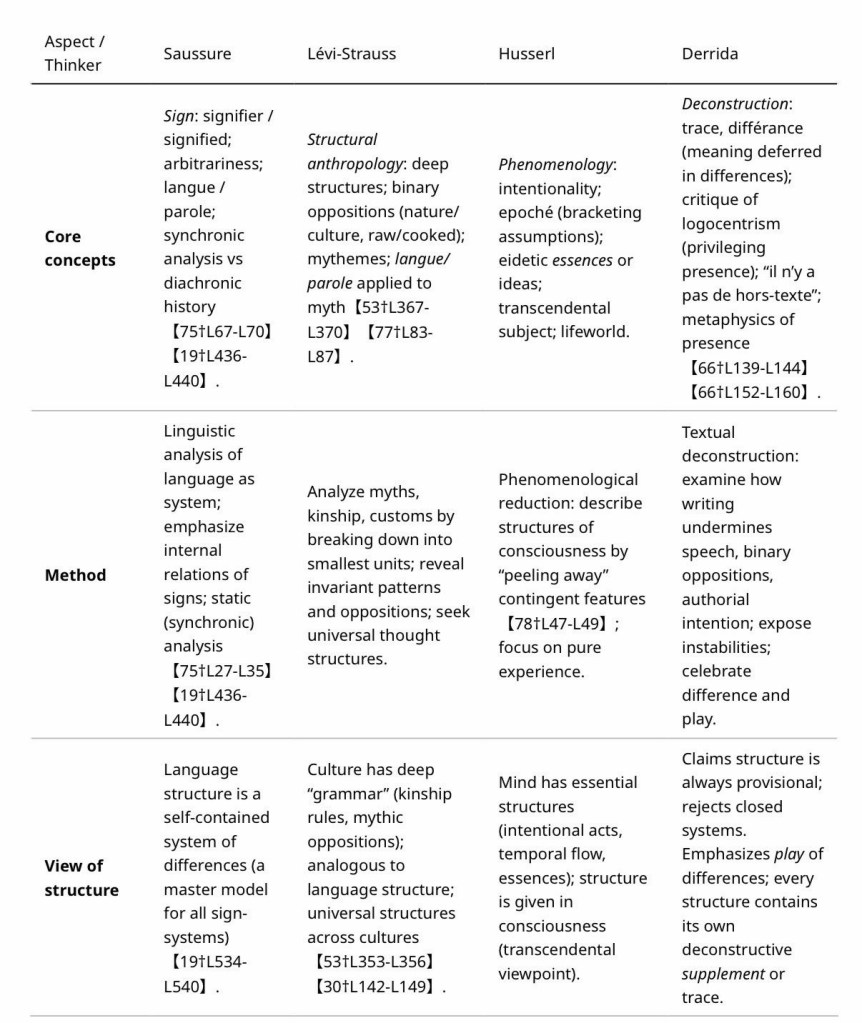
Ferdinand de Saussure (1857–1913) revolutionized linguistics by proposing that language is a system of interrelated signs rather than a simple naming of pre-existing things. A linguistic sign combines a signifier (sound-image) with a signified (concept), united by a purely psychological bond. Saussure stressed the arbitrary nature of the sign: there is no inherent connection between the sound and the concept it represents. For example, the French signifier sœur has no natural link to the concept sister – any sound could have served equally well. This arbitrariness means meaning arises from differences within the language system (e.g. sœur is not mère or frère).
Saussure also distinguished langue (the abstract grammar or system of a language known by a community) from parole (individual utterances). The study of langue allows linguists to analyze the synchronous structure of language at a given time, in contrast to diachrony, which examines historical change. He insisted that to understand language one must focus on its synchronic structure: “Language is a system of signs that expresses ideas” at a moment in time. This synchronic approach became a hallmark of structuralism, where the analyst seeks the invariant structure beneath changing phenomena.
THE DISCOVERY OF STRUCTURE
The modern history of structuralism begins with a question that appears simple but transforms the entire study of human meaning: where does meaning come from? Before Saussure, language was generally understood through a representational model. Words were treated as names attached to things. A word possessed meaning because it referred to an object, idea, or reality that existed independently of language. Language was therefore secondary: a tool through which human beings expressed thoughts and described a world already given. Saussure’s great innovation was to reverse this relationship. Language is not simply a collection of names assigned to pre-existing realities. It is a system that actively organizes the possibilities of meaning. A word does not possess meaning because it contains a direct connection to an object. It possesses meaning because it occupies a position within a larger network of differences. The fundamental discovery of Saussure is that meaning is relational. A sign does not stand alone. It exists only within a system that distinguishes it from other signs. Meaning is therefore not located inside individual elements but emerges from the relations between them. The question of language changes from “What does this word represent?” to “What differences allow this word to function as meaningful?” This was the decisive movement from substance to structure. Saussure expressed this transformation through his theory of the linguistic sign. A sign consists of two inseparable components: the signifier and the signified. The signifier is the sound-image, the material form of language—the sounds we hear or the marks we write. The signified is the concept associated with that form. Together they create the linguistic sign. However, the connection between signifier and signified is not natural. It is arbitrary. There is nothing inherent in the sound pattern “tree” that connects it to the concept of a tree. Other languages demonstrate this clearly: French uses arbre, German uses Baum, and Arabic uses shajara. The same reality is organized through different signs because the relationship between sound and concept is established by the linguistic system rather than by nature itself. Yet arbitrariness does not produce disorder. It produces structure. Because words do not receive their meanings from natural resemblance, they receive them from their differences within the system. A word means what it means because it is not other words. The meaning of “father,” for example, is not contained within the sound itself. It emerges through its position in relation to “mother,” “child,” “son,” “daughter,” and the entire network of distinctions through which kinship becomes intelligible. A sign therefore has no isolated identity. Its identity is structural. Saussure’s famous insight—that language consists of differences without positive terms—became the foundation of structuralist thought. A linguistic element is not first something in itself and then placed into relation with other elements. Rather, its very identity is produced through those relations. The system does not merely organize already existing meanings; it makes meaningful identity possible in the first place. This discovery transformed linguistics. The nineteenth century had primarily approached language historically. Scholars such as Franz Bopp, Jacob Grimm, and August Schleicher sought to reconstruct the origins and evolution of languages. They traced sound changes, linguistic families, and historical transformations. Their work revealed that language possessed order across time. Saussure introduced a different question: how does language function as a system at a given moment? This distinction became the difference between diachrony and synchrony. Diachronic analysis studies language as a historical development. It asks how a word, sound, or grammatical form changed over centuries. Synchronic analysis studies language as an organized system existing at a particular moment. It asks how elements relate to one another within the structure that makes communication possible. Saussure used the example of chess to illustrate this distinction. The value of a chess piece does not come from its physical material or historical origin. A knight is meaningful because of its position and possible movements within the rules of the game. A wooden piece and a plastic piece can perform the same function because what matters is not the substance of the object but its relation within the system. Language operates in the same way. A word is meaningful because of its position within the total structure of language. This insight would become the foundation for structural anthropology. If language possesses an underlying organization that governs how meaning is produced, perhaps other human creations operate according to similar principles. Perhaps myths, rituals, kinship systems, and social practices are not simply collections of individual actions or beliefs. Perhaps they are symbolic systems whose elements acquire meaning through their relations to one another. This possibility transformed the human sciences. Saussure’s distinction between langue and parole made this expansion possible. Langue refers to the underlying system of rules, conventions, and differences shared by a linguistic community. Parole refers to individual acts of speech—the particular sentences and expressions produced by speakers. An individual speaker creates a unique statement, but that statement is only possible because the speaker participates in a larger linguistic structure. The individual does not invent language anew each time they speak. They enter a system that precedes them and provides the conditions through which expression becomes possible. This distinction revealed a broader principle: human activity is often guided by structures that remain invisible to those who participate in them. People speak without consciously knowing the complete grammar that organizes their speech. They follow linguistic rules they have never explicitly learned. The structure operates beneath conscious intention. For Saussure, this was not a limitation of human freedom. It was the condition that made meaningful action possible. Without a shared structure, communication could not occur. Structure does not eliminate creativity; it provides the field within which creativity can emerge. This insight would become the central inspiration for Claude Lévi-Strauss. Lévi-Strauss recognized that Saussure had uncovered more than a theory of language. He had discovered a general model for understanding human culture. If language is not a collection of isolated signs but a system of relations, then perhaps culture itself should be approached in the same way. Myths, rituals, kinship practices, and social institutions might contain underlying structures comparable to the grammar of a language. The task of anthropology would therefore change. Instead of asking only what a cultural practice means to the people who perform it, the anthropologist could ask what system of relations allows that practice to have meaning at all. The visible elements of culture would become like the words of a language: individual expressions generated by a deeper structure. Saussure’s achievement was therefore not simply the creation of modern linguistics. He introduced a new way of understanding intelligibility itself. Meaning no longer appeared as something contained within isolated objects, beliefs, or actions. Meaning emerged through relations. The structural turn begins with this realization: Things do not become meaningful because they exist independently and then enter into relationships. They become meaningful because they already belong to a system of relations. The next step was inevitable. If language possesses a hidden structure, perhaps culture does as well. Claude Lévi-Strauss would take this discovery and ask the revolutionary question that would define structural anthropology: What if human beings do not merely speak languages, but live within structures of meaning that function like languages?
Primary sources: Saussure’s Course in General Linguistics.
Secondary sources: [Wikipedia: Ferdinand de Saussure] (overview of sign, arbitrary nature, langue/parole); introductory linguistics texts on semiology.
Illustrative quotations:
- “The linguistic sign unites, not a thing and a name, but a concept and a sound-image”.
- “The bond between the signifier and the signified is arbitrary… I can simply say: the linguistic sign is arbitrary”.
- “Language is a system of signs that expresses ideas” (necessitating synchronic analysis).
- “We call the combination of a concept and a sound-image a sign… I replace concept and sound-image by signified and signifier”.
- “Language is ultimately not a function of reality, but a self-contained system of differences”.
2. Claude Lévi-Strauss: Structural Anthropology
Claude Lévi-Strauss (1908–2009) is regarded as the father of structural anthropology. Inspired by Saussure’s insight that meaning comes from differences within a system, Lévi-Strauss sought the deep mental structures shaping myths, kinship, and cultural practices. In Structural Anthropology (1958/63) and The Raw and the Cooked (1964), he argued that the human mind universally thinks in binary oppositions (e.g. raw/cooked, nature/culture, life/death). These oppositions are not arbitrary: they reflect innate cognitive patterns that people use “as conceptual tools” for structuring experience. For example, the title The Raw and the Cooked highlights one fundamental pair: “what is ‘raw’ is opposed to what is ‘cooked,’ and the ‘raw’ is associated with nature while the ‘cooked’ is associated with culture”.
Lévi-Strauss analyzed myths by decomposing them into minimal units called mythemes and examining how they combine. Instead of focusing on individual symbols, he looked at relations among elements: “units form relations with each other, based on binary pairs or opposites, which provide the basis of the structure”. Myths from disparate societies often share structural patterns despite different content, because they address universal human contradictions. He famously noted that people everywhere “think about the world in terms of binary opposites—such as high and low, inside and outside, person and animal, life and death—and that every culture can be understood in terms of these opposites”. In doing so, Lévi-Strauss treated cultures analogously to languages: myth is a kind of “language” whose underlying grammar his method aimed to uncover.
CULTURE AS A SYSTEM OF MEANING
If Saussure transformed the understanding of language by demonstrating that meaning arises from relations rather than isolated elements, Claude Lévi-Strauss transformed anthropology by asking whether culture itself operates according to the same principle. The question inherited from Saussure was profound: if language is not a collection of independent signs but a structured system of differences, could other forms of human meaning also possess hidden structures? Could myths, rituals, kinship systems, and social practices be understood not as random collections of customs, but as symbolic systems organized by underlying relations? Lévi-Strauss’s great achievement was to extend the structural method beyond language. He proposed that culture itself has a grammar. Human beings do not simply inhabit the world. They organize it. They divide experience into categories, establish relationships between opposites, and create symbolic systems through which reality becomes intelligible. These structures are often invisible to those who live within them. Just as speakers follow the grammar of a language without consciously knowing all of its rules, cultures follow patterns of thought that exceed individual awareness. The visible expressions of culture are therefore comparable to speech. They are individual manifestations of deeper structures. This was the revolutionary possibility opened by structural anthropology: perhaps the mind does not create meaning freely from moment to moment. Perhaps human thought itself operates through underlying systems of distinction that precede individual consciousness.
From Language to Culture
Lévi-Strauss first encountered structuralism through Saussure’s linguistic revolution. Saussure had shown that a language is not understood by examining individual words in isolation. A word has meaning because of its place within a larger system. The same principle, Lévi-Strauss argued, could illuminate anthropology. A marriage custom, a religious ritual, or a myth should not be interpreted only by asking what it means to the individuals who practice it. Such an approach remains at the level of conscious explanation. The deeper question is: what system of relations makes this practice meaningful within a culture? Anthropology had traditionally focused on historical development, social function, or the conscious beliefs of communities. Lévi-Strauss introduced another possibility: cultural phenomena could be analyzed structurally. The anthropologist becomes less like a historian searching for origins and more like a linguist reconstructing a grammar. The goal is not merely to describe cultural elements but to discover the invisible organization that allows those elements to function together.
Kinship: The First Structural Discovery
Lévi-Strauss’s early work on kinship provided one of the clearest demonstrations of this method. In The Elementary Structures of Kinship (1949), he argued that marriage systems are not simply biological arrangements or individual choices. They are systems of exchange. The central insight was that kinship relations create networks of obligation and reciprocity. Marriage connects families, clans, and social groups through structured exchanges. A person’s relationship to another person is not determined only by biological descent but by their position within a larger symbolic system. The individual does not create the meaning of kinship alone. Kinship meaning emerges from relations. This reflected Saussure’s linguistic insight: just as a word receives meaning from its difference from other words, a social role receives meaning from its position within a network of social relations. The family, therefore, is not merely a natural institution. It is also a symbolic structure.
Myth as a Language
Lévi-Strauss’s most famous contribution came through his analysis of myth. Traditional approaches often treated myths as stories to be interpreted according to their historical origins, religious beliefs, or psychological symbolism. Lévi-Strauss approached them differently. A myth was not primarily a story with a message. It was a system of relationships. Like language, myth consists of elements whose meaning emerges through their arrangement. Lévi-Strauss called the smallest meaningful units of myth mythemes. A myth cannot be understood by examining one character, event, or symbol in isolation. Its meaning emerges through the relations between these units. A single myth may contain oppositions such as: nature / culture life / death human / animal raw / cooked male / female earth / sky These oppositions are not merely contrasts. They are the fundamental tools through which human beings organize experience. The purpose of myth, according to Lévi-Strauss, is not simply to explain the world. It is to mediate contradictions that human beings encounter within existence. Myths provide symbolic structures through which tensions that cannot be easily resolved are given form. The myth of a culture is therefore like a language spoken by the collective mind.
Binary Opposition and the Architecture of Thought
The importance of Lévi-Strauss lies not simply in identifying oppositions but in showing their generative power. Human thought often begins through distinction. To understand one thing, we place it in relation to another. The category of “culture” becomes meaningful through its contrast with “nature.” The category of “life” becomes intelligible through its opposition to “death.” Meaning emerges through differentiation. This principle had appeared in Saussure’s linguistics, but Lévi-Strauss expanded it into a theory of human cognition. The human mind, he argued, possesses a tendency to organize reality through relational structures. These structures are not invented by individuals; they are inherited patterns through which experience becomes intelligible. Culture, in this sense, is not simply a collection of beliefs. It is an organized system of distinctions. The visible world of customs and symbols is the surface expression of deeper mental structures.
The Unconscious Structure of Human Thought
This is where Lévi-Strauss moved beyond traditional anthropology. He was not primarily interested in what people consciously believed. He was interested in the unconscious systems that made those beliefs possible. A person may not know the structure governing their language, yet they speak grammatically. Likewise, a society may not consciously recognize the structural principles organizing its myths and rituals, yet those principles guide cultural expression. Structural anthropology therefore searched beneath conscious intention. The true object of anthropology was not simply human behavior but the hidden organization that made human behavior meaningful. This was one of the most ambitious claims of twentieth-century thought: that human beings are not only creators of meaning but also products of structures that operate through them.
Toward the Structure of Experience
Lévi-Strauss’s structural anthropology prepared the way for a broader philosophical question: if culture possesses hidden structures, what about experience itself? If human beings encounter the world through systems of distinction that precede conscious reflection, then perhaps consciousness is not a simple transparent window onto reality. Perhaps experience itself has an architecture. This question leads toward phenomenology. Edmund Husserl approached a similar problem from another direction. Whereas Lévi-Strauss looked outward toward culture and discovered unconscious structures organizing human meaning, Husserl looked inward toward consciousness and asked what structures make experience possible. Both thinkers challenged the assumption that meaning is immediately available. For Lévi-Strauss, meaning is mediated through cultural structures that precede the individual. For Husserl, meaning is mediated through the intentional structures of consciousness that shape how objects appear. The difference is crucial. Lévi-Strauss locates structure in the symbolic systems of culture and the unconscious organization of human thought. Husserl locates structure in the activity of consciousness itself. Yet both share a revolutionary conviction: The world as it appears is not simply given. It is organized. Structuralism discovered that beneath visible cultural forms lie invisible relations. Phenomenology would ask the next question: beneath visible experience itself, what structures allow anything to appear as meaningful at all?
Primary sources: Lévi-Strauss, Structural Anthropology (1958) and Mythologiques (1964–71, esp. The Raw and the Cooked).
Secondary sources: Anthropological introductions on structuralism (e.g. Lumen LibreTexts); Jacques, Structuralism: An Introduction.
Illustrative quotations:
- “Structural anthropology… is based on Lévi-Strauss’s idea that immutable deep structures exist in all cultures, and that all cultural practices have homologous counterparts in other cultures”.
- “[P]eople think about the world in terms of binary opposites… and every culture can be understood in terms of these opposites”.
- “Certain categorical opposites… e.g. ‘raw’ and ‘cooked’… serve a people as conceptual tools for the formation of abstract notions”.
- “Myth is language, because myth has to be told in order to exist… with the same structures that Saussure described”.
- “These units [of myth] form relations… based on binary pairs or opposites, which provide the basis of the structure”.
3. Edmund Husserl: Phenomenological Structures
Edmund Husserl (1859–1938), the founder of phenomenology, developed methods that influenced structuralist thinking about underlying essences. Husserl held that consciousness is fundamentally intentional: every experience is about something (its object). He introduced the epoché (phenomenological reduction), a methodological “bracketing” of all presumptions about the external world to focus on pure experience. In Ideas I (1913) and other works, he described how by suspending judgment about existence, one can analyze the structure of consciousness and reach its essential forms. For Husserl, the goal was to uncover the eidetic essence (eidos) of phenomena – the invariant core that remains when contingent details are removed. As one commentator puts it: “For Husserl, an eidetic reduction involves peeling away the contingencies of experience… until you reach the eidos or pure essence of a phenomenon”. This is exemplified by Picasso’s reductive drawings of a bull – stripping away detail until only the essential “bull-ness” remains. In his phenomenological method, Husserl argued that our ordinary perceptions are cluttered by assumptions; by pausing those “contextual preconceptions,” we can unveil the “idea” or essence behind our experience.
Structuralist thinkers drew on Husserl’s emphasis on hidden essences. For instance, Lévi-Strauss saw myths as conveying timeless essences of human thought, and he sometimes likened his task to a phenomenologist uncovering the pure structure of culture. However, Husserl differed significantly: his focus was on the transcendental subject and the constitutive role of consciousness, whereas Saussure and Lévi-Strauss focused on objective social or linguistic structures. Husserl’s idealism (the view that essences are accessed via consciousness alone) contrasts with the structuralist pursuit of culturally universal patterns independent of any one mind. Moreover, Husserl’s commitment to presence (the immediate givenness of essences to consciousness) would later be critiqued by Derrida as “metaphysics of presence”.
THE STRUCTURE OF EXPERIENCE
The structural movement that began with language and expanded into culture eventually reached its deepest philosophical question: what makes meaning possible in the first place? Saussure had demonstrated that words do not possess meaning independently but receive their significance through a system of differences. Lévi-Strauss extended this insight to culture, arguing that myths, kinship systems, and social practices are organized by hidden structures that operate beneath conscious awareness. Yet a further question remained. Before there are linguistic signs or cultural systems, there must be a field in which anything can appear as meaningful at all. What is the structure of experience itself? This question defines the philosophy of Edmund Husserl. Husserl did not begin with language or society. He began with consciousness. His project was an attempt to return philosophy to the source from which all meaning emerges: the encounter between consciousness and the world. His famous principle was simple but revolutionary: Consciousness is always consciousness of something. Husserl called this intentionality. Human consciousness is never an empty container filled with representations. It is always directed toward an object, an idea, a memory, a perception, a possibility, or an imagined reality. To perceive a tree, to remember a childhood event, to fear danger, or to desire a future possibility are not merely internal states. They are structured relations between consciousness and what appears to it. Experience itself therefore has a structure. The task of philosophy is not merely to describe external objects. It is to investigate the conditions that allow objects to appear as meaningful in the first place.
The Phenomenological Reduction
To accomplish this, Husserl developed the method of the epoché, or phenomenological reduction. The ordinary attitude of human beings assumes the world exists exactly as it appears. We move through daily life accepting objects, beliefs, scientific theories, and social meanings without questioning the conditions that make them intelligible. Husserl called this the natural attitude. Phenomenology begins by suspending this unquestioned assumption. The philosopher temporarily “brackets” judgments about the external world—not because the world is denied, but because attention is redirected toward the way the world becomes present to consciousness. The question changes. Instead of asking: “What is the world?” phenomenology asks: “How does the world appear as a meaningful world?” This shift was comparable to the structural turn in linguistics and anthropology. Just as Saussure moved away from isolated words toward the system that makes language possible, Husserl moved away from isolated objects toward the structures of consciousness that make experience possible.
The Search for Essential Structures
Husserl’s goal was to uncover the essential structures of experience. Through what he called eidetic reduction, philosophy attempts to distinguish what is accidental from what is necessary. By examining variations of an experience, one can discover the invariant structure that remains throughout those variations. For example, one may imagine different forms of a triangle: large triangles, small triangles, imperfect drawings, abstract representations. Beneath these variations remains a structure that allows each to be recognized as a triangle. Husserl sought similar essential structures within experience itself. What makes perception perception? What makes memory memory? What makes time appear as continuous? What makes an object recognizable as the same object through changing appearances? Phenomenology sought the underlying architecture of appearing.
The Problem of Presence
At the center of Husserl’s philosophy was the idea of presence. Husserl believed that philosophy could return to the origin of meaning by examining those moments in which things are directly given to consciousness. The immediate experience of an object—before scientific theories, cultural interpretations, or linguistic descriptions intervene—appeared to offer philosophy a foundation. The phenomenon as it appears to consciousness became the ground of philosophical investigation. In this sense, Husserl represented the deepest expression of the Western philosophical desire for an origin: a place where meaning could be traced back to its source. But Husserl’s achievement also created the problem that would define Derrida. If meaning originates in consciousness, can consciousness ever fully possess that origin? Is there a moment when meaning is completely present to itself? Or does every experience already contain mediation?
Time, Memory, and the Difficulty of Pure Presence
Husserl himself encountered this difficulty in his analysis of time-consciousness. A present moment is never simply isolated. When we hear a melody, we do not experience each note as a completely separate event. The present note is meaningful because it retains the notes that came before and anticipates those that have not yet arrived. The present is therefore structured by what is no longer present and what is not yet present. Husserl called these dimensions retention and protention. The experience of the present already contains absence. This was one of the most important openings toward Derrida. The attempt to discover pure presence revealed that presence itself depends upon what exceeds it. The origin is never simply there. It carries traces of what is absent.
From Husserl to Derrida: The Question of the Origin
Derrida’s engagement with Husserl was therefore not a rejection of phenomenology but a radical continuation of its own discoveries. Husserl attempted to uncover the structures through which meaning becomes present. Derrida asked whether those structures allow complete presence to ever occur. If consciousness is intentional, then consciousness is always related to something beyond itself. If experience unfolds through time, then every present moment depends upon traces of past and future. If meaning requires distinction, then every act of identification depends upon difference. The very structures that make meaning possible also prevent meaning from becoming completely self-contained. Derrida would later describe this problem through concepts such as trace and différance. The trace names the way every presence contains the mark of what is absent. Différance names the movement through which meaning is produced through both difference and deferral. The philosophical movement is therefore: Husserl asks: What is the structure that allows meaning to appear? Derrida asks: What if the structure of appearing itself prevents any final presence from being achieved? Husserl discovered that experience is structured. Derrida discovered that structure itself is haunted by what it cannot contain. The search for the origin of meaning therefore reaches its final tension. The origin is not a simple point from which meaning emerges. Like the arche itself, it is already woven from relations, differences, and traces. The structure of experience reveals not a foundation of pure presence, but an opening in which meaning is continually formed.
Primary sources: Husserl, Logical Investigations (1900–01) and Ideas Pertaining to a Pure Phenomenology and to a Phenomenological Philosophy I (1913).
Secondary sources: Stanford Encyclopedia of Philosophy on Husserl; introductory phenomenology texts.
Illustrative quotations:
- “Husserl is primarily known for his analyses of intentionality, perception… and his commitment to a form of transcendental idealism”.
- “For Husserl, an eidetic reduction involves ‘peeling away’ the contingencies of experience… until you reach the eidos or pure essence of a phenomenon”.
- “Our everyday perception is cluttered with assumptions… By momentarily pausing these contextual preconceptions, we can uncover the ‘idea’ (eidos, essence) behind what we experience”.
- “The world is not lost as a result of the epoché… The world as ‘phenomenon’… is merely a modality… in which the same ego reflects on [worldly] pre-givenness”.
Before introducing Derrida’s later concepts of trace, différance, and deconstruction, it is necessary to understand the philosophical problem from which they emerged. Derrida’s earliest sustained engagement with phenomenology appears in Structure, Genesis, and Phenomenology, first presented in 1959 and later collected in Writing and Difference. Although frequently overshadowed by Structure, Sign, and Play and Of Grammatology, this essay contains the conceptual breakthrough that defines Derrida’s entire philosophical trajectory. Rather than rejecting phenomenology, Derrida exposes an instability within one of its central ambitions: the attempt to reconcile structure and genesis.
The tension between these two concepts reaches back to the beginning of Western philosophy. Structure refers to the stable organization that allows something to be what it is. It is the enduring form through which identity, intelligibility, and necessity become possible. Genesis, by contrast, names the movement through which something comes into being. It concerns origin, development, emergence, and temporal formation. Philosophers have repeatedly attempted to think both together. We seek explanations that account for the permanence of meaning while also explaining how meaning arises. Yet these two demands continually resist one another. If structure is given priority, history threatens to disappear beneath timeless forms. If genesis is given priority, stable identity dissolves into perpetual becoming. The history of philosophy can often be read as a series of attempts to negotiate this tension without allowing either pole to overwhelm the other.
Derrida locates this difficulty within Husserl’s phenomenology. Husserl sought to explain how ideal structures—logical laws, mathematical objects, linguistic meanings, and the intentional forms of consciousness—could possess universal validity while nevertheless being constituted through the living activity of consciousness. Consciousness is not merely a passive spectator receiving meanings from the world. It actively constitutes the objects that appear within experience. Yet those constituted meanings are not merely subjective events. They aspire to ideality, necessity, and permanence. Phenomenology therefore seeks to explain both the genesis of meaning within lived experience and the stable structures through which meaning becomes universally intelligible.
According to Derrida, this ambition reveals a constitutive tension within phenomenology itself. A purely structural account cannot adequately explain novelty, historical development, or the emergence of meaning. It risks presenting consciousness as a completed architecture detached from the temporal processes that produce it. Yet a purely genetic account proves equally inadequate. If ideal structures are reduced entirely to historical or psychological events, they lose the universality that phenomenology wishes to preserve. Logic becomes psychology, mathematics becomes history, and necessity dissolves into contingency. Structure and genesis therefore appear mutually dependent while simultaneously resisting complete reconciliation.
Rather than resolving this tension by privileging one side over the other, Derrida argues that each continually exceeds itself. Structure cannot exist independently of temporal formation, because every structure bears the history of its constitution. Genesis cannot unfold independently of structure, because every act of becoming already presupposes conditions that make that becoming intelligible. There is therefore no absolutely pure origin standing outside organization, just as there is no perfectly self-contained structure detached from history. Every beginning is already articulated. Every system already carries the traces of its emergence.
This conclusion marks one of the decisive philosophical shifts of the twentieth century. The traditional image of origin assumes that philosophy can eventually arrive at a point of absolute beginning—a moment of pure presence from which all subsequent development unfolds. Derrida argues that phenomenology itself undermines this hope. The origin is never encountered in complete immediacy because it is always mediated by the very structures that make it available to thought. The beginning is not encountered before relation but only within relation. Genesis is already structured.
Likewise, structure can never be understood as a timeless form existing independently of becoming. Every structure possesses a history, not merely in the trivial sense that philosophers gradually discover it, but because the very intelligibility of the structure depends upon temporal processes of constitution, transmission, sedimentation, and repetition. Structure therefore cannot escape genesis any more than genesis can escape structure. Each term inhabits the other.
Derrida’s achievement in this essay is therefore not to abolish phenomenology but to radicalize it from within. Husserl had shown that consciousness possesses an essential organization through which meaning becomes possible. Derrida asks whether that organization can ever be fully present to itself. If every act of constitution already unfolds through temporal retention, anticipation, repetition, and mediation, then consciousness never possesses an absolutely immediate relation to its own origin. Presence itself is internally divided by the movement that produces it.
Although Derrida has not yet introduced the vocabulary that would later define deconstruction, its logic is already visible. The concepts of trace, différance, supplement, and iterability all emerge from this early discovery. The origin is never simply original because it already depends upon relations that exceed immediate presence. Meaning is never self-contained because every act of constitution presupposes distinctions that cannot themselves be reduced to pure presence. What later appears as deconstruction is therefore not an abandonment of phenomenology but the unfolding of a question phenomenology itself had already opened.
This insight also transforms the significance of structuralism. Saussure had demonstrated that language derives its intelligibility from relations rather than isolated terms. Lévi-Strauss extended this principle to culture, discovering relational structures beneath myth, kinship, and ritual. Derrida now extends the problem still further. If every origin is already structured, then structure itself cannot be understood as a completed system resting upon an unquestioned foundation. The very distinction between origin and organization begins to dissolve. This realization prepares the decisive intervention Derrida would make a few years later in Structure, Sign, and Play in the Discourse of the Human Sciences. There the question is no longer simply how structures emerge, but whether any structure can possess a final center capable of securing its own meaning. The movement from phenomenology to structuralism is therefore completed only when the stability of structure itself becomes the object of philosophical investigation.
4. Jacques Derrida: Deconstruction of Structuralism
Jacques Derrida (1930–2004) launched a radical critique of structuralism with his theory of deconstruction. In Of Grammatology (1967), Derrida challenged the structuralist faith in stable structures and clear oppositions. He argued that every sign is haunted by what it is not – a trace of its opposite – and that meaning is always deferred (he introduced the term différance to denote this dual process of difference and deferral). In Derrida’s view, the signifier and signified cannot remain purely distinct: “the meaning of a sign is generated from the difference it has from other signs… the sign itself contains a trace of what it does not mean”. This means there is never a fully present, self-sufficient meaning. Instead, signs refer endlessly to other signs. Derrida also denounced the “logocentrism” of Western thought – the tendency (seen in Saussure and others) to privilege an ultimate Presence or foundational concept (e.g. truth, God, origin). He described such presences as merely “transcendental signifieds” hidden inside language.
For example, Derrida points out that Saussure’s privileging of speech (the phonocentric bias) over writing is a metaphysical commitment. Saussure himself introduced the signifier/signified pair, but Derrida notes that Saussure still assumes that the “presence” of meaning is somehow more achieved in speech. Derrida undermines this by showing that writing (and all textuality) is on par with speech: “Il n’y a pas de hors-texte” (“there is no outside-text”). In effect, Derrida shows that the neat binaries of structuralism (speech/writing, nature/culture, meaning/noise) always collapse: each term contains the other’s trace. His famous phrase for this foundational instability is “différance” – meaning that meanings differ and defer endlessly, never stabilizing to a full presence.
Structure, Sign, and Play: The Center That Is Not a Center
If Saussure discovered that meaning arises from relations rather than isolated entities, and Lévi-Strauss extended this insight from language into culture, Jacques Derrida asked the question that would transform structuralism into post-structuralism: What happens when the structure itself becomes the object of analysis? Derrida’s 1966 lecture, later published as “Structure, Sign, and Play in the Discourse of the Human Sciences” in Writing and Difference, marks one of the decisive turning points in twentieth-century philosophy. Delivered at a conference on structuralism at Johns Hopkins University, the essay did not simply criticize structuralism from outside. It revealed a tension already present within structuralist thought itself. Structuralism had discovered that meaning emerges through relations among elements. A sign means not because it contains an intrinsic identity but because it occupies a position within a system of differences. Yet structuralism often continued to preserve one final assumption: that beneath the play of relations there existed some organizing center, some principle capable of stabilizing the system. Derrida’s argument begins with this contradiction. A structure, by definition, requires organization. The elements within a structure are not random; they are arranged according to a system of relations. Yet every structure traditionally presupposes a center—a point that governs the relations without itself being governed by them. The center organizes the structure. But the center is strangely exempt from the structure. It belongs to the structure while simultaneously standing outside it. Derrida writes that the history of the concept of structure is the history of a series of substitutions of one center for another: essence, existence, substance, subject, consciousness, God, origin, truth, and presence. Western metaphysics repeatedly attempts to locate a fixed point from which meaning can be secured. The paradox is that the center does not function like an ordinary element within the system. If it did, it would be subject to the same relations that govern everything else. It would no longer provide stability. Therefore the center must be treated as both inside and outside the structure. It is the condition of possibility of the structure, yet it escapes structural analysis. The center is therefore not a center in the ordinary sense. It is a privileged absence.
The Event of Decentering
Derrida names the historical moment when this contradiction becomes visible the moment of decentering. The human sciences attempted to discover structures beneath human phenomena: anthropology sought the structures of kinship and myth; linguistics sought the structure of language; psychoanalysis sought the structure of the unconscious. Yet the very success of structural analysis revealed that no ultimate center could be found. Once every element is understood relationally, the supposed foundation itself becomes another relation. The origin becomes dependent upon what it was supposed to ground. This is the decisive rupture. The question is no longer: What is the center of the structure? The question becomes: Why does the structure require the illusion of a center? Derrida does not argue that structures disappear. Rather, he argues that structures enter into a condition of play. Play is not chaos. It is not the absence of order. It is the movement produced when no final element can completely arrest the circulation of differences. Elements receive their meaning through their relations, but those relations are never finally secured by an absolute foundation. The structure remains. But it becomes open. Meaning continues. But without final closure.
Lévi-Strauss and the Problem of the Origin
Derrida develops this argument through a careful reading of Lévi-Strauss. Lévi-Strauss had performed one of the great achievements of structural anthropology: he demonstrated that myths are not collections of arbitrary stories but systems governed by relations. However, Derrida identifies an unresolved tension in Lévi-Strauss’s work. Lévi-Strauss criticizes Western attempts to impose artificial categories upon other cultures. He seeks instead to reveal the unconscious structures through which cultures organize experience. Yet his method itself depends upon a distinction between nature and culture, between what is original and what is constructed. Derrida shows that this opposition cannot remain stable. Nature and culture are not simply opposite terms. Culture appears as what distinguishes itself from nature, yet the very concept of nature is produced within cultural systems of classification. The two terms contaminate one another. The distinction requires what it excludes. This is the logic Derrida will later describe through concepts such as the trace and supplement. The supplement appears to be an addition to something already complete. Yet the need for supplementation reveals that the original was never complete in the first place. The origin requires what supposedly comes afterward. The beginning is already structured by what follows it. Genesis cannot be separated from structure.
Structure and Genesis: The Challenge to Phenomenology
This same problem appears in Derrida’s earlier engagement with phenomenology. Husserl attempted to preserve a relation between structure and origin through the concept of transcendental consciousness. For Husserl, phenomena possess structures because consciousness constitutes meaning through intentional acts. The task of phenomenology is therefore genetic: to return from constituted meanings back to the originating acts of consciousness that make those meanings possible. Derrida’s challenge is that this origin is never purely original. Even the experience of presence depends upon structures that precede it. Consciousness does not encounter meaning from an absolutely self-present origin. The act of constitution already operates through distinctions, differences, and temporal relations. The origin is already mediated. This is the fundamental problem of genesis. If genesis means the emergence of something from an origin, then the origin must somehow exist before the structures that arise from it. But if the origin is completely outside structure, it cannot become intelligible. The moment the origin enters thought, it has already entered a system of differences. There is no pure beginning untouched by relation. The origin is always already structured. This is why Derrida’s critique of phenomenology is not simply a rejection of Husserl. He accepts phenomenology’s insight that meaning requires investigation into its conditions of possibility. But he argues that those conditions cannot be reduced to a final act of consciousness. The condition of possibility is also a condition of impossibility. The very structures that make meaning possible prevent meaning from achieving absolute self-presence.
The Passage Toward Deconstruction
“Structure, Sign, and Play” therefore marks the passage from structuralism to deconstruction. Structuralism discovered that things are meaningful because they belong to systems. Derrida discovered that systems themselves are meaningful only through relations that prevent them from becoming closed. The structure has no final resting point. It is always accompanied by what it excludes, depends upon, or postpones. Every presence carries a trace of absence. Every origin carries a trace of what comes after. Every identity carries the difference through which it became identifiable. The consequence is not that meaning disappears. The consequence is that meaning becomes an event rather than a possession. Structure gives us the conditions under which meaning emerges. Play reveals that those conditions are never completely finished.
Primary sources: Derrida, Of Grammatology (1967) and essay “Différance” (1968).
Secondary sources: Writing and Difference (Derrida); introductions to deconstruction (e.g. Derrida for Beginners).
Illustrative quotations:
- “Because the meaning of a sign is generated from the difference it has from other signs… the sign itself contains a trace of what it does not mean”.
- “Trace can be seen as… ‘the mark of the absence of a presence, an always-already absent present’… language bears within itself the necessity of its own critique”.
- Derrida exposes how “deconstruction… lays bare the inner contradictions of a text” by revealing the “metaphysics of pure presence” hidden in language.
- “Logocentrism” (the philosophy of presence) is the impulse to fix a definitive meaning; Derrida shows that this is impossible because every term already “carries the mark of its difference” (différance).
- Derrida’s slogan: Il n’y a pas de hors-texte (“There is no outside-text”), meaning all meanings arise in an intertextual play, not from an absolute origin.
5. From Structuralism to Post-Structuralism
By the late 1960s and 1970s, thinkers inspired by but critical of structuralism paved the way for post-structuralism. They accepted structuralism’s insight that culture contains patterns, but emphasized flux, difference, and power dynamics. Michel Foucault moved from structuralist archaeology of knowledge to genealogies of power: he showed how discourses (systems of knowledge) both enable and constrain subjects, highlighting discontinuities rather than timeless structures. Gilles Deleuze broke with any notion of deep, stable structures in Difference and Repetition (1968) and with Felix Guattari in Anti-Oedipus (1972), emphasizing flows, multiplicities, and deterritorialization. Jean-François Lyotard (1924–1998) critiqued meta-narratives in The Postmodern Condition (1979): he argued knowledge is fragmented and legitimized by performativity, rejecting structuralism’s grand synthesis.
Common post-structural themes include the historicity of structures, the role of subjectivity, and the impossibility of a single, overarching structure. Instead of binaries, they stressed hybridity and haecceity. For example, Foucault’s studies of madness, sexuality, and punishment show that each era has different “epistemes” – conditions that determine what counts as truth. Deleuze’s “rhizome” model (with Guattari) in A Thousand Plateaus (1980) imagines knowledge as a non-hierarchical network. Lyotard famously characterized postmodern knowledge as “incredulity toward metanarratives.” Today’s trajectories include combining structuralist insights with feminism, postcolonialism, cognitive science, and digital culture, all emphasizing that any “structure” is provisional and contested.
Key figures: In addition to Derrida, Foucault (who quipped “I am merely the altar boy of structuralism”), Deleuze, Lyotard, and also Roland Barthes, Julia Kristeva, and others bridged to post-structuralism.
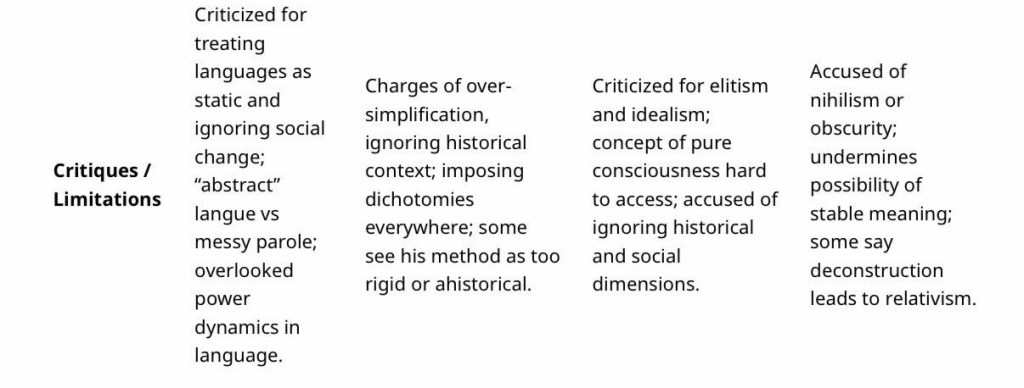
Comparative Overview: The table below contrasts core ideas and approaches across these thinkers
Recommended Reading Path
- Saussure (1916) – Course in General Linguistics (select passages on the sign, langue/parole, synchronic analysis). A foundational text for structuralist ideas about language.
- Lévi-Strauss (1964) – The Raw and the Cooked: Introduction to a Science of Mythology, Vol. 1. Accessible entry into structural anthropology via myth analysis (discusses raw/cooked, binary oppositions).
- Derrida (1967) – Of Grammatology (translated by Gayatri Spivak or others). Key text on deconstruction; read after understanding structuralist basics.
Structuralism and post-structuralism bring philosophy to a threshold. They reveal that neither objects nor systems possess the self-sufficiency once attributed to them. Yet philosophy cannot remain indefinitely at the moment of dissolution. The question after structure is not whether foundations fail, but how beings continue to orient themselves when foundations are incomplete.
Epilogue: After Structuralism
Structuralism transformed philosophy by teaching it to distrust isolated things. Meaning was no longer understood as a property contained within an object but as the effect of a network of relations. Language, myth, kinship, ritual, law, and culture all became intelligible through the structures that organized them. Post-structuralism radicalized this discovery. If structures generate meaning, then structures themselves must also be questioned. Derrida revealed that every structure contains traces of what it excludes, while Foucault demonstrated that structures possess histories, and Deleuze insisted that difference exceeds every system that attempts to contain it. The twentieth century therefore accomplished something remarkable. It displaced substance with relation, certainty with difference, and origin with structure. Yet in doing so it left behind a profound philosophical difficulty. If every structure is incomplete, if every conceptual order remains open to revision, then what becomes of rational judgment? How do we decide, act, or respond before the world has been fully incorporated into a stable conceptual system? This question marks the threshold of another philosophy. The assumption that rationality depends upon complete knowledge has exercised a remarkable influence over Western thought. According to this picture, one first understands, then judges, and finally acts. Action is treated as the consequence of successful conceptual incorporation. Where knowledge is incomplete, rationality is presumed to falter. But this is not how life is lived. Human beings continually find themselves required to respond before understanding is complete. A child withdraws from a flame before possessing the concept of combustion. One hesitates before an unfamiliar sound long before identifying its source. Trust, suspicion, grief, hope, love, fear, and delight all orient conduct prior to their successful theoretical description. The practical life does not wait for philosophy to finish its work. The mistake, then, may not be that reason sometimes operates with incomplete information. The mistake is the assumption that reason begins only after conceptual completion. Structuralism showed that meaning depends upon relations. Rationality after structure begins from the further realization that judgment depends upon orientation. Before we possess a theory, we have already distinguished. Before we explain, we have already responded. Before we define, we have already entered a field of practical significance. Fear provides a simple example. Fear is often treated as an emotion awaiting psychological explanation. Yet its philosophical significance lies elsewhere. Fear is an orientation before it is an object of reflection. It distinguishes danger from safety prior to any explicit account of what danger is. The body has already drawn a distinction upon which thought subsequently elaborates. Pleasure exhibits the same priority. Attraction precedes explanation. Satisfaction precedes theory. The world first appears as inviting or resistant, promising or threatening, nourishing or destructive. Only afterward do concepts attempt to stabilize these orientations into knowledge. Judgment therefore begins neither with propositions nor with representations. It begins with distinction. This is the trace of practical judgment. The trace is not a residual concept left behind after thought has completed itself. It is the mark of an encounter whose practical significance exceeds its conceptual determination. Something has already mattered before it has been fully understood. Practical life continually bears witness to distinctions that precede the language capable of articulating them. Diairesis acquires a new significance in this light. Classical division appears not as the production of distinctions but as their retrospective clarification. Life distinguishes first. Thought later renders those distinctions intelligible. Conceptual articulation follows practical discrimination rather than creating it. The history traced throughout this volume may therefore be understood as a gradual displacement of where philosophy locates intelligibility. Classical philosophy sought intelligibility within substances. Structuralism sought intelligibility within systems. Post-structuralism discovered the instability of systems. The question now becomes whether intelligibility might instead arise within the very movement of response itself. If so, rationality cannot be defined as the possession of complete structures. It must instead be understood as the disciplined capacity to respond faithfully to distinctions whose full conceptual articulation remains unfinished. Reason becomes neither the triumph of certainty nor the abandonment of standards. It becomes the continual labor of refining judgments already demanded by life. Universality likewise assumes a different form. It is no longer conceived as an abstract system detached from experience, nor as a final conceptual framework capable of incorporating every phenomenon. Rather, universality emerges through the gradual sedimentation of relational intelligibility. Distinctions repeatedly vindicated in practical life acquire increasing stability without ever becoming immune to revision. They remain universal not because they escape history, but because they continue to orient judgment across ever-expanding domains of experience. The ambition of philosophy therefore changes once more. Its task is not simply to discover structures. Nor is it merely to deconstruct them. Its task is to understand how finite beings continue to judge responsibly in the interval between encounter and comprehension, between distinction and definition, between response and system. Perhaps this interval is not a deficiency to be overcome. Perhaps it is the very condition under which rational life becomes possible. The future of philosophy may not belong to a search for foundations that eliminate uncertainty. It may belong instead to a more demanding discipline: learning how to think faithfully within the openness that every structure leaves behind. The trace of practical judgment is the name of that discipline. It marks the place where rationality begins—not after the world has been completely understood, but at the moment when the world first demands a response.

 ov1d.com