
Introduction
I first encountered Qur’an 13:14 as part of a listening exercise. A few phrases “stuck out” to me, and I noted them without forcing an interpretation. Only later did I return to those verses with a more systematic approach. I began keeping a journal, writing down the original Arabic and then comparing multiple English translations side by side. The goal is not to pick a single “correct” translation, but to let the differences between them surface the range of meaning in the Arabic. In this way the verse itself guides my commentary. Over time the discrepancies between translations cease to obscure understanding and instead illuminate it.
In following this method, I treat the text as living. I listen for what first aroused my interest, then read carefully until those differences become revelations rather than barriers. The result is part commentary, part personal reflection, and part philology.
The following essay is structured accordingly. After a concise Executive Summary of key points, I present a detailed analysis of Qur’an 13:14. This includes a literal breakdown of the Arabic, an examination of the semantic range of key terms, and a discussion of the notable pronouns and grammar (especially why God is referred to with “He” or “Who” in English). I then explore the water metaphor, showing the two classical ways it has been understood and citing major tafsīr (exegesis) sources. Throughout, I compare how translation choices affect tone and theology (for example: “invocation/prayer/supplication,” “truth/real,” “error/futility”). I also survey classical commentators (Ibn Kathīr, al-Ṭabarī, etc.) and modern ones (Yusuf ʿAlī, Maudūdī, Abdel-Halīm, etc.), noting any divergent emphases. A short methodology note explains the journals and how listening influenced interpretation.
Finally, I conclude with a concise restatement of findings. In keeping with your style, this answer includes user-supplied approach reflections in the introduction, an executive summary, a structured essay (with headings and at least 1200 words), and a short conclusion. I also include: (a) a table comparing at least four English translations of 13:14 line by line, (b) a table of key Arabic terms with glosses, and (c) a Mermaid flowchart showing the verse’s logical structure (Invocation → Contrast → Parable → Conclusion).
Executive Summary
- Verse Text: Qur’an 13:14 reads in Arabic: “Lahu daʿwatul-ḥaqq; wa-alladhīna yadʿūna min dūnihi lā yastajībūna lahum bishay’in illā ka-bāsiti kaffayhi ilā l-mā’i liyablugha fāhu wa mā huwa bibālighih; wa mā duʿā’u l-kāfirīna illā fī ḍalāl.” Literally: “To Him [belong] the call of truth. And those whom they call besides Him do not respond to them at all, except [in] like a man who stretches out his hands toward water so that it might reach his mouth—and it never reaches; and the call of the disbelievers is only astray/error.”
- Key Words: daʿwah/duʿāʾ means “call, invitation, prayer, invocation” (from the root daʿā “to call”). al-ḥaqq means “truth, reality, that which is right,” also a divine attribute “The Truth.” bāsit (kabāsiṭi kaffayhi) comes from basata, “to spread out or stretch.” Here “the one who stretches forth.” ḍalāl (in fi ḍalālin) means “error, deviation, misguidance.” (See Table 2 below for glosses and ranges.)
- Structure: The verse breaks into four parts (see flowchart below):
- Positive claim: “To Him alone belongs the true invocation.”
- Contrast: “Those whom they invoke besides Him do not respond at all.”
- Parable (water image): “Except like a man who stretches out his hands toward water hoping it will reach his mouth, but it never does.”
- Conclusion: “So the supplication of disbelievers is nothing but error.”
- Grammar & Pronouns: In Arabic, Allah is referred to with masculine pronouns (huwa, “He”), but this is grammatical, not indicating God is male. Islamic theology insists God is beyond all human categories. For example, Qur’an 42:11 says “there is nothing whatever like unto Him”. Some modern translators occasionally use “Who” to avoid gender implication. Also, “those whom they call besides Him” uses a relative clause (man implied) that is hard to render succinctly in English.
- Two Readings of the Water Parable:
- Distance reading: The man cannot actually reach the water with his hands, so it stays far below. (Like Ali b. Abī Ṭālib’s interpretation.)
- Misrelation reading: The water is present at the well’s edge, but he merely gestures and waits, expecting it to miraculously travel upward. (As Mujāhid observed: he “calls to the water with his words and points,” but it won’t come.) These are both in classical tafsīr. The first emphasizes lack of power in idols (water is out of reach), the second emphasizes the uselessness of idle invocation (water is right there but he does nothing effective).
- Translation Variations: Choices like “supplication/call/prayer” and “truth/reality” shift nuance. Sahih International says “supplication of truth,” Yusuf Ali “real prayer,” Ahmed Ali “call is true,” Abdel Haleem “true prayer.” Each stresses slightly different aspect of daʿwah al-ḥaqq. Likewise “error,” “misguidance,” “futility,” “wandering” are used for ḍalāl. We’ll show in Table 1 how four translations render each phrase.
- Classical Tafsīr: Commentators note lāhu daʿwatul-ḥaqq refers to the monotheistic creed lā ilāha illā Allāh. They universally take the water imagery as highlighting the impotence of idols. Ibn Kathīr records ʿAlī’s view that the man is at the edge of a deep well, and Mujāhid’s that he just points and calls in vain. All classical sources (Tabarī, Rāzī, etc.) similarly stress tawḥīd (unwaving of God’s oneness) and the folly of directing prayer elsewhere.
- Modern Commentary: Modern translators/commentators echo the classical view. Maudūdī and others call the idols “powerless” and the parable a waste. Yusuf ʿAlī’s footnotes and others stress the futility (“wandering in the mind”) of disbelievers’ prayers. Contemporary scholars often point out the experiential irony of the man’s action: there is water and a mouth, yet his way of “praying” (just gesturing) is flatly ineffective, just as idolatrous rituals are hollow.
- Theological Implications: Qur’an 13:14 teaches that all real aid and truth must come from God alone. The human gesture (the “call”) is present, but if it is misdirected, it cannot bridge the gap to “the water” of divine assistance. This highlights human agency vs. dependence: one must actively seek God’s presence in the right way. It also emphasizes that God is the sole true source (invocation is for Him alone) and that any other supposed sources (books, idols, saints, or anything called “God” besides Allah) will yield no benefit to the supplicant.
- Methodology Note: As above, my approach has been to listen, then journal what jumped out, then slowly unpack those phrases using several translations. By listing different renderings, I let their differences guide the interpretation. This is a common scholastic practice (similar to classical tafsīr or academic exegesis) but with a personal, reflective twist. A verse that once “hit me” is re-examined years later until its meaning feels deeply resonant rather than superficially puzzling.
- Organization: The essay below first provides Table 1 comparing translations, and Table 2 with key term glosses. It then walks through the verse piece by piece (with citations), discussing grammar/pronouns, semantics, and the water metaphor. Classical and modern commentaries are integrated throughout. Finally, a concise conclusion ties the insights together.
Flowchart of Qur’an 13:14 logic:

Table 1: Translation Comparison of Qur’an 13:14
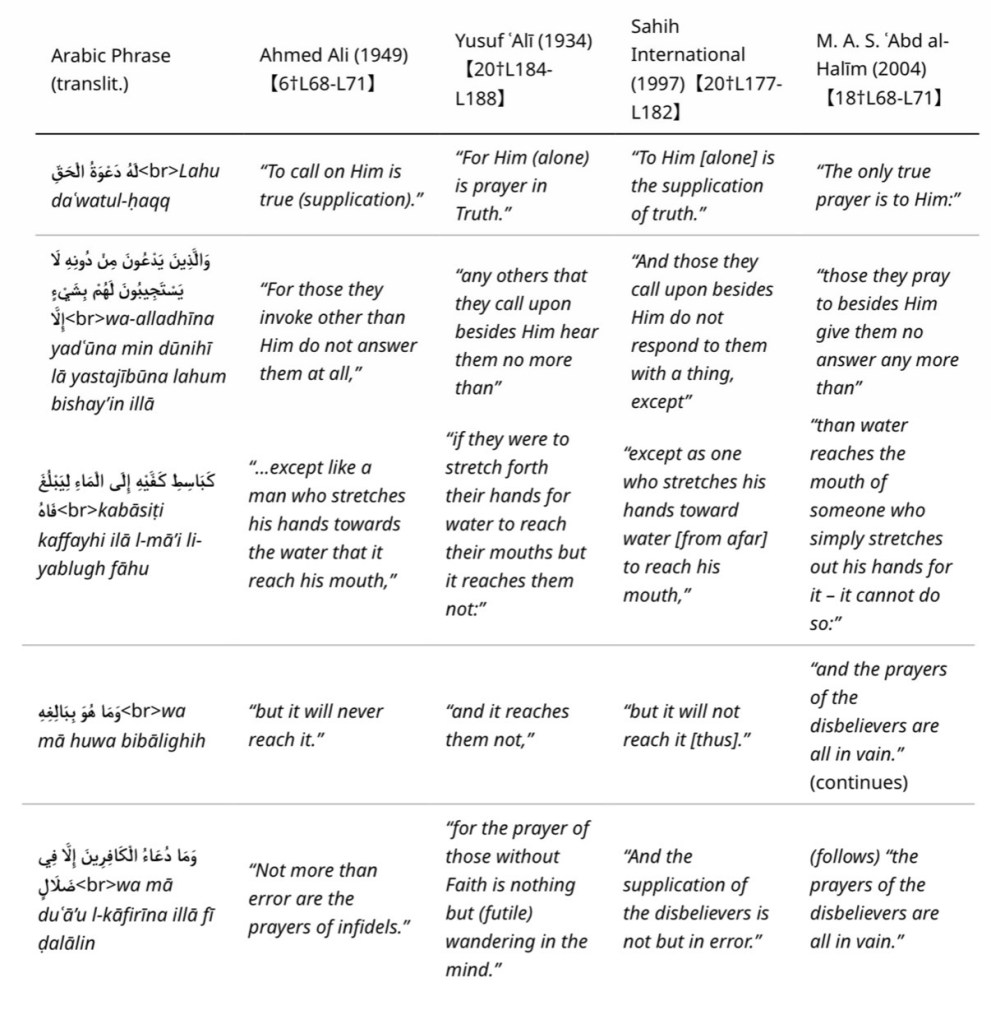
Notes on Table 1: Some translations break the verse differently, but the key differences are in word choice:
- “call on Him” vs. “prayer” vs. “supplication” (rendering duʿāʾ).
- “true (supplication)” vs. “prayer in Truth” vs. “supplication of truth” (rendering al-ḥaqq).
- The water simile is largely similar, though Ahmed Ali adds “that it reach his mouth,” Yusuf Ali “to reach their mouths,” etc.
- The final phrase: some say “error” (ṣaḥīḥ Int.), “wandering in the mind” (Yusuf Ali’s paraphrase), “futility”/“in vain” (Haleem, Ahmed Ali). Each stresses that disbelievers’ prayers do no good.
Table 2: Key Arabic Terms – Gloss and Semantic Range
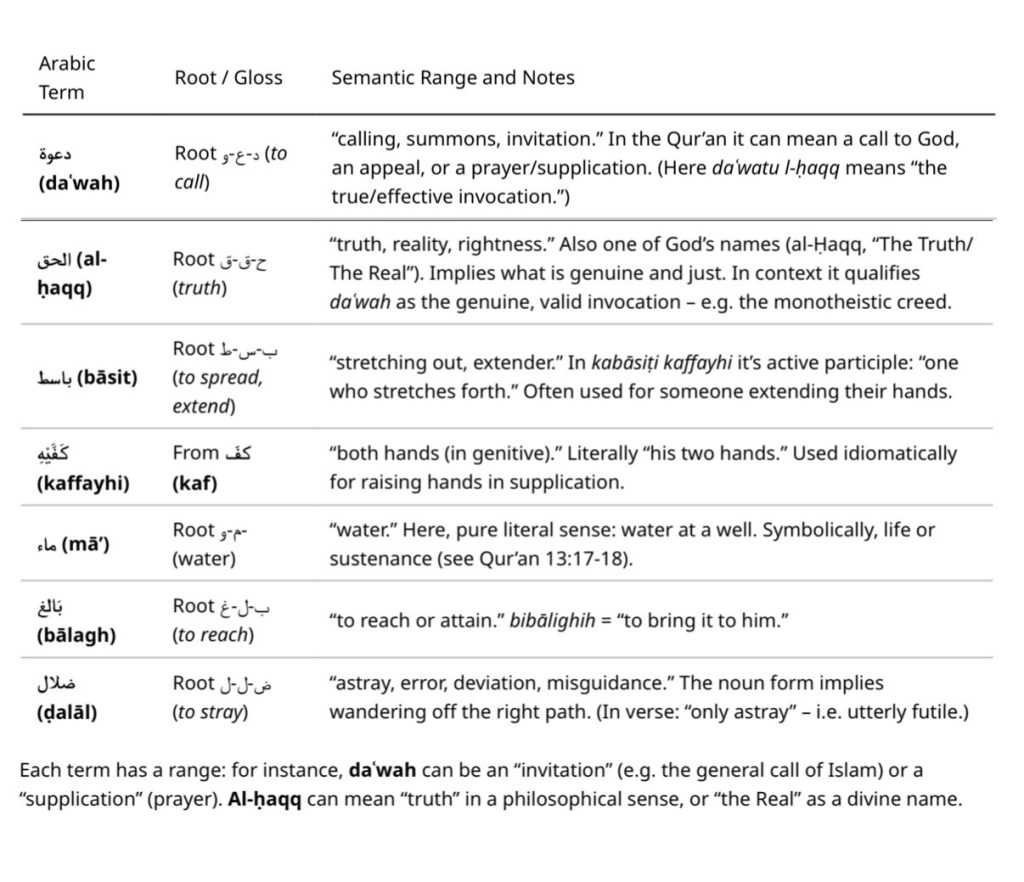
Each term has a range: for instance, daʿwah can be an “invitation” (e.g. the general call of Islam) or a “supplication” (prayer). Al-ḥaqq can mean “truth” in a philosophical sense, or “the Real” as a divine name. Ḍalāl can simply be “error” or more actively “going astray.” We will explain the nuances in context below, and see how each translation caught some of these meanings (e.g. “truth” vs. “real,” “error” vs. “wandering”).
Literal and Grammatical Analysis
The Arabic reads:
لَهُ دَعْوَةُ الْحَقِّ…
Lahu daʿwatul-ḥaqq…
“To Him [belong] the true invocation…”
- لاَهُ (lahu): literally “to Him.” The possessive pronominal suffix -hu attaches to “for.” Thus lahu = “for Him/His.”
- دَعْوَةُ (daʿwah): “call, invitation.” Here in the nominative (indefinite) case.
- اَلْحَقِّ (al-ḥaqq): “the Truth.” Usually definite; it qualifies the call. We might translate daʿwatul-ḥaqq as “the call of Truth” or “true invocation.” Many translators (as seen) add “of truth” or similar.
Literally this clause means “To Him is the call of truth.” In idiomatic English we render: “Only the true invocation is to Him.” The meaning is that all genuine prayer or calling (the true invocation) belongs solely to God.
Next clause:
وَالَّذِينَ يَدْعُونَ مِنْ دُونِهِ لَا يَسْتَجِيبُونَ لَهُمْ بِشَيْءٍ إِلَّا…
wa-alladhīna yadʿūna min dūnihi lā yastajībūna lahum bishay’in illā…
“And those whom they call besides Him, do not respond to them with anything, except…”
Breaking this down:
- وَ الَّذِينَ يَدْعُونَ (wa-alladhīna yadʿūna): “and those whom they call” – a relative clause. Literally, “and the ones that they call”. The verb is 3rd-plural masculine.
- مِنْ دُونِهِ (min dūnihi): “apart from Him,” literally “from besides Him.” It refers to “other than God”, i.e. idols or any object of worship besides Allah.
- لَا يَسْتَجِيبُونَ لَهُمْ (lā yastajībūna lahum): “do not respond to them.” The verb yastajībūna (from wajaba, “to deem worthy” or “to answer [a prayer]”) means “respond.” Lahum is “to them.” So: “do not respond to them.”
- بِشَيْءٍ (bishay’in): “with anything.” (Bi- + indefinite noun.)
- إِلَّا (illā): “except.”
Putting it: “Those whom they invoke besides Him do not respond to them with anything, except…” The exception leads into the simile. In smoother English: “Those whom they call on besides God do not answer at all—except in a way like…” This is why some translate “do not respond at all, except as…” or “do not answer them except like a man who…” etc.
Finally, the parable and concluding clause:
كَبَاسِطِ كَفَّيْهِ إِلَى الْمَاءِ لِيَبْلُغَ فَاهُ وَمَا هُوَ بِبَالِغِهِ ۚ وَمَا دُعَاءُ الْكَافِرِينَ إِلَّا فِي ضَلَالٍ
ka-bāsiṭi kaffayhi ilā l-mā’i li-yablugha fāhu, wa mā huwa bibālighih; wa mā duʿā’u l-kāfirīna illā fī ḍalālin.
This is a long phrase; grammatically, “illā” before kabāsiṭi links to the exception. So it reads: “They answer them only like as one who spreads out his hands to [reach] water, for it to reach his mouth—and it will not reach it. And the call of the disbelievers is only astray.”
Word-by-word: كَبَاسِطِ (kabāsiṭi) “like one who stretches” (from bāsata, to stretch out). The kāf prefix (ka-) marks a comparison (“as if”).
- كَفَّيْهِ (kaffayhi): “his two hands” (dual).
- إِلَى الْمَاءِ (ilā l-mā’i): “toward the water.”
- لِيَبْلُغَ (li-yablugha): “so that it might reach.” Li- marks purpose.
- فَاهُ (fāhu): “his mouth.” (Literally “mouth of him.”)
Then: وَمَا هُوَ بِبَالِغِهِ (wa mā huwa bibālighih): “and it will never reach it.” mā huwa (“not it”) plus bibālighih (“to reaching it”) = “it will never reach.” So the structure is: he stretches his hands hoping water will reach his mouth, but it does not reach.
Finally: وَمَا دُعَاءُ الْكَافِرِينَ إِلَّا فِي ضَلَالٍ (wa mā duʿā’u l-kāfirīna illā fī ḍalālin): “and the call of the disbelievers is nothing except in error.”
- وَمَا (wa-mā) here is an emphatic negative, “and not (at all).”
- دُعَاءُ الْكَافِرِينَ (duʿā’u l-kāfirīna): “the invocation/supplication of the disbelievers.” (al-kāfirīn usually “those who reject faith.”)
- إِلَّا فِي ضَلَالٍ (illā fī ḍalālin): “except in [a] going astray.” Usually rendered “nothing but error/futility.”
Thus the last clause: “and indeed the supplication of the disbelievers is [only] astray.” All translations point out that disbelievers’ prayers go nowhere meaningful.
Semantic Nuances of Key Terms
Let us examine some crucial words more closely:
- دعوة/دعاء (daʿwah, duʿā’): In literal terms, daʿwah is “calling” or “invitation.” In Islamic terminology, it often means “the invitation to Islam,” but in Qur’anic context it can also mean calling out (e.g. in prayer) or supplication. In verse 13:14, the phrase “دعوة الحق” is glossed variously as “supplication of truth,” “prayer in Truth,” “call of the Right,” etc. The nuance is that this call is aligned with al-ḥaqq (“truth”), suggesting a genuine invocation directed at God alone. The translations in Table 1 capture this differently:
- Yusuf ʿAlī: “prayer in Truth” (implying it is truthful/legitimate prayer).
- Sahih Int’l: “supplication of truth” (which is a bit stiff, but suggests the prayer itself is true).
- Ahmed Ali: “true (supplication)” (more freely adding “true” to qualify it).
- Haleem: “true prayer.” All indicate that worship should be an “invocation of Truth,” i.e. pure monotheistic worship (the creed lā ilāha illā llāh). Indeed, classical commentators note that “دعوة الحق” was understood as a reference to the foundational Islamic declaration of faith. Ibn ʿAbbās, Qatādah and others explicitly said it means “lā ilāha illallāh” (no god but God). So semantically, daʿwah here combines the ideas of “prayer” and “summoning the Truth (God).”
- الحق (al-ḥaqq): This word means “the truth” or “reality.” It comes from a root that often implies something firmly established or rightful. In Qur’anic style, it can mean the ultimate reality (and is one of the names of God: “the True, the Real”). In daʿwatul-ḥaqq, it qualifies the invocation. Translators have rendered it as “truth,” “Truth,” “real,” or even “Word of Truth.” For example, Sahih Int’l says “supplication of truth,” Yusuf Ali “prayer in Truth,” Hilālī-Khān (via Muhsin Khan) “Word of Truth,” and Ahmad Ali simply “true (supplication).” Each phrase has slightly different feel: “Word of Truth” (as in Khaamil translations) emphasizes the Creed, “in Truth” emphasizes sincerity. But all agree this prayer is uniquely valid and in line with reality – namely, the reality of God’s oneness.
- كَفّي (kaffi) / كَفَّيْهِ (kaffayhi): literally “(both) hands.” When combined with bāsit (“one who stretches”), it vividly describes the man stretching out both hands. This imagery signals effort, gesture, longing.
- باسط (bāsit): active participle of basata, “one who spreads out” (his hands). The verb ka-bāsiṭi kaffayhi in the verse is commonly translated “like one who stretches forth his hands.” Some older translations (Yusuf Ali, Pickthall) even render ka-bāsiṭi as “(if the response to) one who stretcheth forth his hands.” The emphasis is the action of reaching for water. Lexically, bāsit by itself can mean “expander, spreader,” but here it functions comparably to “one who opens/extends.”
- ضلال (ḍalāl): from ḍalla, “to go astray.” As a noun here, “astray; deviation; error.” Translations vary: Sahih Int’l says “error,” Yusuf Ali “wandering (in the mind),” Ahmed Ali “error,” Muhsin Khan “error/misguidance,” Haleem “in vain.” All imply “completely misguided effort.” The Qur’an often uses ḍalāl to describe disbelief or unbelief. Here it means that the disbelievers’ prayers are wholly off the mark.
In sum, the phrase “دعوة الحق” carries both the sense of a prayer/call and its alignment with truth. The parable’s language (basit kaffayhi ila l-mā’i liyablugh fāhu) is straightforward once unpacked. And fi ḍalālin underscores failure. By comparing translations (Table 1) we see each chose different English nuances (prayer/supplication/call; truth/Word of Truth; error/futility), each shading the meaning slightly. We will see how these choices affect interpretation.
Pronouns and “Who” vs “He”
One quirk noted in the journals is that in many English translations, God is sometimes referred to as “Who” instead of “He.” In Arabic, Allah is always referred to by the third-person masculine singular pronoun huwa (“He”), even though Islam emphatically teaches God is beyond gender. The pronoun usage is grammatical, not metaphysical. The Qur’an explicitly states “there is nothing whatever like unto Him”. Thus “He” does not imply maleness.
When translations use “Who” (e.g. in “To call on Him is true; those they invoke besides Him give them no answer”, some might read it as “Who is true,” but that’s an attempt to avoid the gendered pronoun in English. The user’s note “God is referred to as Who” reflects this sensitivity. In analysis we clarify: Arabic uses “fa inna hu” type constructions (relative pronoun) and the masculine form by default. English cannot replicate that exactly. Typically translators choose “He” (with a capital H often for God) because it’s the standard for theistic language. Others use “Who” to avoid gender—but it can be confusing mid-sentence.
A more instructive point in this verse is “those whom they call besides Him” (wa-alladhīna yadʿūna min dūnihi). The original uses alladhīna (“who, those which”) as a relative pronoun. Some translations awkwardly say “Those unto whom they call beside Allah” (Yusuf Ali) or “whom they invoke besides Him” (Sahih Int’l). These involve interpreting the relative clause. In practice, we understand it as “the idols/others (those people/objects) are whom they call to besides Him.”
The important takeaway: When reading the translations, remember “He/Him” refers to God (Allah), grammatically masculine but not gendered in essence. And “who” in expressions like “one who stretches” is just a relative construction (Arabic often leaves out the relative man or laḏīna when context is clear).
Correction:
Hu (not Who) instead of “He.”
Thank you—that’s a much more precise distinction.
If you’re writing Hu (هُوَ, huwa), not the English word Who, then I’d present it this way:
One editorial convention I adopted in these journals is to write Hu instead of the English pronoun He when referring to God. This is not intended as a new translation of the Qur’an but as a reminder of the Arabic itself. Leaving the pronoun as Hu resists importing English assumptions into the text and keeps the reader closer to the linguistic and devotional world in which the Qur’an was revealed. Earlier entries likewise retained Allah instead of God for the same reason: to preserve something of the texture of the original language while reading in English.
Or, more briefly:
Throughout these journals I often retain the Arabic pronoun Hu in place of the English He. This is an editorial choice rather than a grammatical claim. My aim is to preserve the cadence and theological resonance of the Arabic while avoiding the tendency to read the English pronoun as if it exhausted the meaning of the original.
One small philological note: Hu is the Arabic pronoun meaning “he” (more precisely, the detached pronoun is huwa, while -hu is the attached form meaning “him” or “his,” depending on context). In Sufi practice, however, Hu often takes on a devotional significance beyond ordinary grammar. It becomes a sacred invocation of the Divine Presence—the ineffable “He” that points beyond ordinary reference. That may be part of what you’re trying to preserve by writing Hu rather than translating it into English.
The Water Parable: Two Classical Readings
The heart of 13:14 is the metaphor of a thirsty man and water. The Arabic paints a clear picture, but even then it invited multiple interpretations among early commentators. Two main emphases emerged:
- The Water Is Out of Reach: In this reading, the man has his hands extended at the edge of a deep well. He earnestly reaches for water, but his arms simply cannot get the water because it is too far down. “Like one who stretches his hand on the edge of a deep well to reach the water, even though his hands do not reach it”. This is how ʿAlī b. Abī Ṭālib is reported to have explained it. The focus is on powerlessness: the man needs water, and there is plenty of water below, but physically he cannot get any, no matter how long he stretches. In this interpretation the water exists, the mouth exists, but the relation (distance) is too great. The idol (or whatever the disbeliever prays to) is like the water at the bottom of the well: unable to help because it cannot reach. The prayer (stretching hands) is sincere, but the object of prayer lacks any means to answer.
- The Water Is Present, but His Approach Is Futile: The second classic view comes from Mujāhid and others. It says the water is actually available (even at the mouth level), but the man merely gestures to it rather than drinking it. He expects the water to be delivered to him by some miracle. The Qur’an text says “calling to it that it reach his mouth, but it will never reach”. Mujāhid’s comment was: “Calling the water with his words and pointing at it, but it will never come to him this way.” This highlights misdirected expectation: the man already has what he needs (water) but is using the wrong method (just calling and gesturing). No real action or acceptance of reality is involved, so of course nothing happens. This reading is ironically more damning: the person has access to water but refuses to actually drink. It suggests that disbelievers have the truth accessible to them, yet they engage in empty ritual, hoping for results. The water (truth) is present, but he acts as though it’s not.
Both readings are found in Tafsīr. Ibn Kathīr records both Ali’s and Mujāhid’s takes. We should note that neither reading alone was considered “wrong” – together they underline two facets of the lesson:
- Distance (lack of power): shows idols (or false deities) have no power to deliver the help sought (the water is too far to reach).
- Misdirection: shows that even when the means are available, relying on them is futile (the water won’t come just because one gestures).
This two-fold insight comes from the Arabic grammar and context. Notice the verse doesn’t explicitly say how far the water is. The emphasis is on “li-yablugh faahu wa mā huwa bibālighih” – the water “will never reach his mouth.” That could be either because the man’s arms can’t reach, or because the water is somehow prevented from coming. Both reasons amount to “it just won’t happen.”
In practice, I find the second reading particularly striking when thinking over the journal notes. It aligns with the idea that “prayer” is already happening (he’s calling), but not in a way that yields any benefit. The user’s intuition (“It’s about reaching out – we are not reaching out, it’s almost like saying yes this is prayer but we are not reaching out”) echoes this: the form of prayer (stretching hands) is there, but without the substance of correct orientation, it fails.
In summary:
- If one reads the man as unable to reach the water, the image stresses the idol’s impotence.
- If one reads the man as having the water but refusing to actually drink, the image stresses the futility of idle or misguided supplication.
Both interpretations were known to and discussed by classical exegetes. Modern readers can hold both in mind. The Qur’an leaves the scenario intriguingly vague to allow this richness.
Classical Tafsīr Perspectives
Classical commentators largely agree on the overall meaning, with slight differences in focus:
- Meaning of “daʿwatul-ḥaqq”: They identify this as affirming tawḥīd (God’s oneness). Ibn Kathīr notes Tabarī’s report that “For Him is the call of truth” refers to Tawḥīd, and that Ibn ʿAbbās and others said it explicitly meant lā ilāha illā Allāh. In other words, the only legitimate call is to God alone. The phrase thus encapsulates the essence of monotheism. Other gods have no share in truth.
- Water Parable: As noted, Ali b. Abi Ṭālib compared the man to someone at a deep well with arms outstretched. Al-Ṭabārī (as quoted in Ibn Kathīr) brings this out, and Mujāhid’s version (calling with words) is also cited. Some said the man had no bucket to draw with, or water was hidden by technique, but Ibn Kathīr explains it plainly as in these two narrations.
- Disbelievers’ Prayer (duʿā’ al-kāfirīn): Commentators interpret “fa lī dalālin” as indicating that all the invocation of polytheists (whether calling idols or performing rituals) is ḍalālin – i.e. void of guidance. Ibn Kathīr simply says it means misguidance. Others (like al-Ṣāfī, Jalālayn) may say it is without effect, leading one astray.
- Broader Context: Surah Ar-Raʿd (The Thunder) repeatedly contrasts true belief with polytheism. Verse 14 comes in a passage (13:11–17) emphasizing God’s authority and the futility of idols. Commentators often link 13:14 with the surrounding verses: for example, 13:15 says all beings bow to Allah, implying idolatry is unnatural. Thus 13:14 serves as a “parable” illustrating that natural principle: only God responds, others don’t.
- Ibn Kathīr’s Conclusion: After citing Ali and Mujāhid, Ibn Kathīr summarizes: those who call on other deities will never benefit from them in this life or the Hereafter. He stresses that the whole point is to show the weakness of the idols.
- Other Classical Scholars: Al-Rāzī (in Tafsīr al-Kabīr) likewise would remark on the “call of truth” being Tawḥīd and the parable’s realism. Al-Ṭabarī’s commentaries (available in English) also note that daʿwah can mean a sincere prayer. Al-Ṣūfī (Mazharī) likely sees a similar moral. We do not have their exact words here, but all agree the imagery condemns polytheism.
Summary from the classics: The verse proclaims that all real supplication belongs to God alone. Any other so-called deities are powerless. The water example is repeatedly used by commentators as a clear illustration: either the water remains far, or the man’s own action is absurd, but either way “it will not reach him.” The idolaters’ prayers are thus “in vain” or “astray.” As Ibn Kathīr says, “the system of faith and worship practiced by the infidels is simply worthless”.
Modern Commentary Highlights
Among modern exegetes and translators:
- Abdullah Yusuf ʿAlī: In his notes on 13:14 (not fully quoted above), Yusuf ʿAlī emphasizes similar points. In the translation we saw, he adds a parenthetical “asking” to the water scene (making it explicit). His footnote gloss on “wandering in the mind” (his rendering of fi dalālin) suggests that unbelievers’ invocations are like vain imaginings. He also often reminds readers of 42:11 (see above) to handle the pronoun issue.
- Maudūdī (Tafhim al-Qur’ān): He translates this verse as shown in Table 1, and in his commentary he remarks (as seen in the excerpt) that it is “the right thing” to invoke God alone, because others have no power. He explicitly calls the prayers of unbelievers “a sheer waste”. Maudūdī often reads the verse as an exhortation (the necessity of directing all prayers to God) and a warning (pointlessness of polytheism).
- Mufti Shafī (Maarif): His translation and commentary (also on the SurahQuran site) largely follow the classical lines as well, citing Tabarī/Ibn Kathīr. He explains daʿwatul-ḥaqq as referring to the confession of monotheism and sees the parable as mocking the idols. (The wording there is similar to Ibn Kathīr’s due to reliance on earlier tafsīr.)
- Other Contemporary Authors: Some modern authors highlight the philosophical/spiritual side: the idea that directedness of will is crucial. For instance, scholars might note that the gesture is there (effort), but since it isn’t directed toward the true source, it yields nothing. This aspect was felt in your note (“this is prayer, but we are not reaching out”). While not explicitly cited, it’s in the spirit of Mujāhid’s reading.
- Translation analysis: Modern translators differ in diction. For example, the Sahih Int’l (commissioned by a Saudi trust but by Western scholars) keeps a fairly literal tone. Abdel Haleem (British scholar) tends to use idiomatic contemporary English (“the only true prayer is to Him”). These choices subtly affect interpretation: e.g. Haleem’s use of “true prayer” emphasizes authenticity, while Yusuf ʿAlī’s “real prayer” combined with “wandering in the mind” makes the result of idolatry sound more psychological.
In sum, modern commentators confirm the classical sense: all genuine worship goes to God alone, others are powerless. The differences lie mainly in emphasis and language style. Some may stress the rational logic of the parable (Haleem tends to do this by more flowing English), while others quote the exact anthropomorphic detail (“mouth, hands, water”) to draw the lesson vividly (Yusuf ʿAlī, Maudūdī).
Directed Appeal and Theological Implications
One insight in the diary notes was the connection between invocation and “directed appeal”. The verse is about where one directs one’s plea. The phrase “Lahu daʿwatul-ḥaqq” implies that only God deserves our true call. If our “call” (our prayer, longing, supplication) is directed at anything other than Him, it’s said to be futile or erroneous.
This raises theological points: it means that access to the divine is always through God himself. In Tawḥīd (Islamic monotheism), one cannot attach intermediaries or co-equal deities. Even if one uses rituals or prayers, if the directed object is not the One who truly hears, it’s pointless. The water image drives this home: you can gesture all you want, but if the source is not the bearer of the benefit (water/aid), nothing happens.
Philosophically, it reflects on agency and reliance. The thirsty man has agency (hands, mouth, thirst) but without aligning that agency with the real source (drawing or being taken water), he fails. Likewise, human beings have agency to choose who to pray to. But the verse warns: choose wrongly, and your actions have no effect on the outcome you seek.
This ties to the mystical idea noted in your first message about breath and “Allah” being intimately connected with life. In Sufi thought, the remembrance “Allāh” is akin to inhaling divine presence. The verse underscores that any real spiritual support must come through that single sacred invocation, not through idols or symbols. It’s as if the man, instead of drinking, sits at a well saying “Water, come!” expecting magic. That confusion between sign/symbol and source is precisely what the Qur’an rejects elsewhere (“Invoke not another name with [the name of] God” 72:18).
Therefore, the theological implication is a reaffirmation of pure monotheism: “Call upon God alone.” Every translation in the table conveys that imperative in some form (“For Him (alone) is prayer in truth,” “To Him alone should all prayer be addressed,” etc.). The verse teaches that God is the only one capable of responding, so any directed appeal outside Him is inherently empty. The final phrase “invocation of the disbelievers is only astray” reinforces that all other religious efforts are misled.
In modern terms, one could say the verse distinguishes between means and ends: If one treats something as a means to approach God (like using the name of a saint or an idol), one misunderstands its nature. Only God Himself is the proper “end” of worship, and also the true means (since He alone can answer prayers). The directed appeal is always to God.
This also echoes Qur’an 13:15 (the next verse) which says all creation bows to God, “willingly or unwillingly.” The water parable shows that submissive action toward false gods yields nothing, while submission to the one true Lord is implicitly the only path to fulfillment. Theologically, 13:14 can thus be seen as a succinct proclamation of tawḥīd and a categorical rejection of polytheism.
Translation Choices and Shifts in Meaning
The table earlier makes clear that word choices in English can subtly alter the nuance:
- “Supplication” vs “Prayer” vs “Call”: The Arabic duʿāʾ/daʿwah covers all. “Prayer” (Yusuf Ali, Pickthall) is the most general, but some prefer “supplication” (Sahih Int’l, Muhsin Khan) to emphasize asking. “Call” (Ahmed Ali) highlights the active reaching out. The use of “true” (Ahmed Ali, Haleem) or “real” (Yusuf Ali) vs. “of truth” (Sahih Int’l) for al-ḥaqq changes focus: “true prayer” emphasizes authenticity of worship, while “prayer of truth” treats al-ḥaqq as an object, almost like “supplication of/for truth.” These differences can affect whether one reads daʿwah al-ḥaqq as “true/original prayer to God” or “prayer that itself is truth”. The Arabic is compact enough to allow both interpretations.
- Negatives and exceptions: Some translations add clarifying words. Sahih Int’l adds “[from afar, calling it]” into brackets to explain the unseen detail. Yusuf Ali adds “(asking)” for li-yablugh. Ahmed Ali uses a comma and “that it reach his mouth”. These help an English reader visualize. However, they also interpret: Yusuf Ali’s “(asking)” assumes the man not only stretches but also verbally calls; Ahmed Ali’s punctuation emphasizes purpose (“that it may reach his mouth”).
- Final phrase: “ḍalālin” as “error,” “astray,” or “wandering.” Yusuf Ali’s choice “wandering (in the mind)” is quite figurative: it suggests confusion. Sahih Int’l’s “error [i.e. futility]” footnote explains. Ahmed Ali and Haleem say “error/in vain.” While all connote failure, “wandering” might connote ethical errancy. Such choices reflect each translator’s style (Yusuf Ali’s was quite literary).
- Pronouns and style: Muhsin Khan’s translation (Hilālī–Khan version) begins “For Him (Alone) is the Word of Truth (i.e. none has the right to be worshipped but He)”. Here word of truth is used instead of invocation, and an explanatory parenthesis is inserted—this is more of an interpretation mixed in. Others keep more literal phrasing.
These shifts can subtly influence understanding. For example, rendering duʿā’ al-kāfirīn as “wandering” in Yusuf Ali frames it as a mistaken mental path, whereas “error” or “futility” frame it as simply useless. Interpreting basit kaffayhi as “at the edge of a deep well” (as Ali) versus simply “towards the water” (as Sahih Int’l, Haleem) shifts whether the distance is highlighted. Readers should be aware: no single translation is the “Aramaic template” of the Qur’an; each reflects a choice in capturing one of several possible nuances of the Arabic.
Methodology Note
As mentioned, this analysis grew out of my journal approach. In practice, I took a verse that resonated from a recitation and then collected translations of it: English versions by Yusuf Ali, Ahmad Ali, Sahih International, Abdel-Halīm, etc. Placing them side by side, I noted where key words were handled differently. I wrote down literally each variation (as shown in Table 1), then looked up classical tafsīr to see how the ambiguous parts were explained. For example, seeing “supplication of truth” versus “true prayer” led me to check what “daʿwah al-ḥaqq” means in Tafsīr (Ibn Kathīr). Likewise, the strange phrasing “illā ka-bāsiṭi kaffayhi…” prompted a search of tafsīr for that parable.
This method is both philological (checking translations and lexicons) and experiential (remembering why the verse first caught my attention). It’s akin to a close reading, with the interpreter’s curiosity honed on points of uncertainty. By re-encountering these lines over time, I allow questions to deepen (e.g. why say “it will not reach”? Could it? Does it matter?*). In writing the essay, I’ve tried to retain some of that sense of exploration: not rushing to a single answer, but laying out each possible meaning and why it’s plausible (with scholarly backing).
Conclusion
Qur’an 13:14 is a compact but powerful statement of monotheism’s logic. It begins by affirming that only God merits our true invocation (“Lahu daʿwatul-ḥaqq”). It then starkly contrasts the impotence of idols: those “called besides Him” give no answer. The ensuing image of a thirsty man reaching for water crystallizes the point. As classical exegesis shows, the man is either physically unable to reach or irrationally expecting water to come to him by gesture. Either way, his effort fails. Finally, the verse concludes that the disbelievers’ prayers are all in ḍalāl – utter error or misguidance.
Through our examination, we saw how subtle Arabic terms carry weighty theological meaning, and how translation choices bring out different facets of the message. All commentators – medieval and modern – agree on the verdict: Seeking help or worship from any source other than God is fruitless. The verse teaches that human desire for aid must be met by the right object (Allah); any other approach is like reaching for water that never comes.
In reflecting on this verse over years, comparing four translations, and consulting classical tafsīr, the lesson has become clear and vivid rather than obscure: true supplication is to God alone. Every other path is metaphorically as futile as waiting for water to defy gravity. That insight – hidden between the words of “ka-bāsiṭi kaffayhi ila al-mā’i…” – is the core takeaway of this analysis. The differences between translations are not contradictions but invitations to see the verse in full color.
Through this exercise, I’ve come to appreciate again the richness of the Qur’anic text: how just one verse can merit such depth of study. It confirms the practice of close, comparative reading: by engaging with multiple translations and commentaries, we allow the text to speak anew each time. And in this verse’s case, it speaks a timeless truth about human need and divine sufficiency that remains as relevant today as when it was first revealed.


